When you try to bend a 4-sided tray or battery box with a bench brake, you will find it hard because the clamping bar is stiff and can bend only one side edge. In such situations, a finger brake can come to the rescue.
This is because the clamping bar has detachable pieces that can be separated to complete different tasks. This article covers everything about a finger brake: how it differs from a box-and-pan brake or press brake, what you can make with it, and how to choose one for your sheet metal fabrication work.
What Is a Finger Brake?
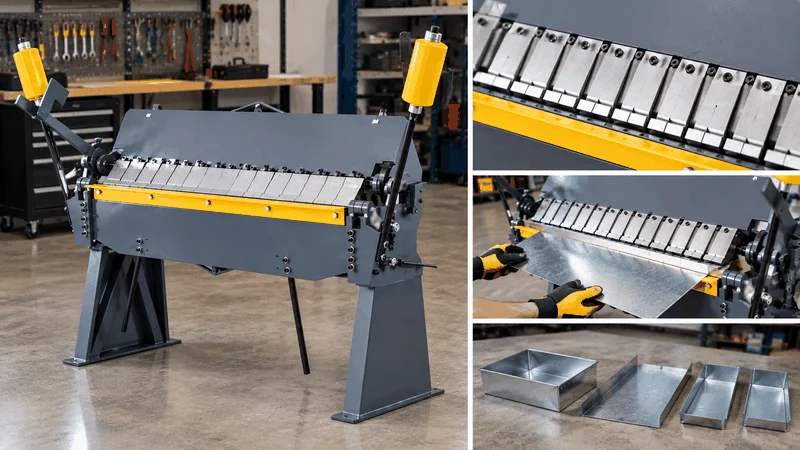
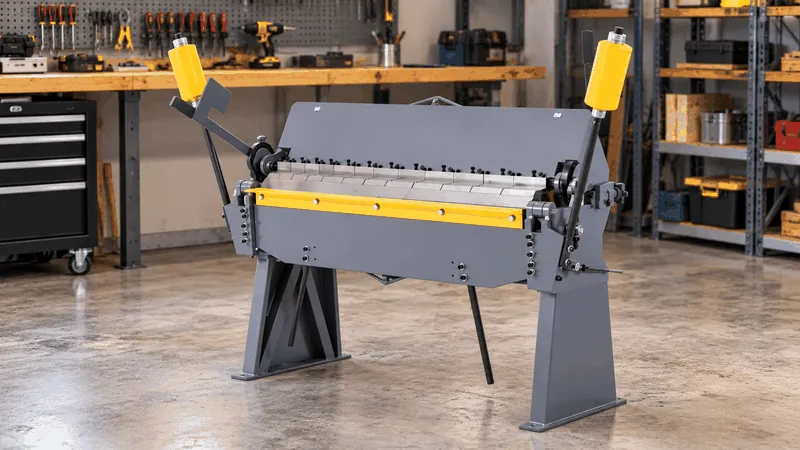
Finger brakes are sheet metal brakes whose upper clamp bar is split into multiple fingers. With a normal brake, a continuous clamp bar can bend only one edge fully. Finger brakes let you remove the fingers likely to obstruct previously bent edges, creating room to bend the next edge. This lets you form all four edges of a box without them interfering with each other. Fingers come in different sizes, and because you can move them around, one machine serves all parts.
Finger Brake vs Box-and-Pan vs Press Brake
Most of the confusion above is caused by the double usage of names:
- A finger brake and a box-and-pan brake are the same type of equipment. “Box and pan brake” is named for its output; “finger brake” is named for the technology used to achieve that output. Most of the products available are named with both terms.
- A cornice (pan) brake has no fingers and uses one solid leaf; it works well for single bends in roofing materials but is useless for making deep boxes.
- A finger press brake is a different piece of equipment; finger dies are mounted on a hydraulic shop press instead of using finger brakes as levers. A finger press brake can bend thicker material because it uses press tonnage instead of arm force.
The main difference: a free-standing mechanical tool operated manually with interchangeable fingers is a typical finger brake, while finger dies used in a press-type body are the press version.
What Is a Finger Brake Used For?
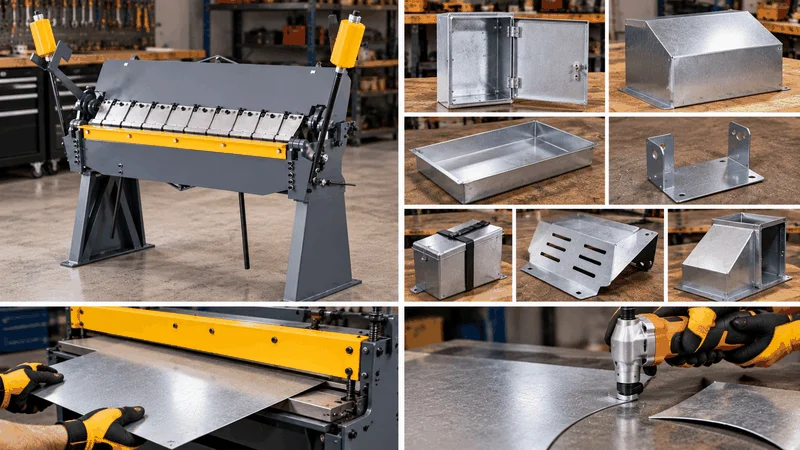
If you need to shape flat metal into three-dimensional pieces, you’ll likely need a finger brake; applications include fabricating housings for electronics, chassis, brackets, HVAC ducts, trays, pans, and covers.
Custom fabricators and off-road constructors use the finger brake to shape battery boxes, skid plates, and mounting tabs. If the stock is a thicker gauge, a finger brake kit attached to the press, including the SWAG Off Road finger brake, will do the job. Since the finger brake shapes only metal, you must reduce the stock to the right size with a sheet metal shear for straight cuts and a metal nibbler for the rest.
Finger Brake vs Other Fabrication Equipment: What a Small Shop Needs
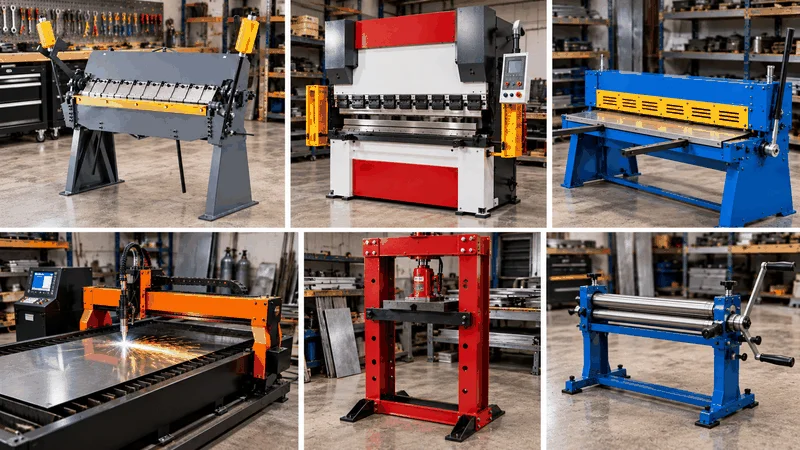
A finger brake can create components, but it is only one workstation in a workshop. Therefore, it is important to know where it fits with other machines.
| Equipment | How it bends | Typical capacity | Best for | Main drawback |
| Manual finger brake | Hand lever against removable fingers | 12–20 ga, depending on bed width | Boxes, trays and enclosures in light gauge | Arm force caps the thickness |
| Finger dies in a shop press | Press tonnage through finger dies | Up to 1/4 in A-36 at full width (per maker, ~60-ton press) | Occasional thick-plate bends | Needs a hydraulic press you already own |
| CNC press brake | Programmable ram and back-gauge | Heavy plate at volume | Repeat production to tight tolerance | Cost, floor space and programming time |
Which sheet metal fabrication equipment is overrated for small shops, and what are the alternatives?
Although the CNC press brake is a good machine, speed and programmability are useless at low production volumes. In addition, it doesn’t make sense to invest in a machine that takes up so much space in a small shop. Use the shear’s manual finger brake or a plasma cutter to cut materials.
You can do most of your light-gauge production with these tools at a lower cost. When you need to cut thicker material occasionally, you can use a finger die set in a press. The right fabrication tools for a small business depend on what you produce and its size, not on the most powerful machine.
How to Choose a Finger Brake
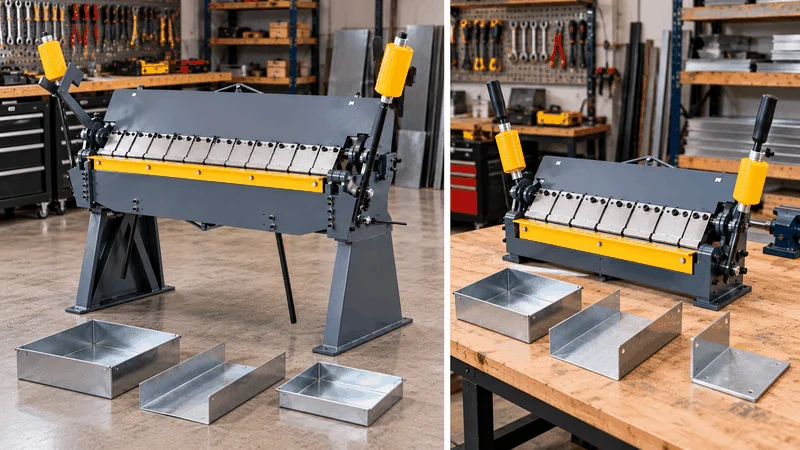
Just a couple of simple criteria will allow you to establish whether a finger brake is what you need:
- Maximum bend capacity or maximum width of a part to be bent in one stroke. Small parts can be bent on machines with 24–36 inch beds, while large parts require a 48-inch finger brake or wider.
- Thickness of metal sheet. In the case of steel, the lower gauge number means the thicker material (other types of metals have their own numbering). Thus, “18 ga full, 16 ga half” means 18 gauge is used throughout the bed, and 16 gauge is used for half the bed. Manual finger brakes usually bend 12 to 16 gauge (depending on the specific brake), while press brake dies can bend thicker material with enough tonnage.
- Number of fingers – the greater variety of fingers with different sizes will allow you to set up more box and tray sizes without using shimming.
- Frame rigidity – the stronger the brake, the less bend-line deviation you get with wide bends.
For heavy-duty material, a 48-inch 12-gauge finger brake is at the top of the manual category, but for thin-gauge hobby applications, a smaller 24-inch benchtop unit is fine.
Which metal thicknesses are most cost-effective for small-batch structural sheet metal parts?
When it comes to lightweight structural components such as frames, mounting pieces, and When considering the use of light structural parts like frames, mounts, and brackets, one should limit themselves to steel gauges that fall within the 16 to 11 range; that is, steel that is strong enough to take weight but flexible enough to allow cutting, drilling, and bending in a metal shop. However, whether the brake can form the gauges mentioned above depends on the following factors.
In most cases, the finger brake handles lighter gauges and will not form 11 gauges across its full width; therefore, you must determine the gauges based on the machine’s capabilities, not vice versa. Lighter gauges from 18 to 22 are suitable for enclosures and panels, while anything thicker than 1/4 inch is better left to the press brake. When making a small batch of parts, choose gauges the brake can form.
Best Finger Brakes to Consider
Recommended For Your Project
| Model | Type | Width | Max mild steel (as listed) | Fingers |
| VEVOR heavy-duty finger brake | Manual, standalone | 48 in | 12 ga | 8 |
| VEVOR portable finger brake | Manual, benchtop | 24 in | 20 ga steel / 14 ga aluminum | 10 |
| Grizzly G0950 | Manual, standalone | 48 in | 18 ga full / 16 ga half | 16 |
| Baileigh BB-4816 | Manual, standalone | 48 in | 16 ga | 16 |
| SWAG Off Road 50″ kit | Press-mounted DIY | up to 49 in | up to 1/4 in A-36 at full width (per maker, ~60-ton press) | 7 finger sizes |
Variations include capacity, number of fingers, and machine type. Manual brakes vary in capacity and number of fingers; the VEVOR heavy-duty brake has the highest capacity, while the Grizzly and Baileigh brakes have more fingers.
An exception in the manual brakes list is the SWAG Off Road kit, which uses a hydraulic press. This lets the SWAG brake bend thick metal sheets (1/4 inch A-36), provided you have an appropriate hydraulic press, per the manufacturer’s claims. VEVOR offers a 50-inch, 16-gauge manual brake; the clamps and fingers are detailed in the 48-inch brake manual.
Conclusion
The finger brake allows you to interchange fingers to make boxes, pans, and other structures, not just bend. For most amateur and small-business use of box and pan brakes, you only need to mount the finger brake on the press to bend heavy plates in an existing press shop setting.
Ensure the finger brake selection matches the material to be formed in width, gauge, and finger configuration, and stick to one or two gauges the machine can bend; the finger brake will become your main forming machine.
Frequently Asked Questions
What are the best sheet metal bending machines for a small fabrication shop by price and reliability?
A manual finger brake is a great solution for small fabrication companies because it eliminates the need for powered bending machines. A 48-inch brake is recommended for larger materials, while a benchtop brake may be enough for brackets, trays, and thin-gauge sheet metal. You need to evaluate the machine’s capabilities, frame construction, spare availability, warranty, and price.
What are the best sheet metal fabrication options for hobbyists making one-off custom parts, by cost and accessibility?
The simplest, cheapest setup includes a manual finger brake, hand shears, and a drill; no power source needed. This is enough to cut, bend, and fasten brackets, boxes, and sheets.
What are the best affordable sheet metal fabrication kits for learning bending and forming at home?
First, get a finger brake between 18 and 24 inches for lightweight materials at your workbench, or a 3-in-1 machine that combines shearing and rolling into one unit (if your machine allows it) if you don’t have ample workbench space. The builder’s kit is your next step.