When you look for a sheet metal brake, you will find models ranging from a benchtop folder to an eight-foot industrial bender, but it is not always clear which one can bend the pieces you produce. A sheet metal brake holds the sheet and folds it in a straight line, but the type, size, and capacity will determine whether the bend is sharp or rough. This article explains the types of brakes, how to use them, and how to match them to your project needs, within the wider world of sheet metal fabrication processes.
What Is a Sheet Metal Brake?
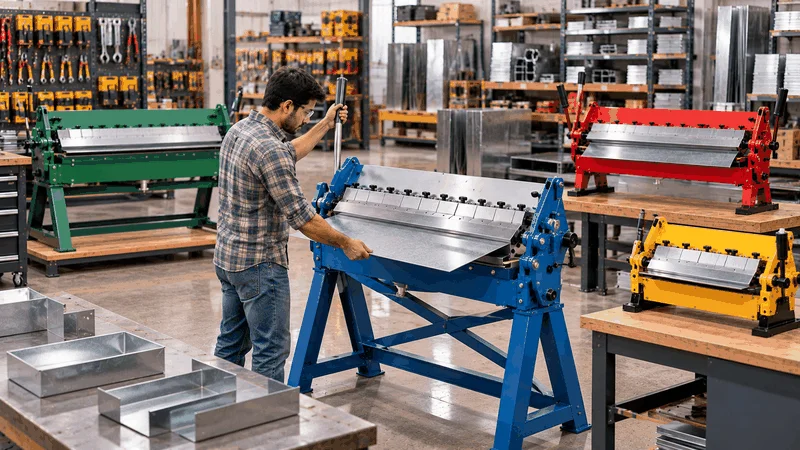
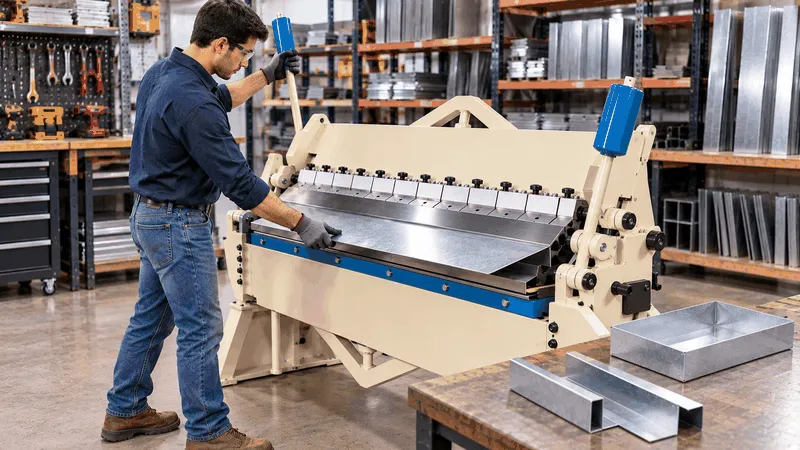
A sheet metal brake grips a flat blank between a bed and a pivoting arm, raises the apron, and bends the uncovered edge into an angle. A single bend forms the basis of most light fabrication, such as edges, flanges, channels, boxes, and brackets. Because it shapes metal without cutting, a blank must be cut to size with a sheet metal shear before the brake processes it.
Good bend formation depends on strong clamping, a clean bending surface, and a rigid bed that will not give way under pressure; for this reason, two brakes of identical width may perform very differently. For complex shapes a straight shear cannot produce, there is a metal nibbler.
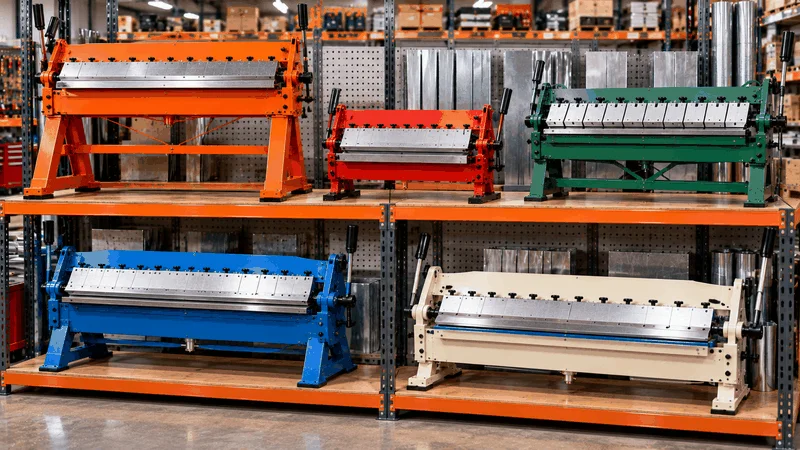
Types of Sheet Metal Brake
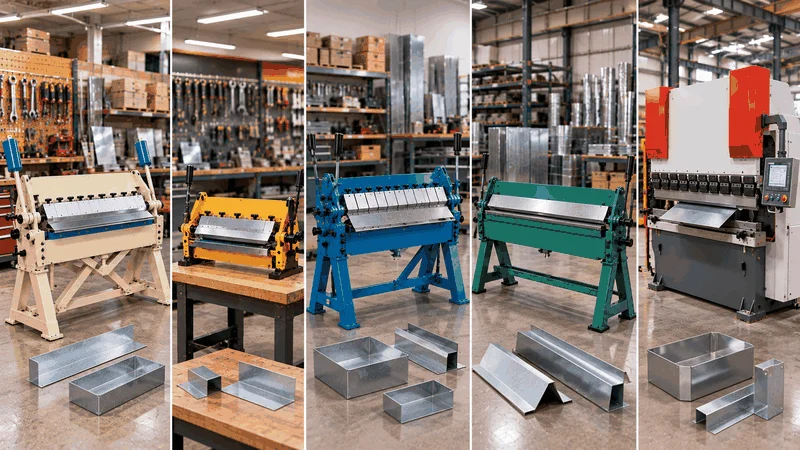
It is easy to make a mistake when choosing the right sheet metal brake, so it should be your starting point. Four types of sheet metal brakes are similar in price but vary in forming ability.
| Type | Key feature | Typical bed width | Best suited to | Main limitation |
| Manual sheet metal brake | Hand-operated; no motor or controls | 24–48 in | General work in thin to medium gauge | Effort rises with width and gauge |
| Portable sheet metal brake | Compact enough to bench-mount or move | 24–36 in | Trim, flashing, hobby fabrication | Trades capacity for portability |
| Box and pan (finger) brake | Removable fingers on the clamping bar | 24–50 in | Trays, boxes and enclosures with four folded sides | Fingers reset for each part size |
| Cornice (pan) brake | Full-width leaf, no fingers | Up to 8 ft and beyond | Long single bends for roofing and HVAC | Cannot form four-sided boxes |
The manual sheet metal brake is still the most popular option in smaller shops, since there is no motor or control system that could fail. When workbench space is at a premium, a portable sheet metal brake like the 24-inch portable brake would do the job.
Needs range from a smaller brake for the home shop to an 8 ft sheet metal brake for roofing panels and architectural trim, where no smaller bed can bend the material in a single pass. The bed width is the only specification that cannot be worked around later, so plan for your largest piece of material, not the average. For wider materials, if you can’t go to an industrial brake, the 50-inch pan brake will do.
A Sheet Metal Brake vs Other Production Methods
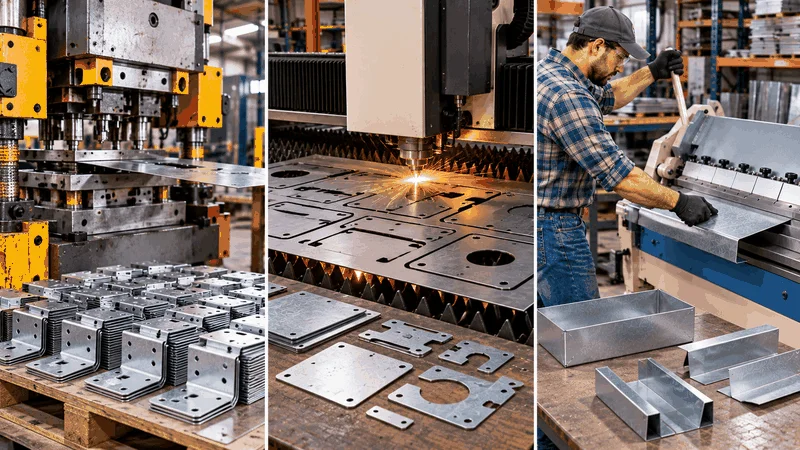
A sheet metal brake is one method of forming metal, but not the only method. The right fabrication tooling depends on quantity, tolerances, and budget.
Which production process gives the best value for stamped sheet metal parts versus laser-cut and formed parts?
Ultimately, it comes down to volume. Stamping requires a relatively high initial tooling investment but offers the lowest cost per part at high volumes, with excellent repeatability. Laser cutting and then forming the profile on a brake requires no custom tooling and is best for prototyping, one-off, and small- to medium-batch production, especially with complex profiles.
Which metal-forming techniques are best for tight-tolerance sheet metal parts in terms of cost and accuracy?
For the tightest bends with repeatability, a CNC press brake with a programmable back-gauge ranks first for accuracy, while air bending on a CNC press brake offers the best compromise between cost and bend precision. Bottoming and coining offer even better accuracy but require much greater force and individual tooling for each part. A manual press brake can be quite accurate for small production lots but isn’t the right tool for precision production runs.
Which sheet metal fabrication equipment is overrated for small shops, and what are the alternatives?
The full CNC press brake is what people typically overbuy: it costs money and takes up space for work the small shop seldom does. A realistic option is a good old manual sheet metal brake for bending, paired with either a shear or a plasma cutter for cutting.
How to Choose a Sheet Metal Brake
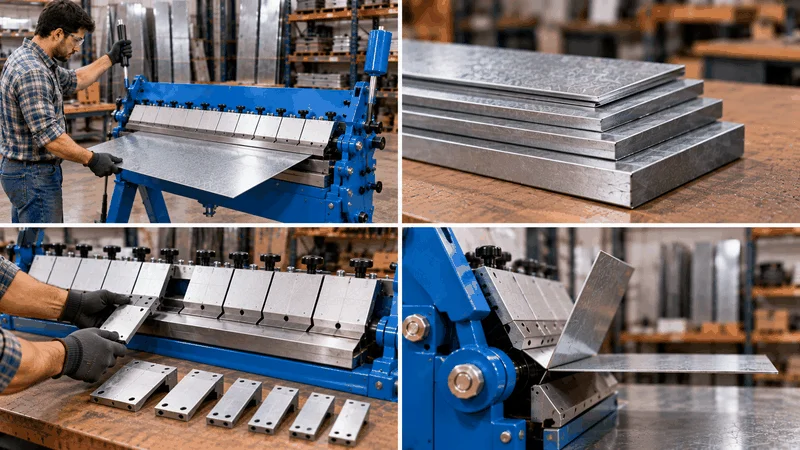
Four measurements will determine if the brake is a fit for your operation:
- Width: maximum bend in a single operation; standard beds measure 24”, 36”, 48” and 50”.
- Gauge capacity: maximum sheet it bends in reverse (a lower gauge number means a thicker material) and decreases with increasing width: “18 ga at full width, 16 ga at half”.
- Fingers: the more there are, and the larger they are, the greater the variety of boxes and trays it can create.
- Bend angle: usually covers a 0–135° range, which is more than enough for overbending because it allows springback.
For structural material, a 48” brake with a capacity of 12 gauge is the highest-end in the list, whereas for thinner material you require significantly less equipment.
Which metal thicknesses are most cost-effective for structural sheet metal parts in small batches? For structural parts such as frames, mounts, and brackets, 16 to 11 gauge steel (approximately 1.5mm to 3mm) is just right. It’s strong enough to carry loads but thin enough to cut, drill, and bend by hand. For enclosures and coverings, 18 to 22-gauge steel will do, and anything thicker than 1/4 inch should be bent only with a press brake. In limited quantities, stick to one or two gauges that can be cut from full sheets.
Best Sheet Metal Brakes for Small Shops
Recommended For Your Project
| Model | Width | Max mild steel (as listed) | Fingers | Bend angle |
| VEVOR heavy-duty brake | 48 in | 12 ga | 8 | 0–135° |
| VEVOR portable brake | 24 in | 20 ga steel / 14 ga aluminum | 10 | 0–130° |
| Grizzly G0950 pan and box brake | 48 in | 18 ga full / 16 ga half | 16 | 0–135° |
| Baileigh BB-4816 | 48 in | 16 ga | 16 | 0–135° |
| Eastwood 48-inch brake | 48 in | 18 ga steel / 16 ga aluminum | removable (count not stated) | 0–135° |
The lower the gauge number and the larger the bed size, the more work it takes; short, light brakes save on storage and cost, so choose accordingly for your product line.
How to Use (and How to Make) a Sheet Metal Brake
Sheet metal brake operation follows a standard routine: cut and deburr the blank, mark the bend line, position only the fingers that will cover the panel width, clamp the sheet with the line at the edge of the die, and raise the apron above 90 degrees to accommodate springback.
A power-operated handle makes repeated bends easier. You should always test on scrap material and arrange your bends so that an earlier flange does not get in the way of making a subsequent bend. Model-specific clamping and finger positioning are best done using the 48-inch brake manual as a reference.
As for sheet metal brake construction, do-it-yourself benders based on angle iron and piano hinge are easy for many hobbyists to make as a weekend activity. However, they lack the clamping force, finger adjustment, and consistency of a professionally made brake, making them useful for odd brackets but inadequate when precision or higher gauge is needed.
Conclusion
A sheet metal brake can fit in practically any shop, as long as it is the right one. Choose the brake first – manual if reliability is what matters most, portable if space is limited, box and pan for making boxes. Press brake only in case of large volumes and then fit the dimensions to those you will be working with. Limit production to two or three economical gauges, use a brake with a shear and a drill, and you’ll cover the basics of sheet metal fabrication without unnecessary capacity costs.
Frequently Asked Questions
What are the best sheet metal bending machines for a small fabrication shop by price and reliability?
The manual box-and-pan brake is very reliable for the price because there is little to go wrong. A good-quality 48-inch brake, like a Grizzly or Baileigh, will suffice day to day, while a smaller 30-inch brake will be adequate for less rigorous work.
Which entry-level CNC press brakes give the best reliability for the money?
“Entry-level” is relative; even small hydraulic CNC machines are expensive, and they only deliver value when you start producing large quantities of thick sheet metal. In most cases, a quality brake with appropriate tooling is the better buy.
What are the best sheet metal fabrication options for hobbyists making one-off custom parts, by cost and accessibility?
The manual brake, hand shear, and drill make up the simplest set of tools available, inexpensive and requiring no electricity or programming, but sufficient for making custom brackets and panels at home.
What are the best affordable sheet metal fabrication kits for learning bending and forming at home?
Begin with the 24″ benchtop brake with a tolerant 20-gauge capacity, or a 3-in-1 shear-brake-roll combination, if you have limited space at the bench.