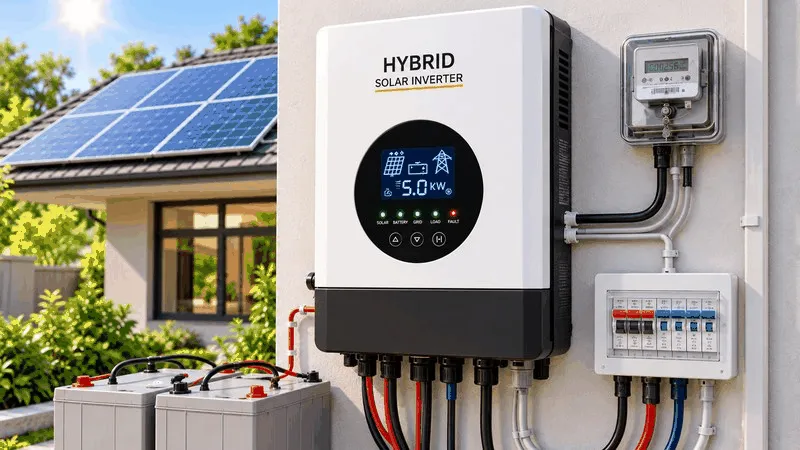
Your solar panels produce most of their electricity at midday, while you use most of it in the evenings. A hybrid solar inverter helps bridge this gap. A hybrid solar inverter manages your solar production, stores electricity in a battery, and draws from the grid when needed, all in one device.
If you are unfamiliar with what a solar power inverter does, start by understanding its functions. From power rating to smart monitoring, the right hybrid solar inverter keeps your home powered and your energy bills in check.
- Tip 1: Know What Kind of Hybrid Solar Inverter You Are Buying
- Tip 2: Check the MPPT Input and Efficiency
- Tip 3: Match Battery Voltage, Chemistry, and Size
- Tip 4: Choose Working Modes That Raise Self-Use
- Tip 5: Look at Backup Speed, Monitoring, and Build
- Popular Hybrid Solar Inverters Compared
- Tip 6: Size the Inverter to Your Peak Load
Tip 1: Know What Kind of Hybrid Solar Inverter You Are Buying
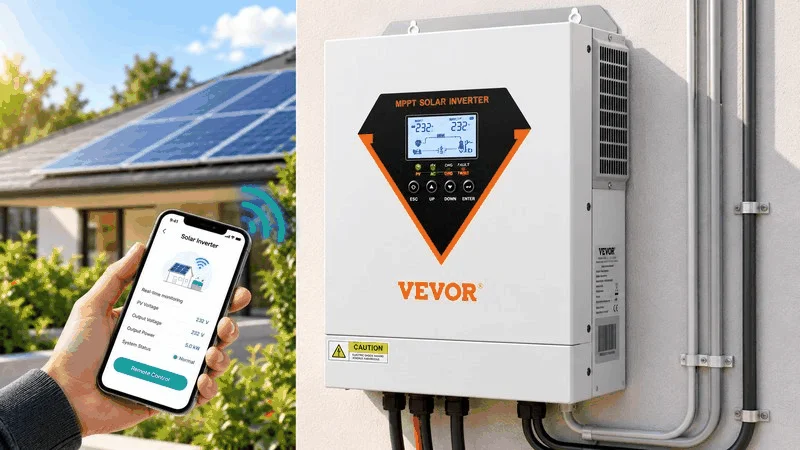
“Hybrid” includes two types of inverters, and people often get confused about which one they need.
- Grid-interactive hybrids connect to the grid in parallel, can return excess solar power to the grid, and require a grid-code compliance certificate to do so.
- Off-grid hybrids, also called “inverter-chargers”, draw grid electricity through an AC input to charge batteries or power appliances when solar and battery capacity is insufficient. Most cannot return excess electricity.
Most cheap models are the second type of inverter, which can be used for backup and off-grid purposes. For installing a grid-interactive system in France, first check whether it has a certificate and which operating mode it uses.
This 6000W hybrid inverter charger returns power only when operating in SUF mode, as described. That 5500W model cannot be connected to the grid at all, as per its Q&A. Decide first what you need – exporting or not.
Which hybrid solar inverters are least likely to face compatibility issues with French grid regulations?
In France, the best option is one with documentation for your project. Connecting to the network requires a Consuel certificate. If the inverter has built-in decoupling safety features, then the Consuel will require the NF EN 50549-1 (or -2) certificate, along with Part 10.
This is applicable for all projects under 36 kVA starting from 1 July 2026. Several economical options do not include this certificate; therefore, ask the seller beforehand. If you don’t intend to sell excess energy, Enedis will provide you with the CACSI, which is the agreement for self-consumption in low voltage without injection. It should not inject power back into the grid using limiting devices, if necessary. A qualified electrician can confirm what your hybrid solar inverter setup needs.
Recommended For Your Project
Tip 2: Check the MPPT Input and Efficiency
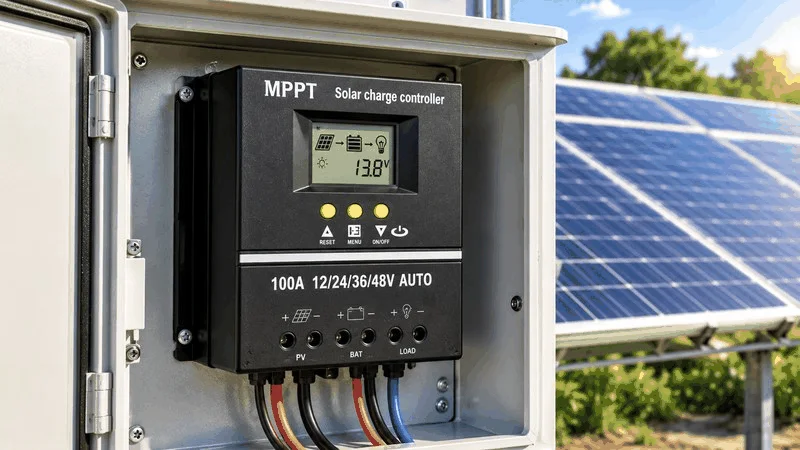
The MPPT controller maximizes your solar energy harvest as sunshine intensity varies. With a hybrid inverter with an MPPT system, you don’t need a dedicated charge controller. For more details, this guide explains how an MPPT charge controller works.
In choosing one of the models, be sure to note three specifications on the data sheet:
- MPPT voltage range. The panels’ string must remain within this range regardless of whether it is a cold or hot day;
- Maximum PV power. This indicates the number of panels the model accepts;
- Charge current – the maximum current the device can provide to the battery. The actual rate of charging depends on the intensity of solar energy and battery limits.
The ranges that can be accommodated vary widely. The 3500W 60A model accepts 30 to 160V DC and supports a maximum of 1,500W panels. The 3500W 100A model accepts 60 to 500V DC and supports up to 4,000W. Identical wattage output; totally different roof configurations.
A hybrid solar inverter’s efficiency is just as important as that of any other inverter. According to WHC Solar, 95% or higher is advisable. The 3500W, 5500W, and 6000W models have efficiencies between 94% and 96%. The inverters also use some energy while idle. The 3500W 100A inverter uses 35W when idle.
Tip 3: Match Battery Voltage, Chemistry, and Size
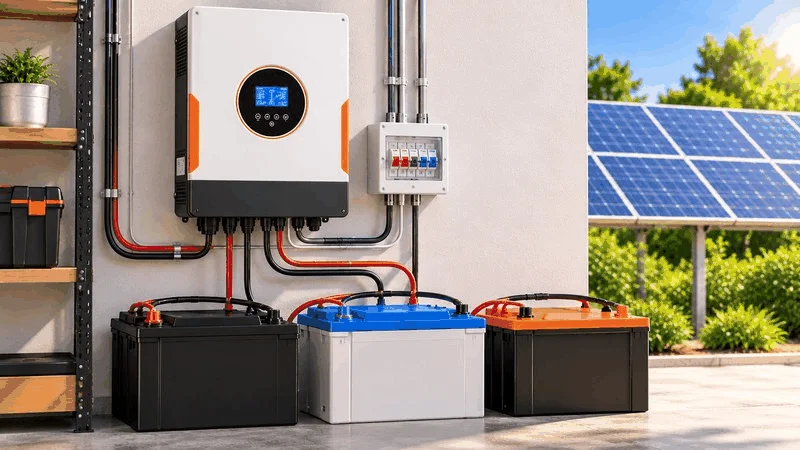
A hybrid solar inverter with battery support is useless if it doesn’t fit your battery. Start by considering the voltage: smaller systems may work at 24V, and larger home systems may work at 48V. The battery pack and inverter must be compatible.
Next, consider the chemistry: using the wrong charging parameters can reduce battery life. This guide lists lead-acid and lithium batteries, and the 3500W, 5500W, and 6000W inverters also feature LiFePO4 batteries. Some also include lithium activation and an RS485 communication port to communicate with the battery management system and get the actual state of charge. Still thinking? Browse renewable energy equipment
What hybrid solar inverters are most compatible with common battery sizes used in France?
Batteries are available in 24V and 48V capacities. A 100 Ah, 48V battery (nominal 51.2V) contains 5.1 kWh, and two batteries contain 10 kWh of energy. This goes well with an inverter such as a 5,500 W 48 V hybrid solar inverter. For studios, sheds, or a small apartment, a 24V battery with 3,000- 3,500 W capacity is sufficient.
What hybrid solar inverters are best when planning to add batteries later in France?
Choose a model that doesn’t require a battery right now. The Q&A for the 6000W model says the device doesn’t work with a battery or the power grid. If you also want an off-grid cabin system, check out the available off-grid inverter options. Next, check whether the unit’s charge current is high enough to charge the larger bank you plan to use. A 100A or 120A rating leaves room to grow, as long as your panels and battery can use it. Check that it supports lithium communication, too.
Tip 4: Choose Working Modes That Raise Self-Use
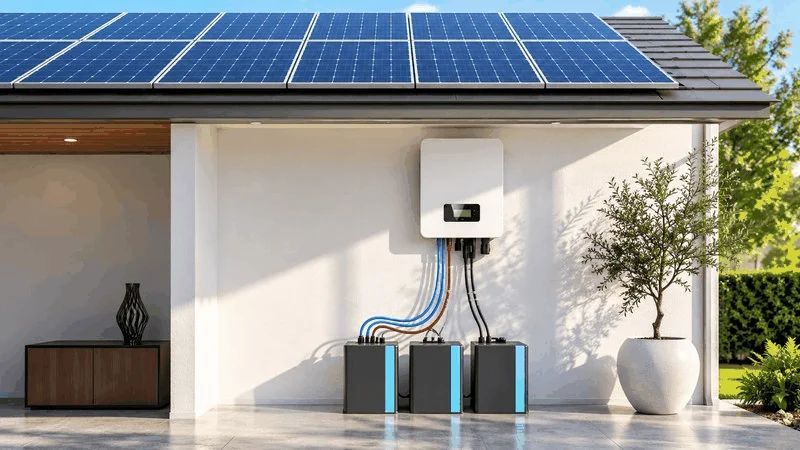
The best inverter for your home lets you choose where each watt goes. Various inverters provide different options such as UTL, SOL, SBU, and SUB, which mean:
| Mode | What powers your home first | Best for |
| SBU (solar, battery, utility) | Solar, then battery, then grid | Cutting your bill and boosting self-use |
| SUB (solar, utility, battery) | Solar, then grid, with the battery held back | Keeping the battery full for outages |
| SOL (solar first) | Solar first; fallback order varies | Sunny homes, after checking the manual |
| UTL (utility first) | Grid first | Very cloudy weeks |
Labels vary by brand, so check your manual. If you are new to the setup menus, this step-by-step inverter setup guide helps.
What hybrid solar inverters are best for minimizing grid export and maximizing self-use in France?
Try to get a hybrid solar inverter that keeps power in the house by default and has an evening mode like SBU, where the battery takes precedence. In France, what you earn from exporting your excess power is much less than the cost of grid power, thus using power at home is much more valuable. A good solar hybrid inverter will store the midday power and use it during the evening.
Which hybrid solar inverters marketed in France are best for quickly reducing electricity bills?
To achieve rapid savings, you will need: enough panels to cover the MPPT inputs, battery capacity for night operation, and SBU mode enabled. Should you choose to install a second separate panel string at a later stage, a device from the charge controller range will be able to charge the same battery bank. If your system is based on the off-peak rate plan, some configurations will allow charging from the mains at cheaper rates, but not all models support scheduling.
Tip 5: Look at Backup Speed, Monitoring, and Build
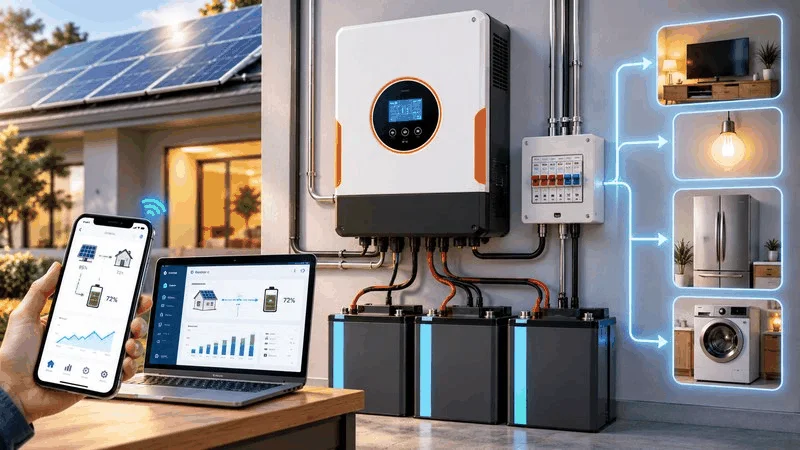
Backup is one of the main reasons why people buy a hybrid solar inverter in the first place. For a quick fix, look at power stations that handle home backup; they may be all you need. For whole-house coverage, consider the switch-over time. 3500W, 5500W, and 6000W models offer 10 ms in UPS mode and 20 ms in appliance mode, which should suffice for computers and routers.
A pure sine wave output will also come in handy. With it, motors, fridges, and electronics get grid-quality power. You can find out more about pure sine wave and modified inverters in this guide.
Which hybrid solar inverters are most reliable for French homes that need grid-tied and battery backup?
Reliability begins with the proper environment. Per the specifications, the 6000W and 3500W (100A) inverter models are not water-resistant; install your inverter in a dry, ventilated area away from heat sources. Monitoring is key in identifying issues associated with hybrid solar inverters. The 4000W WiFi inverter and the 6000W inverter include WiFi and mobile app monitoring, while the 5500W model includes an LCD screen.
Popular Hybrid Solar Inverters Compared
To better understand how some of the common ones stack up, the following table compares two VEVOR units with three well-known options in the 5 kW range.
The larger 5500W unit pairs a 100A MPPT controller with 5,500W of capacity for those who need more output from their homes. Each Growatt, Deye, and Solis unit has its own tilt.
| Model | Rated Power | MPPT | Phase | Best For |
| VEVOR 5500W Hybrid | 5500 W | 100A | Single | Larger homes, higher loads |
| VEVOR 3000W Hybrid | 3000 W | 80A | Single | Small homes, campers |
| Growatt SPF 5000 ES | 5000 W | 100A | Single | Off-grid storage setups |
| Deye SUN-5K-SG04LP1 | 5000 W | 2 trackers | Single | Grid-tied homes, on- or off-grid use |
| Solis S6-EH1P5K-L-PLUS | 5000 W | 2 trackers | Single | Grid-tied homes with storage |
One more point to remember: both the first two models and Growatt list MPPT charge current in amps, while Deye and Solis list the number of trackers. The measurements differ, so it is better to look at them separately than as one value. In the lower range, the 3000W model is an affordable option for a small house, cabin, or camper.
Whichever brand it is, the inverter is just one piece of equipment you’ll need. Other cables, fuses, and mounts are also considered solar power accessories.
Tip 6: Size the Inverter to Your Peak Load
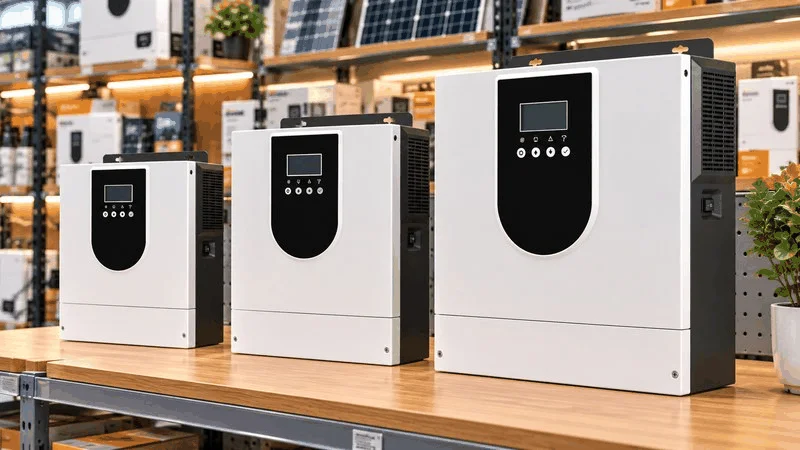
The total wattage of the devices running at any one time,, such as the kettle, fridge, and washing machine, should be less than what your hybrid solar inverter can handle, with some margin. After that, check the surge rating of the motors and pumps. For example, the 6000W inverter has a peak rating of 12,000VA, while the 3500W has 7,000VA. Most pure sine wave inverter listings give a peak rating, so compare that figure, not just the headline watts.
Most homes in France use only one phase for electricity; therefore, you need a single phase hybrid inverter. If you live in a three-phase home, you’ll need a similar system. If you plan to set up an off-grid cabin or a portable power solution, the 3000W 24V hybrid inverter may be all you need.
Moreover, the 6000W, 5500W, and 3500W (100A) variants do not support parallel operation. If you think you may need more power in the future, it’s better to invest now than add another device later.
If a full installation seems too complex, a portable system will be just right. These devices require no wiring, but their capacity is much lower than a home battery pack. This portable power station buying guide covers those smaller options in more detail.
Conclusion
It all boils down to a simple checklist. Start by checking if you want to export electricity. Match the MPPT window, battery voltage, and maximum load to your home. Choose battery-first settings so as to retain more solar energy for yourself, and always get approval from Enedis and an electrician for any grid connection. After checking these, comparing hybrid inverters will be easy.
Frequently Asked Questions
Can a hybrid solar inverter work without a battery?
Some can. Although the 6000W generator described in this guide is listed as battery-free at startup, some require a battery to start.
Do I need permission to connect a hybrid inverter in France?
Yes, generally. Self-consumption without exporting requires a CACSI agreement with Enedis, and a Consuel certificate is generally required. The inverter must have the NF EN 50549 certification. Consult a certified electrician.
Is 24V or 48V better for a hybrid solar inverter?
48V suits bigger houses better because it delivers the same power at lower current and with smaller cables. 24V can work well for small houses, sheds, and cabins. Our 24V generators have a maximum power capacity of 4,000W.