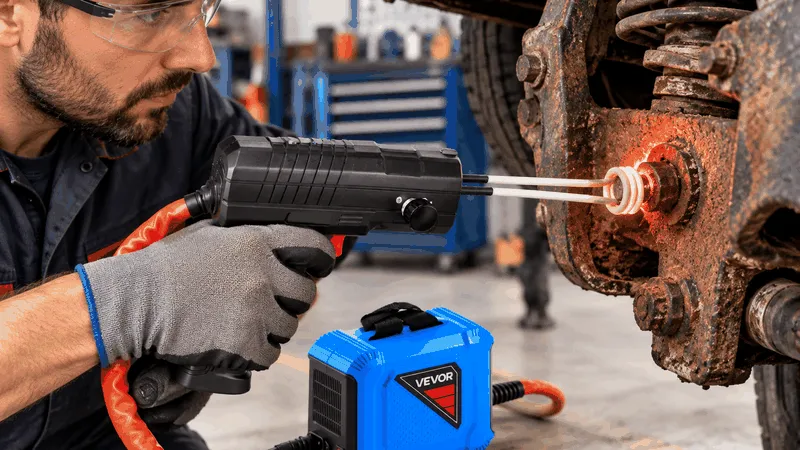
A seized bolt from a customer’s driveway, no handy bench to put it on, and a propane torch isn’t an option near a fuel tank. A handheld induction heater is made for just such situations: a gun-type device that heats a rusty fastener without flames, right where the job needs it. These induction heater kits sacrifice some brute force for mobility, and that is all that matters here.
This guide weighs the real pros and cons of portable handheld induction heaters, notes when a larger model makes more sense, and recommends the top picks, along with other rusty nut removal solutions. It also recommends other solutions for removing rusty nuts. It also recommends other rusty nut removal solutions.
What Is a Handheld Induction Heater?
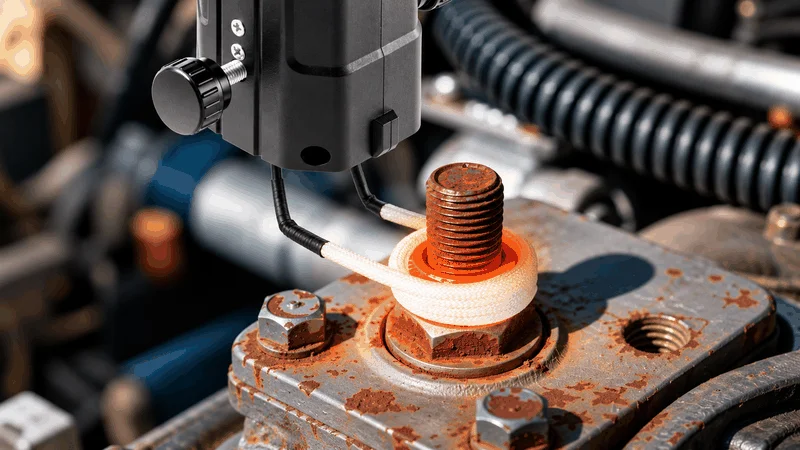
A handheld induction heater is a portable induction heater that works like the flameless heating method used in an industrial station. The device has a coil at its end that passes high-frequency alternating current to induce eddy currents in the ferrous bolt or nut. Portable induction heaters operate between 1 kW and 1.8 kW and weigh a few kilograms, so a handheld magnetic induction heater fits in a toolbox rather than on a trolley. The advantage is that you can move it to the car.
Pros of a Handheld Induction Heater
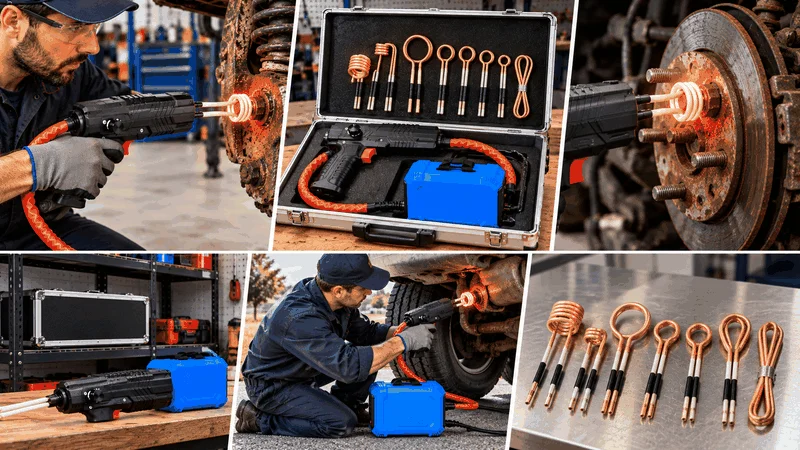
The benefits of this handheld induction heater, for the type of mechanic it is, are plentiful, and it belongs right amongst your normal auto mechanics tools:
- Portability. The key benefit: an induction heating tool you carry to the stuck bolt, instead of the other way around.
- Compact footprint. It hangs on a shelf or fits in a box, making it ideal for a small garage with limited floor space.
- Flameless heat. With no open flame, it won’t burn fuel lines, brake hoses, or rubber.
- Lower cost. A portable induction heating tool is the least expensive way to get into this technology, and it costs much less than a stationary unit.
- Coils. Induction kits with multiple coils let you reach difficult fasteners; even a 10-coil kit lets you heat around brake calipers and steering linkages a stationary coil can’t.
- Mobile-friendly. For the mobile mechanic, a portable tool and short extension cord will cover most jobs.
Cons of a Handheld Induction Heater
The handheld induction heater constraints are equally tangible, and by ignoring them, buyers get themselves into trouble:
- Power limitations. Limited to roughly 1-2 kW, a handheld will heat a single bolt fast, but it will take longer to heat a larger mass, such as a big flange or a hefty shaft.
- Duty cycle. The air-cooled handheld will heat up during a long session, so it needs cooling periods between duty cycles to avoid thermal shut-off.
- Not for continuous work. It wasn’t designed for all-day continuous use.
- Stays corded. A handheld is mobile but not cordless – it requires a power source, so remote operations require a generator or an extension.
None of the above means that a handheld induction heater is a bad tool. It simply means that a handheld is a specialized tool.
Handheld vs Station: When to Step Up
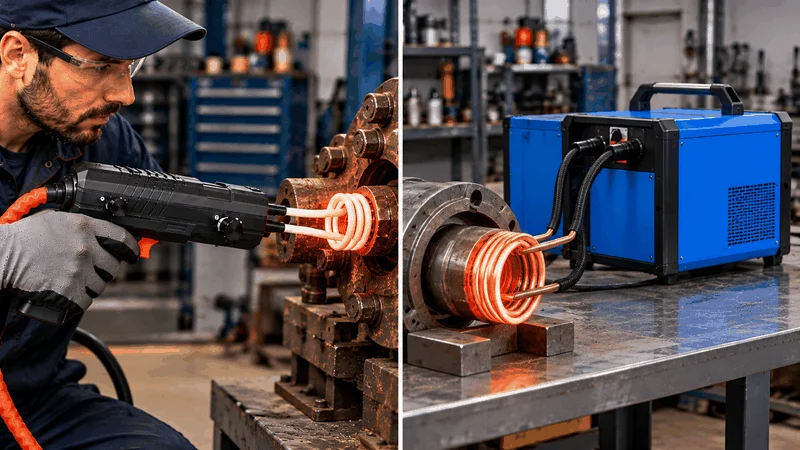
The real dividing line is the quantity and mass of work. If you heat up a sporadically stuck bolt, hub bearing, or trim fastener, a portable will do just fine. If you need to heat large parts continuously in a busy commercial shop or industrial environment.
A water-cooled unit like the GYS Powerduction 50LG will have much higher capacity for much longer periods than a portable. The entire induction heating lineup covers both, so it really depends on how hard you want to push it. Most home and mobile mechanics never outgrow a good handheld.
Choosing a Handheld Induction Heater
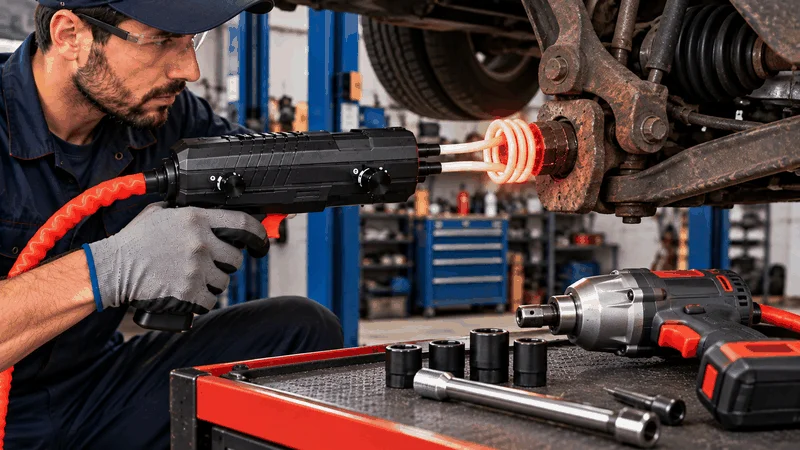
Among handheld induction heater tools, there are clear differences between an effective tool and an inefficient one. These include sufficient power for your normal fasteners, a suitable coil configuration that fits the area you work on, a reasonable duty cycle, and safety features.
Weight and balance also matter because you will be working with the handheld induction heater in awkward positions underneath the vehicle. You should also have impact wrenches on hand to finish the job.
What are the safest induction heater kits for use in small garages, and which models prioritize safety features?
No single type is safest, but look for features like overheating protection, a duty cycle, reverse polarity protection, and an insulated coil. The absence of a flame eliminates the risk of direct flame exposure. But it doesn’t eliminate other heating hazards around fuel and rubber, and you must handle the metal carefully. In a small garage, keep the coil away from wiring, fuel, flammable materials, and medical devices. And treat it like the rest of your mechanic tools by following the manual.
Best Handheld Induction Heaters
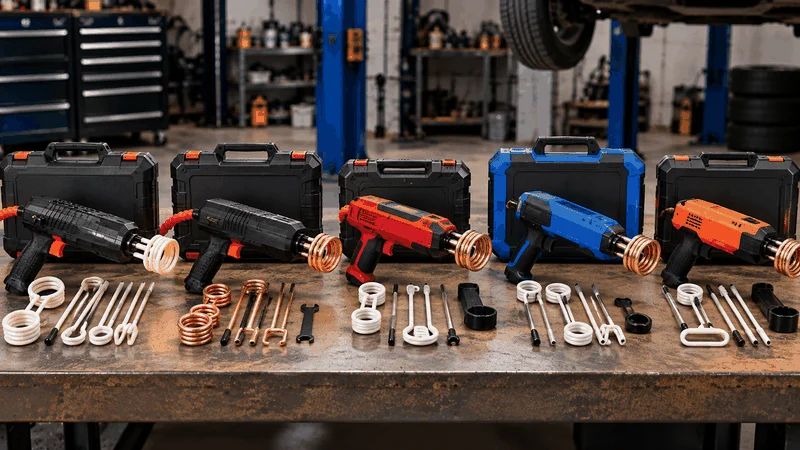
Comparison of five handheld induction heaters and portable devices: two from VEVOR against three others, including one handheld from France.
Recommended For Your Project
| Model | Power | Supply | Coils included | Notes |
| VEVOR 1100 W kit | 1100 W | 230 V | Up to 10 coils + case | Most coils for tight access |
| VEVOR 1800 W kit | 1800 W (EU); 1500 W US version | 230 V (EU) / 110 V (US) | 4 coils + case | US model scaled to stay on a 110 V line |
| Mini-Ductor Venom HP | 1800 W | 120 V (240 V available) | 3 coils, incl. Bearing Buddy | Reverse-polarity protection |
| GYS Powerduction 10R | 1200 W | 230 V single-phase | inductor (user-selected) | ~3.5 kg; high duty cycle |
| SIP 01161 Induction Heater | 1220 W (1.2 kW) | 230 V | 4 coils | UK workshop kit |
For coil count, the VEVOR 1100 W kit shines as an affordable all-arounder for penetrating densely mounted suspension and brake components. Moving up a bit, the 1800 W kit adds extra power for very rusty structural bolts. Please note that VEVOR offers this handheld induction heater chassis at 1500 W in the US, so it can run on a standard 110 V outlet, while the 1800 W version requires 230 V or a separate 20 A circuit.
Among more advanced models, the Mini-Ductor Venom HP includes reverse-polarity protection and a bearing coil. The GYS Powerduction 10R is a French-brand handheld with a high duty cycle, and the SIP 01161 is a UK workshop kit rated up to 1220 W. For the smallest and lightest model, choose a 1 kW heater.
Safety and Buying in France
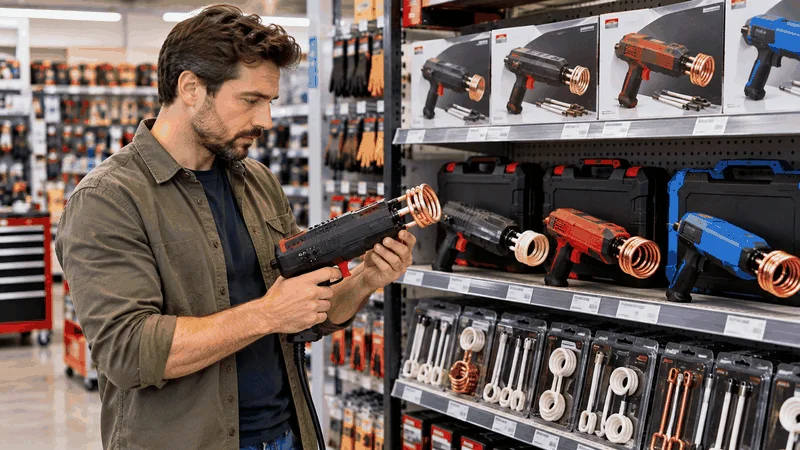
The lack of flames makes the torch safer from a fire perspective, but it doesn’t mean the heating process will always be safe around fuel, brake fluid, or rubber. Watch for overheating and reverse-polarity protection. Avoid placing the coil near wires or implantable devices like pacemakers; remove all magnetic jewelry; and let the tool cool between uses.
For French buyers, VEVOR delivers its range of gacrossage to the EU; GYS, a French company, produces its own Powerduction 10R torch, which is available almost everywhere in the UK and EU. Whatever you choose, the manufacturer’s user guide will provide the latest safety advice.
Conclusion
For most home and mobile mechanics, a handheld induction heater is the perfect tool, portable, flame-free, inexpensive, and able to release stuck bolts, hub bearings, and trim fasteners. Its limitations are power and duty cycle, so the water-cooled induction heating station is the right tool for tough, ongoing work. Match the power and coil set to your fastener requirements, follow the duty cycle, and use common sense; since coils are the consumable, always keep an extra coil set in the box.
Frequently Asked Questions
What are the most compact induction heater kits suitable for small garages in France?
The most compact versions are the lighter 1-1.2 kW handheld models that fit into a toolbox and require nothing more than a regular power socket. Great when bench and floor space is limited. Look for a machine weighing at most a couple of kilograms, with its coils in a carrying case.
Which induction heater kits are easiest to transport, and list models that fold or are lightweight?
Handheld induction heaters do not collapse; however, they are always portable, with the smallest ones being the 1-1.2 kW models like the GYS Powerduction 10R (3.5 kg). The 1 kW handheld from VEVOR is provided with a carrying case to hold the coils.
Which portable induction heater kits are best for mobile mechanics in France?
For a mobile mechanic, a lightweight design, quick setup, and a wide coil range matter, so a 1.1–1.5 kW portable unit with a complete coil kit is ideal. The carrying case is ideal for use alongside other auto repair equipment.
What are the best induction heater kits that include multiple coil sizes and accessories?
The VEVOR ten-coil set offers the widest range of coils, including straight, side-access, U-shaped, and flexible coils. So a portable handheld induction heater can heat any fastener without extra purchases.
What are the best induction heater kits for removing car hub bearings?
For a portable hub removal unit, use enough wattage with either a bearing or a U-shaped coil—a 1500 W kit will suffice for most automobile races from a regular outlet. Heat the race evenly, let it expand, and remove the bearing.