The gauge won’t drop as it should when you connect your pump and let it run. A pump that is too small crawls on larger lines, and a pump that is too high costs unnecessary money. Because a 5 CFM vacuum pump is in the middle, many technicians and DIYers choose it. Read this quick HVAC vacuum pump guide.
This article explains what a 5 CFM vacuum pump is and how to confidently choose from a reliable lineup of air conditioning vacuum pumps, the differences between single-stage and two-stage models, and how to match a 5 CFM AC vacuum pump to your system.
Recommended For Your Project
What a 5 CFM Vacuum Pump Is and What the Rating Means
Before charging a system, a 5 CFM vacuum pump removes moisture, air, and non-condensable gas from refrigerant lines. If any of that remains inside, it combines with the oil, turns into acid, and gradually consumes your compressor. That’s why you vacuum first, and it also explains why a 5 CFM AC vacuum pump is so popular for air conditioning maintenance.
What the 5 CFM vacuum pump rating actually tells you
Cubic feet per minute is called CFM. Free air displacement is how much air the pump can move per minute. So, rather than a depth number, the 5 CFM vacuum pump capacity is a speed number. A higher 5 CFM vacuum pump rating clears lines faster, but it does not mean the pump draws a deeper vacuum. You should also check the depth measurement, which is expressed in microns.
Typical 5 CFM vacuum pump specifications
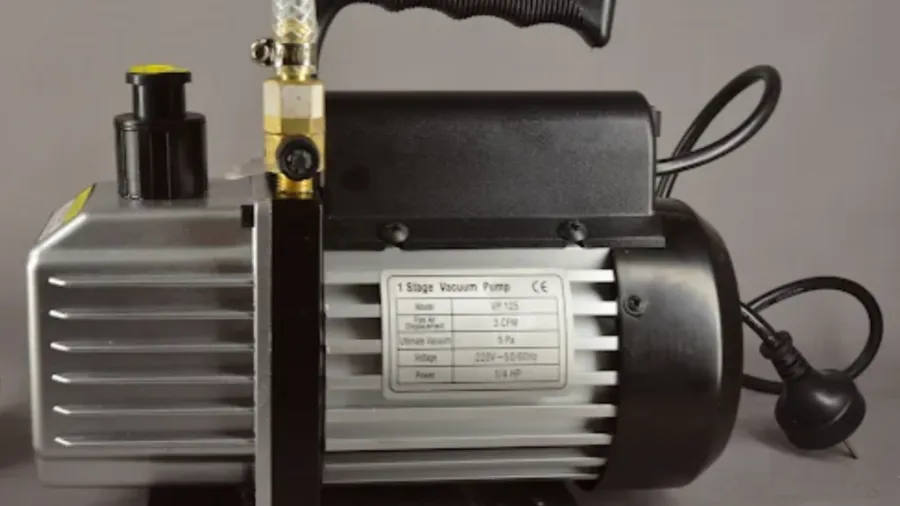
Most 5 CFM vacuum pumps have a rotary vane assembly, a 1/3 HP to 1/2 HP motor, and a small bottle of pump oil. The standard design is a 5 CFM rotary vane pump, which uses two vanes that ride inside a rotor and sweep air out as they rotate.
You can learn more by looking at the 5 CFM vacuum pump specifications on the label. A two-stage model typically lists an ultimate vacuum of about 25 microns, whereas a single-stage model runs higher.
The pump is compatible with both home and automobile fittings because its inlet ports are typically 1/4″, 3/8″, and 1/2″ ACME. This size is popular because of its flexible ports and 5 CFM vacuum pump performance.
5 CFM Vacuum Pump Performance: Single Stage vs Two Stage
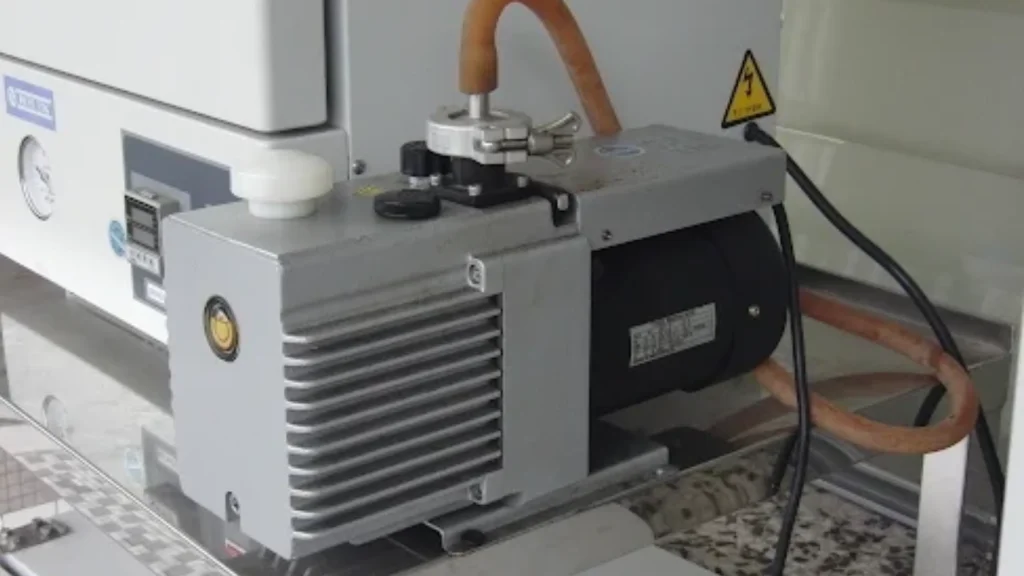
Let’s make this easy, since this is the option most buyers find confusing. The depth of a vacuum, not its speed, depends on the number of stages.
A single-stage vacuum pump uses one compression cycle. It reduces to about 75 microns, which is sufficient for simple home splits and automobile air conditioning. A one stage vacuum pump is a good place to start because it is lighter, less expensive, and simple to operate. Although it doesn’t reach the deepest vacuum, a single-stage 5 CFM AC vacuum pump still moves air quickly.
A two-stage vacuum pump circulates air through two consecutive chambers. The second stage finishes the job and pulls down to about 25 microns, while the first stage does the heavy lifting. When you need to remove moisture, a 5 CFM two stage vacuum pump wins because it pulls deeper.
What are the best two-stage vs single-stage vacuum pumps and which should I pick for typical residential jobs?
When weighing the two, homeowners frequently ask the same question. A dependable single-stage 5 CFM AC vacuum pump works well for routine home split servicing; for deeper, faster moisture removal or work on newer systems, use a two-stage pump. A single-stage 5 CFM pump with an oil bottle is a good value, but a two-stage 5 CFM rotary vane model can help when you need it.
Matching a 5 CFM Vacuum Pump to Your System
When you are going to select your vacuum pump, make sure CFM should match the task. If it’s too little, you’ll wait forever; if it’s too much, you’ll pay for unused air. This is how the sizes correspond.
Where 5 CFM fits, and when to size up or down
For quick one-time repairs and tight automotive lines, a small 2.5 CFM vacuum pump works well. A 5 CFM rotary vane pump increases speed without adding much weight. Because it clears lines fast without adding much weight, the 5 CFM vacuum pump for AC can handle most home splits and mid-size jobs.
Only when operating large commercial equipment or long line sets daily is a 12 CFM vacuum pump worth the investment. The air conditioning vacuum pump category groups pumps by CFM so you can browse the full range.
What are the top portable vacuum pumps for HVAC and how do they compare on weight and power?
Portability matters if you move between jobs. Smaller 2.5 to 4.5 CFM pumps cut weight for easier hauling, while 9 to 12 CFM models trade portability for speed. Most 5 CFM units run a 1/3 to 1/2 HP motor and weigh 20 to 25 pounds. The table below compares common portable HVAC pumps so you can balance weight against power.
| Portable Pump | Free Air (CFM) | Approx. Weight | Best For |
| Compact 2.5 CFM single-stage | 2.5 CFM | ~15 lb | Tight auto lines, quick one-off repairs |
| 4.5 CFM single-stage | 4.5 CFM | ~18–20 lb | Easy hauling between small home jobs |
| 5 CFM rotary vane (1/3–1/2 HP) | 5 CFM | 20–25 lb | Most home splits and mid-size jobs; the balanced choice |
| 7 CFM two-stage | 7 CFM | ~25–28 lb | Busy auto shops wanting deeper, faster pulls |
| 9–12 CFM two-stage | 9–12 CFM | 30 lb+ | Speed on big lines; trades portability for power |
Which vacuum pumps are best for occasional DIY HVAC repairs and how do they compare on price and ease of use?
Weekend fixers want something easy and reasonably priced. The simplest starting point is a single-stage vacuum pump at 5 CFM or less, which has fewer moving parts, costs less, and is easier to learn. A two-stage model, on the other hand, is slightly more expensive but provides a deeper vacuum when you’re ready for it.
Comparing 5 CFM Vacuum Pumps by Specs
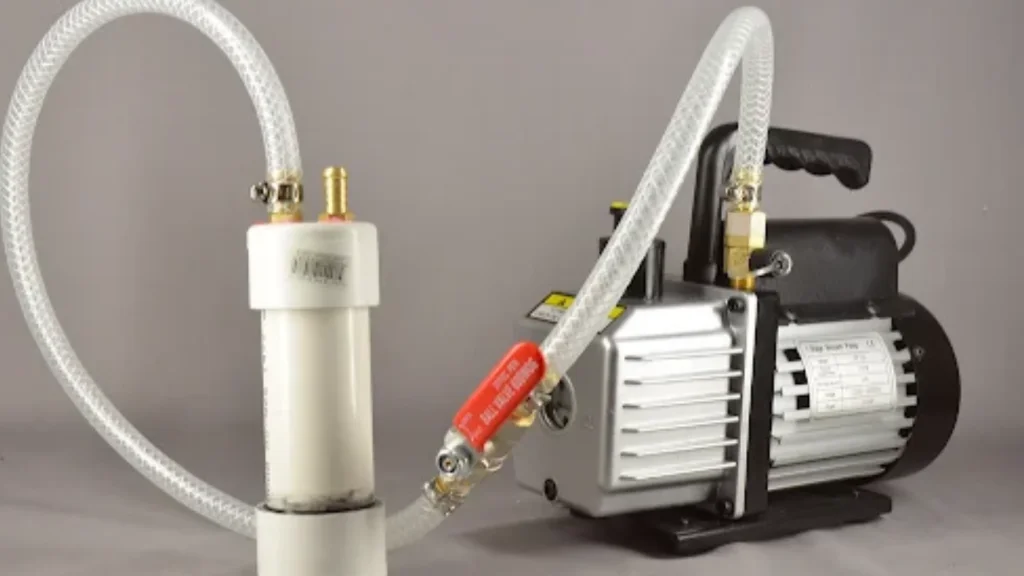
Here is a side-by-side comparison of the popular options because numbers are the best way to tell a story.
What are the best vacuum pumps for quick pull-down time, and how do they compare by specs?
A 5 CFM AC vacuum pump balances quick pull-down with easy handling for daily tasks, which is part of why its 5 CFM vacuum pump performance suits most home and auto work. Pull-down time decreases as CFM rises, so a 9 to 12 CFM pump clears long lines fastest.
| Pump type | Free air (CFM) | Typical ultimate vacuum | Best for |
| Single-stage 5 CFM | 5 CFM | 75 microns | Car AC, basic home splits |
| Two-stage 5 CFM | 5 CFM | 25 microns | Deeper moisture removal, newer systems |
| Two-stage 12 CFM | 12 CFM | 25 microns | Long line sets, commercial jobs |
| Single-stage 2.5 CFM | 2.5 CFM | 75 microns | Tight auto lines, quick repairs |
Which vacuum pumps are best for deep vacuum and how do they compare in micron rating?
For deep vacuum, a two-stage rotary vane pump is the best choice, for example, a 5 CFM two-stage model, which pulls down to about 25 microns versus roughly 75 for a single-stage pump. The micron reading, not CFM, decides whether deep-vacuum work succeeds or fails, so any critical moisture-removal task calls for a two-stage design regardless of how much air the pump moves.
Heavy-Duty and Refrigerant Use Cases
Your choice depends on both the job size and the refrigerant you’re servicing. The pump matters more now than in the past because modern blends are more moisture-sensitive.
What are the best vacuum pumps for use with R-410A systems and how do they compare?
Most high-quality 5 CFM AC vacuum pump models are rated for R-410A, R-134a, and R-22, and use a two-stage design to pull deeper vacuums. R-410A operates at high pressure and detests trapped moisture. The specification sheet lists compatible refrigerants for pump-and-gauge sets, such as this 4.5 CFM single-stage kit with manifold gauges.
| Pump Option | Stages | Ultimate Vacuum | R-410A Fit |
| 5 CFM two-stage rotary vane | Two-stage | ~25 microns | Ideal, deep, fast pull for high-pressure R-410A |
| 5 CFM single-stage | Single-stage | ~75 microns | Usable on older low-pressure blends, marginal for R-410A |
| 7 CFM two-stage | Two-stage | ~25 microns | Great for frequent R-410A and R-32 service |
| 12 CFM two-stage | Two-stage | ~25 microns | R-410A on long commercial line sets |
What are the top heavy-duty vacuum pumps for commercial HVAC and how do they compare on CFM and reliability?
Professionals servicing large systems need more power. A robust single-stage 12 CFM pump is the lighter-duty option when speed matters more than ultimate depth; for commercial lines, a 12 CFM two-stage pump moves large volumes quickly and handles daily use.
| Heavy-Duty Pump | Free Air (CFM) | Stages | Why It Suits Commercial HVAC |
| Single-stage 12 CFM | 12 CFM | Single-stage | Lighter-duty speed when depth matters less |
| Two-stage 9 CFM | 9 CFM | Two-stage | Deep vacuum with strong throughput for daily use |
| Two-stage 12 CFM | 12 CFM | Two-stage | Moves large volumes fast on long line sets; built for daily load |
Match the pump to your job: single-stage 12 CFM for raw speed, two-stage 9–12 CFM when the lines must also run deep and dry.
Match the pump to your job.
| Your job | CFM to pick | Stages | Why |
| Occasional DIY or car AC | 2.5 to 5 CFM | Single-stage | Simple, light, low cost |
| Regular home AC service | 5 CFM | Single or two-stage | Fast pull-down, easy to carry |
| R-410A & newer systems | 5 CFM | Two-stage | Deeper vacuum removes moisture |
| Commercial or daily use | 9 to 12 CFM | Two-stage | Clears big lines fast, durable |
How to Use a 5 CFM Vacuum Pump?
Good technique is still necessary, even with good tools. How you use a vacuum pump determines whether you achieve a strong vacuum or waste an hour, even though the pump does the work.
- Before you start, check the pump oil to make sure it is clean, as dirty or cloudy oil will ruin the suction.
- Attach the yellow hose of the manifold gauge set to the pump inlet and the other hoses to the system ports.
- Turn on the vacuum pump and open the two valves on the gauge set.
- Run the pump until the gauge reaches the desired position and stops moving.
- Turn the pump off. Close the valves on each side of the gauge set to prevent air from getting in.
- Turn off the pump for 15 minutes and watch the gauge to make sure the pressure does not rise.
Conclusion
A single-stage vacuum pump can handle standard car and home air conditioning, but a two-stage model is worth the investment for deeper moisture removal and more modern systems. Verify that the inlet ports fit your hoses, confirm the refrigerant ratings you require, and make sure you have a fresh bottle of oil on hand or included. Your 5 CFM AC vacuum pump will pull clean vacuums for years if you get those three things right.
FAQs
How many microns should a 5 CFM vacuum pump pull?
A single-stage CFM model approaches 75 microns, whereas a two-stage 5 CFM model reaches roughly 25 microns. For most AC work, both are acceptable; however, for deep moisture removal, use two stages.
Can one 5 CFM pump service both home and car AC?
Indeed. Most have 1/4″, 3/8″, and 1/2″ ACME inlet ports along with the appropriate refrigerant ratings, allowing one pump to handle both automotive and home HVAC systems with the appropriate hoses.
How long should a 5 CFM vacuum pump run?
For small residential and automobile systems, allow 30 to 45 minutes. Watch the gauge and the hold test instead of the clock because larger lines take longer.
Do I need to change the oil often?
Before starting any task, check it and replace it if it looks cloudy, hazy, or milky. Clean oil improves sealing and helps the pump create a deeper vacuum faster.