Woodworking Lathes




Results for Woodworking Lathes
VEVOR has a wide selection of flashing tapes designed for contractors, deck builders, roofers, and DIY users who need to waterproof homes or businesses. VEVOR offers flashing tape for deck joists to protect structural lumber, as well as heavy-duty waterproof flashing tape for sealing windows and doors. There are options for multiple widths, substrate types, and adhesive needs. Crafted to stick well and maintain their moisture-barrier performance over time, our flashing tapes provide reliable security in any situation.
VEVOR Woodworking Lathes: Professional Turning Performance for Bowls, Spindles, and Beyond
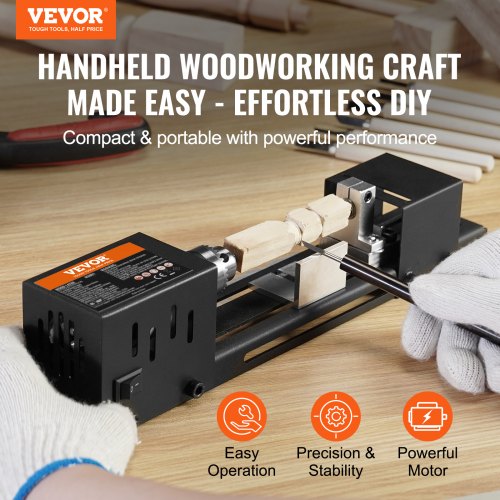
Are you looking for a lathe that maintains speed under load without bogging down and provides the rigidity needed for smooth cuts? Woodworking lathes turn spinning motion into shaped wood. The quality of the lathe determines whether you get glass-smooth surfaces that need little sanding or rough, tool-marked surfaces that need hours of repair. VEVOR's woodworking lathes come with a range of motor powers, swing capacities, and bed lengths to suit a wide range of amateur and professional turning needs.
Motor Power and Swing Capacity: Selecting the Right Woodworking Lathes for Your Projects
To choose the right woodworking lathes, you must first know the largest width and length of wood that you want to turn. VEVOR offers a wide range of woodworking lathes, from small benchtop models with 1/2 HP motors to large floor-standing machines with 2 HP motors, with swing sizes ranging from 10 to 20 inches.
Motor Power Requirements for Different Turning Applications
The motor horsepower of your woodworking lathe determines how much torque it delivers to the spindle. This directly affects how quickly the lathe can keep cutting when tools are in the wood. When making light cuts on softwoods and smaller stock, VEVOR's small wooden lathe models with 1/2 to 3/4 HP motors are good for pen turning, small spindles, and bowls up to 8 inches in diameter.
For turning medium-sized bowls, furniture legs, and wooden spindles, you should use 1 HP motors because the thicker, wider wood requires more torque to keep the speed from dropping while cutting. This VEVOR 1 HP tabletop woodworking lathe can handle bowls up to 12 inches in diameter and spindles up to 2 inches in diameter without slowing much during normal-depth cuts.
When it comes to production turning, big-bowl blanks, or active stock removal, 1-1/2 to 2 HP motors maintain a steady speed even when making heavy cuts on unbalanced rough blanks. Variable speed control makes motors more powerful. Running at lower speeds increases torque, allowing smaller motors to handle heavier stock at lower RPM. VEVOR's woodworking lathes feature electronic speed controls that help maintain consistent speed across the usable range.
Swing Capacity and Distance Between Centers for Project Sizing
The biggest bowl or faceplate project your woodworking lathe can handle is based on its swing capacity, which is the largest diameter workpiece that can fit over the bed of the machine. For salad bowls, small decorative vessels, and regular dinnerware, VEVOR's 10-inch swing benchtop woodworking lathe can handle bowls and trays up to 10 inches in diameter when turned outboard or with offset tool rests.
Mid-capacity 12- to 14-inch swing types can turn most bowls for home use, such as serving platters, fruit bowls, and artistic hollow forms, without an outboard turning setup. VEVOR offers 16- to 20-inch swing woodworking lathes that can handle statement pieces, segmented bowls, and industrial production runs for professional bowl turners or those making large architectural pieces.
A small woodworking lathe that can turn 36-inch pieces can handle table legs, stair balusters, and most furniture parts. Beds 40 inches or longer can accommodate full-length bedposts and architectural columns. With bed extensions, some VEVOR models can practically double the spindle capacity for long tasks, without permanently dedicating floor space to extended beds.
Variable Speed Range and Speed Control Methods
Large-diameter bowl blanks require low speeds to avoid dangerous centrifugal forces, while small spindles require high speeds for smooth cuts. Variable speed ranges from 500 to 3,800 RPM on VEVOR's woodworking lathes cover all spinning tasks. A good range for large rough-bowl blanks is 500 to 800 RPM because the centrifugal force is still manageable and the tools can cut cleanly without grabbing.
As the bowls get rounder and more balanced, speed up to 1,200-1,800 RPM for final cuts and grinding. Spindles and pen blanks for small jobs spin at 2,500 to 3,800 RPM, which is quick enough to make cuts on small pieces of work that are as smooth as glass. Electronic variable speed on VEVOR's benchtop woodworking lathe models lets you change the speed with a dial without stopping the lathe.
This feature is important for finding the optimal speed in the middle of a job when the workpiece diameter changes. Using stepped pulleys for mechanical variable speed means stopping the lathe and moving the belts between the sheaves. For most turners, the ease of using electronics is more important than the simplicity of machines. Each VEVOR woodworking lathe machine has a clear sign showing how to change the speed.
Indexing and Reverse Capability for Advanced Techniques
The 24-position indexing on VEVOR's woodworking lathes divides the spindle into 15-degree steps, making it easy to match flutes or pieces that are the same distance apart. Some types feature 60-position indexing with 6-degree spacing for more detailed work or compatibility with certain jig systems. When doing routing or carving tasks that would normally spin the work, the indexing pins lock in place and stop the spindle from turning.
Some finishing methods and spiral-cutting operations require the workpiece to rotate in the opposite direction of normal rotation. This is possible with reverse rotation. VEVOR's reversible wooden lathes feature electronic direction switches and mechanical safety interlocks that prevent them from accidentally turning backward while turning normally.
When sanding, reverse is especially helpful because switching between forward and reverse spinning stops directional scratch patterns and spreads abrasive wear more evenly. Some turners don't need indexing or reverse, but these functions make it much easier to be creative with decorative work. VEVOR offers both basic and fully equipped woodworking lathes to suit any price or skill level.
Features and Construction Quality: Building Your VEVOR Woodworking Lathes for Precision and Longevity
Professional-grade woodworking lathes differ from amateur machines in more ways than just power and capacity. VEVOR's wooden lathes are known for cast-iron beds, precision-ground ways, and high-quality bearings that remain accurate for decades.
Cast-Iron Construction and Vibration Damping
The lathe bed material decides how rigid and vibration-damping it is, which is important for making smooth cuts and getting a good surface finish. Compared with cheaper lathes with tubular-steel or stamped-sheet-metal beds, VEVOR's cast-iron bed structure better absorbs vibrations caused by uneven blanks, interrupted cuts, and motor operation. Cast iron's bulk and internal damping properties prevent vibrations from reaching the cutting tools through the bed.
The extra mass also prevents deflection when rough turning heavy bowl blanks, which can cause uneven centrifugal forces. VEVOR's benchtop woodworking lathes feature cast-iron headstocks and tailstocks mounted on steel beds. This keeps the woodworking lathe machine from vibrating at key-cutting spots and makes them lighter, so they are easier to move around. Full cast-iron bed lathes are the most rigid and are used by professionals.
VEVOR woodworking lathes make sure that the bedways are flat and aligned to within 0.001 inches. This ensures that the centers of the tailstock and headstock spindles are perfectly aligned, allowing the spindles to turn accurately without taper. With sealed ball bearings in the headstock shafts, there is no play or runout, which can cause vibration and a poor surface finish.
Tool Rest Design, Swing Radius, and Accessory Compatibility
VEVOR's woodworking lathes come with heavy-duty tool rests with T-slot bases that let you move the rests anywhere along the bed and rotate them 360 degrees for the best tooling angle. The remaining edges are precisely ground to be smooth and curved. This lets the tools slide easily while cutting, so they don't get stuck on rough spots or sharp edges that stop the cutting motion.
Standard rest lengths range from 6 to 12 inches. Longer rests support tools over a larger contact area, which lowers vibrations. Shorter rests, on the other hand, allow access to tight places inside bowls and hollow forms. VEVOR's woodworking lathes feature standard Morse taper spindles and tailstocks that accept universal live centers, drive centers, and chucks from any manufacturer.
This makes the lathes more useful in a variety of situations. For small woodworking lathes, the most common taper size is MT1; for larger machines, MT2 is more common. If you use standard-sized faceplate threads, you can put aftermarket faceplates, chuck adapters, and other accessories without having to make custom threads or adapters. All spindle and tailstock accessories come with mounting thread specs in VEVOR.
Why Choose VEVOR Woodworking Lathes for Your Turning Projects?
From small benchtop models for turning pens to full-size machines for making professional bowls, VEVOR's woodworking lathes can handle any job. All of them feature variable speed control, cast-iron construction, and precision-ground parts, delivering clean cuts and accurate results. VEVOR is the best choice for amateur turners, woodworking teachers, and production makers because it offers electronic speed control, indexing, and compatibility with standard accessories. Explore VEVOR's full selection of small wooden lathes and woodworking lathes today to find the right one for your needs and start making the things you've been dreaming of.
FAQs
What size woodworking lathe do I need for bowl turning?
For bowls up to 10 inches in diameter, VEVOR's 10-12-inch swing benchtop woodworking lathe with a 1 HP motor is sufficient. Bowls 12-16 inches require 14-16 inch swing capacity with 1-1/2 HP minimum. Large production bowls over 16 inches need an 18-20 inch swing and 2 HP motors to maintain speed during heavy cuts.
What is the difference between benchtop and floor-standing woodworking lathes?
Benchtop woodworking lathes mount on workbenches, weigh 80-150 pounds, and offer adequate rigidity for most turning while remaining portable. Floor-standing lathes weigh 200+ pounds, provide maximum vibration damping from cast-iron construction, and suit professional shops with permanent installation space. Both can produce quality work when properly maintained.
Do I need a variable-speed woodworking lathe?
Yes. Variable speed optimizes RPM for changing workpiece diameter and wood type without stopping the lathe. Large rough blanks need 500-800 RPM for safety, while small spindles require 2,500+ RPM for smooth cuts. VEVOR's electronic variable-speed woodworking lathes adjust speed via dial control during operation.
What motor power do I need for furniture spindle turning?
Standard furniture legs and balusters require a minimum of 1 HP on a small woodworking lathe with a 36-40-inch between-centers capacity. Hardwoods and aggressive stock removal benefit from a 1-1/2 HP motor. Larger architectural columns demand 2 HP motors. Match motor power to the maximum spindle diameter and the typical wood species you'll turn.