Water Testing Kits
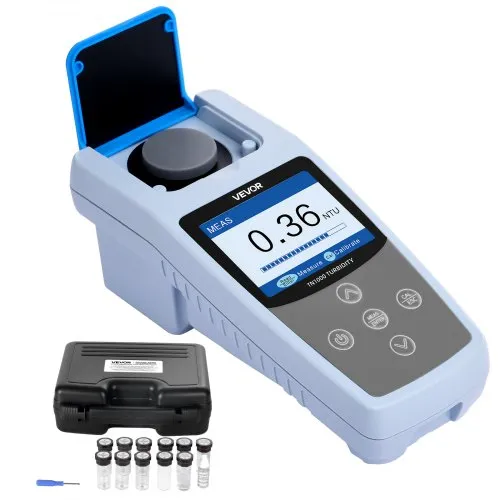


Results for Water Testing Kits
Water quality specialists, environmental technicians, laboratory analysts, aquaculture operators, and municipal water treatment staff who require accurate and dependable turbidity measurement in both field and laboratory settings can use VEVOR's turbidity meters. VEVOR's portfolio encompasses all NTU measurement ranges, accuracy requirements, and deployment scenarios, from small handheld turbidity meters for on-site water testing to high-precision water turbidity meters for laboratory analysis. VEVOR's comprehensive turbidity meter collection lets you measure your water's clarity with confidence.
VEVOR Turbidity Meters: Portable and Bench-Top NTU Measurement for Field and Laboratory Water Quality Testing
Do you require a trustworthy turbidity meter for water that provides precise NTU readings in the field without the bulk and fragility of lab bench instruments? Precision optical measurement methods, broad NTU measurement ranges, and portable handheld turbidity meter designs are all combined in VEVOR turbidity meters to provide reliable results for industrial process control, aquaculture management, environmental monitoring, and drinking water testing. VEVOR provides precise findings, whether you require a bench model for laboratory analysis or a portable turbidity meter for field sampling.
Measurement Range & Accuracy in VEVOR Turbidity Meters
The two primary performance factors that determine whether a turbidity meter generates accurate, useful readings across the water clarity conditions encountered in your testing application—from extremely clean drinking water to highly turbid environmental water samples—are the measurement range and the accuracy specification.
NTU Measurement Range: Covering Every Water Clarity Condition
Nephelometric Turbidity Units (NTU), a widely recognized unit for water clarity based on the 90-degree light-scattering concept used in nephelometric measurement devices, are used to express turbidity. VEVOR turbidity meters come in a variety of measurement ranges, from 0 to 200 NTU for drinking water-focused devices to 0 to 1000 NTU and beyond for industrial and environmental water testing.
For drinking water quality verification, aquarium and aquaculture water monitoring, swimming pool water clarity testing, and any application where water is expected to be near clear and the measurement goal is confirming compliance with low-turbidity standards, VEVOR low-range turbidity meters covering 0 to 200 NTU are a suitable specification. The EPA drinking water treatment target of 0.3 NTU and the WHO drinking water recommendation of 1 NTU both lie well within this low-range capacity, making VEVOR's lower-range turbidity meter models suitable instruments for assessing the quality of drinking water in homes and municipalities. Environmental water samples from rivers, lakes, and groundwater sources, where turbidity fluctuates greatly with seasonal conditions, storm runoff events, and sediment resuspension, can be measured with mid-range VEVOR models capable of up to 400 NTU. High-range models up to 1000 NTU are suitable for environmental monitoring in severely disturbed aquatic environments where turbidity frequently exceeds the range of conventional drinking water instruments, for industrial process water monitoring, and for wastewater treatment intake measurement.
Optical System Accuracy and Detection Principle
The three accuracy-related performance characteristics that differentiate a trustworthy instrument from one that yields inconsistent readings under actual field sampling conditions are measurement accuracy, repeatability, and resistance to interference from colored water samples, all of which are determined by the optical detection system inside a turbidity meter.
The nephelometric 90-degree light scattering detection concept included in ISO 7027 and EPA Method 180.1, the two most frequently cited turbidity measuring standards for drinking water and environmental water quality applications, is used by VEVOR turbidity meters. In nephelometry, a water sample is illuminated by a light source, and the intensity of scattered light from suspended particles is measured by a detector positioned 90 degrees to the light beam. This detection geometry offers high sensitivity at low turbidity levels and provides consistent readings that are less affected by sample color or dissolved organic content. In drinking water applications, VEVOR's optical system accuracy specifications usually range from ±2% of reading to ±0.1 NTU at the low end. This precision level is necessary for effective distinction between turbidity readings close to regulatory compliance thresholds. In VEVOR instruments, a consistent sample-volume cuvette design maintains a constant optical path length between measurements, helping maintain calibration validity and comparable readings across sampling occasions and operators.
Portable Turbidity Meter Sensitivity at Low NTU Levels
In drinking water quality applications, where the difference between 0.2 and 0.5 NTU can represent the difference between treatment standard compliance and non-compliance, measurement sensitivity at very low NTU values below 1 NTU is the performance attribute that counts most.
At the low end of their measurement range, VEVOR handheld turbidity meter models intended for drinking water and high-purity water applications achieve detection resolution of 0.01 NTU, which is the resolution level required to consistently distinguish turbidity values in the sub-1 NTU range where decisions about drinking water quality are made. To maintain accuracy at the low measurement ranges where drinking water quality management operates, VEVOR incorporates the following engineering components into its precision turbidity meter models: a high-intensity light source, a low-noise photodetector, and effective stray-light rejection in the optical housing. Low NTU sensitivity in a portable turbidity meter enables early detection of clarity deterioration before it reaches visually apparent levels, allowing proactive water management rather than a reactive response to already-poor conditions for aquaculture and aquarium applications, where water clarity can directly affect fish health and visual presentation.
Field vs. Laboratory Measurement Accuracy Considerations
Both laboratory bench turbidity meters and portable handheld turbidity meters are precise devices. Still, they are designed for distinct operating parameters and accuracy standards that reflect the real-world conditions of field sampling rather than controlled laboratory analysis.
With drop-rated housings that can withstand the unintentional effects of outdoor and industrial field environments, VEVOR portable turbidity meter models are designed to maintain accuracy specifications across the ambient temperature range and handling conditions of field use. These conditions typically range from 0°C to 50°C. In the controlled temperature and vibration-free conditions of a laboratory setting, laboratory-grade VEVOR turbidity meters consistently meet tighter accuracy criteria, often around ±1% of the reading, depending on the model and range. VEVOR's range includes both deployment scenarios with instruments calibrated to consistent NTU standards, making field and laboratory results directly comparable for water quality specialists who require laboratory analysis to corroborate field screening results. Choosing the right instrument tier for the intended deployment environment ensures that accuracy requirements are achievable in real-world scenarios rather than only under ideal conditions, which field sampling never provides.
Display Features & Calibration in VEVOR Turbidity Meters
Beyond measuring performance, a turbidity meter's display features and calibration systems determine how easy it is for operators to read and record measurements in field settings, as well as how reliably the device's accuracy can be confirmed and sustained over time.
Display Technology and Field Readability
A portable turbidity meter's display system must deliver unambiguous, clear NTU readings in the whole spectrum of ambient light conditions encountered during field use, from brilliant outdoor daylight to gloomy indoor surroundings, where screen visibility is usually most difficult.
High-contrast LCDs with backlighting are used in many VEVOR handheld turbidity meter models to maintain readability in low-light indoor sampling environments, such as monitoring rooms in water treatment plants, laboratory settings, and evening field sampling, without the need for external illumination. The resolution granularity of VEVOR turbidity meters aligns with the optical system's accuracy and provides operators with the measurement detail required for accurate water quality assessment and recordkeeping. The display resolution ranges from 0.01 NTU at the low end to 0.1 NTU at the high end. In field conditions where writing and viewing at the same time is impractical, data hold functions on VEVOR portable turbidity meter models freeze the displayed reading after sample measurement, enabling the operator to record the result without continuously monitoring the display during manual data logging.
Calibration System and Traceability
The procedure that sustains turbidity meter accuracy over time and provides the measurement traceability necessary for regulatory compliance reporting, laboratory accreditation, and the validity of environmental monitoring data is routine calibration against approved NTU standards.
Using certified NTU standard solutions, such as a zero-turbidity blank, a low-range standard, and a mid- or high-range standard, many VEVOR turbidity meters enable multi-point calibration. This feature enables the calibration curve of the device to be confirmed and modified throughout the entire working measurement range rather than just at a single reference point. VEVOR instruments' calibration standard concentrations are in line with globally accepted NTU reference standards, ensuring calibration results can be linked to recognized measurement references that meet laboratory and regulatory accreditation criteria. On VEVOR water turbidity meter models, calibration validity indicators display the last calibration date and notify the operator when recalibration is due, based on a user-configurable calibration interval. This active calibration management support prevents the operator from using an out-of-calibration instrument without realizing that the instrument's accuracy has drifted beyond specification.
Why Choose VEVOR Turbidity Meters for Your Water Quality Testing?
For dependable, traceable turbidity measurement in any deployment setting, VEVOR turbidity meters provide the NTU measurement range, optical accuracy, portable handheld design, and multi-point calibration capability required by environmental technicians, laboratory analysts, and water quality specialists. Whether you require a high-precision water turbidity meter for laboratory analysis or a small, portable turbidity meter for field sampling, VEVOR's entire range offers a wide range of specifications at competitive prices, backed by dependable after-sales service. Explore the entire VEVOR assortment now to evaluate water clarity with assurance.
FAQs
What NTU range turbidity meter do I need for drinking water testing?
A VEVOR turbidity meter with a resolution of 0.01 NTU and a range of 0 to 200 NTU is a common specification for verifying drinking water quality. VEVOR's drinking water-focused models are well within the low end of the WHO and EPA drinking water turbidity requirements, which are set at 1 NTU or lower.
What is the difference between a portable and a bench turbidity meter?
With drop-rated housings, illuminated screens, and battery operation across a broad range of ambient temperatures, portable handheld turbidity meters are ideal for field use. Under carefully regulated laboratory circumstances, bench models meet more stringent accuracy requirements. Both matched field and laboratory deployment modes are available with VEVOR.
How often should a VEVOR turbidity meter be calibrated?
The frequency of calibration is determined by use intensity and regulatory requirements; it is usually done monthly to monitor regulatory compliance and before each major environmental sampling campaign. To facilitate scheduled recalibration without manual tracking, the VEVOR turbidity meter for water models includes calibration interval reminders.
Can VEVOR turbidity meters measure highly turbid wastewater samples?
Yes. When ordinary drinking water range instruments reach their upper limit, VEVOR high-range water turbidity meters, ranging from 0 to 1000 NTU, are suitable for wastewater inflow measurement, industrial process water monitoring, and sampling severely murky environmental water.
What calibration standards do VEVOR turbidity meters use?
Internationally accepted NTU standard solutions at concentrations in line with ISO 7027 and EPA Method 180.1 reference standards are commonly used to calibrate VEVOR turbidity meters. The use of verified, traceable NTU standards during calibration guarantees that measurement findings meet the traceability requirements for laboratory accreditation and regulatory reporting.