Roman Chairs







Results for Roman Chairs
VEVOR ash vacuums clean fireplaces, wood stoves, and pellet stoves effectively and efficiently. Our wide selection includes models that can handle both hot and cold ash safely, with varying capacities and heat resistance. VEVOR delivers solid performance in all situations, from small units for occasional home use to large systems for frequent cleaning. Every vacuum for ash has improved filtration to catch fine ash particles. This protects your home's indoor air quality and makes cleanup after a fire easier.
VEVOR Heavy Duty Roman Chairs for Complete Posterior Chain Development
Do you want to use specialized equipment that can adapt to your body size and exercise level to strengthen your hamstrings, glutes, and lower back? For athletes and individuals undergoing rehabilitation who need customizable support, Roman chairs are ideal. VEVOR offers sturdy alternatives to Roman chair hyperextension benches that maintain precise body alignment. Our Roman chairs address the fundamental challenge of providing professional posterior chain training safely and of designing a flexible home gym around multi functional adjustable weight bench equipment.
Weight Capacity & Adjustability, Optimizing Your Training Experience
To ensure safe operation, appropriate muscle targeting, and long term equipment durability across a range of users and training intensities, choosing the best Roman chair requires knowledge of weight capacity ratings, adjustment ranges, and body configuration options.
Weight Capacity Ratings and Structural Safety
Roman chairs' weight capacity determines whether they can safely support people during dynamic exercise movements when stresses are much greater than static bodyweight. Depending on the type, VEVOR Roman chairs typically have a weight capacity of 265 to 600 pounds. Commercial-grade units can support 500–600 pounds for larger users or loaded exercise variations, while entry-level home gym configurations can support 265-330 pounds. Understanding dynamic loading is essential. As the upper body lowers and reverses direction, hyperextension movements produce peak pressures 1.5–2 times bodyweight. This means that during controlled repetitions, a 200-pound user generates a peak structural load of roughly 300–400 pounds. Whenever possible, choose models with a rated capacity comfortably higher than your body weight to ensure safety during intense training.
Whether advertised capacity ratings accurately reflect safety margins in the real world depends directly on steel gauge and frame weld quality. At the highest-stress points, hip pad mounting brackets, front leg junctions, and foot roller attachment points, where concentrated pressures build up during training, VEVOR Roman chair hyperextension bench models feature reinforced weld points. Powder-coated steel frames preserve structural integrity over years of regular exercise by resisting corrosion from perspiration exposure, which is common in home gyms. It is especially crucial for severely loaded training requiring additional weight plates to regularly verify capacity through frame inspection, which detects emerging cracks or joint loosening before they cause a dangerous failure during exercise.
Height and Angle Adjustment Systems
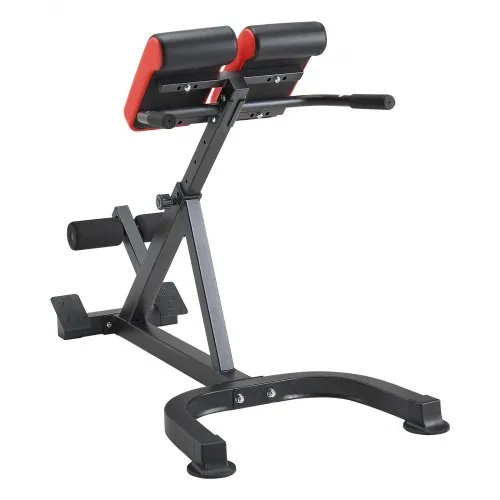
Roman chairs' adjustability dictates how well they fit people of various heights, and their angle adjustment allows them to target specific muscle regions. Adjusting the height of the hip pad is crucial because an incorrect height can make the hip joint too high, limiting range of motion and shifting the load to the lower back, or too low, causing unpleasant hyperextension beyond safe joint angles. To accommodate users who are 5 feet to 6'4", VEVOR models have adjustable hip pads in 4–8 positions with a vertical range of 6–12 inches. Proper positioning of the pad at its upper edge allows a full range of motion during hyperextension.
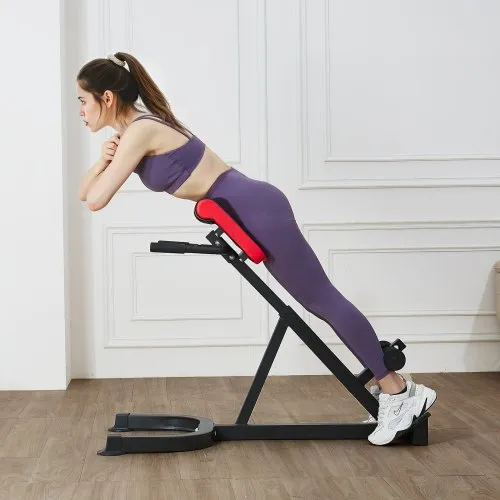
Angle adjustment turns ordinary Roman chairs into adaptable, adjustable back extension machine designs that target different muscles at varying elevations. Bodybuilders aiming for posterior chain aesthetics prefer declined positions between 45 and 60 degrees, which enhance range of motion and shift attention toward glute and hamstring development. Flat 180-degree positions promote the engagement of the lower back erector spinae. For novices or rehabilitation users, inclined postures above horizontal make exercises easier by establishing basic strength before moving on to more difficult angles. The multi-position angle systems from VEVOR feature clear angle markings that allow consistent session-to-session settings for progressive training programs, and their secure locking mechanisms prevent unanticipated angle shifts during workouts that could cause damage.
Foot Roller Adjustment and Body Anchoring
The location of the foot roller controls safe body anchoring during hyperextension movements, which directly impacts muscle activation patterns and workout safety. To prevent feet from rising during the ascending phase of hyperextension and to prevent painful strain on the ankle joint itself, properly positioned rollers protect the Achilles tendon and the lower calf. For safe anchoring without restricting circulation during prolonged training sets, VEVOR Roman chairs feature adjustable roller heights that fit foot sizes from small to extra-large, as well as roller spacing adjustments that accommodate varying lower leg thicknesses.
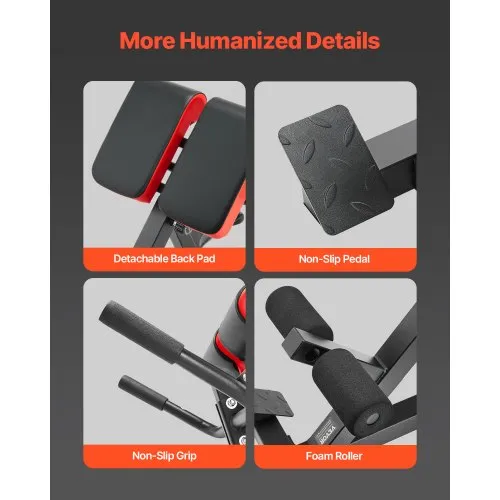
In loaded sets where a lot of downward force is applied to the lower leg, the quality of the roller padding significantly impacts comfort. Dense foam padding, which is usually 2-3 inches thick, distributes pressure over a wider contact area, avoiding painful pressure points that can form with thin or low-density padding during high-repetition training. Some VEVOR multi function weight bench models feature dual roller systems with upper and lower anchoring points, which significantly increase stability during movements with heavy loads. This feature lets you add weight plates or resistance bands with confidence, without worrying about instability. It is important to pay close attention to roller adjustment during initial setup. Before starting exercise sets, users should confirm strong anchoring, especially when experimenting with different angle configurations or adding external resistance.
User Height Range and Body Proportion Accommodation
Roman chairs provide proper placement for users with varying torso-to-leg length ratios, which are not captured by similar heights, thanks to body proportion accommodation that goes beyond basic height adjustment. The fine adjustment capability within each height setting addresses the proportional disparities between users with longer torsos relative to leg length and those with proportionally longer legs at the same overall height. These users require somewhat different hip pad settings. Compared to straightforward 4-position systems that only provide coarse adjustments, VEVOR multi functional adjustable weight bench setups with several micro-adjustment points between major height settings support a wider range of body proportions more precisely.
The reach distance between the foot rollers and the hip pads determines the extent of body stretch during hyperextension; if it is too short, the hips cannot fully flex during the descent phase, limiting range of motion and reducing the effectiveness of the exercise. Tall athletes with long femurs who need more distance between the anchoring and support points, or users with compact frames, can both benefit from VEVOR's front-to-back length adjustment on premium models. In family home gyms, recording personal settings after initial fitting allows for instantaneous restoration of the proper configuration between shared users, avoiding frequent adjustments that squander training time.
Construction & Features: Durability and Training Versatility
Your Roman chairs will provide safe, efficient training with long-term durability through intense, regular use in home gyms and light commercial settings, if you understand their construction quality and extra features.
Steel Frame Construction and Stability
Roman chairs' ability to withstand years of rigorous training or to develop wobbling and structural weaknesses that erode confidence during exercise depends on the quality of the frame construction. VEVOR Heavy-gauge steel tubing, usually 14–16 gauge, makes up the main structural frame of Roman chairs. This type of steel resists flexing and deformation under dynamic loading and maintains dimensional stability, preventing the gradual loosening of adjustment mechanisms common in lighter constructions. When users move their weight laterally during repetitions, rectangular tubing profiles resist twisting forces from asymmetric loading better than round-tube alternatives with comparable wall thickness.
Large rubber feet on floor contact points keep you from sliding on smooth gym floors and shield surfaces from scratches, allowing you to stay in a steady position during workouts without damaging the floor. Non-slip rubber contact areas roughly three to four inches in diameter distribute the equipment's weight across a large enough surface area to prevent the gradual development of localized floor impressions beneath smaller contact points. Roman chairs retain their original rigidity throughout an extended service life with minimal maintenance, thanks to welded frame joints rather than fastened connections at key structural intersections, which prevent the slow loosening that eventually leads to instability and creaking.
Padding Quality and Multi-Exercise Versatility
Roman chairs with poor padding become painful but useful training aids that people look forward to using daily. Commercial-grade vinyl upholstery atop high-density foam padding (at least 3 inches thick) keeps the cushioning pleasant during intense training sessions without bottoming out, which happens when foam fully collapses under body weight. The sweat-resistant, easily cleaned vinyl used in VEVOR's upholstery prevents surface cracking, which damages less expensive coverings after only a few months of frequent usage, and it wipes down quickly between users.
Because multi-exercise variety allows for training beyond standard hyperextension movements, it maximizes the device's utility. The multi function weight bench configurations from VEVOR allow for hip flexor stretching with a padded surface for supported positioning, oblique twists that target lateral core muscles, and reverse hyperextensions that emphasize glute development from unusual angles. Because of their adaptability, Roman chairs are attractive focal points for home gyms rather than being one-use pieces that take up valuable floor space and offer little diversity in training. High-end models feature attachment points for resistance bands, expanding the range of exercises for thorough posterior-chain and core development.
Why Choose VEVOR Roman Chairs?
For home and light commercial gym applications, VEVOR offers an extensive selection of Roman chairs that combine professional-grade structural integrity, adaptability, and exceptional value. Our selection includes sturdy Roman chair hyperextension bench models for focused back training, versatile multi function weight bench configurations for exercise variety, and precisely adjustable multi-functional weight bench designs that accommodate a wide range of users. More users can now access expert-style posterior chain training thanks to VEVOR's heavy-gauge steel construction, competitive pricing, and extensive adjustment systems. We invite you to explore our entire collection to help you develop a more robust, sturdy back that your training requires. Buy today!
FAQs
What weight capacity Roman chair do I need for safe training?
Select models that can withstand dynamic loading forces during activity by at least 50% above your body weight. Roman chairs rated at least 300 pounds are the best choice for a user weighing 200 pounds. Before making a purchase, account for additional resistance when calculating the total capacity of loaded hyperextensions with weight plates.
How do I adjust a Roman chair hyperextension bench for my height?
Adjust the height of the hip pad so that, when standing next to the apparatus, the upper edge of the pad lines up with your hip joint. To comfortably secure the lower calf without applying pressure to the ankle, adjust the foot rollers. Verify the entire range of motion without limitation or instability by doing one slow repeat to test positioning.
Can Roman chairs help with lower back pain rehabilitation?
Under expert supervision, Roman chairs assist rehabilitation regimens by strengthening the erector spinae, which stabilizes the lumbar spine. Before starting back extension exercises for injury recovery, always consult a physical therapist. As your strength and comfort increase, progressively increase the resistance and range of motion.
What muscles do adjustable back extension machines target?
Primary muscles include the erector spinae, glutes, and hamstrings, with additional activation of the core stabilizers and hip flexors. Angle changes change the focus; while declining positions highlight the development of the glutes and hamstrings for complete posterior chain strengthening, flatter angles enhance lower back engagement.
Are VEVOR multi function weight bench models suitable for home gyms?
Indeed, VEVOR models are ideal for home gyms because of their small footprints, which fit well with most specialized training areas. While the sturdy structure can withstand frequent, intense exercise, the non-slip rubber feet preserve the flooring. In home gym settings with limited space, multi-exercise equipment justifies investment over single-purpose options, maximizing value.