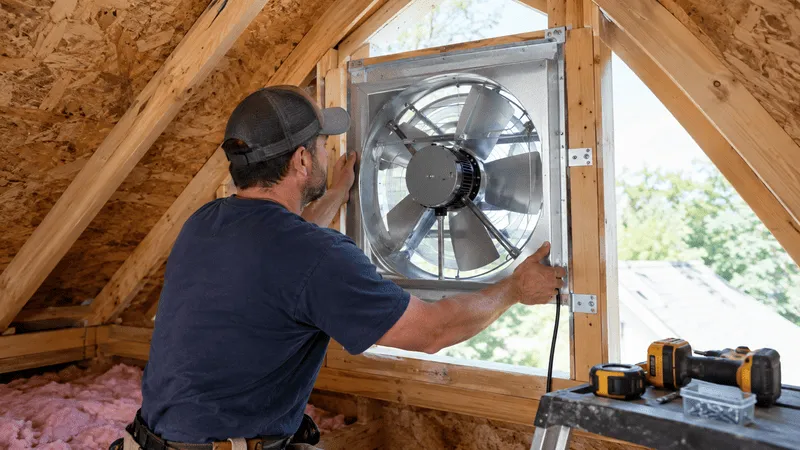
An attic gable fan with a thermostat can help with airflow and heat buildup if your attic gets too hot in the summer. Instead of running 24/7, an attic gable fan with a thermostat can automatically turn on when the attic reaches a certain temperature. That makes ventilation more responsive and efficient. But with so many different sizes of gable exhaust fans, airflow ratings, types of motors, and thermostat options to choose from, choosing the right model can be confusing.
This guide covers what you should consider in an attic gable fan with thermostat, including installation requirements and more.
How to Choose the Right Attic Gable Fan with Thermostat
Choosing the right attic gable fan with thermostat is simpler when you are aware of its requirements. The following are the six factors to look into, in order of priority:
- Airflow (CFM): This is the amount of air the fan circulates per minute. Compare it with your attic size (see the size section below).
- Thermostat type: Adjustable models allow you to set the temperature at which the thermostat turns on, typically between 80°F and 110°F, while fixed models are more basic and offer less versatility.
- Power source: Hard-wired fans provide constant power. In solar models, no wiring is even included.
- Mounting style: When the attic has a gable wall, the gable-mounted fan is typically the simplest option to install and doesn’t require any cuts in the roof.
- Build quality: Find a housing that is weatherproof, a durable motor, and a quiet blade design.
- Safety and support: When making your purchase, review the warranty and certification information on the product page.
Check out this step-by-step installation demo for a gable attic fan with thermostats that shows you how to choose the size, check features before buying.
@dwscustoms bath room exhaust fan with light vevor #exhaustfan #bathroom #ledlight #vevor #kingscoot21 #dwscustoms #fyp
♬ original sound – King Scoot
Still undecided on the type of ventilation? Here’s a little bit of information on attic ventilation options to help:
| Factor | What to Look For | Why It Matters | Selection Advice |
|---|---|---|---|
| Airflow | CFM matched to attic size | Too little won’t cool; too much can pull in house air | Start with CFM / attic sq ft |
| Thermostat | Adjustable, about 80–110°F | Controls when the fan runs | Start near 100°F |
| Power Source | Hardwired or solar | Affects install effort and reliability | Hardwired for max airflow; solar for no wiring |
| Mounting | Gable wall or roof | Decides how hard the install is | Pick gable if you have a gable wall |
| Build Quality | Weather-resistant housing, quiet motor | Affects lifespan and noise | Check the warranty terms |
For those who are interested in multiple models, VEVOR’s 16-inch attic gable vent fan with thermostat setting control can cover up to 4,200 sq ft, followed by wall mount models listed below.
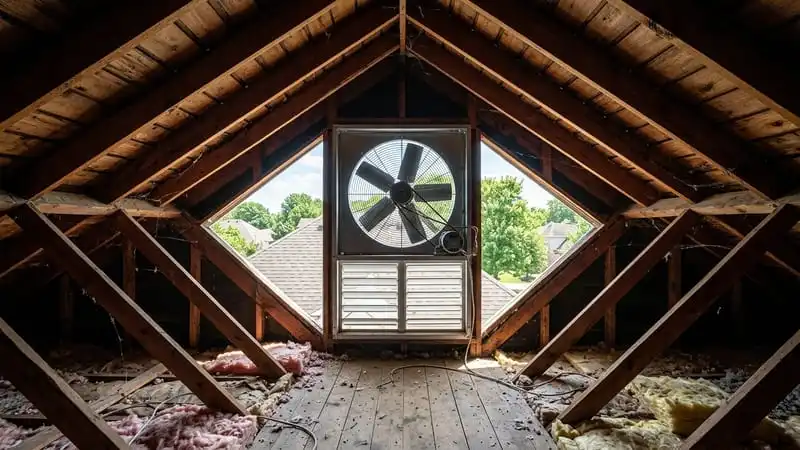
How to Choose the Best Attic Fan Size for Your Attic
Many buyers make the mistake of choosing the wrong size. If you have a gable fan that is too small, the heat will be trapped inside. If it is too large, it can draw cool air from your home through any openings in the ceiling.
Recommended For Your Project
The right attic fan for you will be based on the size of your attic and the CFM, or cubic feet per minute, of the fan. The bigger the attic, the higher the CFM it requires. Attic size: As a rule of thumb, budget on 1 CFM for every square foot of attic space. So, a 1,500-square-foot attic needs 1,500 CFM.
Hot climates, dark roofs, and steep roof pitches will benefit from having a little more power than the minimum, so consider getting a fan with a CFM near the top of the suggested range.
When selecting a gable mount attic fan with thermostat, be sure the CFM rating is clearly displayed. Then check to ensure that your soffit vents are free before you go larger! Gable mount fans can be purchased in various sizes to compare coverage.
If the attic is small, there is no need for a large fan. For the small space, the 10-inch or 12-inch smart model works best, and for the medium-size attic, the 14-inch or 16-inch smart model provides an ideal fit.

Solar Gable Fan with Thermostat vs. Hardwired: Which Fits?
After determining the size, you will know how your gable exhaust fan will be powered. Both types work well. They’re only suitable for different houses.
Hardwired
A gable mounted attic fan with thermostat and electric fan control will provide continuous, powerful airflow throughout the day and night and will be connected to your home’s electrical system. You should have power nearby or have an electrician bring power to wall-mounted exhaust fans.
Choose hardwired if:
- The objective is to get the most airflow.
- There is a nearby electrical box or outlet.
- You have a large attic space or one that is shaded.
Solar
There is no running cost, no wiring, and a solar gable fan with thermostat operates on a solar panel in the sun. The stronger the sun, the more your attic needs assistance and the more output it will produce.
These VEVOR wall mount fans can be installed in a gable end wall. Look at individual product pages for mounting instructions:
| Model | Airflow | Key Features | Best For |
|---|---|---|---|
| 24-inch smart programming fan | 2,900 CFM | EC motor, variable speed, temperature control, timer | Large attics |
| 20-inch smart programming fan | 4,800 CFM | EC motor, variable speed, temperature control, timer | Very large attics, workshops |
| 24-inch fan with speed controller | 3,320 CFM | AC motor, speed controller, no assembly | Large attics, garages |
| 20-inch wall-mount fan | 3,000 CFM | Wall mount, shutter | Mid-to-large attics, sheds |
| 30-inch heavy-duty fan | 6,900 CFM | AC motor, steel build, low noise | Barns, big outbuildings |
| 36-inch heavy-duty fan | 11,000 CFM | AC motor, steel build, low noise | Shops, commercial spaces |
Choose solar only if:
- You’d like the fan not to need electricity at all.
- Running wire will be difficult.
- Your gable wall receives a lot of sunlight.
Still undecided? Choose solar for simple installation and hardwired for enhanced airflow.
Benefits of a Gable Fan and Better Attic Airflow
By selecting a gable attic fan with thermostat, you can expect to recoup the cost in three ways:
- A cooler attic: Your AC uses less energy to heat your rooms, which means less heat radiates into them.
- Reduction of moisture and mold: Dampness does not accumulate with movement of air.
- A longer roof life: This will help cool the roof deck and shingles.
Does an attic gable fan with a thermostat have the capacity to do this? Passive gable vents are vents that allow hot air to flow out but require wind and natural air movement. Thermostat-controlled powered attic gable vent fans draw air when it is needed, even on hot, calm days. Just ensure fresh air is able to enter the fan through soffit vents or the fan will have trouble.
For big attics, a hardwired VEVOR gable mounted attic fan with thermostat is good, and a durable 24″ wall-mount fan with speed controller is a good choice for larger areas. Understand the benefits of attic ventilation in reducing cooling expenses or explore attic gable fan vents.
Summary,
Selecting an appropriate gable attic fan with thermostats relies on proper size, a temperature regulator, and an appropriate power type for your home. An attic gable exhaust fan with thermostat is best, with adequate intake vents, either solar or hardwired. Include the smart placement of the sensors in your attic, and your cooling bills will thank you! Looking to cool things off? Check out the gable mount attic fan options from VEVOR and select the perfect one.
FAQs
How do I install a thermostatic attic fan safely?
Disconnect the electricity at the breaker box first. Always use a stable ladder and attic boards, follow the wiring diagram and properly ground the fan. If wiring is beyond your ability, get an electrician to do it for you!
How Attic Temperature Sensors Work and Where to Place Them?
The brain of your fan is the thermostat. A small air temperature sensor is located in an attic gable exhaust fan with a thermostat. Once it reaches your set point, a switch closes and the motor turns on. The fan turns off when the temperature in the attic drops a couple of degrees.
Can gable vents improve attic airflow and reduce heat?
Yes. Gable vents allow the hot air to escape, and when used with soffit vents which provide fresh air, they are most effective. The powered fan provides additional air movement, particularly during hot, still days.
Is a gable mount or roof mount better?
No roof cuts or risk of leaks when installing a gable mount attic fan with thermostat on the wall. Attics without a gable wall are suitable for roof mounts.
Does an attic gable vent fan with thermostat work in winter?
Yes. In cold weather, the thermostat will turn off the fan. In humid climates, add a humidistat to help control moisture.