For many years, identifying a pipe issue required costly speculation and frequently pointless investigation. For both professionals and homeowners, the drain camera has revolutionized modern life.
A contemporary, indispensable plumbing item is a drain camera. Without damaging walls or yards, it enables you to view into your pipes and correctly diagnose clogs, breaks, and root infiltration. You can save a significant amount of money on repairs if you understand how a reliable drain camera works.
What Is a Drain Camera?
An advanced visual inspection tool is a drain camera. It is made up of a long, flexible cable or push rod that is connected to a waterproof camera head.
Similar to a cleanout, access port is used to insert the camera gradually into the pipe. The operator can view the live video feed on a monitor.
Strong LED lights are frequently installed on the camera head. By illuminating the pipe’s dark interior, these lights make the walls and any debris clearly visible.
You can see the precise type, position, and degree of a blockage thanks to this technology. It eliminates uncertainty in plumbing maintenance.
What can you do with a drain camera?
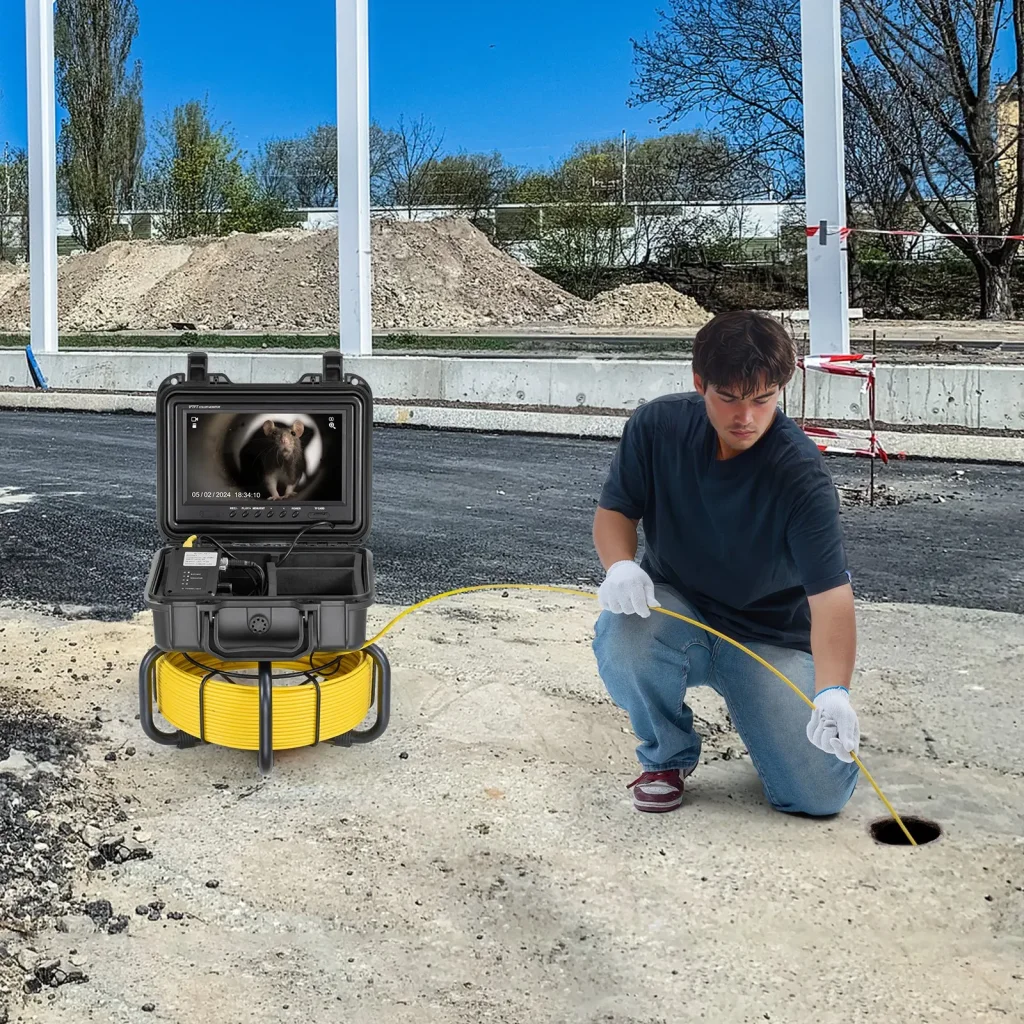
The best method for locating and identifying a variety of common and complicated plumbing problems is a drain camera inspection.
- Finding Blockages: Whether it’s oil, roots, or a foreign object that was inadvertently flushed, you can identify the precise cause of a clog.
- Evaluating Pipe Damage: The camera shows cracks, punctures, or breaks brought on by nearby construction activities or ground movement.
- Recognising Root Intrusion: Tree roots are a major issue. The camera reveals the precise location of the roots’ entry into the line and verifies their existence.
- Examining Pipe Condition: In older cast iron or clay pipes, the camera offers a clear picture of corrosion, scaling, or silt accumulation.
- Pre-Purchase Inspections: A drain camera inspection ensures the main sewer line is sound before purchasing a home, avoiding costly unplanned repairs down the road.
- Post-Repair Verification: The camera can be sent down to verify that the issue has been fully fixed after a plumber completes a repair.
Types of Drain Cameras
The size and shape of the pipe you are checking will determine the type of camera that is required. Different jobs require different tools.
Push‑rod Cameras
These are currently the most popular and adaptable kind of drain camera. They have a camera attached to a fibreglass rod that is semi-rigid.
The operator manually pushes the rod, which is kept on a reel, into the pipe. They are crucial for checking lines that range in diameter from 1.5 to 12 inches.
Pros
- Incredibly portable and simple to operate with only one person.
- Excellent for negotiating residential plumbing lines’ many sharp turns.
- They are reasonably priced, so both seasoned do-it-yourselfers and small enterprises may afford them.
Cons
- Restricted travel distance, usually between 100 and 200 feet, depending on the push rod’s stiffness.
- The camera head is stationary, it cannot turn to face the pipe walls.
- Friction build-up makes it challenging to manoeuvre through very lengthy, straight passages.
Rotating Cameras
These are mounted on a flexible push rod or specialised cable and are also referred to as pan-and-tilt cameras. The camera head itself is movable.
The camera may be remotely turned 360 degrees left and right (pan) and tilted up and down (tilt).
Pros
- Offers extremely detailed views of pipe walls and joint connections using a drain sewer camera.
- Vital for identifying minor joint separation or stress fractures in pipes.
- Enables the operator to confirm lateral lines and connection sites precisely.
Cons
- Considerably more complicated and costly than typical fixed-head cameras.
- Needs specific training in order to use the pan-and-tilt features efficiently during an examination.
- It is a little more difficult to manage because of the rotating mechanism, which adds complexity.
Crawler Cameras
The more robust solution is crawler cameras. They are wheeled or track-mounted motorised units.
Large-diameter pipes, typically 6 inches and larger, such as large industrial conduits or municipal storm drains, are the target of these durable cameras.
Pros
- May cover hundreds of feet of pipe and travel great distances without the need for operator effort.
- Even in the presence of debris, the motorised movement offers a highly steady image feed.
- Frequently have the capacity to assess pipe slope and have strong onboard lighting.
Cons
- Need vehicles and specialised access equipment for deployment and transportation.
- For almost all household or small commercial uses, it is just too big and costly.
- Less efficient in negotiating the narrow, small-diameter turns present in residential plumbing systems.
What to consider when buying a drain camera
When choosing a drainage camera, you must make sure that the tool’s parameters match the pipelines you intend to inspect most frequently. Accurate diagnostics are ensured by selecting the appropriate features.
Camera Resolution and Image Quality
For the purpose of detecting slight root intrusion or hairline fissures, a good image is essential. You may zoom in on flaws with more resolution.
Choose a camera with a minimum resolution of 720p. High-end models, such as a drain camera, frequently have 1080p, which offers better clarity and detail.
Cable Length and Flexibility
How deep into the line you can see depends on the cable. A 100 to 130-foot cable is enough for the majority of home main lines.
The rigidity of the cable is also crucial. It won’t push too far and is too flexible. It is too rigid and difficult to manoeuvre around tight elbows.
Compatibility With Pipe Sizes
Make sure the camera head is the right size for the smallest pipe you intend to examine. A 2-inch toilet line cannot accommodate a camera that is too big.
Although there are specialised cameras for extremely small pipes, general-purpose ones usually work well with pipes between 1.5 and 6 inches.
Durability and Waterproof Rating
Water, muck, and rubbing against pipe walls are just a few of the challenging conditions that the camera head must endure. Seek out heads made of stainless steel.
Verify the unit’s IP (Ingress Protection) rating; IP68 is the standard, indicating that it is completely sealed against dust and ongoing submersion in water.
Lighting and Visibility Features
The interior of the pipe is entirely dark. To completely illuminate the examination area, the camera requires strong, movable LED lights.
Controlling the brightness helps avoid “washing out” the image, which can occur when light reflects off the pipe wall too strongly.
Recording and Storage Options
You can capture still photos and record videos with the best drain camera. This proof is essential for estimating repairs or demonstrating the precise issue to homeowners.
Look for internal storage or an integrated SD card slot. For precise location marking, high-quality models also have an on-screen counter that measures the wire length.
Battery Life and Power Source
Plumbing tasks frequently require several hours. Make sure the reel unit and monitor have a long-lasting rechargeable battery, usually lithium-ion.
Choose a model that can operate dependably without AC power while concurrently charging the battery if you intend to spend a lot of time checking.
Monitor Size and Display Clarity
Your window into the pipe is the monitor. It is considerably easier to identify minute cracks and flaws with a larger screen (7 to 9 inches).
For clear viewing outside or in brightly light spaces, the display should be bright and have sun visors.
FAQs
How do I know if I need a drain camera inspection?
If you have slow drainage across several fixtures, frequent clogs in the same spot, or suspect tree roots, you might think about doing an inspection.
A pre-purchase camera check of the main sewer system is also strongly advised if you are purchasing an older home.
Will a drain camera work in small-diameter pipes?
Yes, however the appropriate tool is required. To inspect lines as short as 1.5 inches, like those found in sinks and toilets, specialised small-diameter push-rod cameras with extremely narrow camera heads (often less than 1 inch) are available.
Can a drain camera find tree roots in the pipe?
Of course. One of the most popular and useful applications of a drain camera is locating and verifying tree roots. The repair technique can be guided by the camera’s ability to clearly display where the roots are penetrating the pipe and how big the growth is. (External Link: EPA Sewer Maintenance Guide).
Conclusion
When it comes to modern diagnostics, the Vevor drain camera is revolutionary because it provides clarity where there was previously only uncertainty and darkness. It transforms pipe repair from a destructive activity into a precision procedure.
Whether you are a professional plumber or a serious home remodel, investing in a quality drain camera is worth the expense. It will ensure proper repairs each and every time, save time, and eliminate needless excavation.