
Lab Instruments & Equipment









Results for Lab Instruments & Equipment
Lab instruments and equipment are the measuring, sample-preparation, and sample-conditioning devices a laboratory relies on to turn physical material into reliable data. Each one performs a single defined job: determining mass, magnifying a specimen, mixing or breaking down a sample, spinning components apart by density, or holding a sample at a set temperature. What unites the category is repeatability. These are precision tools built to return the same result under the same conditions, time after time, so that measurements and experiments can be trusted, compared, and reproduced rather than estimated by hand.
The catalog spans four jobs: measuring, viewing, preparing, and conditioning samples. Analytical balances read to 220 g at 0.0001 g behind a glass draft shield, while compound microscopes cover monocular, binocular, and trinocular bodies from 40X to 5000X. Sample prep runs from homogenizers, spanning 500 to 900 W dispersers and 2000 W ultrasonic cell disruptors, to centrifuges spinning 0.2 to 15 ml tubes and vortex mixers at 3000 rpm. Temperature control reaches from recirculating chillers and ultra-low freezers down to minus 123 degrees F up to high-temperature oil baths at 572 degrees F. Typical uses are research labs, quality-control benches, pharmacy and food testing, and teaching settings.
Four things decide what you need:
- Instrument class: decide first whether you are measuring (balances, microscopes), preparing samples (homogenizers, mixers, centrifuges), or conditioning them (chillers, baths, freezers, incubators).
- Precision grade: match readability, speed stability, and temperature tolerance to how tight your results have to be.
- Sample size: tube volume, batch capacity, and chamber size decide which model within a family fits your throughput.
- Temperature span: for heating and cooling gear, choose by the exact range, from minus 123 degrees F sample storage up to 572 degrees F oil baths.
Browse the full lab instruments and equipment range to match a tool to your workflow, or step up to the wider lab and scientific products category.
Lab Instruments and Equipment Types at a Glance
The table below sets the main instrument families side by side so you can see what each one does and where it fits.
| Instrument Type | What It Does | Headline Specification | Typical Sample | Best For |
|---|---|---|---|---|
| Analytical balances | Quantify mass to sub-milligram | 220 g capacity at 0.0001 g readability | Powders, reagents, small solids | Formulation, pharmacy and QC weighing |
| Compound microscopes | Magnify specimens optically | 40X to 5000X, monocular, binocular or trinocular | Prepared slides | Biology, materials study and imaging |
| Homogenizers and vortex mixers | Mix, disperse and disrupt | 3000 rpm vortex up to 2000 W ultrasonic | Liquids, suspensions, cells | Emulsions, lysis and sample prep |
| Centrifuges | Separate by density | 7000 rpm fixed or 500 to 4000 rpm, 0.2 to 15 ml | Filled tubes | Spinning down samples in clinical and teaching labs |
| Recirculating chillers and oil baths | Hold a set temperature | Minus 22 degrees F chilling to 572 degrees F heating | Reaction vessels, condensers | Cooling instruments and running heated reactions |
| Ultra-low freezers and incubators | Store and culture samples | Minus 123 degrees F freezing to 158 degrees F incubation | Vials, petri dishes | Long-term storage and microbiology |
VEVOR Lab Instruments and Equipment for Every Scientific and Professional Application
Are you looking for dependable lab instruments and equipment that can meet your needs for quality control, training, or research? The right lab equipment is crucial for boosting reproducibility, reducing errors, and saving time. Professionals and students may operate confidently in any laboratory setting with VEVOR's wide range of lab equipment, which includes everything from precise measurement to sample preparation.
Explore Lab Instruments and Equipment by Instrument Type and Application
Understanding the functions and applications each instrument type best serves is the first step in selecting appropriate lab instruments and equipment. Whether you're working in a field research setting, an industrial quality control environment, or a university lab, VEVOR's catalog covers a wide range of instrument types, making it easy to match the right equipment to your workflow.
Analytical Balances — Precision Weighing for Critical Measurements
In every scientific context, analytical balances are among the most basic lab instruments. Pharmaceutical compounding, chemical analysis, food science, and materials testing are just a few of the industries that use these precision instruments for precise mass measurements. Because VEVOR analytical balances are designed to provide readability down to 0.001g or finer, they are appropriate for situations where even small errors can affect outcomes.
Capacity and readability are the two main factors to consider when choosing an analytical balance. While larger-capacity models are better suited for industrial or formulation operations, a balance with a 200g capacity and 0.0001g readability works well for the majority of common chemical work. To achieve consistent, high-accuracy readings, VEVOR models typically include a draft shield to protect the weighing pan from air currents.
Internal calibration, which saves time during daily setup and eliminates the need for extra calibration weights, is another feature to look for. In high-throughput labs, auto-calibration functionality is beneficial. Additionally, VEVOR analytical balances feature USB or RS-232 connectivity, enabling direct data transfer to printers or PCs for easy record-keeping. For labs that seek dependable results without going over budget on equipment, VEVOR strikes a balance between accuracy, build quality, and useful connectivity.
VEVOR ensures that cost does not become a barrier to excellent measurement by offering entry-level precision balances that still meet strict accuracy criteria for school labs or startups with limited resources.
Microscopes and Microscope Equipment — See More, Learn More
In biology, materials science, medicine, and education, microscopes are among the most significant types of lab instruments. Compound microscopes, stereo microscopes, and the compelling trinocular compound microscope, a professional-grade choice intended for prolonged observation and picture documentation, are all part of VEVOR's microscope collection.
A trinocular compound microscope has three eyepiece ports: two for direct binocular viewing and a third for connecting an imaging device or digital camera. Without disrupting operations, this design enables researchers or educators to study specimens and capture high-resolution images simultaneously. The magnification range supported by VEVOR trinocular compound microscopes typically spans 40x to 2500x, encompassing everything from fine particle studies to cellular architecture.
Equally significant and complementary to the main instrument are microscope accessories such as prepared slides, stage clips, immersion oil, and LED illuminators. To ensure users have everything they need to start working right away, VEVOR offers a variety of suitable microscope equipment. Compared to conventional halogen sources, LED illumination, a standard feature in VEVOR models, offers steady, cool light that minimizes specimen damage.
Models with mechanical stages provide accurate, reproducible slide positioning, which is crucial for methodically scanning vast sample areas in clinical or research settings. VEVOR's more affordable compound microscopes, which maintain high-quality optics and robust construction, are advantageous to both students and enthusiasts.
Mixing and Blending Equipment — Consistent Sample Preparation Every Time
For sample preparation in chemistry, biology, food science, and pharmaceutical research, mixing and blending equipment is a crucial category of lab equipment. Reliable mixing and blending equipment is an essential component of any well-equipped lab since inconsistent mixing results in poor experimental repeatability. A variety of lab mixers, vortex mixers, magnetic stirrers, and overhead stirrers suitable for various sample types and quantities is available from VEVOR.
One of the most useful pieces of scientific equipment is a magnetic stirrer with a hot plate, which simultaneously heats and stirs liquid samples. VEVOR models support a variety of chemical processes, from straightforward dissolution to regulated synthesis reactions, with temperature control up to 380°C and configurable RPM settings, typically 200-1500 RPM.
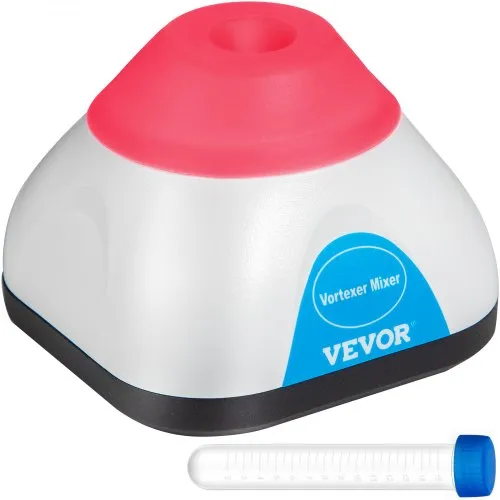
For quickly combining small amounts in test or microcentrifuge tubes, vortex mixers are essential. VEVOR vortex mixers are compatible with a variety of tube adapters and offer steady, customizable orbital speeds. Overhead stirrers can effectively handle viscous or high-volume samples that magnetic stirrers cannot in larger-volume applications.
When selecting mixing and blending equipment, consider temperature requirements, the required speed range, your sample's viscosity, and whether touchless operation is required. All of these situations are covered by VEVOR's lineup, which has well-defined characteristics that make comparisons simple, even for first-time lab equipment buyers.
Centrifuges and Measurement Instruments — Completing the Lab Setup
A fully functional lab requires complementary lab instruments and equipment, such as centrifuges, pH meters, thermometers, and pipetting tools, as well as balances, microscopes, and mixers. The compact and standard benchtop centrifuges from VEVOR are ideal for spinning down samples in industrial, clinical, or educational settings.
VEVOR pH meters include digital displays with automatic temperature compensation, which ensure accurate readings even when sample or ambient temperatures fluctuate, a factor that can significantly impact the accuracy of results in titration or environmental testing applications. VEVOR completes its ecosystem of essential lab equipment with thermometers, timers, and lab glassware, enabling customers to purchase a range of instruments from a single reliable supplier.
This variety of goods simplifies procurement and removes the hassle of dealing with several providers for labs starting from scratch. Every instrument features clear displays, easy-to-use controls, and sturdy materials, making it suitable for regular lab use. Your lab equipment investment will last over time thanks to VEVOR's consistent product quality across instrument categories, which provides dependable performance at every stage of the workflow.
Choosing Lab Instruments and Equipment by Task
Use the table below to move from the job in front of you to the instrument that fits it best.
| Buyer's Situation | Priority Pick | Key Consideration | Why It Fits |
|---|---|---|---|
| Weighing reagents for formulation | 220 g, 0.0001 g analytical balance | Readability | Sub-milligram steps catch dosing errors a coarser scale misses, and the draft shield steadies the reading |
| Documenting specimens for teaching or papers | 40X-5000X trinocular microscope | Imaging port | The third port feeds a camera so viewing continues while the image is captured |
| Breaking down cells or tough tissue | 2000 W ultrasonic homogenizer | Disruption method | Ultrasonic cavitation ruptures cell walls that a rotor-stator blade only stirs |
| Holding a reaction at high temperature | High-temperature oil bath to 572 degrees F | Temperature ceiling | Oil carries heat well past water's boiling point while the circulator keeps the bath even |
| Cooling a rotary evaporator or condenser | Minus 20 degrees C recirculating chiller | Cooling match | Dual circulation pulls heat from the condenser so vapor recaptures instead of escaping |
| Storing biological samples long term | Minus 123 degrees F ultra-low freezer | Minimum temperature | A minus 123 degrees F floor keeps sensitive samples viable where a standard freezer cannot |
Key Precision Features to Look for in Lab Instruments and Equipment
Effective lab instruments and equipment demonstrate precision. The precision and consistency of your tools directly impact the quality of your findings, whether you're measuring mass, examining specimens, or creating samples. You may choose lab equipment that consistently meets your standards by identifying which precise aspects are most important.
Readability, Repeatability, and Calibration in Precision Instruments
Three fundamental precision metrics, readability, repeatability, and linearity, apply when assessinganalytical balances and other measurement-based lab instruments and equipment. For pharmaceutical or delicate chemical applications, readability is defined as the smallest increment the device can display. Another crucial element is calibration.
Many VEVOR analytical balances feature internal automatic calibration, eliminating the need for time-consuming, human-error-prone manual calibration procedures by using an integrated reference weight to self-calibrate in response to temperature variations. The quality of the objective lenses and the numerical aperture rating, which determines resolving power, define the optical precision of microscope equipment. To reduce chromatic and spherical aberrations and produce crisper, more accurate images across the entire field of view, VEVOR trinocular compound microscopes employ achromatic or semi-plan objectives.
Precision in mixing and blending equipment translates into stability and speed. In timed reaction experiments or cell culture applications, a vortex mixer or magnetic stirrer that cannot maintain a consistent fixed speed can yield inconsistent results. Higher-end VEVOR mixing equipment features closed-loop motor control to maintain speed stability within strict tolerances regardless of sample load.
Build Quality, Safety Features, and Long-Term Reliability
Long-term use and safety are determined by the physical design oflab instruments and equipment, which goes beyond measurement accuracy. VEVOR microscopes have a significant advantage over plastic-body alternatives due to their all-metal frames, which withstand vibration and maintain optical alignment over years of frequent use. Overload protection is a feature of analytical balances that prolongs instrument life by preventing damage from unintentional overloading. Non-slip feet, splash-resistant enclosures, and thermal cutoff switches that prevent overheating during prolonged operation are features of VEVOR's mixing equipment.
Safety certifications, such as CE and RoHS compliance when appropriate, indicate that VEVOR lab equipment meets widely recognized standards for material and electrical safety, providing institutional customers with the paperwork often needed for procurement approval. Purchasing high-quality lab instruments and equipment from the outset helps reduce downtime and replacement costs and supports reliable, secure operation in any academic or professional lab setting.
Best-Seller Comparison
Here is how five of the most popular products on this page compare side by side.
| Product | Instrument Type | Core Specification | Material / Housing | Illumination / Display | Notable Extra | Best For |
|---|---|---|---|---|---|---|
| Trinocular Microscope, 40X-5000X | Trinocular compound microscope | 40X to 5000X magnification | Metal frame | LED illumination | Mechanical stage, slides and PC interface included | Only three-port model here; pairs a camera feed with live viewing for imaging and teaching |
| Binocular Microscope, 40-5000X | Binocular compound microscope | 40 to 5000X magnification | Aluminum alloy body | LED light | Dual stage, two eyepiece sets and phone holder | Binocular build with spare eyepieces; routine viewing without the third camera port |
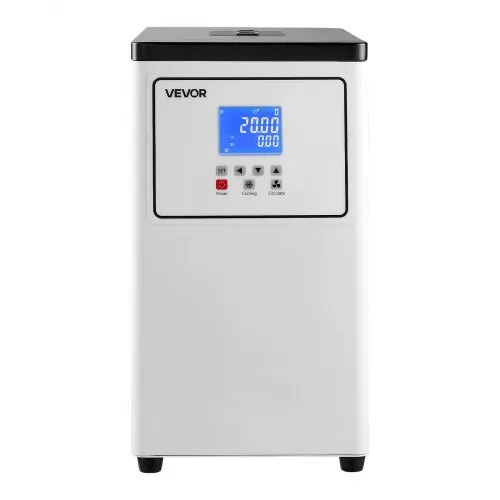
| 6 L Recirculating Chiller, 23-212 degrees F | Recirculating chiller circulator | 23 to 212 degrees F, 6 L | 304 stainless steel bath | LCD display | Built-in circulation pump | The temperature-control pick; moves coolant from near-freezing to boiling |
| 12 L UV Tool Sanitizer, 185 nm | UV tool sanitizing cabinet | 12 L, 185 nm UV | Tempered glass door | Timer panel | Multiple sanitizing modes | Only disinfection unit here; UV cabinet for tools between uses |
| 500 W Dispersing Homogenizer, 200-11000 rpm | High-shear dispersing homogenizer | 500 W, 200 to 11000 rpm | Stainless steel | Digital display | High-shear dispersing head | Widest speed span in the group; emulsifies and disperses liquid samples |
Why Choose VEVOR Lab Instruments and Equipment?
VEVOR provides a full line of lab instruments and equipment, including analytical balances, trinocular compound microscopes, microscope accessories, and mixing and blending tools, all at affordable prices for both institutions and private customers. With dependable after-sales support, we design each product to provide the accuracy your work requires. VEVOR provides the equipment you need to keep your job going, whether you're updating outdated equipment or setting up a new lab. Discover the ideal lab equipment for your application by browsing the entire selection now.
FAQs
What is the difference between a trinocular and a binocular compound microscope?
A third port on a trinocular compound microscope allows you to attach a camera and view and take pictures simultaneously. There are only two eyepieces in a binocular model. For documentation, research, and educational settings, trinocular models are often the best choice.
How do I calibrate an analytical balance?
Many VEVOR analytical balances feature automatic internal calibration; all you have to do is turn it on via the control panel, and the balance will use an integrated reference weight to self-calibrate. For regulatory compliance, external calibration using verified weights is also supported.
What type of mixing equipment is best for viscous samples?
Large-volume or high-viscosity samples are generally best handled with overhead stirrers. Low-viscosity liquids are well suited to magnetic stirrers. To accommodate a variety of sample types, VEVOR provides both types with variable speed settings.
Can VEVOR microscope equipment be used for clinical or medical applications?
VEVOR compound and trinocular microscopes are appropriate for use in general laboratories, research, and education. Before purchasing a model for controlled clinical diagnostics, ensure it complies with local regulations.
Are VEVOR lab instruments suitable for educational institutions?
Yes, without compromising accuracy or build quality, VEVOR provides lab instruments and equipment at prices appropriate for schools, colleges, and institutions. Educational institutions widely use VEVOR balances, microscopes, and mixing equipment for both instruction and fundamental research.
How do I choose the right benchtop cooler for my laboratory needs?
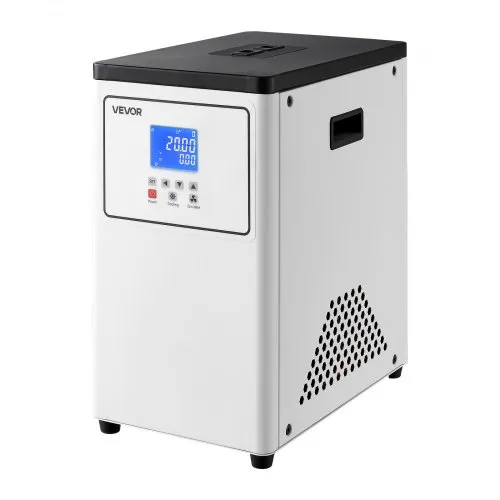
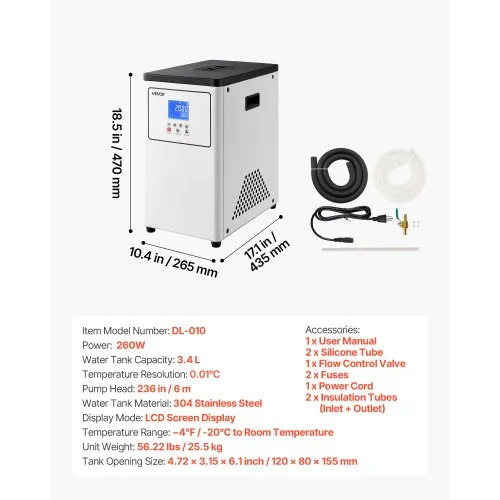
Start with the lowest temperature you need and the heat load to remove, then match tank volume to your vessels. A recirculating chiller circulator suits condensers and reactions; a minus 20 degrees C unit pairs with rotary evaporators up to 2 L, while minus 30 degrees C models reach deeper cooling.
What maintenance tips are essential for keeping laboratory chillers in optimal condition?
Keep the coolant clean and topped up, clear dust from the condenser and vents for airflow, and check the hoses and 304 stainless bath for scale or leaks. Run the pump periodically, use the right fluid for your temperature range, and confirm the display reads steady before each session.
How do ultrasonic cell disruptors work in laboratory applications?
An ultrasonic homogenizer drives a titanium probe at around 20 kHz, creating rapid cavitation bubbles in the sample. Their collapse produces shear forces that rupture cell walls and membranes, releasing contents for extraction or breaking particles down in lysis, emulsification, and nanoparticle dispersion.
What should I consider when choosing an ultrasonic homogenizer for scientific research?
Match probe tip and power to the sample: a 0.3 in probe suits 50 to 300 ml, while a 2000 W, 0.79 in probe unit processes larger or tougher batches. Weigh frequency, continuous, timer and pulse modes to limit heat buildup, and favor models with noise reduction.
What is the difference between a monocular and a binocular microscope?
A monocular microscope has one eyepiece, which is lighter, simpler, and lower cost, suiting kids, hobbyists, and basic classroom use at 40X to 2000X. A binocular model adds a second eyepiece for two-eyed viewing that reduces eye strain over long sessions. Both appear in the compound microscope range.