

Cold Air Intake Kit


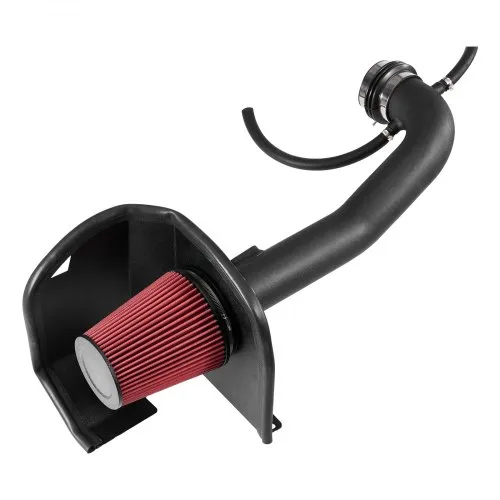


Results for Cold Air Intake Kit
A cold air intake kit is an engine air induction upgrade that replaces the factory airbox and intake tube with a smoother, wider tube and a high-flow filter placed to draw cooler air from outside the hot engine compartment. Cooler air is denser, so every intake stroke carries more oxygen into the combustion chamber. The engine's sensors register the added airflow and the computer adds fuel to match, so the mixture burns more completely. The result is quicker throttle response, a gain in horsepower and torque, and a fuller intake sound under acceleration.
VEVOR builds vehicle-specific kits, each pairing a heat shield with an intake tube between 3.3 and 3.94 inches across. Full-size V8 pickup and SUV kits cover 4.8L, 5.3L and 6.2L engines from 1999 to 2025 with 3.5 to 3.94 inch tubes. 5.7L V8 pickup kits pair a 3.94 inch tube with a reinforced bracket for half-ton and heavy-duty trucks. 3.6L V6 muscle car kits use a 3.5 inch tube on 2011 to 2023 coupes and sedans, while mid-size V6 pickup kits run a 3.3 inch tube on 3.5L gas engines. Typical uses are towing and hauling, daily commuting, spirited weekend driving and sharpening response on older high-mileage trucks.
Six things decide what you need:
- Exact fitment: match model year, engine displacement and body style to the listing, since a kit built for a 6.2L will not line up on a 6.0L.
- Tube diameter: stay with the size engineered for your engine; it is matched to the engine's airflow and sensor housing, so going larger is not an upgrade.
- Heat shielding: a shield that seals against the hood keeps the filter breathing outside air rather than engine heat.
- Filter media: washable non-woven filters are rinsed, dried and reused instead of being replaced like paper elements.
- Installation: most kits bolt to factory mounting points, but some need a drilled hole to secure a bracket, so read the manual first.
- Emissions rules: confirm an aftermarket intake is accepted for road use where you live before you install it.
Compare every VEVOR cold air intake kit above, then round out the job with parts from our fuel system collection or the wider auto parts catalog.
Cold Air Intake Kit Types at a Glance
Cold air intake kits differ mainly in where the filter sits and how it is shielded, which changes the air it breathes and the work needed to fit it.
| Type | Air Source | Fitment | Install Effort | Trade-offs |
|---|---|---|---|---|
| Heat-shielded open filter | Fender or grille side, walled off by a shield sealed to the hood | Vehicle-specific, bolt-on | Low to moderate; hand tools | Strong sound and airflow; relies on a good hood seal |
| Enclosed airbox | Factory or dedicated duct feeding a sealed box | Vehicle-specific, bolt-on | Low | Best heat isolation; quieter intake note |
| Fender-well relocated | Low in the fender or behind the bumper | Vehicle-specific, extended tube | Moderate to high; liner or bumper removal | Coldest air; can ingest water in deep puddles |
| Universal kit | Wherever the builder routes the tube | Custom, cut and coupled to fit | High; fabrication and sensor fitting | Suits swaps and custom builds; may need a tune |
VEVOR Cold Air Intake Kits for Every Vehicle and Every Performance Goal
Looking for cold air intake kits that will make a real difference in how the throttle responds and how the engine sounds right after proper installation? VEVOR cold air intake kits have mandrel-bent intake pipes and high-flow air filtration. This gives your engine a cooler, denser air charge that runs more efficiently and makes more power across a broad range of engine speeds. You can find the right VEVOR cold air intake kit to help unlock your engine’s performance, regardless of what you drive.
Vehicle Compatibility and Performance Gains in Cold Air Intake Kits
To pick the right cold air intake kit, you need to know how the intake system will work with your engine and what kind of performance gains you can realistically expect from the upgrade. VEVOR's cold air intake systems are designed to improve horsepower, torque, and throttle response by increasing the volume and density of air entering the combustion chamber. These systems are compatible with a wide range of vehicle applications and engine sizes.
Universal Fitment Options for Broad Vehicle Application
For enthusiasts upgrading a modified or engine-swapped vehicle, a universal cold air intake kit provides the components needed to build a custom intake system, regardless of engine bay layout. VEVOR's universal cold air intake kit range features mandrel-bent aluminum or steel intake pipes in various diameters, high-flow cone filters with varying flow rates, and a wide selection of reducers, couplers, and clamps, making them compatible with many engine bay layouts.
If you route the intake tract to pull air from a cool, low-restriction area away from engine heat sources, a well-fitted universal cold air intake kit will work just as well as a vehicle-specific option. To allow for this routing flexibility, the VEVOR universal cold air intake kit includes pipe sections in different lengths and bend angles. This way, installers can place the filter in the best airflow location for each vehicle without any issues.
Owners of modified vehicles, track-day enthusiasts, and builders doing engine swaps or custom fabrications where off-the-shelf kits don't exist frequently choose VEVOR's universal cold air intake kits. VEVOR's universal cold air intake kits come with a wide range of parts, so you can buy everything you need for a custom intake build in one go, from the throttle body to the filter. You won't have to go to multiple sources to get the parts you need.
Vehicle-Specific Cold Air Intake Systems for Precision Fitment
Vehicle-specific cold air intake systems deliver the most consistent performance and the highest level of installation confidence for owners of popular production cars. They guarantee a perfect fit and the best routing for the intake pipe. For VEVOR's vehicle cold air intake kits, the intake pipe geometry, filter positioning, and mounting hardware are carefully designed to fit specific makes, models, and engine variants with application-matched hardware. They don't require any modifications to the existing engine bay architecture.
VEVOR vehicle cold air intake kits are dyno-tested to demonstrate potential performance improvements for the engines they are made for. Depending on the engine size, state of tune, and the level of restriction in the factory intake being replaced, these kits usually add 5-15 horsepower and 8-12 lb-ft of torque. Besides the increase in peak power, the improvement in throttle response, or how quickly and sharply the engine reacts to stepping on the gas, is often the most noticeable benefit of adding a cold-air intake system to a car.
Performance Gains Across Engine Types and Displacements
Different engine types, displacements, and induction systems yield different performance benefits from cold air intake kits. Knowing these differences helps you set realistic goals and determine which users will benefit most from the upgrade. Naturally aspirated engines can benefit noticeably from well-designed cold air intake systems because cooler, denser air contains more oxygen per unit volume, improving combustion efficiency and power output.
Turbocharged and supercharged engines respond in a more complex way to cold air intake kits. In this case, the main benefit is that they open up the intake system, allowing the turbocharger or supercharger to work with less effort and pull more air through its compressor wheel at any given boost pressure. This lowers upstream restriction, leading to either more airflow at the same boost level or the ability to hit the target boost pressure at lower engine speeds. These changes can improve low-end torque delivery and transient throttle response.
Because they need more airflow at peak power, high-displacement V6 and V8 engines usually see the biggest gains in horsepower and torque from cold-air intake systems. This is because a smaller intake restriction has a greater effect on engines that need more air. VEVOR cold air intake kits for larger displacement engines use intake pipes with a wider diameter and higher-capacity cone filters that are specifically sized for the engines' airflow needs. This ensures the intake system does not restrict airflow when the engine is operating at high RPM, where airflow demand is at its peak.
Heat Shield and Filter Positioning for Maximum Cold Air Delivery
A true cold air intake kit differs from a basic short ram intake system because it continuously draws cold, dense air from outside the car to the engine, rather than recycling the hot air that normally surrounds the engine when the car is running. The VEVOR cold air intake kits address this problem by using heat-shield enclosures, longer intake-pipe routing, and strategically placed filters to keep the air filter out of the hot engine bay.
Heat shield systems on VEVOR cold air intake kits use aluminum or reinforced polymer enclosures that surround the air filter and seal against the underside of the hood or the inner wing panel of the vehicle. This creates a sealed space that pulls cool air from the front grille or wheel-arch ducts rather than hot air from the engine bay. This thermal isolation is a key factor that determines how consistently cold-air intake systems perform across a range of driving conditions and ambient temperatures.
While VEVOR vehicle cold air intake kits place the cone filter at the lowest point in the intake path, the position is usually before and below the engine, where the air temperature is consistently lower than in the engine bay. This positioning strategy, along with heat-reflective wrapping on intake pipe sections that run close to exhaust manifolds or other heat sources, helps VEVOR cold air intake kits deliver cooler intake air, rather than primarily offering a cosmetic change without the thermal management to back it up.
Matching a Cold Air Intake to How You Drive
Power gains are only part of the decision; how and where you drive sets which risks and prep steps matter most before you buy.
| Driving Situation | Main Payoff | Key Risk | Before You Install | Buyer Takeaway |
|---|---|---|---|---|
| Towing or hauling with a full-size V8 | Torque and throttle response under load | Heat soak at low speed with a heavy trailer | Confirm displacement and model year match exactly | Biggest payoff here; large V8s draw the most air under load. |
| Daily commuting | Sharper pedal response, deeper intake note | Louder sound under hard acceleration | Check local emissions rules for street use | Worth it for feel; expect modest fuel economy change at best. |
| Turbocharged engine | Less restriction ahead of the compressor | Air metering errors if the sensor housing changes | Confirm the kit keeps the factory sensor location | Gains depend on the whole boost setup, not the intake alone. |
| Wet roads and water crossings | Unchanged when the filter sits high behind the shield | Water ingestion if the filter sits low | Check filter height against the bumper line | Keep the filter high and never ford deep water. |
| Dusty gravel and trail driving | Reusable filter handles frequent cleaning | Faster filter loading and lost airflow | Plan more frequent filter inspections | Clean sooner than the normal interval after dusty trips. |
Material and Installation in the VEVOR Cold Air Intake Kits
Not only do the materials used in cold air intake kits affect how well they work and fit, but they also affect how long the system lasts, how well it works over years of use, and how confidently a skilled do-it-yourself installer can attempt the installation without professional help. When VEVOR makes cold air intake kits, they use heat-resistant materials that are effective at moving air and durable enough for use in cars. The kits also include easy-to-use installation hardware and instructions.
Aluminum, Powder-Coat, and High-Flow Filter Materials
The material of intake pipes in cold-air intake systems directly affects how well they move air and how long they last in the harsh temperatures and mechanical conditions of an engine bay. VEVOR cold air intake kits use mandrel-bent aluminum intake pipes in most of their models. This material performs and lasts better than the corrugated rubber or blow-molded plastic factory intake parts it replaces.
By using mandrel bending, the process used to make VEVOR aluminum intake pipes, the internal hole diameter remains the same throughout all bends. This means the pipes don't get smaller inside every time they change direction, unlike crush-bent pipes. In factory and lower-quality aftermarket intake pipes, these internal restrictions cause turbulence and localized airflow restriction, reducing the intake system's effective flow capacity compared with a smooth, consistent-diameter design. Mandrel-bent VEVOR pipes significantly reduce internal restrictions across the intake tract.
Many layers of oiled cotton gauze or dry synthetic filter media make up the high-flow cone filters in VEVOR cold air intake kits. These filters move much more air than the flat-panel paper filters found in most stock airboxes, while still effectively removing particles that wear down engines. VEVOR cold air intake systems feature properly sized filter housings for each engine application, helping reduce airflow restriction at high RPM.
Straightforward DIY Installation Across All Fitment Types
One of the best things about VEVOR cold air intake kits compared to more complex engine performance upgrades is that they are easy for skilled home mechanics without access to special tools, workshop lifts, or professional automotive training to install. Individuals can easily install VEVOR cold air intake kits with common hand tools, such as a socket set, screwdrivers, and pliers, and finish the job in 1 to 3 hours, depending on the type of car and the installer's skill level.
The VEVOR universal cold air intake kit installation process is easy to understand: take off the factory airbox and intake pipe assembly, mount the new intake pipe using the provided brackets and existing vehicle mounting points, connect the silicone couplers and clamps at the throttle body and filter end, place the heat shield if it comes with the kit, and make sure all connections are secure before starting the engine to make sure the kit fits correctly. Every VEVOR cold air intake kit comes with clear, step-by-step instructions and all the hardware you need, including clamps, reducers, mounting brackets, and filter oil, if needed. This way, you don't have to look for extra parts or figure out how to follow vague generic directions.
Vehicle-specific VEVOR cold air intake kits come with application-matched instructions and vehicle-specific reference photographs that show the exact routing, bracket positions, and connection points for that make and model. This makes installation clear and helps first-time installers complete the job correctly, even if they haven't changed the intake system on that platform before.
Best-Seller Comparison
Here is how the first five kits in this range compare on the details that separate one fitment from the next.
| Product | Tube Diameter | Engine | Model Years | Vehicle Type | Kit Weight | Mounting | Best For |
|---|---|---|---|---|---|---|---|
| Cold Air Intake 3.94 in, 5.7L V8 | 3.94 in | 5.7L V8 | 2009-2018 half-ton; 2013-2018 heavy-duty | Full-size pickup | 12.6 lbs | Reinforced bracket; panel drilling needed | Widest tube in the top five; half-ton and heavy-duty 5.7L trucks |
| Cold Air Intake 3.9 in, 4.8L/5.3L V8 | 3.9 in | 4.8L or 5.3L V8 | 1999-2006 | Full-size pickup and SUV | 8.2 lbs | Factory mounting points, no drilling | Lightest kit and oldest fitment here; early V8 trucks and SUVs |
| Cold Air Intake 3.5 in, 6.2L V8 | 3.5 in | 6.2L V8 | 2014-2018 pickup; 2015-2020 SUV | Full-size pickup and SUV | 9.3 lbs | Factory mounting points | Pre-2019 6.2L choice; trucks to 2018 and SUVs to 2020 |
| Cold Air Intake 3.5 in, 3.6L V6 | 3.5 in | 3.6L V6 | 2011-2023 | Coupe and sedan | 8.6 lbs | Reinforced bracket, factory points | Only V6 and only car fitment in the top five |
| Cold Air Intake 3.9 in, 6.2L V8 | 3.9 in | 6.2L V8 | 2019-2025 pickup; 2021-2025 SUV | Full-size pickup and SUV | 13.4 lbs | Reinforced brackets, bolt-on | Heaviest, most reinforced build; newest 6.2L trucks and SUVs |
Shop VEVOR Cold Air Intake Kits for Real Performance Gains
VEVOR cold air intake kits give performance-minded drivers the better airflow, better thermal management, and higher build quality they deserve. They come in a range of choices, from universal cold air intake kits for custom builds to precision-fitted vehicle cold air intake kits for popular production cars. VEVOR makes achieving a noticeable performance boost more accessible and affordable by offering a wide range of cold air intake systems, mandrel-bent aluminum piping, high-flow filter media, and competitive pricing backed by reliable after-sales support. Check out all of our cold air intake kits right now and give your engine the air it needs.
FAQs
Will a VEVOR cold air intake kit void my vehicle warranty?
Installing an aftermarket cold air intake system sometimes preserves a car's warranty in many places. However, manufacturers may deny warranty claims if they can prove that the intake modification directly caused the issue.
How much power can I expect from a universal cold air intake kit?
A good universal cold air intake kit can add 5 to 15 horsepower and 8 to 12 lb-ft of torque, depending on the engine's size and displacement, and how restrictive the original intake system was. For engines of similar displacement, turbocharged engines may show noticeable gains, though the exact improvement depends on the overall intake and boost setup.
Do VEVOR cold air intake systems require regular maintenance?
Yes. Depending on driving conditions and air quality, VEVOR cold air intake systems require their high-flow oiled cotton gauze screens to be cleaned and oiled every 30,000 to 50,000 km. When you clean dry synthetic filter media, you don't have to re-oil them between service times.
Can I install a VEVOR vehicle cold air intake kit myself?
Yes. Installing a VEVOR car cold air intake kit yourself with common hand tools should take between one and three hours. It comes with all the hardware, silicone couplers, clamps, and vehicle-specific directions with pictures to help you understand. For most uses, you won't need a professional to install it.
Will a cold air intake kit improve fuel economy as well as performance?
Denser, cooler intake air can improve combustion efficiency, leading to small fuel-economy gains at steady state. But because cold-air intake systems make the throttle more sensitive, drivers often drive faster, which can cancel out or reduce any potential fuel economy gains in real-world driving.
Where can I find affordable cold air intakes online?
VEVOR's online store offers value-focused cold air intakes, with vehicle-specific kits for full-size pickups, SUVs and V6 muscle cars. Each kit ships with its heat shield, high-flow filter and mounting hardware, so there are no extra parts to buy. Check each product page for current pricing.
How do I choose the best cold air intake for my vehicle?
Start with exact fitment: the model year, engine displacement and body style must match the listing, or the tube will not line up. Then compare tube diameter, heat shield design and mounting method. A 3.94 inch kit for 5.7L V8 trucks, for example, needs panel drilling to secure its bracket.
Is a cold air intake worth it?
Yes, for most naturally aspirated V8 trucks and V6 cars, if you value sharper throttle response, a deeper intake sound and modest power gains. It is less worthwhile if you expect large fuel savings, mostly cruise at steady speeds, or live where emissions rules restrict aftermarket intakes.
How much is a cold air intake?
The cost depends on fitment complexity, tube diameter, heat shield build and the hardware included, so there is no single standard figure. VEVOR lists the current price on each product page because promotions and regions change it, and many owners fit the kit themselves to save shop labor.
Where to buy a cold air intake?
Buy directly from the VEVOR website or app, where each listing states the compatible model years and engines, from full-size V8 trucks to
