Welding Table






Results for Welding Table
VEVOR offers foldable, mobile, and stationary welding tables, making them suitable for both a shop with several stations and a garage welder with limited storage. Each welding table in this range is made of steel and has fixture holes for jigs and clamps. It is designed to withstand heat and spatter without warping. Depending on the model, weight capacity ranges from 400 to 1200 pounds. Some tables have wheels for mobility, foldable legs for storage, or height adjustments for standing or sitting. This series includes both wheeled workbenches and small foldable weld tables.
VEVOR Welding Tables: Foldable, Mobile, and Adjustable Steel Workbenches
Tired of fastening a workpiece to an adjacent surface? A dedicated welding table provides fixture holes for clamps, a steel surface that withstands spatter, and enough weight capacity to support a project while you work. VEVOR's collection includes everything from small folding models that store flat against a wall to wheeled, mobile tables designed for shops that frequently rearrange stations, so the table fits your area rather than the other way around.
Portability and Material: Choosing the Right Welding Tables
The steel the table is made of determines how long it will last, and how you move it, or if you move it at all, quickly narrows the options.
Foldable Welding Tables for Storage and Transport
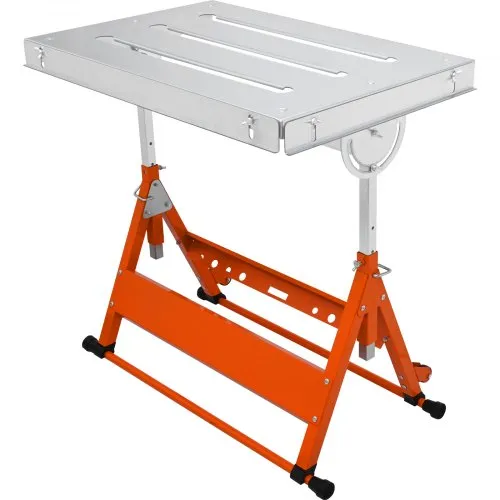
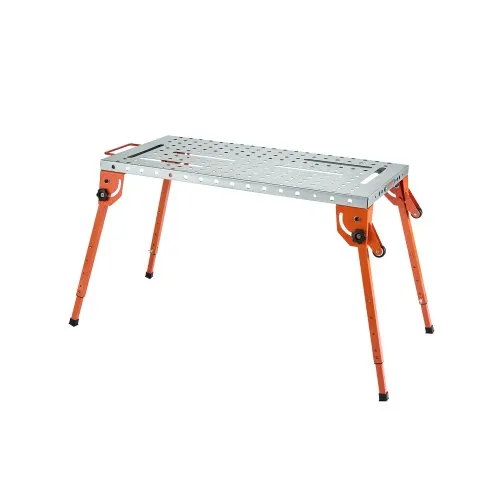
The main issue with a dedicated work surface is that it takes up floor space even when not in use; a foldable welding table resolves this problem. VEVOR's foldable models store flat against a wall or tuck under a bench between projects, shrinking to a fraction of their working footprint.
In a garage or small shop, where the welding table shares space with a car, other tools, or general storage, this feature matters most. A folding weld table is also more portable than a stationary one, whether you're taking it to a construction site, a friend's garage for a project, or moving it out of the way while renovating a house.
Although VEVOR's welder table models still have a true weight capacity of up to 500 pounds on the 44-inch model, the trade-off is typically stability at the hinge points; a folding joint is more likely to flex than a fully welded frame. The space savings outweigh a stability tradeoff that most stationary users won't notice, especially for those who weld infrequently rather than frequently or who don't have space for a permanent bench.
Mobile Welding Tables with Wheels
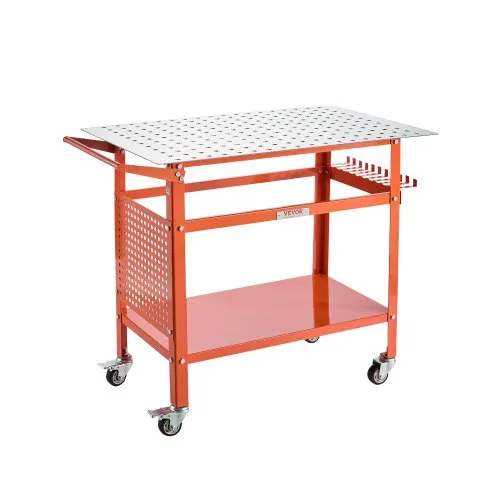
A welding table with wheels addresses a different issue than a foldable one: moving a heavy table without lifting it. VEVOR movable steel welding workbench models roll on caster wheels; higher-capacity variants have braking casters that lock the table in place once you've wheeled it to the desired location.
This works well in single-bay garages where you need to move the table aside between projects, or in businesses that reorganize stations based on the task at hand. Because a wheeled base doesn't have the same flex issues as a hinge, a mobile welding table also supports a heavier design. This 36 by 18-inch wheeled variant supports up to 1200 pounds, more than the foldable versions.
For safety and accuracy, lock the brakes before welding; a table that rolls mid-weld throws off your footing and bead. A wheeled table welds just as steadily as a stationary one after it is positioned and braked, and it's also more convenient because you don't have to arrange your shop around a single stationary bench.
Portable Welding Tables for On-Site and Multi-Station Work
Both foldable and wheeled portable welding tables fall under this category, though the distinction matters depending on how you intend to use one. Foldable tables are the most practical choice if you must remove the table from the shop and lay it flat in a truck bed for a construction site. Wheels are typically preferable if the table only needs to travel between stations within a shop and you want to avoid the setup time of unfolding it each time.
For welders who work in different locations, a lighter folding weld table matters more than raw weight capacity because the table is only functional if it is truly portable. For a shop with a fixed layout but shifting station requirements, a wheeled solution virtually eliminates setup time.
Be truthful about the table's actual means of transportation when making a purchase. You are paying for portability you never use if a table has wheels but never rolls or folds and never leaves the store. Instead of choosing what looks most functional on paper, match the portability type to how you'll actually use it.
Steel Construction: What Material Actually Means Here
If you're specifically looking for a stainless steel welding table, note that every table in our range is made of steel, usually carbon steel rather than stainless steel. For good reason, carbon steel is the most commonly used material for welding tables: it withstands heat and spatter, resists distortion under continuous use, and costs far less than stainless steel without compromising the toughness a work surface truly requires.
Stainless steel is more common in food service or corrosion-resistant equipment than in welding tables because its primary benefits, rust resistance and a cleanable finish, don't really matter on a surface that will inevitably collect grinding dust and weld spatter. Long before rust becomes a limiting factor, a welding table is refinished or replaced because of warping or damage.
For instance, a coat of paint or a rust-inhibiting treatment on a carbon steel table solves most corrosion issues without the added expense of stainless steel if corrosion resistance matters for your shop environment, coastal humidity, or outdoor storage. The steel construction in a shop or garage is designed to perform the actual function of a welding table, not to seem tidy in a showroom.
Features and Adjustability of VEVOR's Welding Tables
Beyond portability, table comfort depends on features like tool slots, fixture holes, and height adjustability.
Adjustable Height and Tilt for Adjustable Welding Tables Explained
A fixed-height table means you have to work at the height the manufacturer intended. That could mean bending down to a low surface or reaching up at a high one. Not all tables in this lineup are adjustable, but the ones that are solve a serious problem. Adjustable welding tables let you change the table surface to the work, not your position to the table.
The 30-inch model has adjustable height and three tilt angles, so you can tilt the surface itself and not just raise or lower it flat, but VEVOR’s 44-inch folding model has four height levels. Angle is more important than you think. For some welds, you want a moderate angle so you can keep your bead consistent without straining your arm.
The smaller adjustable model has retractable guide rails that add an extra level of control by letting you set a straight reference edge for repeated cuts without clamping a different guide each time. That combination of height/tilt/guide adjustment handles more situations than a fixed height table ever could for anyone doing a variety of tasks.
Fixture Holes, Tool Slots, and Other Features
Fixture holes convert a flat steel surface into a real welding table. All VEVOR models have 5/8-inch (0.63-inch) holes, designed for common clamps and jigs to hold a workpiece steady without a second pair of hands. More holes typically mean more clamping positions. This helps with projects with lots of pieces or irregularities.
Tool slots hold squares, hammers, and wire brushes for easy access during a job. Some models also have a bottom shelf or tray for storing bulkier items, like a grinder or extra clamps. The stationary model has non-slip foot pads that keep the table from creeping during heavy hammering or vigorous grinding.
Each of these things can make a welding table good or bad, but together they separate a plain steel surface from a really well organized workbench built for regular shop use. Since two tables rated for the same load can still perform differently day to day, it’s more important to look at the specific combination of holes, slots, and storage a model offers than it is to compare weight capacity in isolation.
Why Choose VEVOR Welding Tables?
VEVOR's foldable, movable, and adjustable welding tables are built from steel to withstand heat, spatter, and repeated clamping without warping. Weight capacity ranges from 400 to 1200 pounds, and standard clamps can hold a project steady through fixture holes across the surface. Every table in this series is priced under $155, so furnishing a shop or garage doesn't require a specialty fabrication budget. Browse the selection and choose the welding table that best fits your workload and available space, backed by VEVOR's return policy and support staff.
FAQs
Are VEVOR welding tables made of stainless steel?
No, they are made of carbon steel, which is used for welding tables because it is less expensive and more resilient to heat and spatter than stainless steel. For corrosion resistance, which isn't the primary concern on a work surface, stainless steel matters more.
Should I get a folding or wheeled welding table?
If you need to take tables out of the shop completely, or if you have limited storage space, folding tables are a good option. Because rolling eliminates the setup time of unfolding, wheeled tables are ideal for shops that rearrange stations while keeping the table on-site.
What size fixture holes do these welding tables use?
Most models use 5/8-inch (0.63-inch) fixture holes, suitable for common clamps and jigs. Because hole size and spacing determine whether clamps and accessories fit, check the specific model.
How much weight can a welding table hold?
Depending on the model, this lineup's capacity varies from 400 to 1200 pounds. Wheeled and stationary tables can support heavier loads, while foldable tables often fall at the lower end of that spectrum.