
Leather Working Tools Kit






Results for Leather Working Tools Kit
A leather working tool kit is a bundled collection of hand tools assembled to carry a piece of leather through every stage of making, from the first cut to the finished edge. Rather than buying each implement on its own, the kit gathers the cutting, hole-punching, stitching, stamping, and edge-finishing tools that a single project needs into one organized set. Each tool performs one defined job: a blade separates the hide, a punch or chisel opens evenly spaced holes, needles and thread close the seam, and bevelers and burnishers smooth the edge. Together they let one person complete a leather item start to finish.
Kits are sorted mainly by how many tools they hold and how deep a workflow they support. A compact beginner leather working tool kit covers the core cut-punch-stitch-finish sequence for small goods, while a mid-size all-in-one leather craft set adds extra punches, stamps, and a full waxed-thread supply for steady hobby use. A larger professional leather working tool kit layers in carving tools, broader stamp selections, and a wider edge-beveler range for detailed, repeatable work, and ships in either a canvas or leather storage roll. Typical uses are wallets, belts, bags, keychains, leather jewelry, shoe and furniture repair, and decorative tooled pieces.
Four things decide which kit you need:
- Piece count: match the tool total to your project depth, since a 38-piece set handles small goods while a 92-piece set supports carving, stamping, and finishing variety.
- Storage type: choose a canvas bag for a stable studio kit or a roll-up leather wrap when you carry tools to classes and outdoor sessions.
- Tool breadth: check that the categories you actually use (punching, saddle stitching, edge beveling, stamping, grooving) are all present before you buy.
- Skill stage: a beginner set keeps the tool list focused so functions stay clear, while larger sets reward crafters who already know which gaps to fill.
Browse the full VEVOR leather working tool kit range to compare piece counts and bag types side by side, or jump straight to a larger professional configuration when you are ready to expand your bench. Every kit arrives organized, ready to use, and backed by dependable after-sales support.
Leather Working Tool Kit Types at a Glance
The table below groups the kits by configuration so you can see how tool count, carry format, and intended depth line up before choosing.
| Kit Type | Tool Count | Storage Format | Workflow Depth | Selection Note |
|---|---|---|---|---|
| Compact beginner kit | Around 38 pieces | Canvas bag | Core cut, punch, stitch, and finish steps for small goods | Lightest, clearest starting point when tool functions are still new |
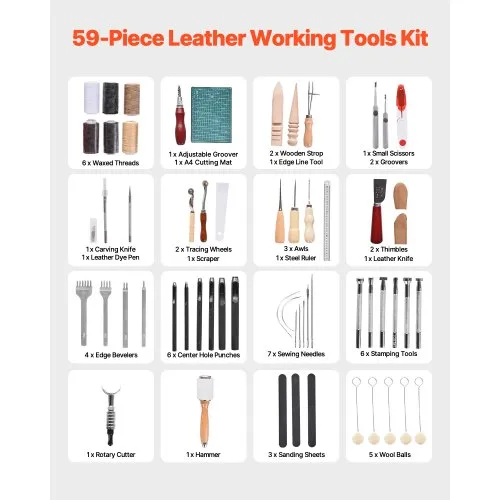
| Standard all-in-one kit | Around 59 to 61 pieces | Canvas bag | Full stage coverage plus extra punches, stamps, and waxed thread | Best balance of variety and simplicity for steady hobby work |
| Portable roll kit | Around 72 pieces | Leather roll wrap | Adds carving and edging tools in a fold-out carry format | Pick when tools travel to classes or outdoor sessions often |
| Professional kit | Around 92 pieces | Leather roll wrap | Widest carving, stamping, and engraving selection for detailed work | Choose after you know which specialized tools your projects demand |
VEVOR Leather Working Tool Kits for Cutting, Stitching & Finishing Every Leather Project
Are you looking to upgrade your outdated tool collection, or are you starting your first leather project? With the right leather working tool kit, you can avoid wasting money on unnecessary items, the hassle of seeking specific tools, and the hassle of figuring out compatibility. From initial cuts to final finishing, VEVOR's leathercraft tools for cutting, stitching, and finishing leather at fair prices, with after-sales support, are carefully selected to fit actual project workflows.
Tool Types & Kit Contents: What a Complete Leather Working Tool Kit Should Include
The equipment in a leather working tool set determines its usefulness. The best leather working kits include all the tools needed for key steps such as cutting, edge preparation, sewing, stamping, and finishing, so you can complete a project from raw hide to final product without having to buy the necessary tools in the middle of the job.
Cutting and Measuring Tools: Precision from the First Mark
The basis of any leather job is precise cutting. It is impossible to fix a badly cut piece later on because each step exacerbates the original mistake. At the very least, a full leather working tool kit should include a steel ruler, a heavy-duty utility or strap cutter for straight lines, a swivel knife for curved cuts and artistic carving, and a cutting pad to protect the work area and the edge of the blade. The most skill-dependent cutting instrument in leather working is the swivel knife. Once mastered, it enables freehand carving and decorative work that is not feasible with fixed-blade tools.
The blade rotates in its barrel to follow curved design lines, which takes practice to handle consistently. To maintain straight stitch lines without manually marking each hole, wing dividers or stitch groove tools score parallel lines along edges to create stitching guides and decorative borders. Cutting tools with precision-ground edges and grips designed for prolonged use without hand strain are part of VEVOR's leather working tool kits. Any collection of tools for leather crafting should start with a sharp cutting tool because it will outlast dozens of less expensive options.
Hole Punching and Stitching Tools: The Core of Every Leather Project
The most labor-intensive and skill-visible aspect of leather working is stitching, and the tools used to prepare leather for stitching directly affect the final seam's quality and uniformity. For hand stitching, pricking irons, also known as stitching chisels, punch uniformly spaced, slanted holes in leather. Stitch density depends on the distance between prongs; finer items, such as wallets and card holders, benefit from a 3-4 mm spacing, while larger items, such as belts and bags, where a bolder stitch appearance accentuates the heavier leather weight, should use a 5-6 mm spacing. A decent leather working tools starter kit should include at least two pricking irons: one with multiple prongs for straight runs and one with a single prong for corners and curves when the multi-prong tool cannot maintain uniform spacing.
Waxed linen or polyester thread and blunt-tipped saddle stitching needles finish the stitching setup. In contrast to machine stitching, saddle stitching creates a lockstitch that withstands cutting or abrading of individual thread sections by using two needles at once, one through each side of the hole. To free up both hands for two-needle stitching without having to hold the workpiece during the seam manually, VEVOR's leather working tool kits include stitching horses or clamps in larger kit configurations.
Edge Finishing and Stamping Tools: The Details That Define Finished Quality
Edge finishing and surface detailing are two areas where the right tools for leather crafting make an instant, noticeable difference and are key factors that distinguish leather work that appears purely handmade from pieces that look professionally finished. By eliminating the sharp 90-degree corner that cutting leaves behind, edge bevelers produce a neat chamfered edge that resists delamination, accepts burnishing uniformly, and looks professional without exposing raw cut edges. Smaller-number bevelers fit lighter leathers, whereas larger sizes, such as #3 and #4, suit heavier bridle and vegetable-tanned leathers. To accommodate the leather weights commonly encountered in varied project workloads, a high-quality leathercraft tool set should include at least two bevel sizes.
After beveling, bone folders and wood slickers buff the edges, squeezing the leather fibers to provide a polished, smooth surface without the need for extra materials. By sealing the edges against moisture and abrasion, edge paint or gum tragacanth applied during burnishing greatly increases the service life of the completed objects. Stamping kits featuring alphabet, numeric, and ornamental stamps enable recipients to customize and brand their final products. The professional leather working tool kit options offered by VEVOR include cutting and stitching tools, edge-finishing and stamping tools, and everything else required to transform a piece from raw to retail-ready quality.
Matching a Leather Working Tool Kit to Your Project
Beyond the tool categories above, the kit that fits depends on what you make most. This table pairs common project types with the tools that matter and flags what first-time buyers tend to overlook.
| Project Type | Tools That Matter Most | Stitch Spacing to Prioritize | What Buyers Often Overlook |
|---|---|---|---|
| Wallets and card holders | Fine pricking irons, swivel knife, small punches | 3 to 4 mm fine spacing | A single-prong iron for tight corners, not just the straight multi-prong |
| Belts and straps | Strap cutter, edge beveler, larger punches | 5 to 6 mm bolder spacing | Two beveler sizes, since one size will not suit heavier belt leather |
| Bags and totes | Stitching clamp, multiple punch sizes, groover | 5 to 6 mm for heavier panels | A clamp or horse to free both hands for long two-needle seams |
| Decorative tooled pieces | Swivel knife, carving tools, stamp set | Spacing varies by panel | Carving and stamp variety only appear in the larger kits, not compact sets |
| Repairs and mixed materials | Assorted needles, waxed thread, awl | Match existing holes | Enough waxed thread supply, since repairs burn through more than expected |
Storage and Organization: Keeping Your Kit Ready for Every Project
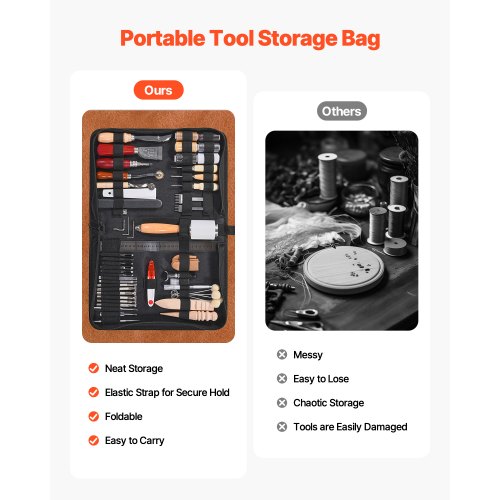
When a leather working tool kit is not organized, it soon becomes a disorganized mess of loose instruments that are hard to find, prone to damage, and likely to injure someone by accident. The smallest storage option is a roll-up canvas or leather tool wrap, which keeps cutting edges safe and separate while storing individual tools in designated pockets. A cleverly constructed wrap unfolds to show all of the tools at once, eliminating the need for digging, and then folds back up to fit in a studio drawer or project bag. Harder tools stored loosely can damage delicate punches and pricking irons, which are best protected in rigid tool cases.
The leather working tool kits from VEVOR come in neat cases or wraps that match the kit's size, protecting the tools during transit and helping ensure they are ready to use as soon as they arrive. When collections grow beyond the initial contents, the kit remains organized thanks to the addition of individual tool pouches to the base storage system. Effective kit organization has a direct impact on how frequently you reach for tools and how smoothly a project session goes from setup to pack-down; it is not merely a decorative element.
Material Quality & Skill Level: Choosing the Right Kit for Where You Are in Your Craft
The two aspects that most purchasers overlook when choosing a leather working tool kit are material quality and skill-level targeting, despite their direct impact on how enjoyable the tools are to use and how long they last before needing to be resharpened or replaced.
Tool Steel Quality and Handle Construction: What Separates Good Tools from Great Ones
The steel composition of cutting, punching, and stitching tools affects how accurately they work across various leather weights and varieties, as well as how long an edge lasts between sharpening sessions. Often considered a standard for high-quality leathercraft tools, carbon-steel tools are easier to resharpen with a common leather strop and honing compound and retain their edge longer than stainless-steel counterparts. High-carbon steel punches retain uniform hole geometry after thousands of uses by cutting through thick veg-tan leather cleanly and without quickly damaging the punch tip.
Although they lose some edge retention, stainless steel tools are more resistant to surface corrosion in humid workshop settings. For tools that do not require frequent sharpening, this feature is a fair trade-off. Long-term use of the handle material influences fatigue. Hardwood handles, such as rosewood, walnut, or beech, are better at absorbing vibration from mallet strikes than plastic ones, which lessens hand fatigue during punching and stamping. Compared with low-cost kits with injection-molded plastic handles for all tool types, VEVOR's professional leather working tool kit line features hardwood-handled tools in its premium configurations, offering a notably more comfortable working environment.
Starter Kits vs. Professional Kits: Matching Kit Depth to Your Skill Level
Not all leather workers require a fifty-piece professional kit right away, and purchasing more equipment than your present level of expertise can utilize leads to clutter and wasteful spending rather than improved outcomes. A leather working tools starter kit, usually consisting of 10 to 20 items, includes the necessary tools for belt projects, wallets, keychains, and basic bags. The swivel knife, pricking iron set, stitching needles, thread, edge beveler, and simple punches included in these kits are sufficient to complete the majority of beginner and intermediate crafts without overburdening a novice maker with tools whose functions are still unclear.
A professional leather working tool kit, which includes 30 pieces or more, unlocks more difficult project types and higher-quality finishing by adding specialized stamps, multiple pricking iron spacings, a full edge beveler size range, a mallet, a stitch groover, a wing divider, and finishing tools. After you have completed several tasks and identified the specific tool gaps that are restricting your current job, it is appropriate to upgrade to a professional kit. The product listing page for VEVOR's leather working tool kits breaks them down by project type and item count, making it easy to find the ideal place to start without buying tools you will not use for months. As your abilities and project goals advance, you can always add specific tools to a VEVOR base kit to upgrade from a starting kit to a professional configuration.
Best-Seller Comparison
These five kits are the current lineup; they appear on the category page. Compare piece count, carry format, and weight to find the depth and portability that suit your bench.
| Product | Pieces | Storage Bag | Carry Weight | Tool Breadth | Format | Best For |
|---|---|---|---|---|---|---|
| 61-Piece Kit, Canvas Bag | 61 | Canvas | 6.61 lb / 3 kg | Cut, punch, sew, stamp, engrave, sand, adjustable groover | Zipped bag | Heaviest canvas set here; a loaded studio kit that stays on the bench |
| 72-Piece Kit, Leather Roll | 72 | Leather roll | 3.31 lb / 1.5 kg | Cut, stitch, carve, punch, edge, groove, stamp | Fold-out wrap | Lightest of the roll kits; the one to grab when tools travel |
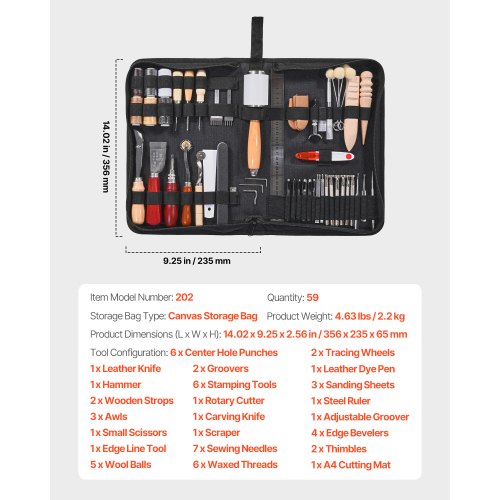
| 59-Piece Kit, Canvas Bag | 59 | Canvas | 4.85 lb / 2.2 kg | Full stages plus 7 needles and 6 waxed-thread spools | Zipped bag | Most stitching supply in the lineup; best for seam-heavy projects |
| 38-Piece Beginner Kit | 38 | Canvas | 1.98 lb / 0.9 kg | Cut, punch, stitch, carve, edge, groove, stamp | Compact bag | Lightest and smallest; the clearest entry point for first-timers |
| 92-Piece Kit, Leather Roll | 92 | Leather roll | 5.29 lb / 2.4 kg | Widest carving, engraving, and stamping selection | Fold-out wrap | Most complete set here; built for detailed, varied tooled work |
Shop VEVOR Leather Working Tool Kits for Every Skill Level and Project Type
Whether you are purchasing leather craft tools for the first time or upgrading to a professional leather working tool kit for production quality, VEVOR leather working tool kits provide the cutting, stitching, finishing, and stamping tools required to accomplish real leather projects. Each kit is reasonably priced, well-stocked, and comes with dependable post-purchase assistance. Start your next leather project now by browsing the entire collection.
FAQs
What should a good leather working tool kit include for a beginner?
A swivel knife, pricking irons, stitching needles, waxed thread, an edge beveler, hole punches, and a cutting mat are essential components of a leather working tools starter kit. These tools are sufficient to accomplish wallets, keychains, and easy bag projects because they cover cutting, stitching, and basic finishing.
What is the difference between a starter kit and a professional leather working tool kit?
Starting packages include 10-20 essential pieces of equipment for simple projects. Professional leather working tool kits come with at least 30 instruments, including finishing tools, a variety of pricking iron spacings, specialist stamps, and comprehensive beveler size ranges, enabling more intricate projects and better outcomes.
Which leather is best for beginners to work with?
For novices, vegetable-tanned leather is often the best option. It is robust, responds well to carving and stamping, maintains its shape when cut and stitched, and finishes neatly with common leathercraft tools. Because chrome-tanned leather is softer and more challenging to tool, it tends to suit more experienced artisans.
How do I maintain cutting tools in a leather working kit?
To keep the blades of swivel knives and skivers razor sharp, strop them on a leather strop filled with honing compound every few hours of use. Maintain dry and clean punch tips. To prevent cutting tools from contacting one another's edges between uses, store them in separate pockets.
Which leather sewing or stitching kit is best for a beginner?
For hand stitching, start with an all-in-one set that already includes saddle-stitching needles, waxed thread, pricking irons, and an awl, so you are not sourcing parts separately. The 59-piece kit ships with seven assorted needles and six waxed-thread spools, which covers most beginner seams comfortably.
How do VEVOR kit sizes differ from the 38-piece up to the 92-piece?
The sets scale by tool count and carry format. The 38-piece kit is the lightest beginner option in a compact canvas bag, mid-range canvas sets add punches and thread, and the 92-piece kit adds the widest carving and stamping selection in a roll-up leather wrap.
How do I choose the right leather craft kit for my project?
Start from what you build most. Small goods like wallets need fine pricking irons and small punches, belts need a strap cutter and larger bevelers, and tooled pieces need carving and stamp variety. Then match piece count and storage format to how often your tools travel.
Which tools in these kits handle detailed or decorative work?
Detailed work relies on the swivel knife for freehand carving, carving and bevel tools for depth and clean edges, and alphabet, numeric, and ornamental stamps for personalization. The larger configurations, such as the 92-piece professional kit, carry the broadest selection of these finishing and carving tools.
Should I buy an all-in-one kit or buy tools individually?
An all-in-one kit is usually the better start, since it covers every stage from cutting to finishing in one organized set and avoids compatibility guesswork. Buy individual tools later, once you have finished a few projects and know the specific gaps restricting your current work.