

Fuses


Results for Fuses
A fuse is a small sacrificial safety device that guards an electrical circuit against excessive current. Inside each one sits a thin metal element rated to carry a set current continuously. When the current rises past that limit, whether from an overload or a short circuit, the element heats and melts, opening the circuit before the surge can damage wiring or connected equipment. Because the element is built to fail first, the fuse gives itself up to keep everything downstream safe. Once it has blown, it is replaced rather than reset, which restores protection and signals that a fault occurred.
VEVOR fuses come in several formats to suit different circuits. glass tube fuses protect electronics, appliances, and older vehicle circuits, and their clear body reveals a blown element at a glance. Blade fuses in ATO, ATC, ATM, and Micro2 shapes seat in modern vehicle fuse boxes, while add-a-circuit fuse taps draw a new accessory feed from an existing slot without cutting wiring. High-current specialty forms such as midi and ANL guard battery, inverter, and audio lines. Ratings commonly run from about 1A for delicate electronics to 30A and beyond for heavier loads, each paired with a suitable voltage rating. Typical uses are automotive accessory wiring, marine panels, workshop repairs, and home appliance protection.
Four things decide what you need:
- Amperage: size the fuse to the circuit's normal running current, not the equipment's brief peak draw.
- Voltage: choose a rating that meets or exceeds the circuit voltage so a blown fuse clears the fault safely.
- Format: match the body style (glass tube, blade, fuse tap, or bolt-down) to your holder or fuse box.
- Response: pick fast-blow for electronics and slow-blow for motors or transformers that surge at startup.
Browse the full range of VEVOR fuses and related power distribution hardware to find circuit protection sized for your vehicle, boat, workshop, or home.
Fuse Types at a Glance
The main fuse formats differ in where they sit, how they mount, and how you spot a failure, as summarized below.
| Type | Where It's Typically Used | Mounting / Placement | Fault Check Method | Selection Note |
|---|---|---|---|---|
| Glass tube fuses | Electronics, appliances, audio gear, older vehicles | Seats in a spring-clip or inline holder | Blown element visible through the glass body | Easiest to inspect; keep assorted ratings on hand |
| Blade fuses (ATO/ATC/ATM/Micro2) | Modern car, truck, and marine fuse boxes | Pushes into a keyed blade slot | Translucent housing shows a broken link | Match the exact blade size your panel uses |
| Fuse taps (add-a-circuit) | Adding an accessory circuit to a vehicle | Plugs into an existing slot and adds a second | Check the tapped fuse in the holder | Adds power without cutting factory wiring |
| High-current fuses (midi/ANL) | Battery, inverter, and car-audio feeds | Bolts down onto stud terminals | Multimeter needed on the sealed body | Chosen for heavy loads above blade ratings |
VEVOR Fuses: Precision-Rated Circuit Protection for Automotive, Marine, and Home Use
Not every fuse is the same, and putting the wrong type or grade of fuse in a circuit can damage equipment, start an electrical fire, or cause the whole system to fail. Every VEVOR fuse is accurately rated, clearly labeled, and made to meet international electrical standards. This ensures each fuse reliably protects its intended circuit. VEVOR offers a wide selection of fuses, from fuse taps for clean wiring in cars to glass fuse assortment kits with dozens of ratings in one box.
Amperage, Voltage & Type: Choosing the Right Fuses for Your Application
To choose the right fuse, ensure that the three key factors, the fuse type, current rating, and voltage rating, match your circuit's needs. A wide range of ratings and formats is available for VEVOR fuses, so every buyer can find the perfect fuse for their electrical safety needs.
Amperage Ratings: Matching Fuses to Your Circuit Load
The primary specification of a fuse is its amperage rating. It defines the maximum continuous current the fuse can carry before the internal element melts and opens the circuit. To meet almost all usual needs for circuit protection in cars, boats, and homes, VEVOR fuses come in a wide range of amperage ratings, including 1A, 2A, 3A, 5A, 7.5A, 10A, 15A, 20A, 25A, 30A, and higher.
It is essential to choose the correct amperage rating. An undersized fuse may blow under normal load conditions, causing unnecessary interruptions and downtime. An oversized fuse allows excessive current to flow before interrupting the circuit, potentially damaging connected devices or wiring before protection activates. VEVOR glass fuses and blade-style fuses have their amperage value stamped clearly on the end cap or body. The marking makes them easy to find when installing or replacing them.
Voltage Ratings and Why They Matter for Fuse Selection
It is important to match the fuse's current and voltage ratings to the circuit it protects to ensure safety and effectiveness. When a fuse blows, its voltage rating indicates the maximum voltage it can safely interrupt. If the fuse's voltage rating is lower than the circuit voltage, it may arc internally after blowing instead of opening the circuit safely, creating a new hazard rather than clearing the fault.
When adding a new circuit to an existing car fuse box with a fuse tap adapter, it is just as important to ensure that the replacement fuse maintains the correct voltage rating for the vehicle's system as it is to ensure it matches the amperage. VEVOR fuse tap adapter products work with standard-blade fuse boxes and clearly indicate the supported voltage and amperage range. This makes it easy to add an extra powered circuit safely and properly, without damaging the vehicle's existing circuits.
Fuse Types: Blade, Glass, and Specialty Fuses Explained
Different types of fuses have different physical formats, placement methods, and best circuit environments. There are three main types of fuses that VEVOR sells: blade fuses, glass fuses, and specialty forms such as midi and ANL fuses for high-current applications. Knowing the differences will help you choose the right fuse type for each circuit's physical needs and working conditions.
Older cars, home tools, audio equipment, and hobby electronics all use glass tube fuses. It is possible to buy VEVOR glass fuses one at a time or in assortment kits that include the most popular ratings. Glass fuses are among the fastest types to assess and replace in the field because the clear glass body of each lets you check it visually right away. For example, you can see right away if an element has blown without using a multimeter. VEVOR glass fuses are manufactured to meet AGC and AGX standards, ensuring compatibility with a wide range of equipment.
Slow-Blow vs. Fast-Blow Fuses: Choosing the Right Response
In addition to type and rating, the blow characteristic of a fuse, or how quickly it reacts to an overcurrent event, is an important factor that many buyers miss. There are two main response types: fast‑blow and slow‑blow fuses. Each type is best suited to a different circuit and load in real-life electrical applications.
"T"-shaped slow-blow fuses can handle short surges of current above their maximum amperage without blowing, but they will blow when the overcurrent lasts for a long time. Because of this, slow-blow fuses are a common choice for motor and transformer circuits that require a large current surge at startup before settling into regular operating current. If you use a fast‑blow fuse in a motor circuit, it may blow repeatedly when the motor starts up. Slow‑blow fuses are designed to handle these inrush events properly while still protecting the circuit from real fault conditions.
Matching Fuse Behavior and Size to the Load
Beyond picking a format, the circuit itself decides how fast a fuse should react and how to size it, which the prose does not lay out side by side.
| Circuit / Load Type | Response Type to Favor | Why That Response | Sizing Guidance | What to Watch For |
|---|---|---|---|---|
| LED strips and sensitive electronics | Fast-blow | No startup surge, so instant cutoff protects parts | Size just above the steady draw | Oversizing lets heat reach delicate components |
| Motor, pump, or compressor circuits | Slow-blow | A large inrush at startup settles within moments | Rate for running current, allow for surge | Fast-blow here nuisance-trips on every start |
| Transformer or power supply | Slow-blow | Magnetizing inrush spikes the instant it powers on | Match to the continuous load | Confirm the voltage rating suits the supply |
| Vehicle accessory circuit (dashcam, GPS, lights) | Fast-blow blade | Steady DC draw with little inrush | Match the device's rated current | Verify the fuse voltage fits a 12V or 24V system |
| Lighting or resistive heater | Fast-blow | Minimal surge once it has warmed up | Size to the measured running current | Leave slight headroom for warm-up current |
Quantity & Applications: Getting the Most from VEVOR Fuses
Whether you need a single replacement fuse or a large amount for regular maintenance, VEVOR fuses come in different pack sizes, styles, and assortment kits to meet all of your needs. Choosing the appropriate pack size ensures you always have the right fuse available when needed.
Bulk Fuses and Assortment Kits for Workshops and Technicians
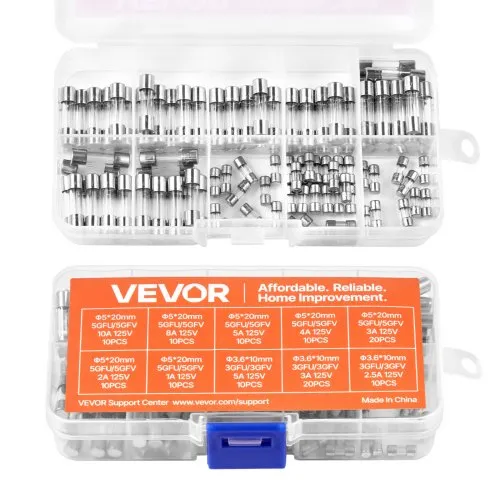
Buying fuses in bulk or an assortment kit is the best way to save money and make things easier on the job for automotive technicians, marine electricians, and workshop users who routinely replace and test fuses in a variety of vehicles and equipment. That's exactly why VEVOR made the glass fuse assortment kit: it contains the most common glass fuses and blade fuses in one neatly organized case, so each grade is easy to find and understand during busy repair sessions.
A VEVOR glass fuse assortment kit usually includes at least 100 fuses with amperage ratings of 8–12. This covers most routine fuse replacement needs in a typical workshop setting for cars, boats, and homes. An organized assortment kit reduces diagnostic time and helps prevent incorrect fuse installation. The organized case layout helps prevent this problem. Fuse taps included with some VEVOR assortment kits make the kits even more useful by enabling new circuits during car electrical upgrades without having to buy extra parts separately.
Fuse Tap Adapters for Automotive and Marine Wiring Projects
Fuse taps and fuse tap adapters are very useful additions to any job involving wiring in a car or boat. A VEVOR fuse tap adapter doesn't cut into existing wiring to add a new powered circuit for a dashcam, GPS unit, LED accessory, or other device. Instead, it plugs directly into an existing blade fuse slot in the vehicle's fuse box and provides a second fused output for the new circuit. This is a clean, reversible installation method that doesn’t require cutting or splicing factory wiring.
Assorted VEVOR fuse tap adapter models are available in low-profile and standard-blade styles and are compatible with mini, standard ATO, and maxi fuse box layouts found in a wide range of cars, trucks, and boats. Each fuse tap adapter has a slot for an add‑a‑circuit (piggyback) fuse. This lets the installer choose the exact amperage rating needed for the new device being powered. This is an important safety measure that ensures the added circuit is protected at the correct current level without relying on the original circuit's fuse.
Best-Seller Comparison
VEVOR currently lists two distinct fuse kits; the table sets their formats, ratings, and build side by side to show which job each one suits.
| Product | Fuse Format | Voltage Rating | Pieces Included | Amperage Coverage | Build / Material | Best For |
|---|---|---|---|---|---|---|
| Fast-Blow Glass Fuse Kit, 120 Pcs | Glass tube, fast-blow | 125V | 120 | 1A to 10A (two sizes) | Glass body with sorted storage box | Only glass-tube kit here; bench electronics, LED and appliance repair |
| 24-Pc Mini Fuse Tap, 4 Types | Blade add-a-circuit tap | 12V (12V/24V systems) | 24 (12x5A, 6x15A, 6x20A) | 5A to 20A blade fuses | Copper wire with nylon connectors | Only add-a-circuit tap here; wiring new 12V accessories without splicing |
Why Choose VEVOR Fuses?
VEVOR fuses protect electrical circuits accurately and reliably in cars, marine, industrial, and home settings. VEVOR offers precision-rated glass fuses, blade fuses, full glass fuse assortment kits, and clean-install fuse tap adapter options to meet all your fuse needs at reasonable prices. There is reliable after-sales support for every product. Choose VEVOR fuses for dependable circuit protection across a wide range of applications.
FAQs
How do I choose the correct amperage fuse for my circuit?
Avoid matching the fuse amperage to the equipment's maximum or peak draw. Instead, match it to the circuit's maximum normal running current. If you're not sure, check the equipment instructions or the wiring diagram for your car. The VEVOR glass fuse assortment kit has the most popular amperage ratings, so you can quickly find a suitable option.
What is a fuse tap adapter, and when do I need one?
With a fuse tap adapter, you can add a new powered circuit to a car's fuse box without cutting any wires. Just put the VEVOR fuse tap adapter into a blade fuse slot that's already there, and then connect your new device to the adapter's output with the right-sized fuse in place.
What is the difference between fast-blow and slow-blow fuses?
Fast-blow fuses protect electronics by blowing quickly when they sense excessive current above their rating. Slow-blow fuses can withstand short spikes in starting current before blowing, making them ideal for motor and transformer circuits. Both kinds of VEVOR fuses have clear markings that say "F" for fast-blow and "T" for slow-blow.
Are VEVOR glass fuses compatible with standard fuse holders?
Yes, VEVOR glass fuses are the same size as normal AGC and AGX fuses, so they can be used in any glass fuse holder found in cars, appliances, audio equipment, and hobby electronics. The glass fuse assortment kit has the most popular ratings for a wide range of applications.
Can I use a higher amperage fuse if my current fuse keeps blowing?
Not at all. A fuse that keeps blowing is usually a sign of an underlying circuit problem or undersized wiring, not a defect in the fuse itself. Installing a higher-rated fuse compromises safety and increases the risk of fire or damage to the wiring. To fix the problem, first identify the cause, then replace the VEVOR fuse with the correct rating.
Where can I buy high-quality fuses online at the best prices?
You can buy fuses directly from the VEVOR website, which ships automotive, marine, and home circuit-protection products with reliable after-sales support. Browse the VEVOR fuses category to compare formats, amperage ratings, and pack sizes, then order the kit that matches your circuits and keep spares on hand.
How do I choose the right fuse for my electrical project?
Match three things to the circuit: the physical format, the amperage rating set to the normal running current, and a voltage rating at or above the circuit voltage. Pick fast-blow for electronics and slow-blow for motors. For vehicle add-ons, an add-a-circuit fuse tap adds a protected circuit cleanly.
What are the common types of fuses used in automotive applications?
Vehicles mainly use blade fuses in ATO, ATC, ATM, and Micro2 formats, plus low-profile mini versions for tight panels and high-current bolt-down fuses for battery or audio feeds. Glass tube fuses appear in older models. Shop these under automotive fuses and match the format to your fuse box.
How much are fuses for a house?
Costs vary by region, retailer, and promotion. What you need depends on the circuits: most homes use low-amperage glass tube fuses for appliances and electronics, bought singly or in assortment kits. Check each device's rating, then match the format and amperage before buying.
What is the difference between a fuse and a circuit breaker?
A fuse contains a metal element that melts once during an overload and must be replaced, while a circuit breaker trips mechanically and can be reset and reused. Fuses react very quickly and suit sensitive electronics. For replaceable reliable circuit protection, matched glass or blade fuses are a simple, dependable choice.
