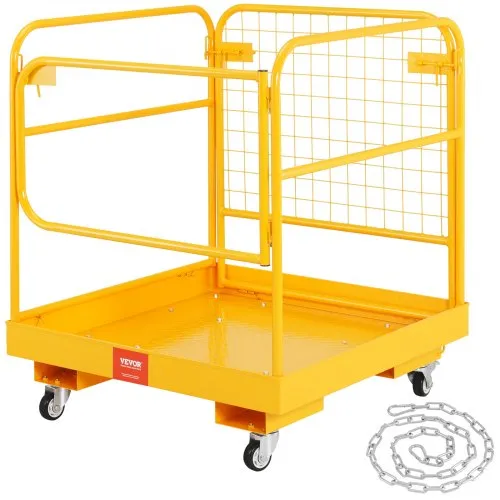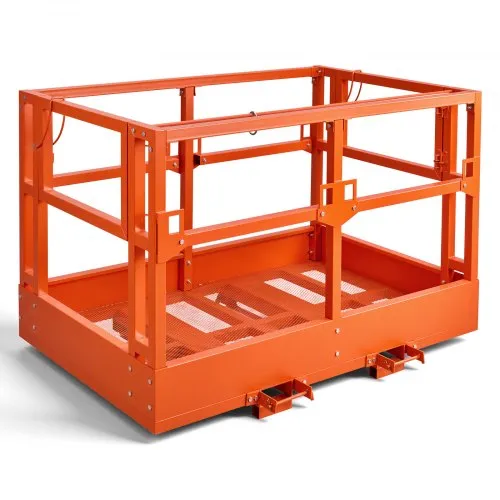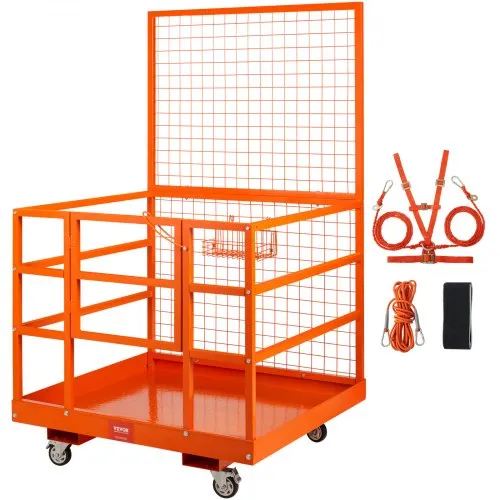


Do you require forklift safety cages to keep workers safe while performing elevated tasks like high-shelf inventory work, warehouse maintenance, or sign installation? VEVOR offers a variety of cage types and sizes, from wide, large-capacity baskets for operations that require extra space to work safely at height to compact conventional platforms for daily tasks. To keep workers steady at height, each forklift safety cage is built with reinforced steel, sturdy guardrails, and robust fork-pocket mounting. VEVOR forklift safety cages offer dependable protection for any elevated work task, whether you need a heavy-duty man basket for daily use or a folding cage for convenient storage.
Without renting a scissor lift, do you need to safely raise an employee to high shelving, ceiling fittings, or overhead maintenance? You can use your current forklift as a temporary aerial fork truck work platform for operations that would otherwise require additional lifting equipment by attaching forklift safety cages directly to its forks. VEVOR offers forklift safety cages in regular, wide, and large designs. They may be folded or collapsed for convenient storage in busy warehouses.
Knowing the types and sizes of cages available helps you choose the best fit, because not all elevated tasks require the same cage.
Although this equipment goes by many names, they all refer to the same basic idea: a platform that attaches to forklift forks to raise a worker off the ground safely. For operations such as reaching high shelves or performing overhead maintenance, a standard forklift cage typically has enclosed guardrails on all sides.
Although the phrase is frequently used to describe designs with a slightly more open or basket-style construction rather than a fully enclosed cage, a lift basket for forklift applications serves the same fundamental purpose. Both designs should include secure attachment points to keep the platform fixed to the forks during use.
A man lift basket for forklift equipment offers dedicated standing space and tool trays or hooks to hold equipment throughout the task, freeing hands for the work rather than balancing tools, for applications involving one or two workers at height.
The essential safety characteristics are the same whether it's called a lift cage for forklift use or a cage for a forklift attachment: complete guardrails, a secure floor, and dependable locking mechanisms that keep the platform from moving or separating during elevation. Terminology differs more across forklift safety cages than real design variations.
When selecting equipment you won't use every day, storage convenience and safety features matter because warehouse and shop space is often at a premium. When not in use, a folding forklift safety cage is easier to store against a wall or stack with other equipment because it folds to a fraction of its working footprint.
When properly engineered, this folding feature does not compromise structural integrity. Look for solid locking pins and reinforced hinge points that keep the cage rigid yet allow rapid collapse for storage. No matter how easy it is to store, a cage that flexes or wobbles at the fold points in use is not safe.
Because the equipment can be stowed between uses rather than permanently occupying floor space near the storage area, a collapsible forklift safety platform is especially helpful for operations that only rarely require aerial access. Because collapsed units are simpler to move between places, folding designs are especially advantageous for rental organizations and multi-site operations.
Folding forklift safety cages are generally slightly pricier than fixed-frame types, but for businesses with limited space, the ease of storage and transportation often makes the expense worthwhile.
Beyond a contained cage, other tasks require a more open platform layout rather than a full guardrail enclosure on all sides. The wide forklift work platform, with the front partially open, makes it easier for workers to reach toward shelving, equipment, or building structures while still providing rail protection on the other sides.
For jobs that require greater freedom of movement at height, a larger floor area on a forklift aerial platform gives the operator more room to maneuver gear, materials, or themselves without feeling cramped in a smaller cage. If you need to do some work laterally (mount signs, maintain lighting, or conduct inspections), this configuration is perfect.
Although they are referred to by a more general term rather than forklifts, forklift work platforms are essentially the same kind of equipment. Regardless of the name, the platform must always have a secure floor, guardrails that comply with relevant safety standards, and a reliable manner to attach the forklift forks.
The choice between platform types and forklift safety cages ultimately comes down to how much movement is needed throughout the task and how secure and contained the worker must feel while elevated.
Cage size affects how many workers can safely be on the platform and how much equipment and material can be carried during the activity. For most routine maintenance and inspection tasks in a warehouse or shop, standard-size forklift safety cages or an oversized option with limited room for hand tools may be sufficient.
A broad forklift work platform provides significantly more floor area for activities requiring two workers at once or when bulkier equipment must travel up with the worker rather than be passed up separately. This extra breadth can greatly boost efficiency for jobs that would normally require multiple up-and-down trips.
To meet the most demanding requirements, a large forklift lift basket offers maximum floor area and typically a higher rated capacity. Larger tool sets, more workers, or heavier materials needed for extended work at heights can all be accommodated. Since these larger units usually have a proportionately larger footprint on the forks, confirm forklift compatibility before purchase.
Compare forklift safety cage sizes and select the cage that matches your actual task requirements, not the largest option. Large cages may be harder to navigate through narrow warehouse aisles.
Factors beyond cage type and size often determine the best fit for a facility's daily operations, including rated capacity and folding convenience.
Each cage has a maximum rated capacity that accounts for the total weight of personnel, equipment, and supplies inside the platform during use. For most regular maintenance, inspection, and stocking duties throughout a facility, a standard forklift man basket can accommodate one to two people, plus hand tools.
One of the most serious safety violations with this equipment is exceeding the rated capacity, since overloading can compromise stability, strain guardrails and welds, and pose a real fall hazard to anyone inside the platform. Before starting any elevated task, always accurately calculate the combined weight of workers and materials.
Since forklift lift capacity usually declines as fork height increases, you should also compare the rated capacity of a forklift basket attachment to your forklift's own lift capacity at the height required for the work. If the forklift itself can't safely lift that total weight to the required height, a 5500-lb cage won't help. For safe operation at any working height, verify the cage rating and the forklift's capacity curve, in addition to the cage specification.
Folding mechanisms vary; therefore, it's important to know how a particular model folds to set reasonable expectations for storage and setup time. Simple hinge-and-pin designs fold quickly, but because a partially secured fold point affects structural integrity during elevation, take care to ensure locking pins are properly placed before use.
For everyday commercial use, a heavy-duty forklift man basket typically features reinforced folding points designed to withstand numerous cycles of collapse and deployment without becoming loose or developing play over time. This durability should take precedence over units intended for infrequent use in facilities that use their cages daily. In practice, setup time matters, especially for facilities that use their forklift safety cages for various operations several times a day.
A well-designed quick-fold system can be ready in less than a minute, but a cage that takes several minutes to unfold and lock into place accumulates wear and tear with repeated use. If at all possible, test the fold-and-lock mechanism in person when assessing forklift safety cages with folding features. This is because models differ more in terms of convenience of use than published specifications usually indicate.
VEVOR forklift safety cages come in regular, broad, and large sizes, with folding and collapsible designs to suit any warehouse or construction site. Each cage delivers commercial-grade durability and safety without the high cost of specialty lifting equipment brands, giving maintenance crews and facilities managers dependable protection at a reasonable price. VEVOR offers forklift safety cages suited and rated for the task, whether you require a heavy-duty man basket for everyday use or a small cage for sporadic maintenance. Get the entire collection now to raise employees to any height safely.
Determine the total weight of the workers, equipment, and supplies, then select a cage with sufficient headroom above that total. Also verify your forklift's lift capacity at the required working height.
Open platforms allow access from one side for easier access to shelves or equipment while retaining rail protection on the other sides. Cages, by contrast, have complete guardrails on all sides for maximum containment.
Most cages attach using ordinary fork pockets, but always make sure the cage's weight and dimensions fit the rated lift capacity and fork spacing of your particular forklift platform at the desired operating height.
The cage's floor dimensions and rated capacity determine this. Wide or large platforms can accommodate two workers with extra equipment or supplies, whereas standard cages usually fit only one worker comfortably.