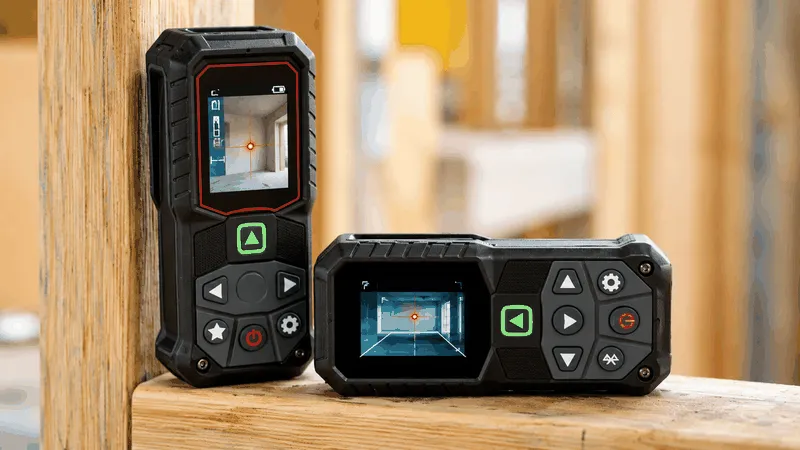
A laser measuring device is only as effective as the surface and environment it reads. Poor readings can come from two factors: a reflective surface that scatters light instead of reflecting it, and an offset reference point that adds the instrument’s length to every reading. You can correct both problems once you understand the cause. Laser models fall under the laser measure family, and VEVOR laser measure explains its basics.
- Why Readings Go Wrong on Dark, Glass and Glossy Surfaces
- The Datum Setting That Ruins Short Measurements
- Laser or Ultrasonic for Stairwells and Small Rooms
- Measuring Square Footage and Volume Step by Step
- DIY Jobs: Shelves, Flooring and Paint
- Pocket Size, Battery Life and Daily Use
- Comparing Brands on Warranty and Tolerance
- Five Laser Measuring Tools Compared
Why Readings Go Wrong on Dark, Glass and Glossy Surfaces
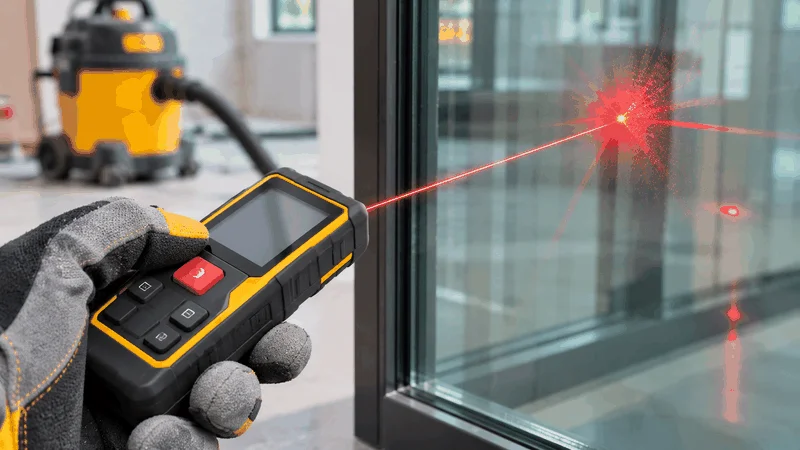
A problem commonly reported with these laser measurers, but not well understood. The laser measurer relies on light reflecting back to its receiver, and certain surfaces don’t reflect light well.
Why does my laser measurer give inconsistent readings on dark, shiny or glass surfaces?
As per the manufacturer’s guidelines, there are four types of problematic surfaces:
- Dark surfaces tend to give weak or irregular signals because they reflect little light. This varies depending on the laser measurer used. Solutions include finding a suitable target or reducing the distance.
- Glass, mirrors, and shiny metals may deflect the light beam away from the receiver. If possible, use a matte and opaque target. With glass, the laser measurer may read the surface behind it.
- Transparent and wet surfaces produce inadequate or irregular signals.
- Porous surfaces are also mentioned as hard targets.
Two ways to correct for these errors are to move the object farther from the laser measurer or to divide the measurement into parts and add them up. However, none of the manufacturer websites reviewed publish error statistics for specific surfaces. So no table shows the error for each one.
When and how to use a target plate
A target plate is a flat, matte card or special plate placed against the surface you are measuring. The target plate provides a constant, diffuse reflective surface for the beam to bounce off, so it reflects evenly back to the receiver.
Keep the plate perpendicular to the beam, not at an angle, and be aware that the measurement will be to the plate’s surface rather than the target itself. The manufacturer recommends a target plate for a laser measuring tool outdoors in bright sunlight. For hard-to-reach targets, see the digital tape measure for alternate methods.
The Datum Setting That Ruins Short Measurements
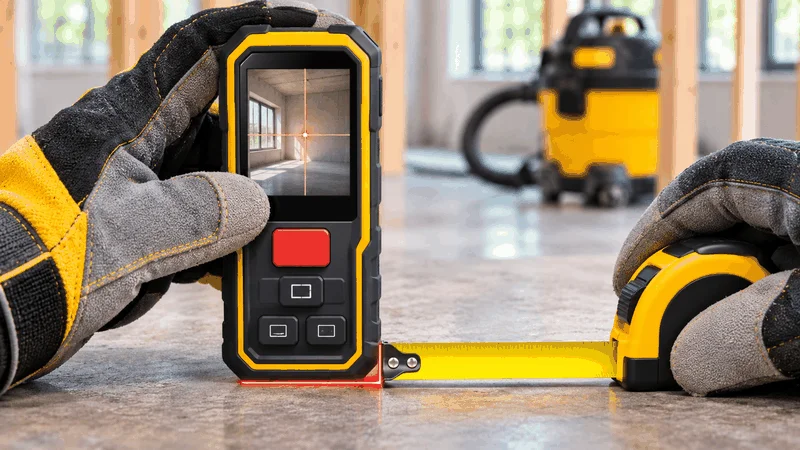
This mistake tends to trap experts more than novices because it yields values that look very realistic. It is most devastating where accuracy matters most.
Which laser measurers are most accurate at short range, for kitchen and cabinet installers?
It is not about the tool. Bosch says laser measurers work equally well at short and long ranges, and manufacturer specifications indicate ranges starting at 0.05 m.
It is about the context. A laser measurer can measure from either the front reference edge or the rear reference edge. If the selected datum does not correspond to the way you place the instrument, there will be a constant offset in your reading.
How it applies most acutely to cabinetry: the offset remains constant, but the measuring distance decreases. For example, using a typical 125 mm laser distance measuring tool, the 125 mm offset accounts for 0.4% of 30 meters, but over 20% of 600 mm of cabinet run.
Two practices to overcome it. Confirm the reference edge before each measurement session, and measure one short dimension with a tape. High-precision hand tools for close measurements are discussed in the VEVOR digital caliper.
Laser or Ultrasonic for Stairwells and Small Rooms
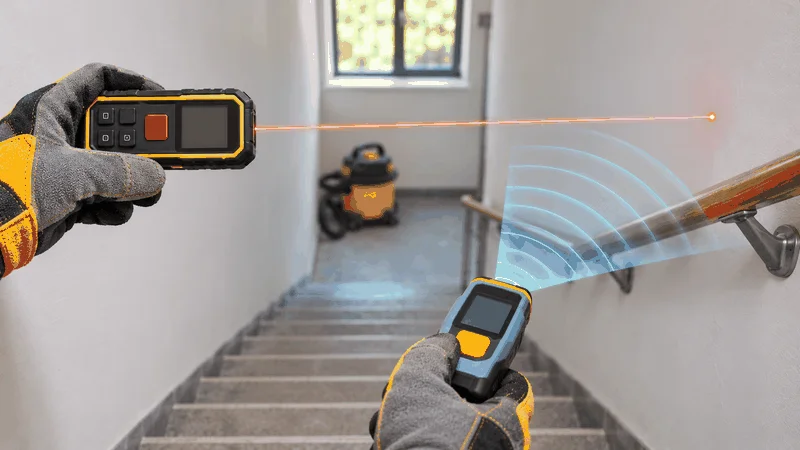
Intuitively, sound seems better suited for confined spaces than laser. However, the beam’s properties contradict that assertion. This is an evaluation of sound versus laser technology, not a comparison of individual products.
What is the difference between a laser measurer and an ultrasonic measurer?
The laser measurer measures the time for light to travel round-trip. Whereas the ultrasonic uses an echo of the sound and measures time based on the speed of sound in the air.
| Laser | Ultrasonic | |
| Accuracy | Millimetre level | Centimetre level |
| Beam | Narrow, highly directional | Fan-shaped |
| Affected by | Clean optics, surface type | Temperature gradients, wind |
A laser measurer is much more appropriate for staircases and smaller areas because of its beam spread. Instead of reflecting from the surface it was aimed at, the sound cone will bounce off the nearest object, such as a railing, newel post, or even a door arch. Reports indicate that ultrasonic devices bounce off the nearest objects and work best on clean surfaces in rooms without people.
For example, one industry publication notes that an ultrasonic fan is about 0.76 m wide at 2 m and needs the target within 10 degrees of perpendicular. This is the data the author provides for this technology, not universal figures, since beam spread can vary from one ultrasonic sensor to another. Narrow-beam ultrasonic sensors even exist for this reason.
Measuring Square Footage and Volume Step by Step
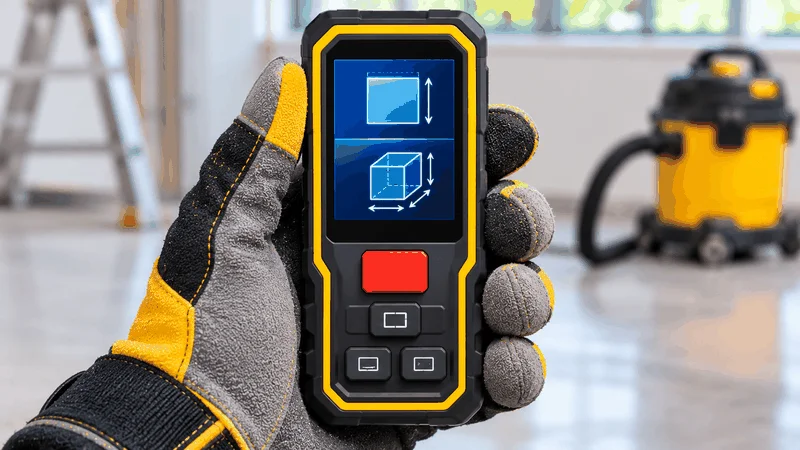
However, most laser measurers compute area and volume onboard, eliminating the math process but not the procedure. One step happens before you take readings.
How do I use a laser measurer to calculate square footage and volume?
Choose units and check the datum. Choose ft, m, in, or ft+in, and confirm what reference point is used.
- Use area mode. The laser measurer asks for two measurements.
- Measure the length by taking the reference point as the start point. Do not move the laser measurer; point the laser to the other side.
- Do the same to measure the width. The VEVOR laser measurer will provide square footage.
- Use volume mode and measure the height to obtain cubic capacity.
- For irregular spaces, measure the room in several rectangles and add the values you get. Each bay and alcove requires two separate measurements.
- Double-check one dimension with the tape, then order materials based on the calculations.
The order of modes differs by model; refer to your manual.
DIY Jobs: Shelves, Flooring and Paint
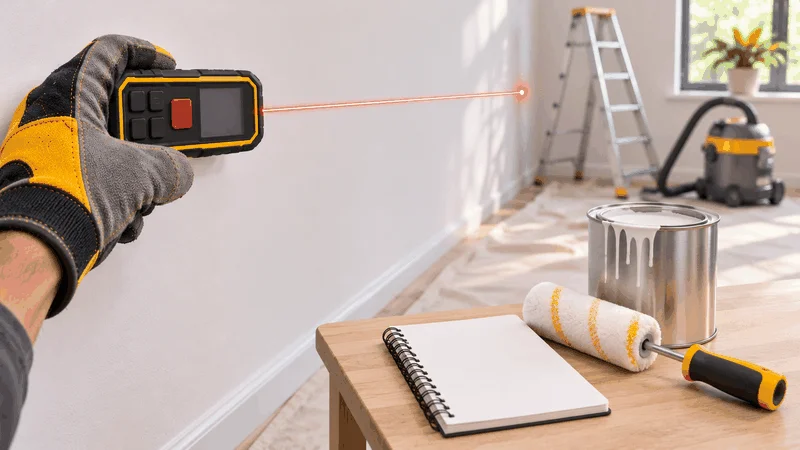
Domestic jobs don’t require the best laser measurer, but they do require using the three functions properly. You perform three tasks in three modes, and people often choose the wrong one.
Which laser measurers are best for DIY projects like shelves, flooring and paint?
- Hanging shelves requires repeatable distances and a definite datum, and that’s where a reference-point error crops up.
- Laying flooring requires area mode and the discipline to break down irregular rooms into several rectangles. Add waste after the laser measurer provides the area measurement.
- Painting estimates require wall area rather than floor area, where walls are measured in length times ceiling height minus openings. Volume mode is not what you want.
Key specifications for DIY users include a backlit screen, enough stored readings to measure an entire room before any recording, and a minimum working distance. Products in the laser measuring category vary on all three fronts.
Pocket Size, Battery Life and Daily Use
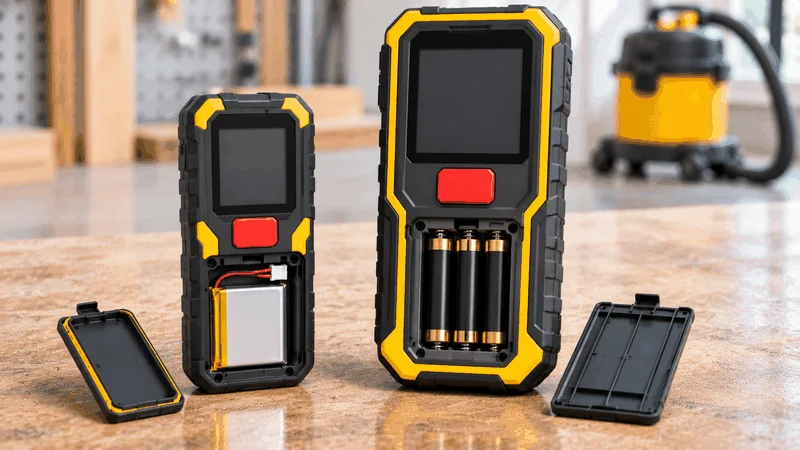
Two practical questions determine whether a laser measure tool is worth buying, and both are frequently compared.
Which compact laser measurers fit a pocket or tool belt?
Dimensions and weight are the numbers to watch, and they can differ more than you might expect in the same range. The 229 ft unit measures 112 × 50 × 25 mm and weighs 103.5 g, while the 328 ft and 400 ft units measure 125 × 54 × 27 mm and weigh 153.1 g and 157.8 g, respectively. The heavier laser measurer won’t fit easily in a tool belt, so it will stay in the bag. The deal is in screen and memory capacity: the smaller one has a 2-inch backlit LCD with 99 groups, and the bigger one has a 2.4-inch color LCD with 100 groups.
Recommended For Your Project
Which offers the best battery life and rechargeable options?
Both these approaches are available. USB-rechargeable built-in batteries don’t require buying new cells; however, when the battery dies, you’ll have downtime. Replaceable cells are easy to swap, and one manufacturer guarantees its replaceable battery sets for over 5,000 tests, depending on the test parameters, although battery life in practice varies. In both cases, a low battery alert can stop the work process. So, once you receive the alert, recharge or replace your battery.
Comparing Brands on Warranty and Tolerance
Warranty and tolerance levels are among the few factors you can compare directly between brands, and they differ more than advertised accuracy levels.
How do the top brands compare on warranty, accuracy tolerance and support?
Regarding stated tolerance, the VEVOR specification sheets mention ±1.5 mm, and the Bosch model checked. Honeytek lists a tolerance of ±2.0 mm and notes that it doesn’t apply to every measurement under every condition—an honest disclaimer to look out for in any listing.
Concerning warranty, the Bosch model comes with a one-year warranty that extends to two if you register it within eight weeks of purchase. The VEVOR product listings I checked didn’t mention warranty information; however, you can always ask the vendor about it.
Regarding documentation, the trend here is the opposite of what you’d usually expect. All three VEVOR products mention their laser class: Class 2, 635 nm, below 1 mW. The Bosch product listing I checked mentions nothing. Still, make sure to check your laser class.
Five Laser Measuring Tools Compared
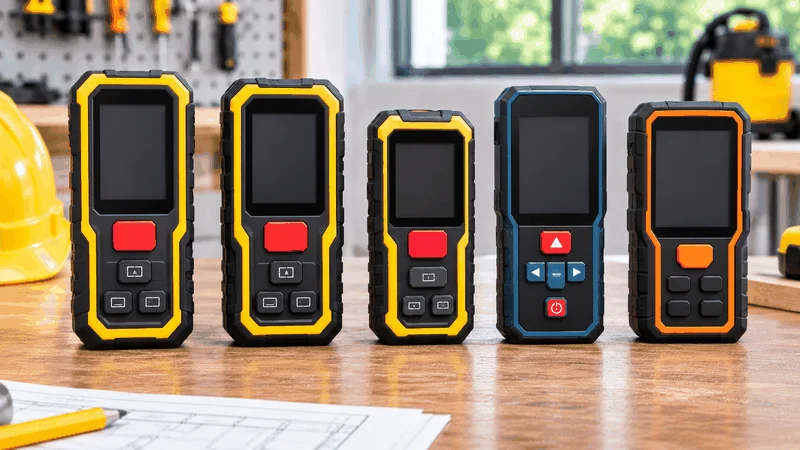
The table below compares five laser measuring tools using the specifications published on their respective product pages.
| Model | Range | Tolerance (spec table) | Memory | Size and weight | Laser class |
| VEVOR SW-S120 | 400 ft / 121 m | ±1.5 mm (title: ±1.6 mm) | 100 groups | 125 × 54 × 27 mm, 157.8 g | Class 2, 635 nm |
| VEVOR SW-S100 | 328 ft / 100 m | ±1.5 mm (title: ±1.6 mm) | 100 groups | 125 × 54 × 27 mm, 153.1 g | Class 2, 635 nm |
| VEVOR SW-DA70 | 229 ft / 70 m | ±1.5 mm (title: ±1.6 mm) | 99 groups | 112 × 50 × 25 mm, 103.5 g | Class 2, 635 nm |
| Bosch GLM400CL | 400 ft | ±1.5 mm typical | 50 readings + 600 images | 0.46 lb | Not stated on page |
| Honeytek LDM series | 40–100 m by model | ±2.0 mm | Not stated | Not stated | Not stated |
Conclusion
The vast majority of poor laser-measure readings stem from two factors. Target: dark, reflective, glass, glossy, moist, and porous objects attenuate and/or reflect the signal, while using a dull target surface at right angles to the measurement spot solves most of these issues. Datum: when the reference point does not align with how you hold the device, you get a systematic offset in all measurements—a tiny offset in the whole room, more than 20% of a 600 mm cabinet run.
In staircases and small rooms, the laser measurer is preferable to the ultrasonic one because its narrower beam won’t detect the handrail. You can verify accuracy by checking the datum, comparing one dimension with a tape measure, and charging when you see the low-battery alert. Operation is covered in VEVOR laser measure and tape alternatives in digital tape measure.
Frequently Asked Questions
Why won’t my laser measurer read a glass wall?
The beam may reflect off the glass, and if the glass is transparent, it may measure something behind it. Use matte and opaque targets for the measurements.
Is ultrasonic better than laser in a small room?
Not usually. Good cone sounds will bounce back from surrounding obstructions; the literature says ultrasonic detectors work best on bare surfaces in an empty room. A laser measurer, with its narrow beam, works well in cramped areas.
Why is my laser measurer out by a few inches at short range?
It is most likely the reference-point setup. If the datum you choose differs from the instrument’s position, each reading will have an error equal to the laser measurer’s size.
Do I need a rechargeable or replaceable-battery model?
Replaceable batteries can be replaced on-site, with one manufacturer rating sets higher than 5,000 measurements under certain circumstances. Battery-operated laser measurers do not require battery replacement, but they must be charged. Precision hand tools are discussed in the VEVOR digital caliper.