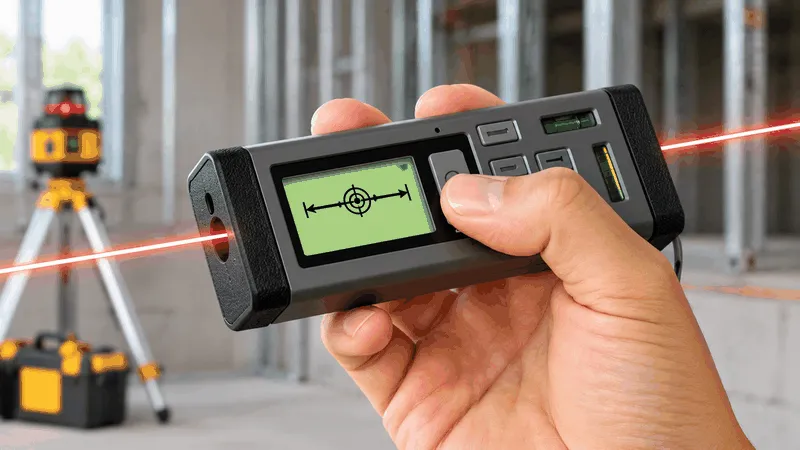
The laser measuring device is commonly marketed as an improvement over the tape measure, but that applies only in half the cases. The laser distance measuring tool has a known, distance-independent tolerance, whereas tape tolerance increases with distance, so you can calculate where one surpasses the other rather than estimate it. This list covers all seven criteria. Units are classified under the laser distance measuring tool type, with actual usage explained in VEVOR laser measure.
- 1. Laser or Tape: Where the Crossover Falls
- 2. Long-Range Outdoor Use and Bright Sunlight
- 3. Area, Volume and Indirect Measurement
- 4. Features That Actually Change the Work
- 5. Roofing, Exterior and Camera Viewfinders
- 6. Budget Against Premium Models
- 7. Checking Accuracy, and Why That Isn’t Calibration
- Four Laser Distance Measuring Instruments Compared
1. Laser or Tape: Where the Crossover Falls
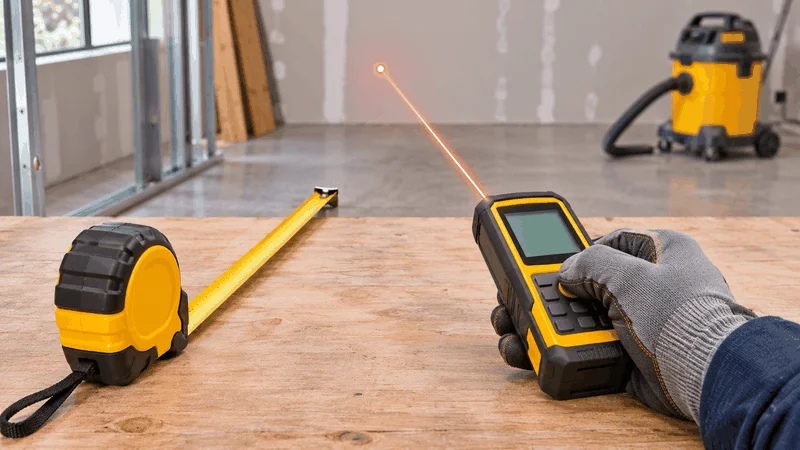
This is the problem behind the laser distance measuring tool buying decision, and tape measures come with published accuracy classes and tolerance formulas, so there is a precise mathematical solution. However, one condition must be met first.
How accurate are laser distance measuring tools compared to tape measures?
The equations given below are the accuracy classes for European tapes, with L being the length in meters: Class I ± (0.1 + 0.1L) mm, Class II ± (0.3 + 0.2L) mm, Class III ± (0.6 + 0.4L) mm. Most tapes available in the USA have no class indication.
The laser distance measuring tool has an indicated accuracy tolerance, but tape-measure tolerance grows with length. A particular laser distance measure’s actual accuracy may vary by model and other factors.
| Distance | Class I tape | Class II tape | Class III tape | Laser stated at ±1.5 mm |
| 2 m | ±0.3 mm | ±0.7 mm | ±1.4 mm | ±1.5 mm |
| 5 m | ±0.6 mm | ±1.3 mm | ±2.6 mm | ±1.5 mm |
| 10 m | ±1.1 mm | ±2.3 mm | ±4.6 mm | ±1.5 mm |
| 30 m | ±3.1 mm | ±6.3 mm | ±12.6 mm | ±1.5 mm |
These values are based on the equations, which the source does not list beyond 30 m. Solving each equation for 1.5 mm yields the crossover points: a Class II tape crosses over to a laser specified at ±1.5 mm around 6 m, a Class I tape stays ahead until around 14 m, and a Class III tape falls behind after 2.25 m. At 30 m, a Class II tape’s tolerance will be about 4.2 times greater than the laser’s.
Recommended For Your Project
When should I still use a tape?
Short runs, and any task a laser distance measuring tool can’t physically do. Lasers require line of sight and a reflective surface, so they cannot bend, turn corners, or go diagonally inside. For joinery tasks within several meters, Class I tape is the superior tool, and digital tape measures cover the electronic alternatives.
2. Long-Range Outdoor Use and Bright Sunlight
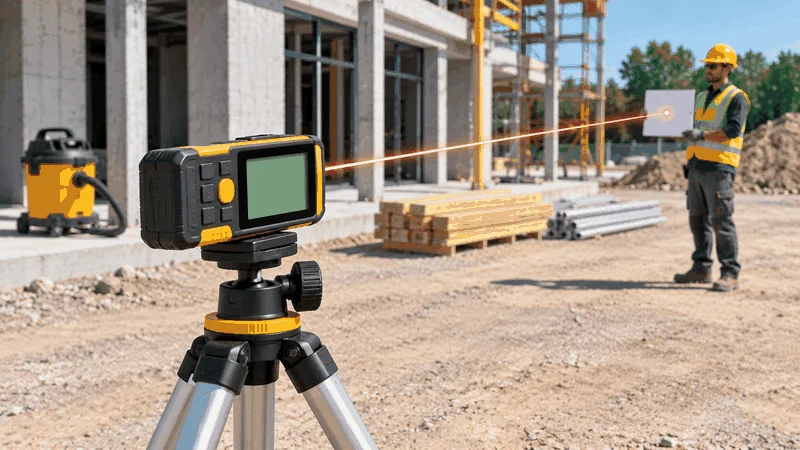
Outdoor performance is where the laser distance measuring tool lets customers down, but for physical reasons rather than a quality defect. Understanding the mechanism reveals what can solve the problem.
How far can they read in bright sunlight?
The maximum published range for a laser distance measuring tool is tested under good conditions. Bright light, target reflectance, and the measuring material will reduce the range. With very bright light, the receiver has difficulty distinguishing the spot’s reflection from ambient light.
There are three ways to solve this problem, in order of effectiveness: use a reflector at the end, use a model with a camera sighting system that locates the spot, or use another distance laser measurement device. For distance measurement, optical rangefinders aim through magnified optics rather than relying on the naked eye. Models like those in the golf rangefinder offer 650- and 900-yard ranges with 6× magnification. Their accuracy is not tested for precision construction measuring; therefore, do not use them for millimeter work without confirming this specification. General technique is covered in the VEVOR laser measure.
3. Area, Volume and Indirect Measurement
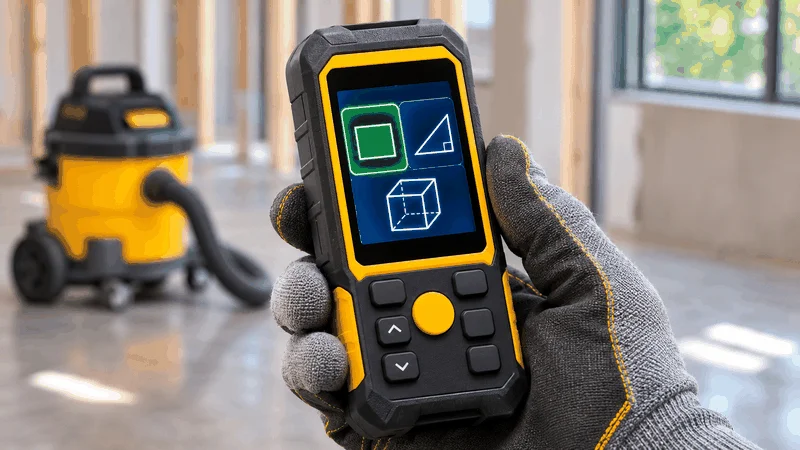
Estimating trades need a laser measuring tool with calculator functions rather than additional range. These functions are well documented, and one function does most of the work.
Which tools suit electricians and HVAC pros needing area, volume, and Pythagorean modes?
The VEVOR 2-in-1 Laser Tape Measure features area, distance, length, volume, angle, maximum, minimum, continuous, delay, and three-point Pythagorean, with a 0.3-second measurement time. The pictures in its manual show “7 Measuring Modes,” even though the listing includes 10 measuring modes; make sure you know what you will receive.
Three-point Pythagorean measures height using three distances when you can’t reach both the bottom and top ends, for example, when the apparatus is fixed high up on a wall or a duct is laid out under a suspended ceiling. Different laser distance measuring tool models apply this feature differently, so refer to your device’s manual rather than assuming they’re all similar.
A laser distance measuring tool’s area and volume modes help calculate room size and the volume of enclosed spaces. HVAC workers still need additional measurements to determine actual airflow volume. For comparison, a Bosch GLM400CL offers 11 functions, including indirect measurement, area, volume, addition/subtraction, a digital spirit level, and a 360-degree inclinometer.
4. Features That Actually Change the Work
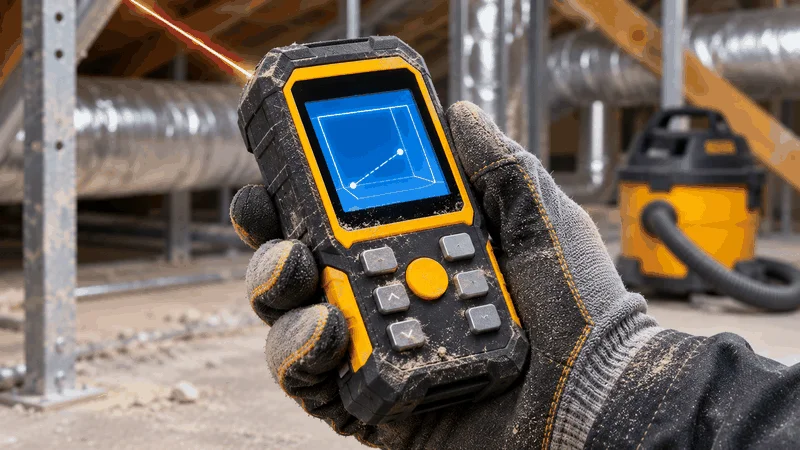
A laser distance measuring tool offers many features; it’s important to know which ones affect the workday. There are four, but two are often neglected.
What features should I look for, such as IP rating, backlit display, and memory?
IP Rating. Both tested laser distance measuring tool units have an IP54 rating, meaning they are dust-protected and resistant to water splashes. This does not mean the device is waterproof, so use it in wet weather according to the manufacturer’s recommendations.
Display. SW-S120 features a 2.4-inch backlit color LCD, whereas the Bosch has a backlit color display with reinforced glass and an on-screen user guide for each mode. Backlighting is more important than screen size in a plant room or roof void.
Memory. The laser distance measuring tool units differ significantly: the SW-S120 auto-saves up to 100 measurement groups, while the Bosch saves the latest 50 readings and over 600 images. The difference is that the budget model saves twice as many measurement groups. This can become apparent when you measure an entire property before writing anything.
Class of laser. The SW-S120 is a Class 2 laser at 635nm with less than 1 mW of power. The Bosch page does not specify any laser class, which is unusual for documentation. Precision hand tools are described in the VEVOR digital caliper.
5. Roofing, Exterior and Camera Viewfinders
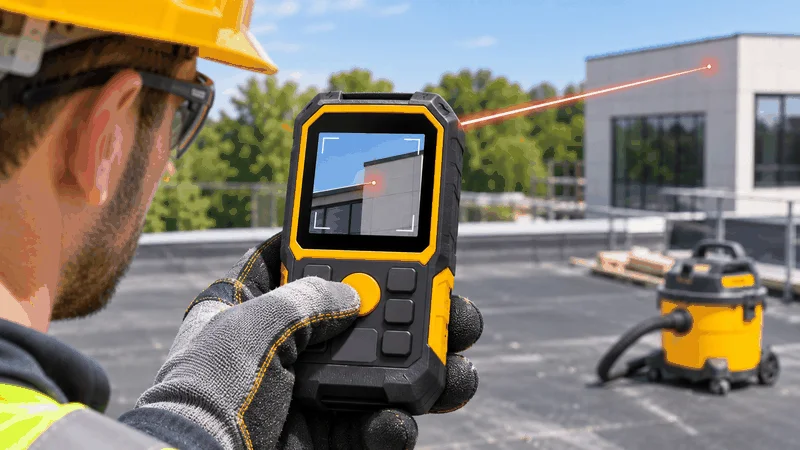
Exterior work combines two of the most difficult environments: distance and daylight. One element solves both, and only one laser distance measuring tool has it.
Which tools have a built-in camera or viewfinder for targeting?
The GLM400CL by Bosch has an adjustable zoom camera to pinpoint the laser spot when shooting at long distances and in bright environments. It stores over 600 images in its measurement memory, though the photos can be too large to transfer via the Bluetooth app. It works with a smartphone to transfer measurements and weighs 0.46 lb.
None of the VEVOR laser distance measuring tool models in this class has a camera or optical viewfinder. That’s the honest difference; the only solution for roof measuring is to use the target plate and another instrument called an optical rangefinder. More formats sit in the laser measure category.
6. Budget Against Premium Models
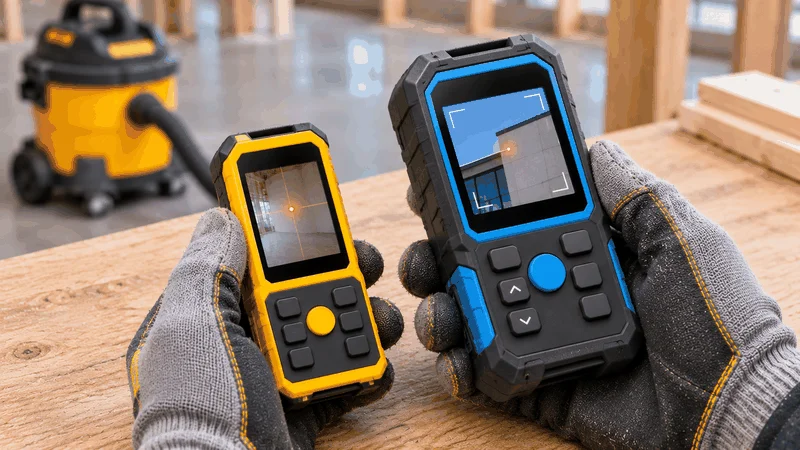
Laser distance measuring tool price levels here are legitimate; however, the specification gap is smaller than the price gap. So it is important to know exactly what the money buys.
How do sub-$50 tools compare with $100+ models on accuracy and durability?
However, at 400 ft, both the SW-S120 and the Bosch GLM400CL quote an error of ±1/16 in. (about 1.5 mm), and both claim IP54. However, you can’t take the SW-S120’s claimed accuracy at face value, since its product page lists ±1.5 mm in the spec table and ±1.6 mm in the title line.
The higher-end model adds premium features: a camera viewfinder, Bluetooth and app transfer, an inclinometer and digital level, and strengthened screen glass. It also includes a year-long warranty that extends to two years if the unit is registered within eight weeks. The lower-end laser distance measuring tool doubles the number of stored measurement groups and adds a laser class specification. The current price for either one was not independently verified.
7. Checking Accuracy, and Why That Isn’t Calibration
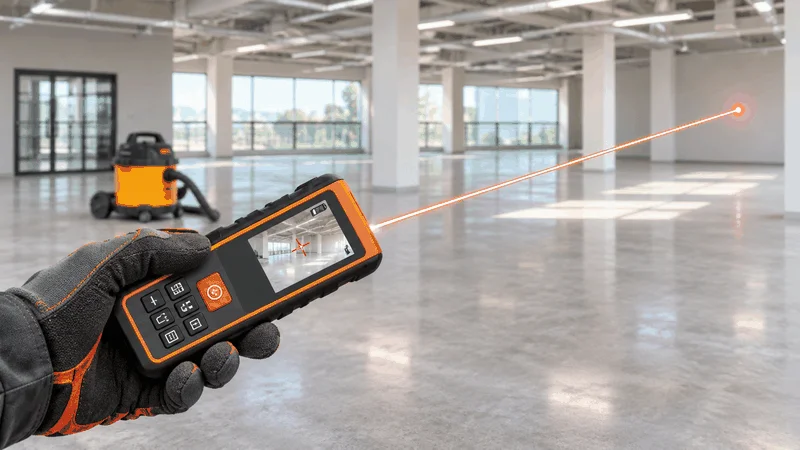
No laser distance measuring tool should be taken for granted before using it on any paid project. The difference between checking and calibration matters here because you can only do one of them.
How do I test or calibrate a laser distance measuring tool?
Checking and calibration are two separate actions. A comparison test shows whether the tool works properly; it doesn’t calibrate the laser distance measuring instrument. None of the reviewed lists include calibration instructions. Distance meters are not generally calibrated in the field like a laser level.
To check: measure the reference distance on a stable surface and compare it with several readings made from the same place. Repeat the procedure at different distances. If the results fall outside the manufacturer’s specified tolerance, contact the manufacturer or an authorized repair center.
A useful trick to remember when using the laser distance measuring tool is which reference point the tool uses, since the distance is always adjusted by the body length when changing between base and tip datums. For the instrument on support, Bosch offers a one-year warranty with a registration extension, while the VEVOR listing did not provide warranty conditions—it may be worth asking before buying. Comparable checks for hand instruments appear in the VEVOR digital caliper.
Four Laser Distance Measuring Instruments Compared
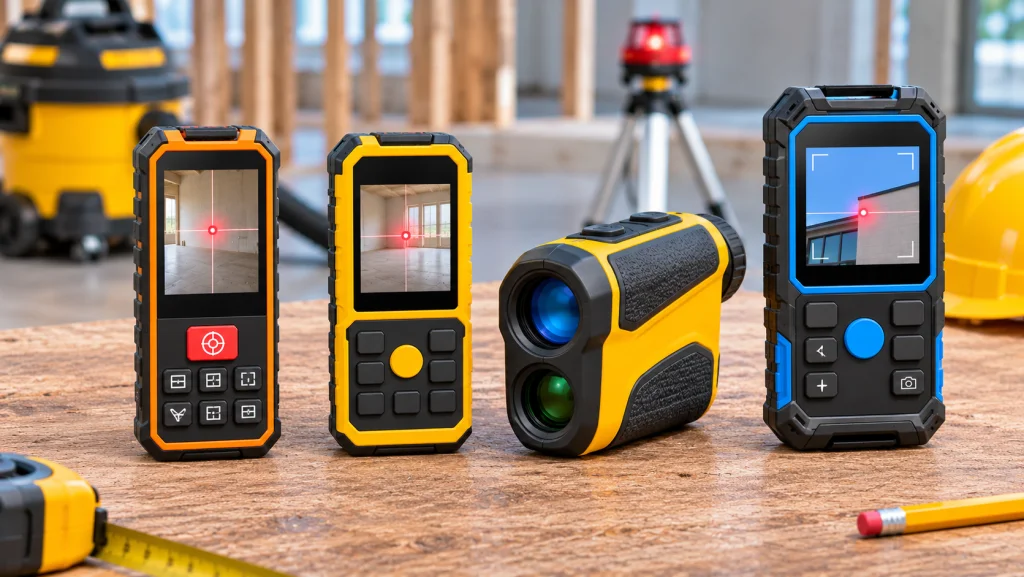
| Model | Range | Stated accuracy | Modes | Memory | Laser class |
| VEVOR SW-S120 | 400 ft / 121 m | ±1.5 mm (title says ±1.6 mm) | Area, volume, 3-point Pythagorean, angle, continuous | 100 groups | Class 2, 635 nm, <1 mW |
| VEVOR 328 ft laser measure | 328 ft / 100 m | ±1.6 mm | Area, volume, Pythagorean | 100 groups | Not verified |
| VEVOR 900 yd rangefinder | 900 yd | Not verified | Slope, flag lock, 6× optics | Not stated | Not verified |
| Bosch GLM400CL | 400 ft | ±1.5 mm typical | 11 functions, indirect, inclinometer | 50 readings + 600 images | Not stated on page |
Conclusion
The laser distance meter is justified after around 6 meters. At 30 m, the Class II tape’s tolerance is about 4.2 times larger than the laser’s stated ±1.5 mm tolerance. Within six meters, the laser distance measuring tool is less accurate than the best tape, and for curves, corners, and inside diagonals, the laser isn’t an option. Remember that the laser’s actual tolerance depends on the model, target material, and conditions.
When shooting outside, assume the published range is for favorable conditions and prepare with a target plate, a camera viewfinder, or an optical rangefinder for longer sightlines. When shopping for a laser distance measuring tool, check memory capacity, the indicated laser class, and make sure the page doesn’t contradict itself on range or tolerance. Tape alternatives are covered in digital tape measure, with more formats in the rotary laser range.
Frequently Asked Questions
Is a laser measure more accurate than a tape measure?
This is based on distance and class of tape. For a laser distance measuring tool specified at ±1.5 mm, the tolerance applies throughout its range, but tape tolerance increases with length, and a Class II tape corresponds up to 6 m.
Why does my laser measure not reach its stated range outdoors?
The published maxima were measured under ideal conditions. Bright light, target reflectivity, and surface finish all limit effective range. Use a reflector target disc, camera model, or optical rangefinder.
What is three-point Pythagorean mode for?
Height is obtained using three readings when you can’t access the bottom or top. Procedures vary by model, so refer to your user manual for details.
Can I calibrate a laser distance measure myself?
Usually no; neither option is listed. You can verify it against a known standard and test it at various distances. Send anything outside tolerance to the manufacturer or an authorized service center.