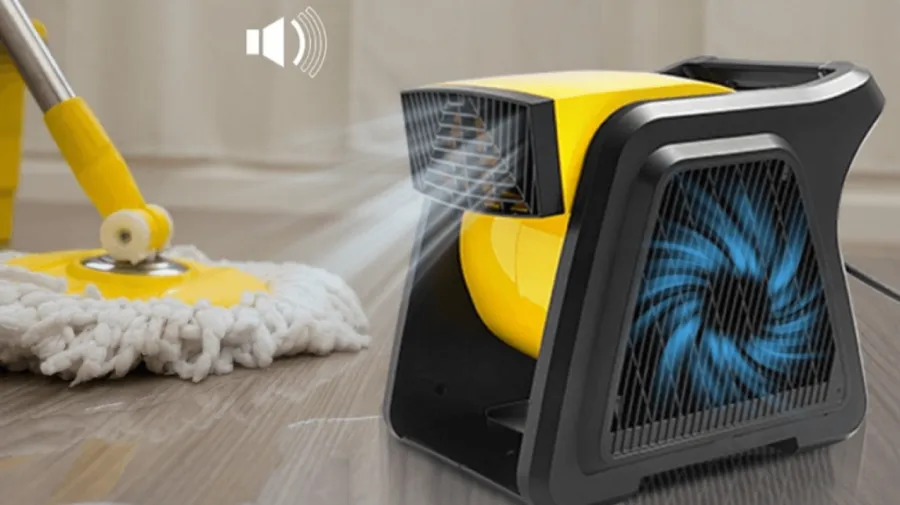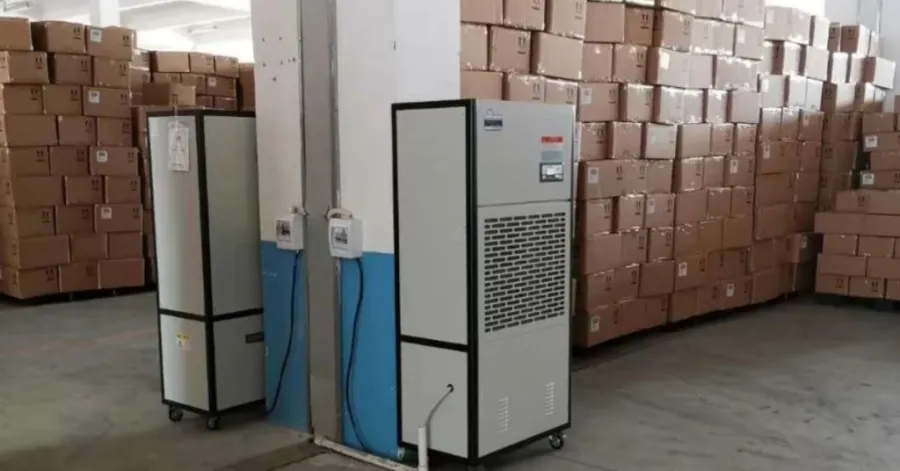
Humidity in warehouses is necessary to prevent damage to stored commodities, equipment, and containers caused by moisture. High humidity may lead to mold and rust, and to product loss, resulting in higher operational expenses and reduced productivity. Selecting an appropriate industrial dehumidifier for the warehouse will maintain air quality and ensure safe storage.
Different warehouses have different solutions based on size, temperature, and moisture levels. Learning how to manage humidity is also useful for enhancing product quality and storage security. This guide outlines key considerations, comparisons, and selection processes to help you choose the right system for your warehouse.
Key Factors for Choosing an Industrial Dehumidifier for a Warehouse
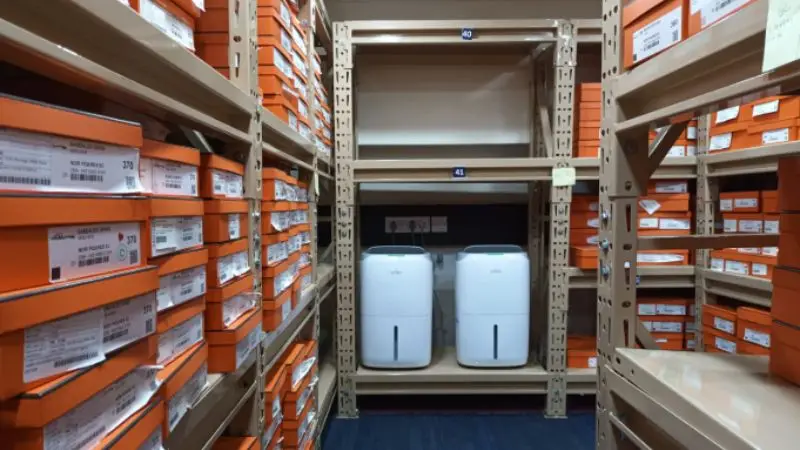
A warehouse should have a constant temperature and humidity to ensure the safety of goods, machines, and packaging. Moisture spreads easily and can destroy materials without control. The selection of the appropriate industrial dehumidifier for the warehouse depends on the space size, moisture level, and type of storage. These aspects also determine ways to reduce humidity in a warehouse without using a lot of energy or making it less efficient. Knowing these fundamentals will enable you to choose a system that is effective in the actual warehouse environment, not on paper only.
Warehouse Size and Humidity Levels
The size of the warehouse and its airflow directly influence moisture accumulation within it. The large storage facilities would tend to have uneven humidity, with some areas remaining wet and others dry. This normally occurs around doors, loading points, and corners that lack proper ventilation. Humidity levels can be measured with digital meters to identify problem areas at an early stage.
In larger facilities, a large warehouse dehumidifier may be necessary as it can be used to cover large areas more evenly. Unless the airflow is large, small or underpowered units cannot meet such demands, resulting in moisture accumulation. In most situations, organizations select the most appropriate industrial dehumidifier to store in the warehouse to maintain humidity levels throughout the facility.
Moisture Load and Dehumidifier Capacity
The total amount of water vapor entering the warehouse daily is called the moisture load. Its sources are external air, human activity, equipment, and minor leakages. Unless this load is managed adequately, humidity levels rise rapidly and affect stored products.
It is essential to select an appropriate capacity for long-term performance. A unit with low capacity will not be able to extract moisture, and the other one is oversized, thereby wasting energy. This is why many companies would like to have an energy-efficient warehouse dehumidifier system that balances performance and price. The correct sizing of the warehouse ensures a smooth running and stable humidity control even when the warehouse is at its busiest.
Types of Dehumidifiers: Refrigerated vs Desiccant
Various warehouse environments need varying dehumidification technologies. Warm and humid conditions are ideal with refrigerated systems. They help eliminate moisture by cooling the air and collecting water, and they can be used in general storage areas.
Desiccant systems, on the other hand, perform better in cool weather. They employ moisture-absorbing materials instead of cooling, making them suitable for low-temperature storage. This can be particularly important in sensitive settings such as an industrial dehumidifier or a cold storage warehouse, where temperature-based systems might not be effective.
The correct type will provide stable humidity, improved product protection, and increased equipment life in the various warehouse settings.
Best Industrial Dehumidifiers for Warehouse Use in 2026
Selecting the appropriate dehumidifier can significantly affect how well a warehouse remains free of moisture damage. The storage sizes, temperatures, and humidity levels have different models constructed.
The following are dependable commercial and industrial units that help ensure stable air quality. The products are tailored to meet warehouse requirements, including general, cold, and high-volume storage.
The following are 5 industrial dehumidifiers suitable for use in a warehouse, with VEVOR listed first as requested.
1. VEVOR 70 Pint Commercial Industrial Dehumidifier
The VEVOR 80 Pint Commercial Industrial Dehumidifier is a medium-to-large warehouse-sized unit that requires some consideration of moisture levels when covering goods and equipment. It helps maintain a constant humidity level in storage premises, workshops, and basements. This model is widely employed in situations where steady performance and budget-friendliness are required. It facilitates continuous drainage; hence, it can be used in a commercial setting with long run times. It is a convenient option for users who need an easy yet efficient solution to warehouse humidity without complicated installation requirements.
Pros:
- Inexpensive to utilize in the business world.
- Continuous drainage option
- Easy to operate and install
Con:
- Does not work well in very humid environments.
@jeromy_henson_bfss VEVOR 125 PINT COMMERCIAL DEHUMIDIFIER WUTH DRAIN HOSE. LARGE CAPACITY DEHUMIDIFIER FOR WATER DAMAGE RESTORATION. #fyp #dehumidifier #vevorttshop #fy #commercialdehumidifiers #fypシ゚viral #dehumidifiers #vevor #waterabsorption #viral #tiktok #moistureabsorber #fypage #fypシ゚viral #vevorproducts #hardwaretools #ttslevelup #ttsdelightnow #springsale #springtok #springdeals #deals #springsavings #tiktokstore #tiktokshopcreatorpicks #sale #tiktokshopspringglowup #deal #tiktokshoprestock #onsalenow #tiktokshopsummersale #look #summertimevibes #savings #summervibes #summersales #tiktokshopsummerturnup #sell #tiktokshop #tiktokshopping #trending2025 #viralvideos #onsale #flashsale #giftideas #giftidea #tiktokshopfinds #tiktokmademebuyit #foryou #foryoupage #trending #wow #tiktokmademedoit #getyours #today #tiktokfinds #tiktokfind #tiktokviral #tiktokviralvideo #tiktokviraltrending #ttsacl #fathersday #fathersdaygift #fathersdaysale #vevorsummerlife @Vevor_US @vevor shop @HAIDEE_collab
♬ original sound – JEROMY HENSON-BFSS☑️
2. Alor Air Sentinel HDi90 Industrial Dehumidifier
The AlorAir Sentinel HDi90 is designed with high moisture control in warehouses, crawl spaces, and industrial storage warehouses. It is very common in environments with prolonged high humidity. This unit has a reputation for high moisture removal efficiency and longevity. It is effective in large areas that require constant dehumidification. The tight shape will also enable them to be installed anywhere in the warehouse corner. It fits well with companies that require dependable humidity control to protect sensitive inventory and equipment in challenging environments.
Pros:
- Great moisture removal ability.
- Durable industrial-grade build. It can be used continuously.
Con:
- A little higher initial price.
3. Dri-Eaz LGR 7000XLi Commercial Dehumidifier
The Dri-Eaz LGR 7000XLi is a high-performance dehumidifier suited to large industries and warehouses. It employs advanced LGR technology to effectively eliminate moisture, even in difficult conditions. This model is common when there is a restoration project and when the large storage facilities are involved, and humidity control should be accurate. It has good circulation and quick moisture removal, so it can be used during emergencies and for long-term use in warehouses. The unit was designed for professional use, where cost savings are less important than reliability and performance.
Pros:
- Extremely efficient in removing moisture.
- Strong performance in large spaces
- Advanced LGR technology
Con:
- Pricier in comparison to the ordinary ones.
4. Aprilaire 1850 Pro Dehumidifier
The Aprilaire 1850 Pro is used in commercial and industrial settings where humidity needs to be maintained consistently. It is commonly used in large buildings, warehouses, and storage rooms where there are no air stability issues. This unit is silent and efficient, thus it can be used during the whole process without disrupting the work in the workplace. It also aids ducted installation, which assists in dispersing dry air evenly in large areas. It is suitable for businesses that require a trade-off between performance, energy efficiency, and long-term reliability.
Pros:
- Quiet operation
- Energy-efficient performance
- Supports ducted installation
Con:
- Requires professional installation
5. Quest Dual 105 Industrial Dehumidifier
Quest Dual 105 is a high-power industrial dehumidifier used in large and commercial warehouses. It is characterized by a high moisture removal ratio and energy-efficient design. This unit is equipped with dual airflow technology to enhance drying performance over expansive areas. It is widely used in environments where humidity needs to be controlled without interruption. Quest Dual 105 is appropriate when a business requires good performance at an economical energy use over a long period of time, particularly in a large-scale storage facility.
Pros:
- Dual airflow with a high-efficiency system.
- Energy-saving operation
- Good performance in big warehouses.
Con:
- Large size in small areas.
How to Select the Best Industrial Dehumidifier for Your Warehouse
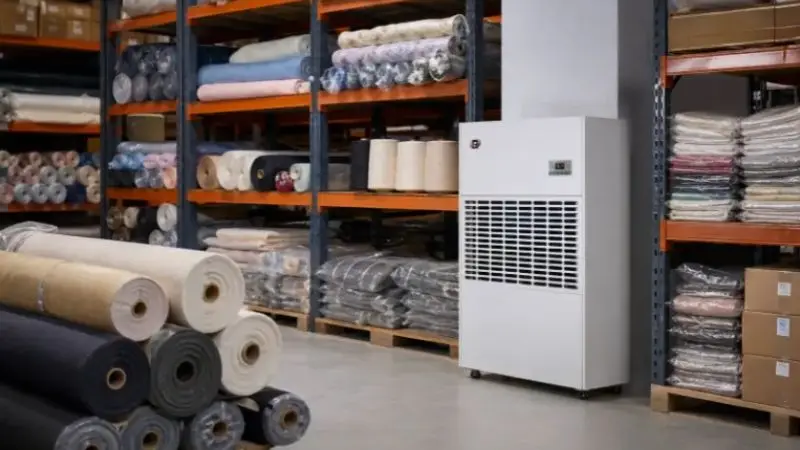
Selecting the appropriate system is important because each warehouse has varying moisture levels, storage requirements, and air circulation patterns. An industrial dehumidifier is necessary in a warehouse to prevent moisture from damaging inventory, machinery, and packaging. The performance, efficiency, and long-term cost should be used to select, not only the initial price. When you know your warehouse needs, it becomes easier to select a system that provides stable humidity control and allows you to operate smoothly without interruptions in your day-to-day operations.
Step-by-Step Guide to Choosing the Right Warehouse Dehumidifier
To begin the selection process, one must first understand the warehouse environment. To start with, calculate the total area (including height), since the volume of air influences moisture-control requirements. Then monitor the humidity in various locations because moisture is not evenly distributed throughout the warehouse. By determining such differences, you can determine the appropriate size of the system.
The second step is to enumerate all the sources of moisture, like workers, machinery, and external air that comes in through the doors. This helps estimate the amount of work the system will undertake. In larger warehouses, a dehumidifier with sufficient capacity is usually required to cover every part of the warehouse. In most situations, companies opt for the most suitable industrial dehumidifier for warehouse storage, as it delivers reliable performance in a challenging environment where humidity control is essential.
Differences Between New and Used Industrial Dehumidifiers
Selection of new and obsolete equipment is based on the budget and risk tolerance. The new dehumidifier offers improved reliability, new technology, and improved service life. It is particularly applicable in warehouses where the humidity should be kept at a constant level to preserve delicate products.
An old system might be cheaper at startup, but it could be worn out, less efficient, or less feature-rich. Although performance in some of the units used remains good, they might not perform as well under sustained use as new models. In sensitive environments like cold storage, a cold storage warehouse dehumidifier is typically recommended in a new state to maintain stable operation and prevent spontaneous failures.
Understanding the Total Cost of Ownership for a Warehouse Dehumidifier
The real price of a dehumidifier is higher than the purchase price. It covers electricity consumption, maintenance, repairs, and life span. There are those models that might be less expensive initially but costly in the long term because they require more energy, and those that will save you money in the long term because they use less energy.
A warehouse dehumidifier system is also energy efficient and consumes less energy when in operation. This is especially important in warehouses that operate 24/7. When making decisions, the better approach is to compute the total cost over several years rather than just the initial investment. This will provide superior financial planning and enable the warehouse to maintain stable humidity control without any unforeseen costs.
Common Warehouse Humidity Problems and Their Practical Solutions
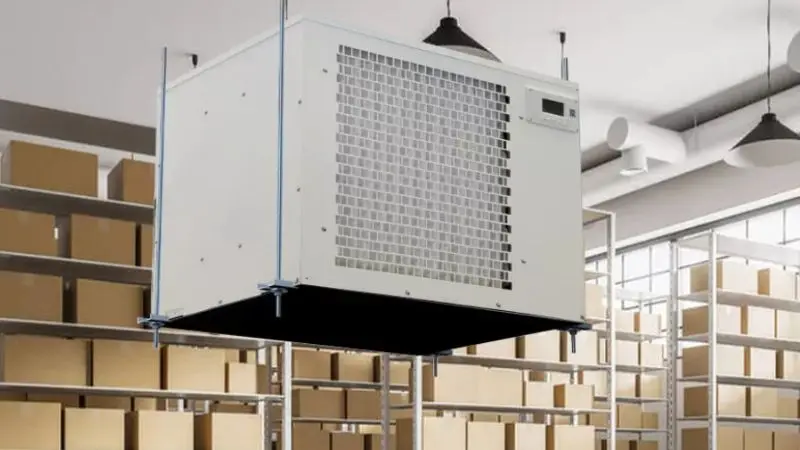
Humidity in warehouses can severely impact storage quality, equipment durability, and safety. The problems accumulate over time and become costly to correct later when the moisture content is not kept at normal levels. An effectively controlled warehouse dehumidifier will prevent such conditions by maintaining air moisture at a constant level. Awareness of likely issues also helps you determine how to promptly lower humidity in the warehouse before it wreaks havoc. The following are the most common humidity-related problems in warehouses and their typical effects on operations.
Condensation Build-Up on Walls and Stored Goods
Condensation occurs when hot air collides with cold surfaces within the warehouse, causing water to drip onto walls, ceilings, and stored products. It is highly typical in storage areas that are improperly ventilated or where temperatures vary widely. Packaging can be weakened or spoiled, and product quality can deteriorate over time due to condensation. It also forms slippery surfaces, which pose more safety hazards to the workers.
A large-warehouse dehumidifier may be required in a large storage facility to regulate moisture content and prevent condensation from spreading to various areas. To prevent the recurrence of moisture accumulation in the warehouse’s high-risk zones, it is important to control airflow and maintain the necessary humidity levels.
Mold and Mildew Growth in Storage Areas
Warehouses with persistent humidity face serious issues with mold and mildew. These are fast-growing fungi in cardboard, cloth, wood, and other organic substances. When they multiply, they can destroy entire batches of stored products and create unhealthy working conditions.
To avoid this, warehouses should maintain constant moisture control rather than occasional treatment. Most facilities use the best industrial dehumidifier for warehouse storage to maintain a safe humidity level throughout the day. An energy-efficient warehouse dehumidifier system is useful in conditions where temperature is also a factor, helping stabilize the environment and lower operational costs. The best way to prevent mold before it occurs is through consistent control of air.
Rust and Corrosion on Machines and Metal Items
Metal machinery and equipment are extremely sensitive to moisture in the air. When moisture is present, rust and corrosion begin to attack exposed surfaces. This not only harms costly machines but also diminishes their performance and longevity. Over time, maintenance expenses and productivity decline as frequent repairs are needed.
When it comes to heavy-duty storage facilities, a warehouse dehumidifier is necessary in order to ensure that valuable equipment is not exposed to moisture. An industrial dehumidifier for a cold storage warehouse is particularly vital in temperature-controlled storage spaces, as condensation can easily develop at low temperatures. Adequate humidity levels also keep the machines in good working order and minimize long-term operational risks.
Wrap Up
The choice of a suitable dehumidification system plays a vital role in ensuring a safe and effective warehouse environment. Learning about the moisture load relative to the types of systems, each step contributes to long-term performance. An adequately selected dehumidifier for a large warehouse space is a device that will regulate humidity levels and preserve the pricey inventory intact. Long-term operating costs are also minimized and reliability enhanced by investing in an energy-efficient warehouse dehumidifier system. The appropriate solution, be it a standard or a cold storage, will help maintain consistent conditions throughout the year. By using the correct method, warehouses will be able to avoid moisture problems and better control storage quality and safety.
FAQ
What is the recommended frequency of checking the humidity level in the warehouse?
Measure the humidity of your warehouse daily. Do this using a digital meter or a humidistat. This will assist you in quickly observing changes and maintaining your warehouse’s security.
How big a warehouse dehumidifier do you require?
A huge warehouse requires a dehumidifier capable of processing 200 pints or more per day. Before you purchase, measure your warehouse and examine the amount of moisture present in it.
Is it possible to have more than one dehumidifier in a warehouse?
In a warehouse, you may have more than one dehumidifier. Position them at various places to occupy the entire space. This works well with large or oddly shaped warehouses.
What do you do to maintain an industrial dehumidifier?
Cleaning of filters should be done monthly. Also, check water and dust leaks. Always follow the manual’s instructions. Caring about your dehumidifier will make it last longer.