Fitting an outdoor area, whether it is a patio or a walkway, often means trimming pavers down to size. Getting the safe cutting technique down keeps your edges neat and prevents you from ruining good blocks. Depending on what gear is in your shed and the shape you need, grab a wet saw, an angle grinder, or a hand splitter.
This walkthrough covers DIY concrete paver cutting all the way through, starting with layout lines and finishing with clean edges. You will learn how to cut pavers by hand, split blocks without a saw at all, and run power tools when you need to move quicker. Practice first on simple straight lines using offcuts.
Table of Contents
What You Need: Tools and Materials for Cutting Pavers
Have your protective gear and the proper tools laid out before making the first cut. Project size, the type of paver, and the profile of the cut will dictate which tool makes sense. Taking time to prep keeps scrap to a minimum and gives you much neater lines.
Recommended For Your Project
Key Tools for Paver Cutting
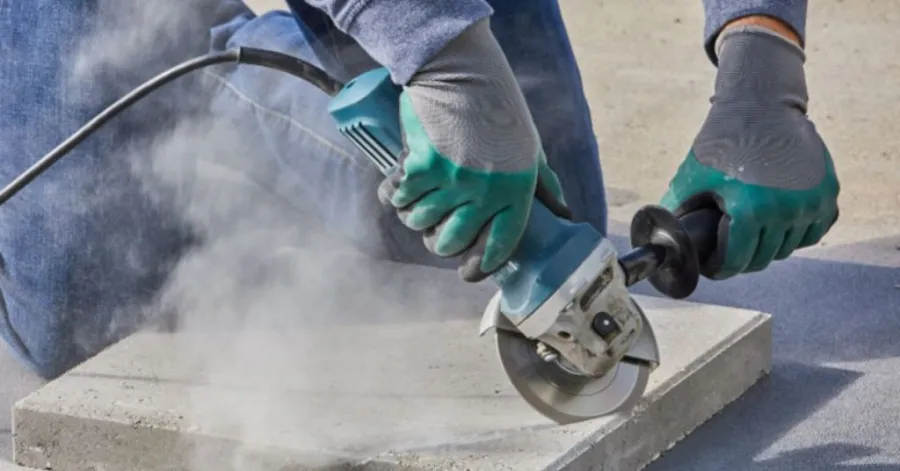
Set yourself up with a handful of basic tools before making any cuts. The right equipment makes it easier to cut pavers cleanly and safely, especially when working with hard concrete or stone. For bigger projects, a wet saw handles the bulk of the work and leaves neat, straight edges. It suppresses the dust and keeps the blade from overheating by feeding water over the cut. Tougher stock also calls for a dependable diamond blade. For trimming, curved lines, or small adjustments, an angle grinder is a good choice. When you just need a straightforward break, a manual paver splitter does the job. Have a tape measure, a pencil, and a straightedge on hand so you can mark your lines. Wearing safety glasses, ear protection, and work gloves will keep you protected while you cut. If you have to cut dry, a hose or a simple spray bottle can keep the dust down.
Have a hammer and chisel ready at your side to handle minor touch-ups. Where the equipment permits, dipping the blade into a bucket of water between cuts helps it cool down. When dealing with dark pavers, grease pencils or marking chalk will give you visible lines. A stable sawhorse or workbench is also necessary so the pavers stay fully supported. When cutting concrete, pick out a concrete diamond wheel designed to fit your specific tool. Most paver-cutting projects are covered once you have this basic gear together.
Best Tools for Different Pavers
You cannot cut pavers of every type every style of paver using the exact same approach. A manual paving stone splitter is frequently all that is required for soft clay pavers. Pressure applied across a pre-scored line will snap the stone right open. Denser concrete pavers generally call for a wet saw or dedicated paver saw mounted with a diamond blade. You can also turn to a diamond cutting wheel for concrete slabs if you have dense pieces to cut or trim down. A wet saw gives you more control, which helps keep thinner paving stones from snapping under heavy pressure. Angle grinders come in handy whenever you have to make curved cuts, work in cramped spots, or trim small areas.
Factor in the overall size of the job before you settle on equipment. Hand tools might be all you need if you are only making a handful of straightforward cuts. Taking on a full patio will probably go faster and smoother if you use a wet saw. Picking the right gear keeps scrap to a minimum and speeds up the work. If the pavers are on the harder side, pick a diamond cutting wheel for concrete that matches both your tool and the material. Let the stone’s hardness, the cut’s profile, and the total workload dictate how you make your cuts.
Choosing the right tool depends on the paver material and type of cut. Use the table below to compare the main tools and their functions.
| Tool | Main Function | Best For |
| Wet Saw | Makes straight, clean cuts while water cools the blade and controls dust | Large projects and concrete pavers |
| Diamond Blade | Cuts through hard, dense materials with a durable abrasive edge | Concrete, brick, and stone pavers |
| Angle Grinder | Makes small, curved, or detailed cuts | Curves, corners, and trimming |
| Manual Paver Splitter | Splits pavers along a scored or marked line | Simple cuts and softer pavers |
| Hammer and Chisel | Breaks off small sections and handles minor adjustments | Touch-ups and small corrections |
| Tape Measure and Straightedge | Measures and marks accurate cutting lines | Planning and marking |
| Sawhorse or Workbench | Supports and stabilizes the paver during cutting | Safer, controlled cutting |
How to Cut Pavers: Step-by-Step Instructions
Taking time to measure and mark everything accurately keeps you from ruining pieces once you start to cut pavers. Getting these opening steps right is what ensures clean edges and pieces that actually fit. Do not rush this part; make sure everything is set before you pick up the saw.
Step 1: Measure the Paver Carefully
Do not touch a tool to the paver until you have exact measurements down. Set the stone down right where it is supposed to go to begin. See how it lines up against the wall or edge. Pull your tape to measure the distance between the paver’s edge and the border. Put that number on paper. A tiny mistake is enough to waste the entire block.
Check your measurement twice, and then do it once more. It might feel like overkill, but you will waste less material. Concrete pavers aren’t cheap, and butchered cuts become expensive fast. Don’t forget to factor in the joint space between each paver. That space usually runs just a few millimeters across. Deduct that width from your number so you won’t have to jam the paver into place. This is the real secret if you want to know how to cut concrete pavers at home without ruining half of them. Accurate measurements are what make or break any paver-cutting job.
Step 2: Mark your cut line
Take that number and mark it directly on the face of the paver. Set the paver down flat on a sturdy work surface. Line up your straightedge across the marks you made. Mark your line using a pencil, chalk, or a grease pencil. Pick a light marker for dark pavers, and switch to a dark marker if the stone is light. Draw it heavy enough that dust and water won’t hide it.
Every cutting technique relies on having a clean guide line. With a wet saw, you run the blade straight down that drawn line. A distinct guide line keeps the blade from wandering while you get the hang of wet saw cuts. The line gives you a clear target to keep your hands steady when running an angle grinder. Running a strip of masking tape along your mark makes it even easier to spot. Anyone starting out can use that tip to keep from drifting off course. Clear layout marks stop the stone from chipping out and keep edges square. This prep holds true across practically any paver cut you make.
How to Cut Pavers Without a Saw
You do not always have to pull out a power tool for these jobs. Basic hand tools are enough to give you tidy cuts. These options do a solid job if you are trying to cut pavers without picking up a saw. The walkthrough here breaks down two primary hand techniques. Neither makes much noise, and they kick up far less dust than any power tool. Where they really shine is making straight cuts through softer stock. Doing the work by hand also keeps costs down if you only have a handful of pieces to trim.
How to Cut Pavers With a Chisel and Hammer
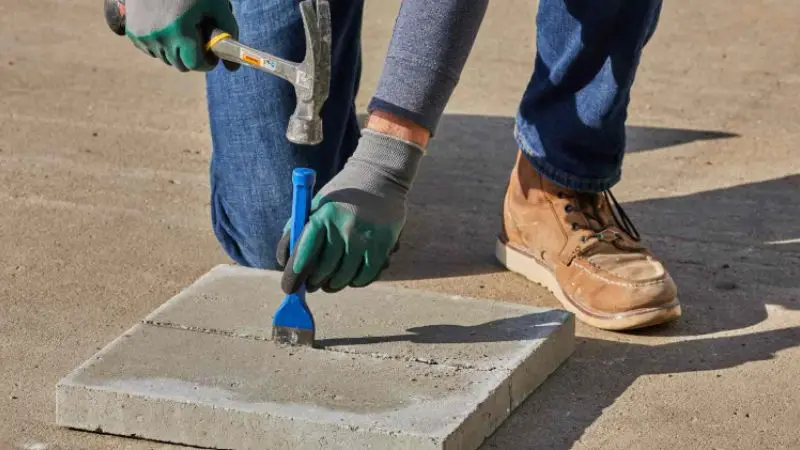
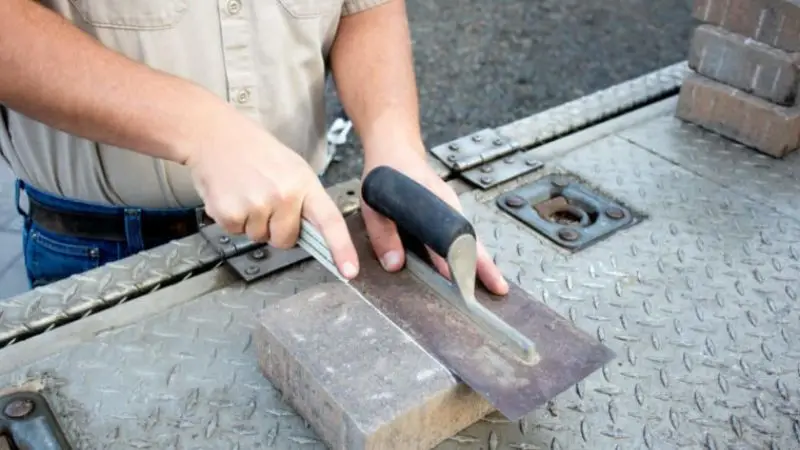
People have been splitting pavers this way for about as long as any method around. Clay pavers and thinner stone slabs respond particularly well to it. All you need is a broad-blade masonry chisel paired with a heavy hammer. Draw your cut line across the paver, then set it down somewhere level and firm.
Position the chisel’s cutting edge directly over the mark you drew. Work your way along the mark, giving the chisel solid hammer taps as you go. Run this groove around all four faces of the stone. Grooving the stone like this creates a line of weakness right where you want it to part. Set the paver over a straight edge and hit the scored groove with one clean, solid whack. The stone ought to snap cleanly along your score mark. Put on safety glasses and work gloves, since the split can send tiny stone fragments flying. Run through the process on a few scrap pieces before touching your good stone.
How to Cut Pavers With a Paver Splitter
Paver splitters are manual tools designed specifically to snap paving stones. The mechanism relies on a scoring wheel paired with a breaking arm. Provided the material is right, this offers a straightforward way to cut concrete pavers yourself. Set the paver in the machine, lining your mark directly up with the wheel. Push down on the handle and maintain that force until the stone snaps under the arm.
Straight lines are where this technique really shines. If the concrete is especially dense, it might resist cracking and end up hurting the tool. Try the tool out on an offcut before you touch the stone you actually need. On the right stone, a splitter takes only a few seconds to snap clean through. Neither of these hand techniques requires an electrical outlet or cords. Reach for the chisel when you want precision, but grab the splitter to knock out straight cuts quickly.
How to Cut Pavers With a Circular Saw
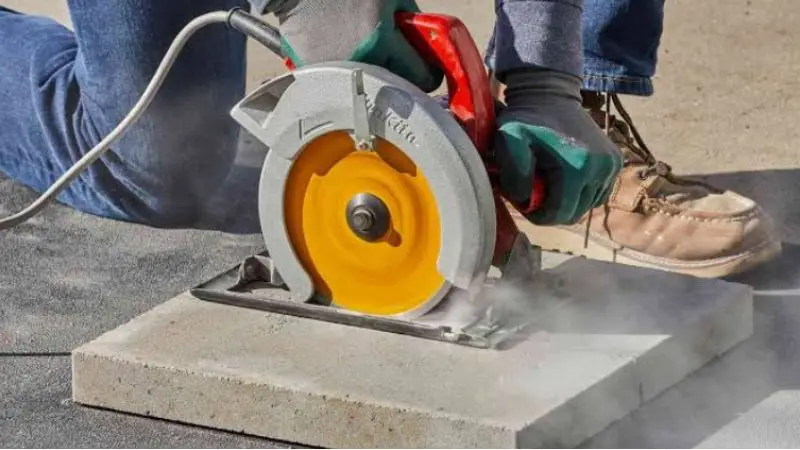
Fitted with the correct blade, a circular saw gives you both mobility and fast cutting. It is a practical option when you need to cut pavers along straight lines or make basic angled cuts across concrete pavers. It handles straight lines and basic angled cuts across concrete pavers without trouble. Crews rely on this technique across all kinds of worksites. All it takes is the correct blade, a solid surface to work on, and steady hands. Getting everything ready beforehand also cuts down on chipped edges and gives you better control through the pass.
Choose the Right Diamond Masonry Blade
A lot depends on having the right blade for this kind of work. Make sure you put on a diamond masonry blade that is specifically rated for stone and concrete. An ordinary wood blade will blunt in no time and can turn the cut into a safety hazard. Continuous-rim blades leave a cleaner finish on dense pavers, whereas segmented blades speed up the cut but tend to produce a coarser edge. Make sure the blade diameter matches your circular saw and confirm the arbor hole sits flush on the spindle.
You can also run a concrete diamond cutting wheel if you are using an appropriate power tool. When you have heavier cutting to do, a paver saw or a wet saw will give you more control over the piece. If cutting pavers with a circular saw is new to you, always read over the blade and tool documentation before making a cut.
Prepare the Paver and Work Area
Get your cutting station completely arranged before you make the first pass. Lay the block on something solid, like a sturdy pair of sawhorses or your workbench. You want it completely still while the blade is running, with no rocking or shifting. Use a piece of chalk or a standard pencil to draw a distinct cut line across the top. If you can, clamp the paver down so it is less likely to shift.
Get your protective equipment on before you begin. Ear protection and safety glasses matter here. If you are cutting dry, wearing a dust mask helps. Spraying water along your mark is another option, provided your saw and workspace support it. Turn the saw on and wait until it gets up to full speed before bringing it to the line. Feed the blade through with an even, unhurried hand. Never push the saw hard into the stone. Allow the edge to cut at its own pace, and run a few test passes on scrap beforehand.
Common Mistakes to Avoid When Cutting Pavers
Steering clear of a handful of typical missteps makes it much simpler to cut pavers accurately. A slip in your measurements or picking the wrong tool can easily ruin stock and complicate the whole job. Keeping the tips below in mind will help you set up right and end up with neater cuts.
Measuring the Paver Incorrectly
Because taking a measurement looks so straightforward, it is easy to hurry through it. Scrapping ruined pavers is often the end result. Get the measurement wrong, and you can ruin an expensive paver, which means starting from scratch. Set the paver where it actually needs to go before you take any measurements, without exception. Measure the clearance to the border or wall, and take off the width of the joint. Most of the time, this spacing comes out to just a few millimeters. Bypass this step, and the piece might end up too big for the space.
People also frequently go wrong by checking just a single edge. Because pavers are rarely true squares, you need to check each end of the planned cut. Before you draw any line, re-verify the block’s placement if the two numbers do not match. Put your line on the right side of the block so you do not end up cutting backwards. Do not rush the measuring phase. Accurate paver cuts always come down to how carefully you measured.
Picking the Wrong Cutting Tool
The wrong equipment can wreck the paver just as easily as it damages your tool. While a manual splitter might handle softer clay pavers without trouble, hard concrete can give it a rough time. Putting a regular wood blade on a circular saw will dull it fast and can make the cut dangerous to perform. Make sure your blade and tool are suited to whatever material you are cutting, every time. That matters even more if you are tackling concrete pavers at home for the first time.
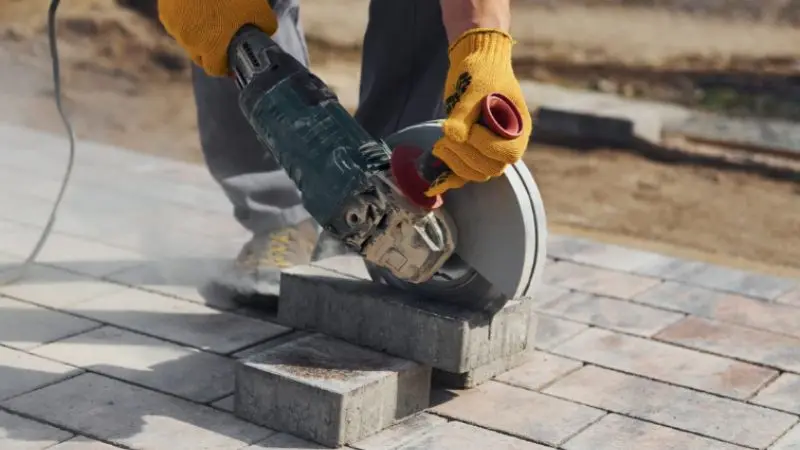
You also need to keep the cut’s shape in mind. For tight spots and curved lines, an angle grinder is a solid choice. Dense paving stones come out with crisp, straight edges when cut on a wet saw. Make sure you put on an appropriate diamond blade if you are learning to cut pavers with an angle grinder. A wet saw might give you better handling on longer straight cuts. Inspect the tool and blade every time before you turn it on. Run a few test passes on scrap pavers before cutting the piece you need.
Wrap Up
From initial layout to the finished edge, you now have the full sequence for cutting pavers down. Match your tool directly to what you are trying to cut. Tough concrete pavers respond best to a diamond blade. Check your measurements two times, factor out the width of the joint, then draw a strong line to follow. Put your safety glasses on, keep the dust down, and let the saw blade feed without forcing it. Test every single paver in place dry before you commit to final placement.
Begin by making basic straight cuts across pieces of scrap. A little practice goes a long way toward building your confidence quickly. Follow these steps, take your time, and you will get clean, accurate cuts for your patio or walkway.
FAQs
Which concrete saws work best for cutting patio stones and pavers?
You get precise cuts from wet-cutting masonry table saws, including models like the Husqvarna MS 360, MK Diamond MK-2001, and VEVOR wet saws. Pick a diamond blade that matches the specific stone you are working with.
What are the pros and cons of walk-behind concrete saws versus hand-held concrete saws?
Walk-behind: Delivers steady, straight lines without demanding as much physical exertion, though its extra weight makes it awkward in cramped quarters.
Hand-held: Gives you portability and freedom of movement, though you need more control to run it and it tires you out faster.
How do diamond blade concrete saws stack up against abrasive wheel saws?
| Feature | Diamond blade | Abrasive wheel |
| Cutting | Cleaner, durable cuts | Grinding action |
| Lifespan | Generally longer | Wears faster |
| Best use | Concrete, stone, pavers | Short, light-duty masonry work |
| Examples | Makita 4100KB, Evolution R230DCT | Abrasive masonry cut-off saws |
People usually favor diamond blades for stone and concrete because the cutting performance holds up over time.
Which concrete saws are safest if you are just starting out, and what features ought to be compared?
A beginner might start by looking at sturdy table saws or smaller wet units like the DEWALT wet saw. Look at how well the blade is guarded, how water is regulated, base stability, total weight, and how clearly you can see the cut line.
Which concrete saws come with the best water hookups for keeping dust down?
Focus on saws that have continuous water feeds or built-in water pumps. Two models that fit this description are the VEVOR 16-inch electric saw and the DEWALT wet saw. Running water keeps blade temperatures down while knocking down airborne dust.
Compare wet cutting vs. dry cutting concrete saws — which models are top for each?
On the wet-cutting side, the VEVOR 16-inch and DEWALT wet saws both run cooler and keep dust down. When it comes to dry cutting, the Makita 4100KB and the Evolution R230DCT give you easy portability. Make sure you hook up proper dust extraction if you’re running them dry.
What are the best compact concrete saws for tight spaces and indoor projects?
Good compact options on the market include the DEWALT DWC860W, Makita 4100KB, and Evolution R230DCT. If you are tackling indoor remodels or working in close quarters, weigh factors like overall weight, how deep it cuts, dust management, and power draw.
Which concrete saws leave behind the smoothest cuts when working on decorative concrete?
When cutting decorative concrete or exposed stone edges, look into wet saws paired with continuous-rim diamond blades. Some reliable examples are Husqvarna wet saws, MK Diamond masonry saws, and wet saws from DEWALT.