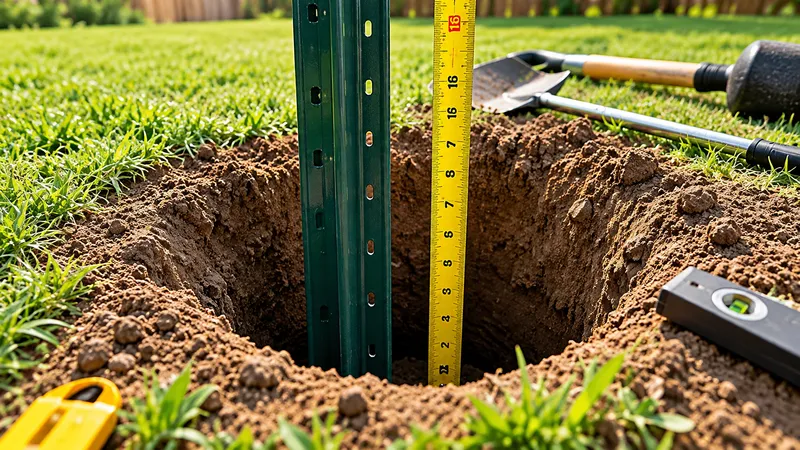
You have dug three holes, and now you’re facing a measuring tape. Dig too shallow, and your fence bends by spring. Dig too deep, and you waste hours digging unnecessarily. The correct fence post depth depends on one factor, a couple of minor tweaks, and an easy test. This post will provide you with a fence post depth chart, an example, and advice for driven posts.
What Is the Recommended Depth for Installing Fence Posts?
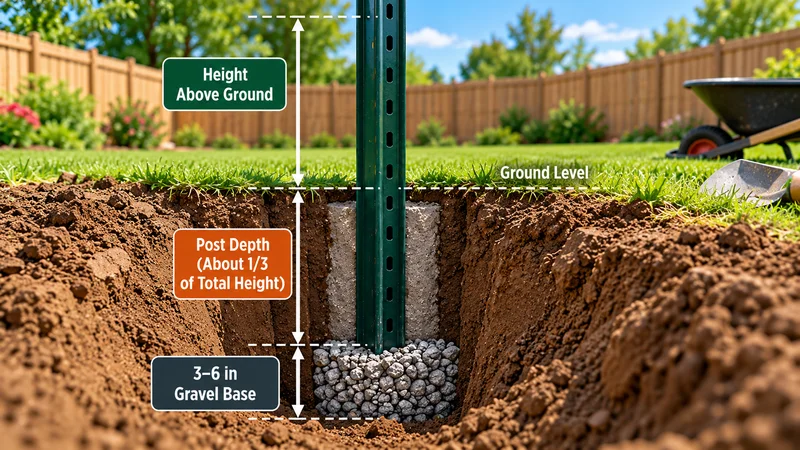
Start by using the rule of thirds for fence post depth. Bury roughly a third of the post’s overall height underground. Afterward, you may want to add a few inches of gravel around the buried post to help water drain. A 9-foot post is buried about 3 feet underground. Here are additional guidelines about hole width and gravel for water drainage. This fence post depth chart will calculate the depth of posts of various heights. Consider this as an estimate only.
| Post Length | Fence Post Depth (One Third) | Hole Depth With a 3 to 6 in Gravel Base | Height Above Ground |
| 6 ft | 24 in | 27 to 30 in | 4 ft |
| 8 ft | 32 in | 35 to 38 in | 5 ft 4 in |
| 9 ft | 36 in | 39 to 42 in | 6 ft |
| 10 ft | 40 in | 43 to 46 in | 6 ft 8 in |
| 12 ft | 48 in | 51 to 54 in | 8 ft |
Select a post whose height above ground is appropriate for your fence, with some room for caps and uneven terrain. Post heights vary by manufacturer, so check the label on your post. One caution: some calculators apply the one-third principle using only the post’s height above ground, which results in a smaller hole size.
Recommended For Your Project
What Is the Recommended Fence Post Depth for a 6-Foot Fence?
You rarely need a 6-foot-deep hole for any fence. Therefore, this calculation will be for a 6-foot fence. Based on the 1/3 ratio, a 6-foot fence indicates a 9-foot post. The fence post depth will therefore be 36 inches or 39 to 42 inches, including the gravel. An 8-foot fence post buried 32 inches will give you 5 feet 4 inches above the ground. Some fence installations use shorter posts, so check the dimensions with your fence installer before buying posts. Math becomes different in cold regions. Most resources indicate that the bottom of the concrete footing should be about six inches below the frost line in your area. Whichever is more would apply. Your local building authorities will tell you the frost line depth and what permits you need for fence post hole depth.
What Changes Fence Post Depth?
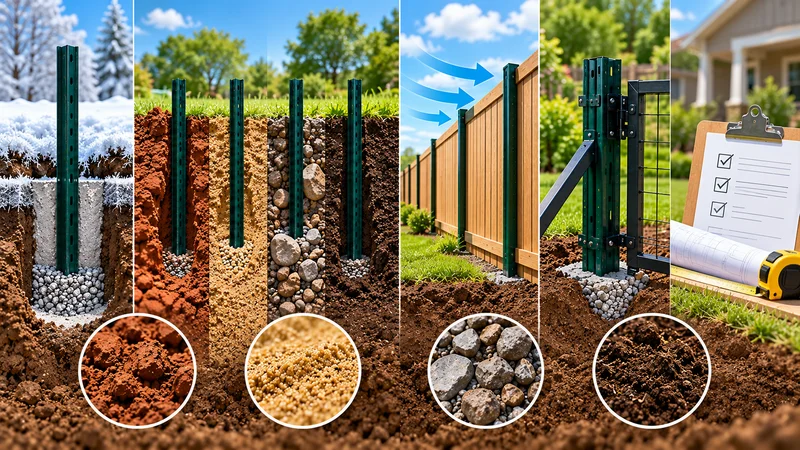
The one-third theory is just a starting point, not a guarantee. Five factors will affect your fence post depths.
| Factor | What It Does | What to Do |
| Frost line | Frozen soil can lift posts | Set the footing bottom below frost depth |
| Soil | Some soils hold posts better | See the soil table below |
| Wind and fence type | Solid panels catch more wind | Plan a deeper, wider footing |
| Gate and corner posts | They carry extra load | Set them deeper than line posts |
| Local code | It may set a minimum | Check before you dig |
Tall, sturdy fences put more on each post, so check post sizes before choosing your fence height. Soil also needs closer attention, as people often overlook it.
| Soil Type | How It Behaves | Depth Note |
| Clay | Holds posts well, but can hold water | Follow your post maker’s drainage advice |
| Sandy or loose soil | Holds posts less firmly | May need a different footing design |
| Rocky ground | Hard to dig, may block depth | Don’t force it, and ask a local pro |
| Loam | Drains and compacts well | The one-third rule is a good start |
Soil is important even for driven posts. The 52cc 2-cycle gas driver specifications say not to use sand, rocky soil, or areas with tree roots. Your drainage and footing choice will depend on your property, so follow the manufacturer’s advice on how to drive your post. Concrete will not substitute for depth. A post in a large concrete block can tip over.
Fence Post and Hole Depth Calculators
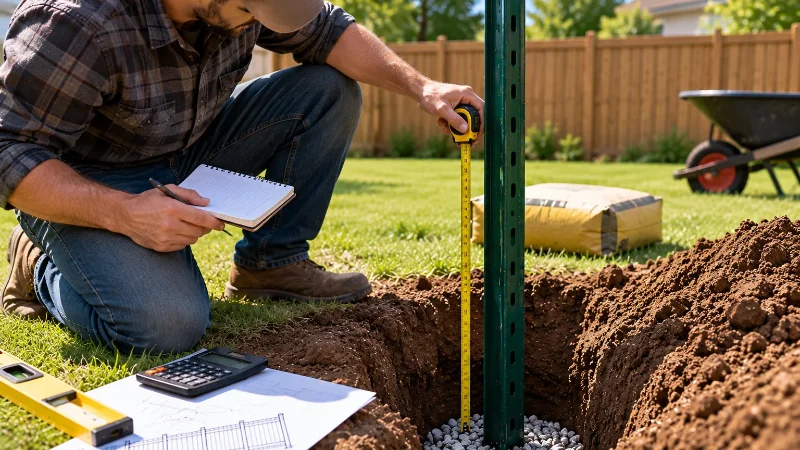
A calculator is the same one-third rule in a tidy form for fence post depth. There’s no widget here, but the by-hand version takes about a minute.
Can I Use Online Calculators to Determine Hole Depth?
Yes, as a starting point. A fence post depth calculator or fence post hole depth calculator takes your fence height and post height (and maybe your frost line), then applies a formula such as one-third. It knows nothing about your soil, your climate, or your building codes. Treat its result as a rough first draft, and have your building department check it. Here is a hand calculation for fence post depth, with a 6-foot fence and a 9-foot post.
| Step | Do This | Example |
| 1. Post length | Measure the whole post | 9 ft |
| 2. One third | Divide by three | 36 in |
| 3. Gravel base | Add 3 to 6 in | 39 to 42 in |
| 4. Frost check | Compare with your local frost depth | Use the deeper number |
Posts that are shorter or longer alter each row, so repeat the procedure with your own post lengths. Most fence post depth calculators can also help you calculate concrete requirements. You can do this manually using the cylinder formula: radius × radius × 3.14 × depth. A common rule is to make post holes three times the post diameter. Let’s take a 4-inch round post in a 12-inch hole with a 42-inch depth and 6-inch gravel bottom.
The hole volume is about 4,069 cubic inches, while the post volume is about 452 cubic inches. The difference is about 3,617 cubic inches, or 2.1 cubic feet. This is a rough estimate for a cylindrical post inside a cylindrical hole. In reality, 4×4 posts are square, so you’ll see some variation.
How Do I Accurately Measure the Depth for Fence Posts?
Accurate fence post depth starts at the surface. Call 811 in the US before you dig, and elsewhere consult your own utility locator services. Next, mark your intended depth on your post with a tape and marker. Take this measurement from the ground level at the point where your post will go, rather than from the peak of an earth mound. Measure all the way to the bottom of the hole, then take note of the reading. See digging post holes for more instructions.
How Do I Install a Fence Using Driven Posts?
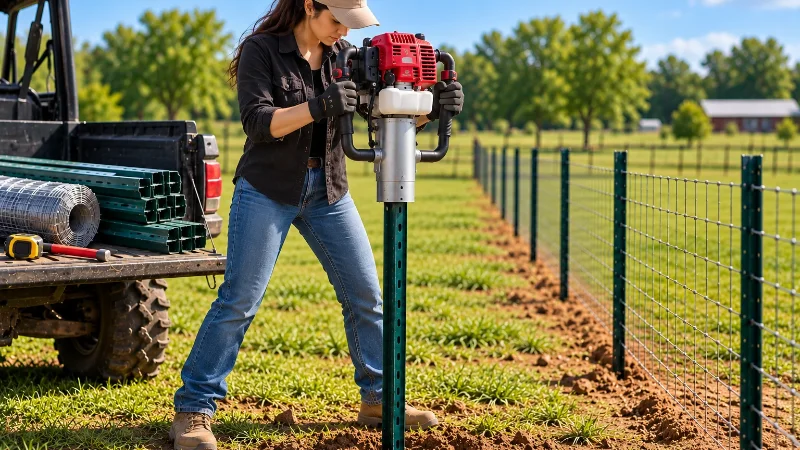
Driveway posts are driven directly into virgin soil. No trench or concrete is used. They work well for wire, farm, and garden fences installed in good ground. Heavy gates and hard ground often require set posts. However, you still need a fence post depth goal for your posts, so follow the post manufacturer’s recommendations and mark the post. Drivable posts minimize digging, and this guide explains how to install metal fence posts with them.
Mark out the fence boundary and look for any underground lines. Place the first post in position by hand, level it on both sides, then drive it in with short, firm strokes until you reach your desired depth. The sleeve has to be able to fit the post. One 3-head gas driver uses heads of 45, 55, and 88mm.
Can You Recommend Tools for Driving Fence Posts?
Yes, but the right choice depends on how many fence posts you’re driving and where you are working. Fence post drivers come in several types, including electric, gasoline, and manual models.
| Tool | Power Source | Best For | Watch Out For |
| Hand rammer | Your own effort | Short runs, small jobs | Tiring on long lines |
| Electric driver | 120V outlet | Jobs near power | Heavy to lift |
| Gas driver | Engine and fuel | Long lines, no outlet | Fuel, noise, upkeep |
A small run can easily use a 2.7-inch hand rammer. First, measure your post, as the hole must be the right size. Near an electrical source, a 2200W electric driver runs on 120V and lists two sleeves: 2.17 in and 2.76 in. It weighs around 45 lb, so make sure you can lift it. When electricity isn’t available, a 4-stroke gas pounder runs on fuel and features a vibration-reducing handle.
@truckintoby Forget the hammer and back-breaking labor 💪. The Vevor 52cc Fence Post and piling driver makes quick work of fence, sign, and farm posts with raw power and precision. Built tough, portable, and ready for the ranch, jobsite, or backyard. #FarmStrong #BuiltForWork #ToolTok #FenceLife #TikTokShopLaborDaySale @Vevor_US
♬ original sound – TruckinToby
Conclusion
Fence post depth calculation is simple math plus a few considerations. Put your posts a third into the ground, but go deeper when frost, wind, gates, and local requirements are involved. Get an initial idea using a calculator, but verify fence post depth locally. Mark your measurements on every post as you measure. Once you have your measurements ready, check out these steel fence posts to see how their lengths fit your requirements.
Frequently Asked Questions
Does fence post depth include the gravel base?
It depends on the guide, so verify. In this case, the buried depth is one-third the post height, and the gravel base is included in the hole depth. Measure the gravel separately so you don’t count it twice.
How does fence post depth change in cold climates?
The first one is not necessarily the ready-to-carry panels. Follow the concrete manufacturer’s guidelines for when the posts can carry a load.
When can I attach panels after setting posts in concrete?
This initial set doesn’t mean that the panel is load-ready. Follow the concrete manufacturer’s guidelines on when posts can carry a load.
What if I hit rock before I reach fence post depth?
Stop! Do not force it. Look for obstructions and consult a professional before cutting or reducing the root length.