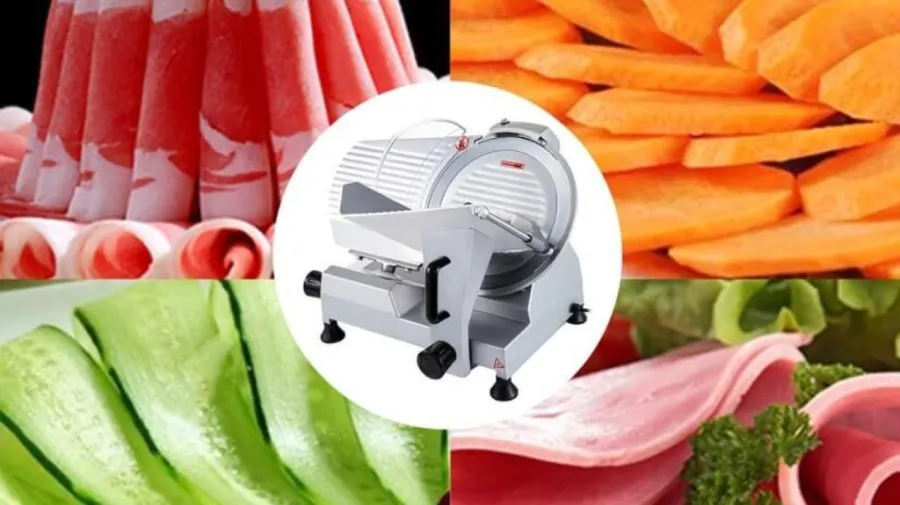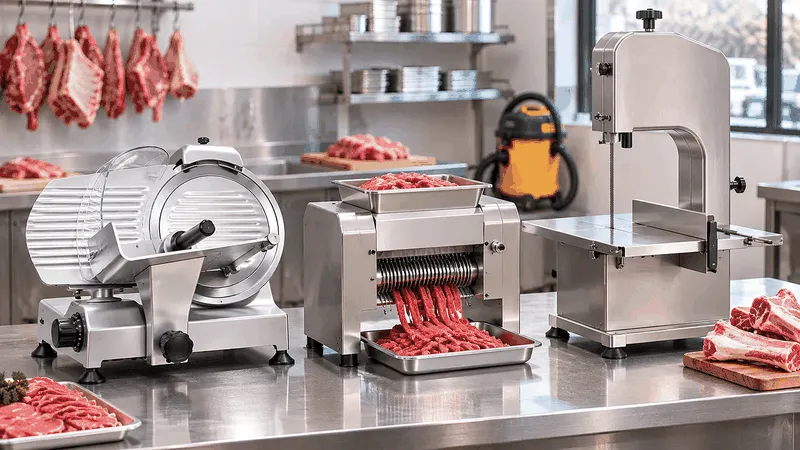
“Cut meat machine” includes three machines, and getting the wrong family is the mistake that costs you the most in this group. The first cuts, the second cuts and minces meat, and the third saws bones. Their published maximums don’t intersect as their listings suggest, and they differ on product temperatures. These cut meat machine types fall into several groups, the first of which is meat slicers. The slicer manual and safety guide cover handling and operation.
What a Meat-Cutting Machine Actually Is
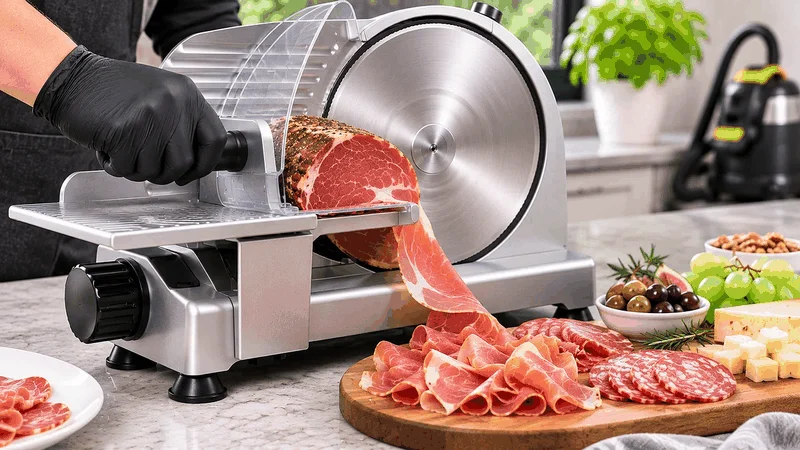
The three cut meat machine families have the same search term, but they differ in how the blade moves. Matching the job to the right family first makes it unnecessary to compare specifications that weren’t comparable anyway. The table presented below contains basically the entire decision for any cut meat machine.
Which machine type suits which job?
| Deli slicer | Strip cutter | Bone saw | |
| Blade | Circular, 6.7–10 in | Blade set, 86 mm diameter; 5 mm cutting thickness | Bandsaw blade, 1650 mm |
| Produces | Slices, adjustable | Slices, shreds or mince at a set thickness | Cuts through bone |
| Power | 130–500W | 850W | 650–2200W |
| Output | Not published | Up to 250 kg/h advertised | Thickness 4–180 mm |
| Bone | No | Stated as not suitable | Yes |
| Product state | Chilled and firm | Not frozen | Partially frozen preferred |
This last row is the one that everyone overlooks. Every cut meat machine family needs meat in different conditions, and these are mutually exclusive, something to decide before moving on to other comparisons. Bandsaw models such as an electric meat and bone cutting machine sit in the bone saw machine category. For deli-slicer setup and handling, see the guide to using a meat slicer.
Slicing Ham and Cooked Meat
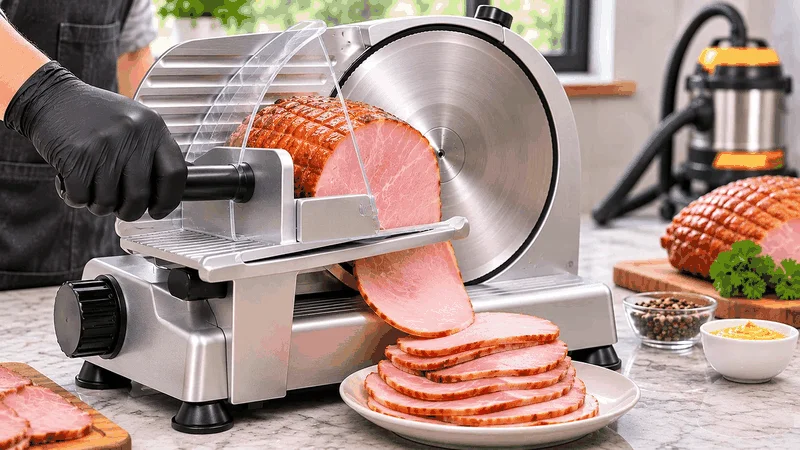
Deli slicers were made for ham, so this is the easiest cut meat machine to give in this article. It’s not about whether they can do it, but how wide a product surface they can accommodate and how thin the thickness can be set. Two numbers describe it.
Can you recommend the best meat slicer for slicing ham?
Blade diameters set the maximum width for whole or half hams at 6.7 to 10 inches. A 10-inch blade doesn’t automatically mean a 10-inch product will fit, since it also depends on the blade exposure and carriage opening of your cut meat machine. Make sure you know the carriage opening if you’ll be cutting large hams often.
As for thickness, the published range is 0-15 mm for the 7.5-inch 200W slicer, 0-12 mm for the 10-inch blade, and 1/32 to 1/2 inch for a 7.5-inch blade. This is the only one listed above that gives a minimum value instead of a maximum. For cooked ham, which is not difficult to slice, any of the models listed will do, including a meat cutting machine for home use. Other formats sit across the cutters and slicers category.
Frozen and Partially Frozen Meat
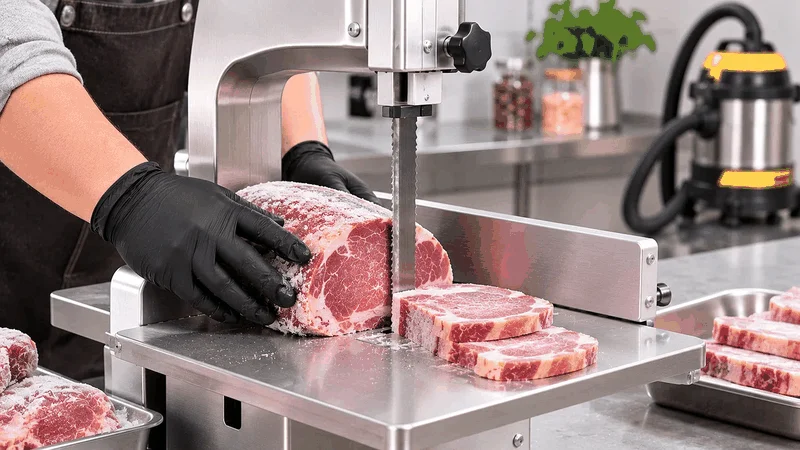
This is where the three groups differ the most. The recommendations for use in manuals contradict common sense more often than not. The meat’s condition dictates which cut meat machine will process it, and manufacturers are more detailed than most manuals.
What are the top meat slicers for slicing frozen or partially frozen meat?
Thin slicing is easier with partially frozen meat, but do not exceed the temperature range indicated in the machine’s instructions. Three positions, all of which are mentioned in the corresponding manuals:
Deli slicers – within the specified limit. Your slicer’s manual indicates that the meat should not be used at temperatures below −6 °C. Check the manual of your intended purchase as temperature limits may vary from model to model. This information can be found in the slicer manual and safety guide.
Strip cutters – no. The 850W cut meat machine is described as inappropriate for processing frozen meat and products with bones. Bone saws – vice versa. The indicated band saw models are presented as meat and bone cutters. Refer to the corresponding manuals for each particular model concerning the types of materials which it is able to cut. The 1500W bone saw listing’s Q&A states that meat should be partially frozen and that soft materials are difficult to cut.
Cheese and Bread
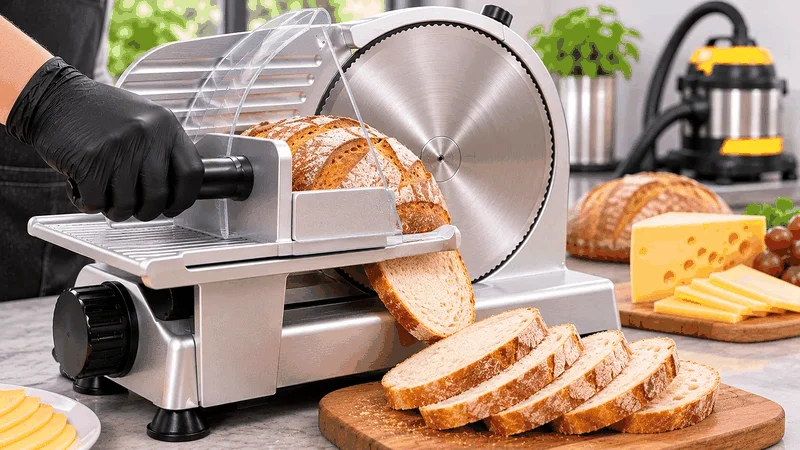
In mixed use, a cut meat machine depends less on motor power and more on blade shape, which is quite well documented. A smooth blade and a serrated blade react differently to a crusty loaf of bread. Don’t forget ease of cleaning, too, since both fat and crumbs stick to it. Practice is covered in kitchen cleaning guidance.
What are the best meat slicers that also work well for slicing cheese and bread?
Blade shape in these listings: 7.5 inches with an undulated stainless blade, 8.5 inches with a serrated stainless blade, and 7.5 inches with the listing stating SUS420 stainless but describing the blade shape in the text as serrated, which should be confirmed with the vendor.
Serrated or undulated blades are the standard choices on a cut meat machine for slicing bread because they slice the crust without crushing the crumb. It’s less obvious with cheese, as textures vary widely and soft cheese sticks to any blade. However, it’s helpful to clean the blade, and all three listings offer a removable blade. One is hand-cleaning, and two are retractable. Compare equipment types in the meat and poultry tools category, checking each model’s approved uses.
Jerky and Thin Deli Strips
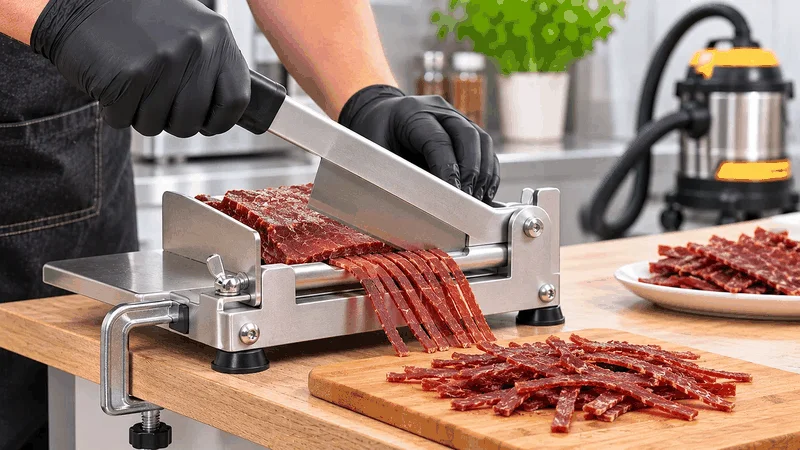
Strips should be thin, not thick; hence, jerky is the only job where a manual cut meat machine can compete with electrical machinery. The product is stiff, production is low, and strip consistency matters more than production rate. There are two entirely different machines for this job.
What are the best meat slicers for making jerky and thin deli strips?
A lever cutter is a manual cut meat machine specifically designed for strips from firm products. This 7.5-inch manual model features two 4Cr14 stainless steel blades, 5 mm thick, weighs 3.64 lb, and comes with a table, G-clip, and sharpener. The listing includes dried beef and biltong in the list of purposes.
In terms of volume, an 850W strip cutter, a commercial electric meat cutting machine, cuts slices, shreds, or mince with a fixed thickness of 5 mm by using interchangeable 86 mm blades. According to the manufacturer, capacity is up to 250 kg per hour. But it depends on the type of meat, preparation, and operating conditions. One limitation: the listing says the blades are interchangeable, but the Q&A notes that there are no 3 mm blades and that only 5 mm blades are included in the set. Related powered cutters sit in the commercial meat cutters category.
Precision and Ultra-Thin Slicing
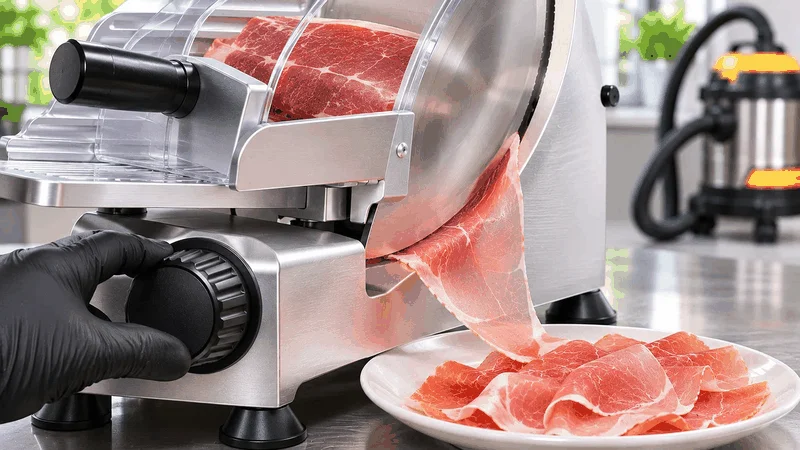
“Thin slicing” is the one feature on which published specs actually distinguish between these machines instead of merely repeating each other. It also highlights an omission in the documentation found in every comparison piece you read, since that number determines it.
What are the best electric meat slicers for precise thin slicing?
Most models state the range starts at zero, which gives the maximum, not the minimum reliable thickness. Only one cut meat machine measuring 7.5 inches stands out because it lists a minimum thickness of 1/32 inch. This information matters more than the rest.
What are the best meat slicers for people who need ultra-thin slices for carpaccio?
Carpaccio is the most difficult item to deal with in this category, since no cut meat machine can be ranked based on published information for this application. No machine has published minimum thickness and increment size, so no machine can prove how accurately the settings can be adjusted. For thickness adjustment and test-slice techniques, review the guide to using a meat slicer.
As a rule of thumb, not as a published specification: minimum beats maximum, a sharp blade beats a powerful motor, and none of the small machines have a built-in sharpener, so it should be organized separately. A 7.5-inch 200W unit has ETL certification, a safety lock, and thickness.
Manual Machines Without Electricity
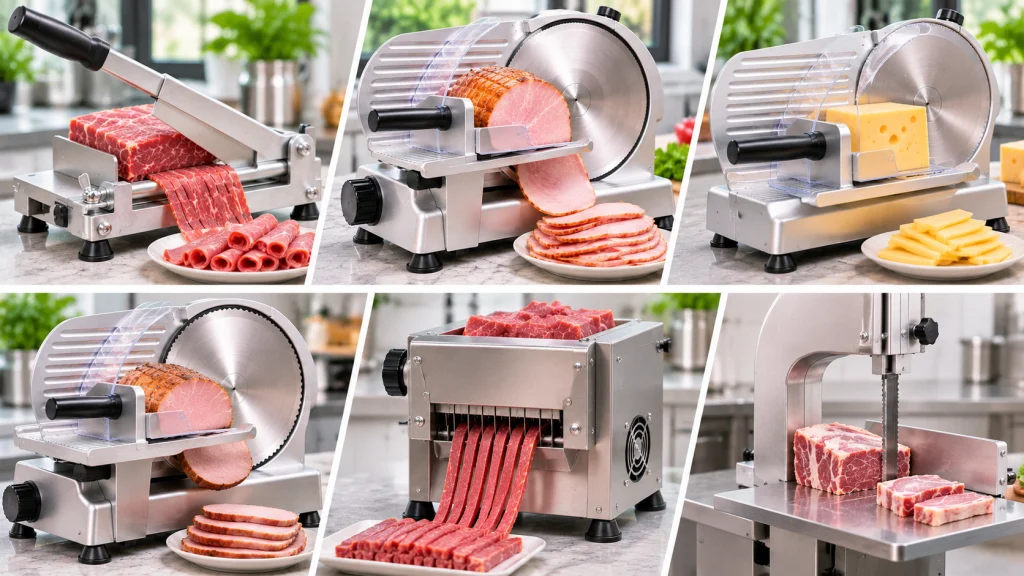
Manual machines aren’t simply a low-cost version of a cut meat machine. They’re a class unto themselves, meeting certain criteria: no power source, minimal moving parts, and less to maintain. The trade-off is effort and output. There are two different types of machines; one can cut deli slices.
Which manual meat slicers are best for someone who wants low maintenance and no electricity?
Levered cutters are the sensible cut meat machine option. The 7.5-inch manual lever cutter weighs 3.64 lb, has no motor, gears, or belt, comes with its own sharpener, and mounts on a table rather than taking up counter space. It works with frozen meat sheets and rolls, deli meats, pastry, and vegetables. Flywheel hand-cranked slicers are the standard deli slicer, in both bench and floor-standing models, and represent another ballgame in size and cost.
An important caveat: Manual versions in this class may also be bone cutters with large blades which will appear similar in pictures but are designed to cut bones rather than make slices. You should look out for a listing giving the blade diameter, cutting length, or blade width – that will tell you what kind of machine you are looking at. Larger versions fall into the category of commercial meat cutters.
Recommended For Your Project
Machines Across the Three Families
The table below presents what manufacturer listings can validate for each cut meat machine: four from the same manufacturer and two from others. Blank spaces represent items that are genuinely unstated, not omitted; the differences in product states are the key starting point. Further formats are grouped under meat and poultry tools.
| Model | Family | Blade | Power | Product state | Bone |
| VEVOR manual lever cutter (KD0142) | Manual cutter | 7.5 in length, 5 mm | None | Sheets and rolls | No |
| VEVOR 7.5″ 200W | Deli slicer | 7.5 in, SUS420 | 200W | See model manual | No |
| Cuisinart FS-75 | Deli slicer | 7.5 in, undulated | 130W | Not stated | No |
| Chefman RJ49 | Deli slicer | 8.5 in, serrated | 180W | Not stated | No |
| VEVOR 850W cutter (SJY-DQ90) | Strip cutter | 86 mm dia., 5 mm cut | 850W | Not frozen | Stated unsuitable |
| VEVOR 1500W bandsaw | Bone saw | 1650 mm band | 1500W | Partially frozen | Yes |
Conclusion
Meat cutting machines come in three types, and the published limit determines which type suits your needs. The deli slicer suits cutting ham, cheese, and bread to adjustable thicknesses. Each model’s manual specifies the minimum temperature. The strip cutter delivers up to 250 kilograms per hour on the 850W machine, but it cannot cut bone or frozen food.
The bandsaws, ranging from 650W to 2200W, are the models in the family that cut bone, making them a heavy duty meat cutting machine for butcher shops. The 1500W model requires partially frozen meat, not soft meat. Before ordering a cut meat machine, make sure the carriage opening is large enough for large hams, the blade sizes cover the needed thickness, and the model manual lists the temperature limits. Other machines fall under the commercial meat slicer category. Further options sit under commercial meat slicers.
Frequently Asked Questions
Can a meat slicer cut through bone?
Not at all. Neither deli slicers nor strip cutters can cut through bone; the 850W cutter makes that clear. Bone cutting requires a bandsaw, with options ranging from 650W to 2200W.
Can I slice frozen meat in a meat-cutting machine?
It depends on the machine and the particular model. Refer to your slicer’s manual to confirm its temperature range. Strip cutters are not suitable for frozen foods, whereas bandsaws can cut frozen products.
What is the difference between a meat slicer and a meat cutter?
The slicing blade is circular and can be adjusted to obtain varying slice sizes. In contrast, the cutting blade is fixed at 5 mm, as on the 850W machine.
Do manual meat cutters need much maintenance?
Less powerful than electric models, with no motor, gears, or belt. The 7.5-inch lever model weighs 3.64 lb and includes its own sharpener. For cleaning instructions, see kitchen cleaning.