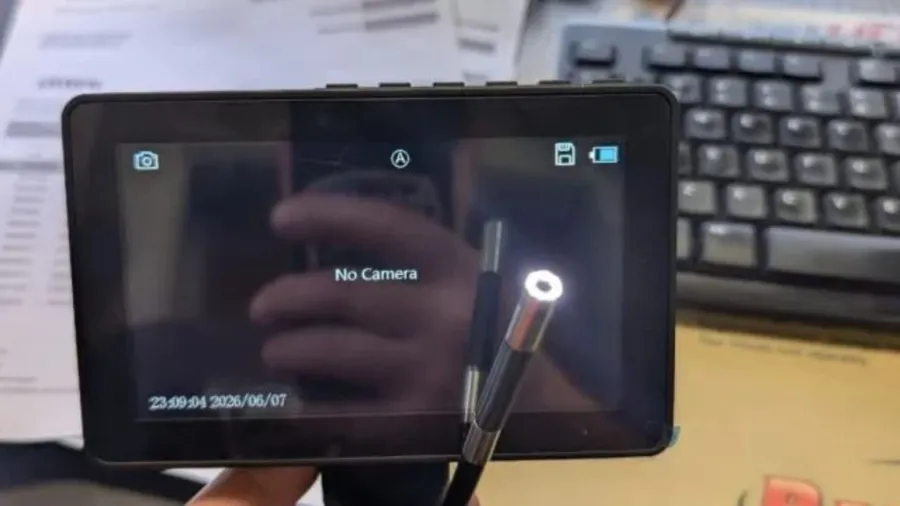
You push a scope into a cylinder, see one wall, pull it out, feed it at a new angle to check the other side, and miss the crack. 4-way borescope cameras do that back and forth: the tip steers up, down, left, and right, so one insertion shows the chamber. That is the pull of a four-way inspection camera over a two-way probe. Borescope lineup includes l four-way models for auto, HVAC, and industrial work. New to steerable scopes? Borescope basics explain the idea. This guide covers how a 4-way inspection camera works, specs that matter, and which four-direction endoscope fits your job.
What A 4 Way Borescope Is
A 4-way borescope is an inspection scope whose camera tip bends in four directions, up, down, left, and right, for a full 360-degree sweep from one entry point. That all-around control sets a four-way borescope apart from a fixed or two-way probe, and a quick look at borescope features shows the difference in practice. Picture it as a four-way inspection camera you aim straight from the handle: you steer the view instead of the whole cable.
How 4-Direction Steering Works
Behind the lens sits a short jointed section pulled by four control wires, one for each direction. A joystick or thumb dial on the handle tensions those wires, so the 4-way articulating camera tips toward whatever you want to see and holds that angle while you look. Because a four-direction endoscope reaches every wall without re-inserting, a 4-direction borescope scans a combustion chamber, a gearbox, or a duct elbow in a single pass.
The real gain of a 4-way articulating camera is time: no pulling out, rotating, and feeding back in to reach the far side. A steady four-way camera probe keeps the picture still as you push past valves or baffles, which turns a careful read into a quick one. Cheaper scopes with loose joints drift off target, while a good four-way camera probe stays where you point it, as a short articulating borescope guide shows.
What are the main differences between various articulating borescopes?
The main difference between articulating borescopes is how far the tip moves and how much you see per insertion. A two-way head bends in one plane, so you still rotate the four-way camera probe to see the sides. A 4-direction borescope bends in all four directions for true 360 coverage, while a rotating probe spins the lens without bending, unlike a 4-way endoscope camera.
For whole-chamber reads, a 4-direction borescope wins because it leaves no blind spots; for a straight pipe, a rotating scope is enough. A 4-direction borescope also has a slightly larger head and costs a little more than a two-way unit, so you pay for the coverage. The table compares the three side by side.
| Type | Tip Movement | Coverage | Best For |
| Two-way | 180° one plane | Partial, re-aim often | One-bend checks |
| 4-way (360°) | All four directions | Whole chamber, one pass | Industrial reads |
| Rotating probe | Lens spins, no bend | Ring around a run | Straight pipes |
| VEVOR 4-way scope | All four, 360° | Whole chamber, one pass | 0.24-inch slim lens, 8X zoom |
Key Specs Of A 4 Way Borescope
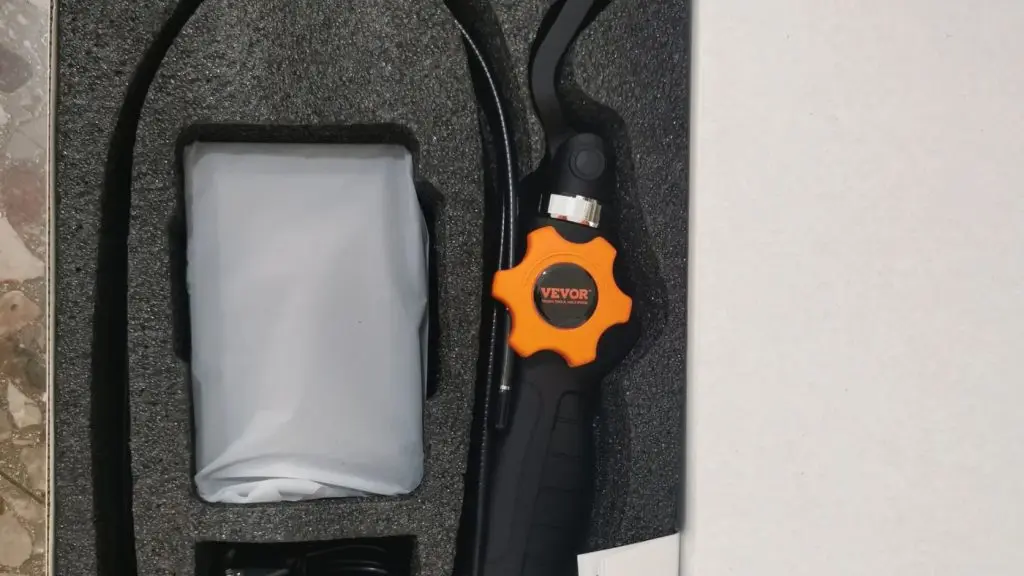
A few specs decide whether a four-way articulating scope is worth the money: probe diameter, image quality, battery, and build. Match these to your engines and ducts and the four-way borescope pulls its weight; miss one and even a four-way articulating scope feels clumsy. These sit alongside the choices you make across the wider inspection cameras range, so weigh them before you buy. Here is what each one changes.
Probe Diameter And Reach
Diameter sets what the tip can enter. Slim 3.9 mm heads slip into spark-plug wells and tight castings, while 6 mm heads carry a bigger lens for ducts and larger bores. A thinner 4-way inspection camera reaches more spots but trades a little lens size, so match the scope diameter to your tightest opening, not the biggest screen. Cable length matters just as much, 3 to 5 feet for engine work, 10 feet or more for duct runs on a four-way inspection camera. A semi-rigid cable holds its shape for straight pushes while a softer one follows bends, and that same practical care applies across your power tools.
Resolution Lighting And Screen
A true 1080p lens shows hairline cracks and carbon that a lower-res 4-way endoscope camera would blur. Adjustable LEDs around the lens keep a shiny bore or dark duct from washing out, and 8X digital zoom on a four-way camera probe helps you read a stamped mark or a valve seat.
A 4-way endoscope camera with a 4.3 to 6-inch IPS screen reads clearly at arm’s length, and anti-glare helps on bright metal. Pair sharp optics with even, dimmable light, and a four-way articulating scope reveals the real condition instead of a wall of glare. A 4-way endoscope camera that nails both resolution and lighting saves you a second trip back into the engine; the borescope basics cover how to judge image quality before you commit.
Battery And Build
Field work needs a battery that lasts and a probe that survives oil and water. Look for a 5000 to 7000mAh cell and an IP67-rated tip. This is where online buyers slip up, so ask it plainly: what should I consider when buying an articulating borescope online? Confirm the real articulation angle in each direction, the probe diameter in millimeters, the waterproof rating, and the screen size before you add a 4-way endoscope camera to the cart.
A quick step-by-step setup gets a new scope running. Read the spec sheet for a four-way inspection camera the way you would read a parts list; one missing number can mean a tip that will not fit your port. If two models look alike, the higher pixel count and bigger battery usually win.
Choosing And Comparing 4 Way Borescopes
With the specs clear, picking a 4-way borescope comes down to your work and your budget. Two questions come up most: one about industrial use, one about which 360-degree options are worth it, so here is a direct answer to each, plus a tier table. Everything below draws from the same borescope range, so start with industrial use.
How do I choose the best articulating endoscope for industrial inspections?
Lead with articulation and diameter, then resolution. For industrial work, a 4-direction borescope that sweeps 360 degrees lets you inspect a whole chamber from one entry, so choose that over a two-way head.
Match the four-way camera probe diameter to your smallest port, choose a true 1080p lens, and get a reinforced cable rated for heat and solvents. A four-way industrial borescope built for the shop floor handles the daily grind; for lighter, occasional checks, for example, inspecting a cylinder, a simpler four-way inspection camera is plenty.
Can you recommend top brands for 360-degree borescopes?
The honest answer: judge a 360-degree scope by its features, not its badge. The best 4-way borescope options share the same traits: a four-direction endoscope with a true 1080p lens and steering that holds its angle, a 5000mAh-plus battery, an IP67 probe, and a bright IPS screen on the 4-way inspection camera.
Rather than chase a name, match a 4-way articulating camera to your work; a well-equipped 360-degree articulating borescope from a value maker often matches units that cost far more. Watch for a four-way articulating scope with a loose joint or a dim fixed light; those let a cheap unit down no matter the label. The table sorts the tiers so you can pick by need instead of by brand.
| Tier | Articulation | Lens / Screen | Battery / Build | Best For |
| Entry | 4-way 360° | 1080p, 4.3 in | 5000mAh, IP67 | Occasional DIY |
| Mid | 4-way 360° + zoom | 1080p, 5 in, 8X | 5000-7000mAh | Regular shop use |
| Pro | 4-way 360°, dual-lens | 1080p+, 6 in | 7000mAh, rugged | Daily diagnostics |
| Example to consider | VEVOR 4-way 360°, 8X | 1080p, 6-in IPS | 7000mAh, IP67 | Auto and mechanical |
Recommended For Your Project
Best 4 Way Borescopes By Job
The right four-direction endoscope depends on the job in front of you. HVAC runs reward reach and battery; multi-use work rewards swappable probes and attachments. Here are the picks by job with the specs that make each one fit, all from the broader tool lineup.
Which borescopes do HVAC technicians recommend for flexibility and camera reach?
For HVAC, choose a four-way borescope on a long, flexible cable with a big battery; ducts are wide but long and full of turns. A 4-direction borescope lets you check every surface of a bend without pulling out, and a 6-inch screen with a 7000mAh cell runs a full day. A long-battery four-way endoscope with a 4.9-foot flexible cable suits supply runs and returns alike. A 4-way inspection camera this size also reaches deep returns a short auto scope cannot. The table sets reach-focused builds against short-cable auto scopes.
| Build | Cable Reach | Steering | Battery / Screen |
| Long flexible (HVAC) | 4.9 – 16 ft | 4-way 360° | High-capacity, 6 in |
| Short semi-rigid (auto) | 3 – 5 ft | 4-way 360° | Standard, 4.5 in |
| Mid flexible (plumbing) | 15 – 50 ft | Rotating / 2-way | Standard, 5 in |
| VEVOR four-way 360° endoscope | 4.9 ft flexible | 4-way 360° | 7000mAh, 6-inch screen |
Which borescopes offer the best set of probes and attachments for multi-use work?
For multi-use work, the best set adds a magnetic pickup, a hook, and a mirror tip, plus multiple lenses or cables. A multi-lens 4-way articulating camera with front and side views, swappable attachments, and both short and long cables covers engines, drains, and wall cavities in one kit. A multi-lens borescope kit with those attachments earns its place in a mixed shop. A four-direction endoscope paired with a magnet and hook turns a 4-way articulating camera into a retrieval tool for dropped bolts and clips. The table lines up the multi-use features.
| Feature | Why It Helps | Good For |
| Magnet and hook tips | Grab dropped bolts | Retrieval jobs |
| Mirror tip | See around a 90° corner | Blind sidewalls |
| Multi-lens (front + side) | Two views at once | Fast inspection |
| Extra short and long cables | One kit, many jobs | Mixed engine and drain work |
| VEVOR triple-lens borescope | Front, side, and split view | Multi-use shop kits |
Conclusion
A 4-way borescope earns its keep the moment you need to see every wall of a chamber without pulling out and re-aiming. Match the probe diameter to your tightest opening, insist on a true 1080p lens and an adjustable light, and pick a battery and a cable that fit your longest runs. Judge 360-degree scopes by specs, not names, and a four-way borescope becomes the tool you reach for first on a stubborn diagnosis. Browse the full borescope collection, weigh the specs for your work, and choose the right 4-way inspection camera to turn a guess into a clear look.
FAQs
Is a 4-way borescope better than a 2-way one?
For whole-chamber reads, yes. A four-direction tip sees every wall from one insertion, while a two-way head often needs re-aiming. For simple one-bend checks, a two-way scope costs less and works just as well.
What probe diameter should I pick for a 4-way borescope?
Match it to your smallest opening. A 3.9 mm tip fits spark-plug wells and tight castings; a 6 mm head carries a bigger lens for ducts and larger bores. Measure the tightest port first.
Can a 4-way borescope reach around tight bends?
Yes, within limits. Four-direction steering bends the tip sharply at the end, but the cable still needs room to follow. Very sharp turns in narrow pipes may call for a slimmer probe.
How long do the batteries last?
Most units run 3 to 6 hours on a 5000 to 7000mAh cell, enough for a shift of intermittent use. Bright LEDs and a large screen drain faster, so dim the light when you can.
Are these scopes waterproof?
The probe and cable usually carry an IP67 rating, so they handle oil, coolant, and water. The handle and screen are not fully sealed, so keep the control unit dry during wet work.