

Aluminum Extrusion Linear Rail
























Results for Aluminum Extrusion Linear Rail
An aluminum extrusion profile is a structural bar made by forcing heated aluminum alloy through a shaped die, producing a continuous length with a fixed cross-section. Recessed channels, or slots, run along each face and accept fasteners at any point on the bar. The result is a rigid yet lightweight building element that carries load, holds alignment, and resists bending. Because parts bolt into the slots instead of being drilled or welded, sections join, adjust, and come apart without permanent alteration. In effect, the profile works as a reusable structural skeleton, pairing the strength of metal with the flexibility of a modular system.
Aluminum extrusion profiles come in several European-standard cross-sections. The square 2020 and 3030 series spread load evenly across all four faces, the larger 4040 handles heavier framing, and the rectangular 2040 and 4080 series add stiffness along one axis for beams and shelves. Most faces are T-slot for bolting brackets and panels, while a V-slot option lets wheels roll along the rail. Lengths run from 400 mm up to 2000 mm, in anodized black or silver, sold in multi-piece packs. Typical uses are 3D printer and CNC frames, workbenches, carts, modular shelving, display and exhibition stands, enclosures, and automated motion systems.
Five things decide what you need:
- Profile size: larger cross-sections such as 4040 resist bending, while 2020 keeps light frames compact and low cost.
- Slot type: T-slot bolts brackets and panels in place, and V-slot lets wheels roll along the rail.
- Length and pack: match rail length and piece count to your longest span and total build, with extra for cuts.
- Finish and color: anodized black and silver both resist corrosion, so this choice is mainly about appearance.
- Fastening plan: check that your T-nuts, corner brackets, and connectors fit the chosen series before ordering.
Browse the full VEVOR aluminum extrusion profile range to compare sizes, lengths, and slot types in one place, or open the wider linear rail selection to pair your frame with matching motion parts.
Aluminum Extrusion Profile Types at a Glance
The table below sets the main profile series side by side so you can see how cross-section, available lengths, and duty differ before you choose.
| Profile Series | Cross-Section (mm) | Lengths on This Page (mm) | Relative Duty | Selection Note |
|---|---|---|---|---|
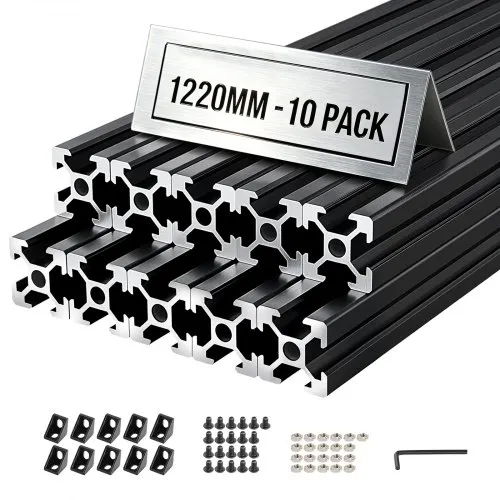
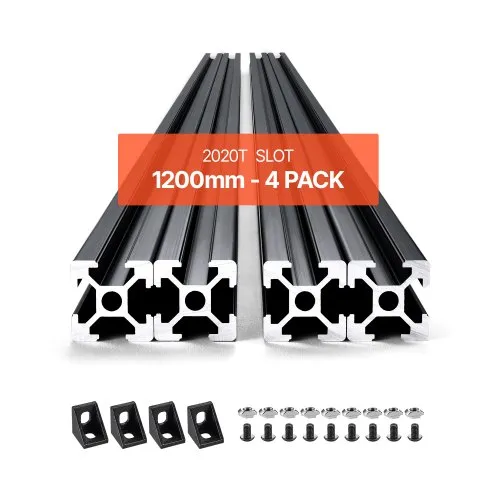
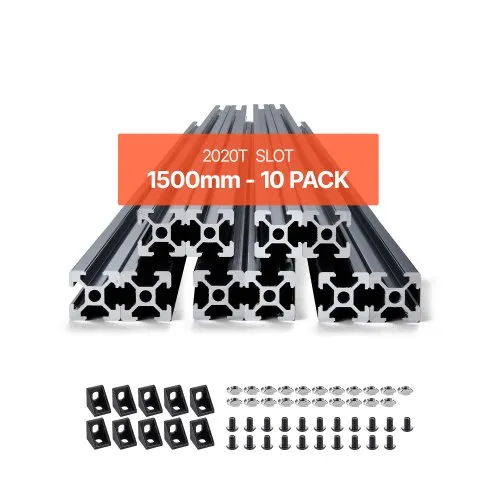
| 2020 | 20 x 20 | 600, 1000, 1200, 1220, 1500, 2000 | Light to medium | Lowest cost per length; flex shows on long unsupported spans |
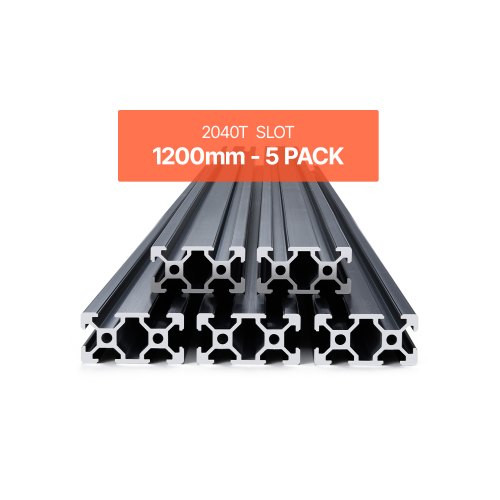
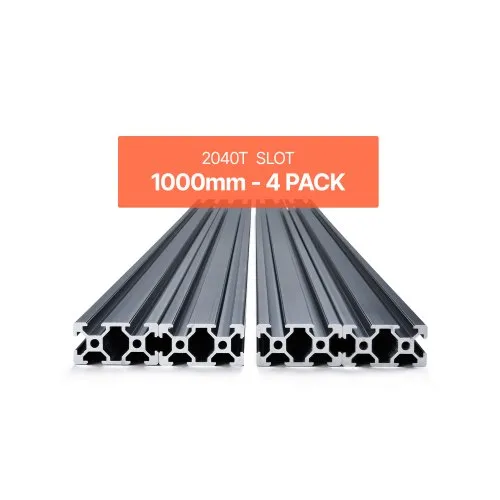
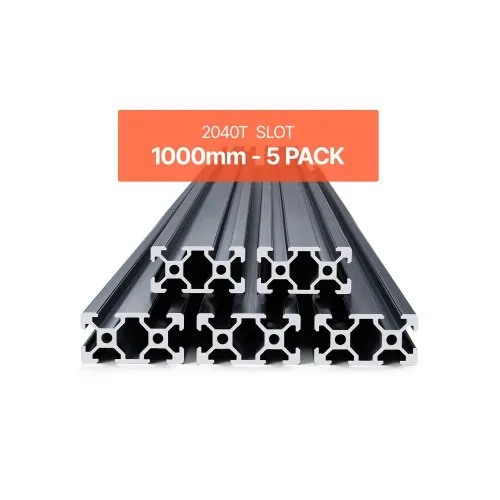
| 2040 | 20 x 40 | 1000, 1200, 1500, 2000 | Medium | One stiff axis; good for shelves and gantry beams |
| 3030 | 30 x 30 | 2000 | Medium | Middle ground when 2020 bends and 4040 is overkill |
| 4040 | 40 x 40 | 400, 600, 1000, 2000 | Heavy | Go-to for rigid machine bases and load-bearing posts |
| 4080 | 40 x 80 | 500 | Heavy structural | Maximum stiffness for long spans and heavy mounting plates |
VEVOR Aluminum Extrusion Profiles – Precision and Versatility
Aluminum extrusion profiles have become the backbone of the current construction, automation, and DIY fabrication. Do you design a structural frame of industrial equipment, create your own 3D printer, or modular furniture? These are made easy with aluminum extrusion profiles, which offer lightweight yet strong support structures. VEVOR aluminum profile extrusion products are suitable for extensive projects, with anodized surfaces of high accuracy and T-slots for easy connection and assembly. Aluminum extrusion profiles make complex constructions simpler and are strong and durable. By investing in its high-quality aluminum profile extrusions, users will enjoy reliability, flexibility, and professional-grade performance for alpha-quality use in personal and industrial applications.
Product Types and Usage Scenario of the VEVOR Aluminum Extrusion
The following are the types and usage scenarios for the VEVOR aluminum extrusion.
Size Options: VEVOR aluminum extrusion profiles are available in many sizes and T-slots to fit various applications. The T-slot aluminum extrusion profile is best suited to smaller frames or lightweight structures and is therefore ideal for 3D printer casings, CNC machine setups, or small-scale DIY constructions. Bigger sizes, such as the 2040 or 4040 extrusion aluminum profiles, are stronger but provide greater support for industrial frames, automated processes, or large modular assemblies. Every aluminum extrusion profile is cut, anodized, and designed to maintain similar dimensions, ensuring easy assembly and high structural uniformity.
Flexible Assembly: VEVOR aluminum profile extrusions will be compatible with standard connectors, brackets, and accessories. The T-slot construction enables users to slide fasteners along the profile, providing flexibility in fastener placement and eliminating the need for drilling or welding. This flexibility makes our aluminum profile extrusion suitable for adjustable equipment, modular workstations, and experimental systems that may require changes or additions.
Wide Applications: Aluminum extrusion profiles are usually used in both professional and hobby-based projects. They have machine frame applications, where they support linear guides and motors, among other machinery, providing stability. VEVOR aluminum extrusion profiles can also be used to construct modular shelving, industrial carts, and custom enclosures that are both strong and attractive. The anodized finish protects against corrosion, wear, weather, and other environmental conditions, providing a longer lifespan for aluminum profile extrusions without sacrificing a clean, professional appearance.
Strong Structures: In complex assemblies, various VEVOR aluminum extrusion profiles can be combined to form robust structures. The long rails, including the 2000 mm (1200 mm) profiles, can be precisely aligned in linear motion applications such as CNC routers, laser engravers, and automated equipment. With high-quality VEVOR aluminum extrusion profiles, users can minimize structural flex, maintain tolerances, and repeat results across projects. VEVOR aluminum profiles are a durable and flexible solution for building industrial automation equipment or a DIY hobby frame.
For Creative Projects: The VEVOR aluminum profile extrusions are also useful for non-mechanical creative projects. With our aluminum extrusion profiles, engineers, designers, and makers can easily construct adjustable fixtures, laboratory installations, or display frames. Lightweight, strong, and modular VEVOR aluminum extrusion profiles are a critical choice for projects that require adaptability and performance.
For Display Frames, Furniture structures, and protective enclosures: Our VEVOR aluminum profile extrusions have rounded edges to make them safer and have a better appearance. It would be ideal in applications with display frames, furniture structures, and protective enclosures where aesthetics and user safety are both of interest.
For Automated Sliding Systems and Precision Engineering Setups: Our aluminum extrusion profiles are made to assist the elements of motion in a linear manner, which is highly accurate and aligned. They are ideal with laser engravers, automated sliding systems, and even precision engineering systems, which demand continuous and precise movement.
For Portable Structures and Exhibition Setups: A VEVOR alum aluminum extrusion profile is hollow at the center, thus being lightweight though having good strength. Our VEVOR aluminum extrusion profile can be used in cases where lightweight frames are required, in portable structures and exhibitions where mobility and quick assembly are considered essential.
For Custom Shelving Units and Workbenches: A VEVOR aluminum extrusion profile is created to be compatible with other accessories and extensions of modular systems. Moreover, our VEVOR aluminum extrusion profiles are ideal for custom shelving units, work benches, and adjustable storage systems, which demand flexibility and growth as time goes by.
Matching the Profile and Hardware to the Task
The section above covers where profiles are used; this table goes a step further and pairs each common task with the slot type and hardware that suits it.
| Task | Suited Profile or Slot | Hardware to Use | What to Watch For |
|---|---|---|---|
| Bolt brackets and panels to a fixed frame | T-slot square (2020, 4040) | T-nuts and angle brackets | Match T-nut size to the slot or it will not grip |
| Slide parts smoothly along a rail | V-slot profile (2040 V-slot) | V-wheels and gantry plates | Keep the groove clean so wheels roll without binding |
| Join profiles into a 3D corner frame | Any T-slot series | Corner brackets or inner connectors | Square each joint before final tightening to avoid skew |
| Carry heavy plates or long shelves across a span | Rectangular 2040 or 4080 | T-nuts with support gussets | Mount the wide face up to carry more with less sag |
Care & Maintenance For the VEVOR Aluminum Extrusion Profiles
The following are the care and maintenance of the VEVOR aluminum extrusion profiles.
Regular Cleaning: Proper care of the VEVOR aluminum extrusion profiles is essential to ensure they perform well and remain structurally stable. To prevent dust and debris from settling on connectors or moving parts, it is advisable to clean aluminum profiles extrusions regularly with mild detergent and water. Periodic checking and greasing of moving joints are recommended for projects with linear guides or sliding parts to ensure smooth operation.
Safe Storage: Aluminum profile extrusions should be stored in a dry place to prevent corrosion over time, though the anodized surface offers some resistance to moisture. To prevent bending or warping of the profiles, heavy, uneven loads should not be placed directly on the profiles. Regular inspection of fasteners and brackets maintains the stability of the entire assembly, especially for industrial frames or automated equipment made with aluminum extrusion profiles. These care guidelines will help users get the most life from aluminum extrusion profiles and maintain consistent performance across all applications.
Avoid Overloading & Keep Connections Tight: The weight on the profile should not be more than the profile can sustain, since this will cause it to bend or break down with time. Periodically inspect and fix bolts, connectors, and brackets so that the structure is solid and stable in the course of its long-term utilization.
Best-Seller Comparison
These five in-stock profiles sit at the top of the category in the catalog; the comparison below lines up size, length, and quantity so you can match one to your build.
| Product | Profile Series | Cross-Section (mm) | Rail Length (mm) | Pieces per Pack | Total Linear Length | Best For |
|---|---|---|---|---|---|---|
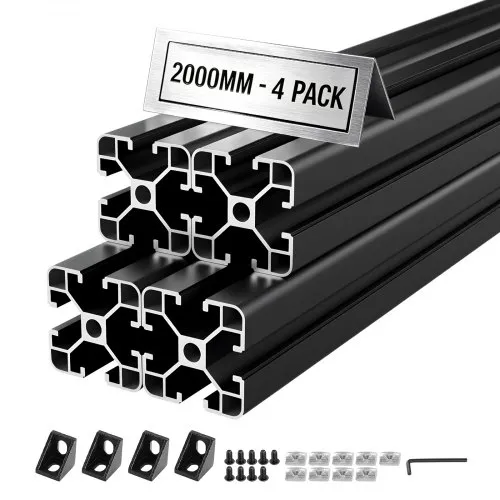
| 4040 Rail, 2000 mm, 4-Pack | 4040 | 40 x 40 | 2000 | 4 | 8 m | Heaviest profile here at full 2 m length; rigid machine bases and gantries |
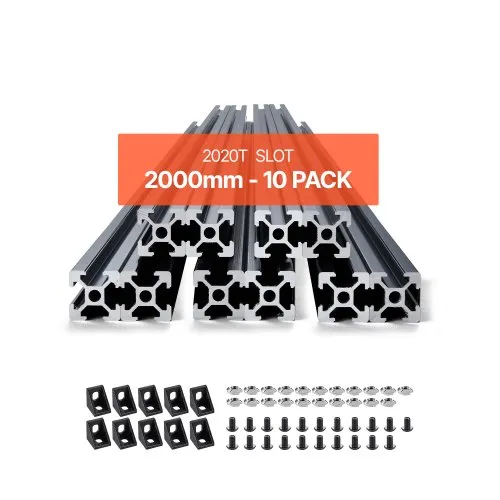
| 2020 Rail, 2000 mm, 10-Pack | 2020 | 20 x 20 | 2000 | 10 | 20 m | Most total rail in the lineup; large multi-frame printer or CNC builds |
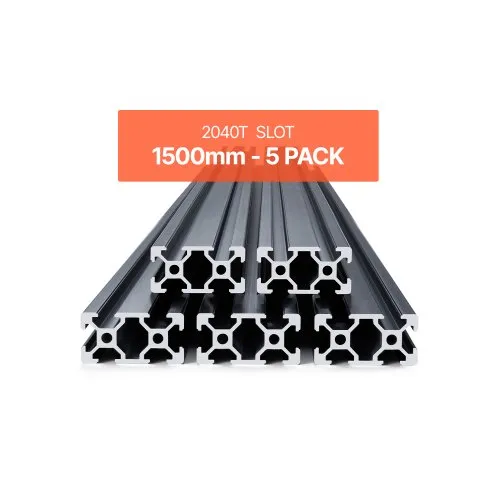
| 2040 Rail, 2000 mm, 5-Pack | 2040 | 20 x 40 | 2000 | 5 | 10 m | Only rectangular profile in the top five; stiff spanning beams and shelves |
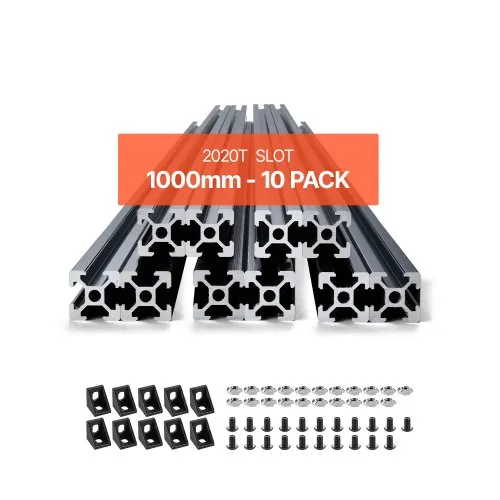
| 2020 Rail, 1000 mm, 10-Pack | 2020 | 20 x 20 | 1000 | 10 | 10 m | Ten ready 1 m cuts; small enclosures and fixtures with little cutting |
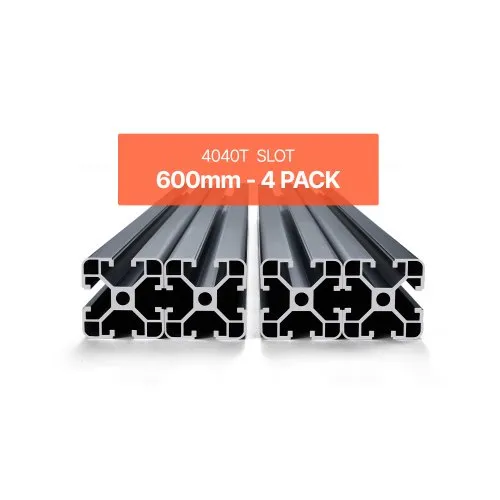
| 4040 Rail, 600 mm, 4-Pack | 4040 | 40 x 40 | 600 | 4 | 2.4 m | Shortest heavy-duty option; compact brackets, feet and corner posts |
Make Intense and Multipurpose Structures using VEVOR Aluminum Extrusion Profiles
VEVOR aluminum extrusion profiles are effective, accurate, and long-lasting solutions to all structural and automation requirements. VEVOR offers industrial machinery, aluminum extrusion profile rails, and general-purpose aluminum extrusion profiles, all strong, modular, and easy to assemble. VEVOR aluminum extrusion profiles are used in the construction of linear motion systems, custom workstations, and modular furniture to deliver performance and reliability to professionals.
FAQs
How do I choose the right aluminum extrusion profile for my project?
Start with load and span: pick a larger cross-section like 4040 for heavy frames and 2020 for light builds. Then match slot type, length, and pack size to your design. Browse the full aluminum extrusion profile range to compare the options side by side.
What are the main types of aluminum extrusions used in construction and manufacturing?
The most common are T-slot profiles for bolting frames together and V-slot profiles for linear motion. They are offered in square sections like 2020, 3030, and 4040 and rectangular sections like 2040 and 4080, each suited to different load, span, and movement needs.
Where can I buy high-quality aluminum profiles online?
VEVOR offers anodized, European-standard aluminum extrusion profiles online in multiple sizes, lengths, and pack quantities, with in-stock shipping. Explore the linear rail selection to find framing and motion profiles for 3D printers, CNC machines, workbenches, and enclosures.
What are the most common shapes of aluminum profiles available?
Square cross-sections such as 2020, 3030, and 4040 give balanced strength on every face, while rectangular sections like 2040 and 4080 add stiffness along one axis for beams and shelving. Most ship with T-slots, and select profiles use V-slots for sliding parts.
What is the difference between T-slot and V-slot aluminum extrusions?
T-slot profiles have straight channels that hold T-nuts and bolts, making them ideal for fixed framing and mounting panels. V-slot profiles have angled grooves that let wheels roll smoothly along the rail, so they are the choice for linear-motion setups like gantries and sliders.
How do I choose between different aluminum profile sizes and series?
Match the series to your load and unsupported span: 2020 suits compact light frames, 3030 and 2040 handle mid-duty builds, and 4040 profiles carry heavy structural loads. Longer spans and heavier loads call for larger cross-sections to limit flex.
What are the main benefits of using anodized aluminum extrusion profiles?
Anodizing adds a hard, corrosion-resistant surface layer that guards against wear, moisture, and weather while keeping a clean black or silver finish. It needs no painting, wipes clean easily, and extends service life, which suits both indoor workshops and exposed structures.
Why are aluminum profiles preferred over steel for structural framing?
Aluminum profiles weigh far less than steel yet stay rigid, so frames are easier to carry, modify, and reconfigure. Slotted faces let parts bolt on without welding or drilling, and the metal resists rust naturally. Compare sizes across the profile range to start.
