







Download VEVOR App 

Get $5.00 Off $99.00+ Orders on Your First 3 App Orders
Scan the QR code to download
SKU: WLZYCLTJ1GLHF4J0P001V0
Copy


+12
More


 Ask about this product by AI
What vehicles is the VEVOR Turbo Boost Leak Tester compatible with?
How do I use the VEVOR Turbo Boost Leak Tester?
What is the pressure gauge range of this turbo leak tester?
Ask something else
VEVOR Turbo Boost Leak Tester 4", 3" 6061 Aluminum End Cap, 0-30 PSI Adapter Gauge Range, Check Test Intake Charge Pipe Pressure Leaks with 4 Pairs of Air Fittings for Turbo Cars, SUVs, Diesel Trucks
4.8 5 Reviews
$ 38 90
Earn at least 2% points on purchases or save up to 15%.
Each when you buy 0+.
Shop
Get -% off for new user
Get $5.00 Off $99.00+ Orders on Your First 3 App Orders.
Download Now


Features & Details
- Turbo System Dedicated: Equipped with a 0-30 psi low-pressure gauge and a dedicated aluminum end cap/silicone coupler, this turbo boost leak tester kit is designed to precisely assess the turbocharger’s internal sealing
- Wide Compatibility: With a 3" OD aluminum end cap for turbo ports, and a 4" OD silicone coupler to expand compatibility, our turbo pressure leakage tester fits most vehicles
- Portable & Durable: All components are stored in a custom tool case for easy carrying and access. Our turbo boost leak tester features a coupler, a robust gauge, and enhanced sealing at key joints, ensuring long-term use in the high-heat engine bay
- Efficient Operation: Follow the simple "connect-pressurize-observe" process. This boost leak tester kit enables turbo system seal testing without extensive disassembly, easily completed by a single person, greatly boosting diagnostic efficiency
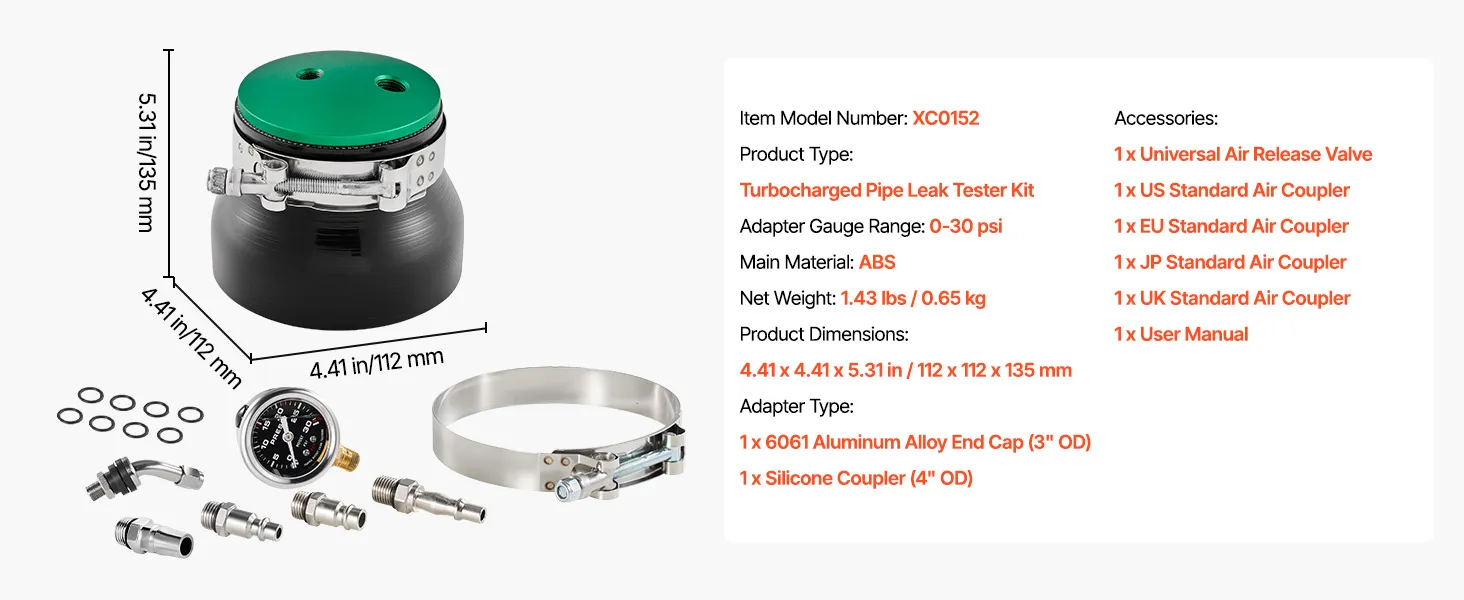
- Complete Accessories: This turbo system leakage tester set includes a corresponding pressure gauge, a coupler, four sizes of universal air fittings, O-ring seals, and a clear instruction manual, ready to use right out of the box
Product specification
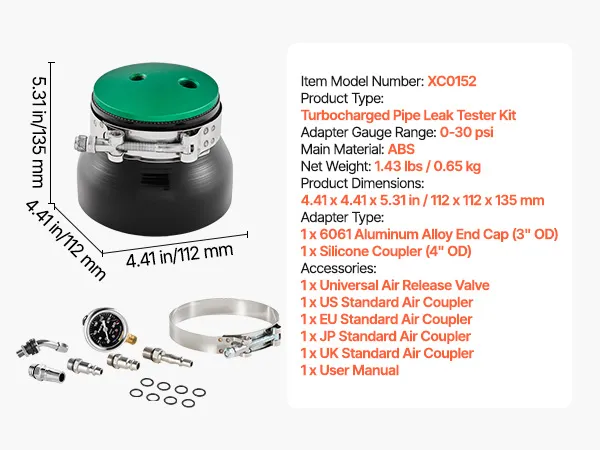
- Item Model Number XC0152
- Product Type Turbocharged Pipe Leak Tester Kit
- Adapter Gauge Range 0-30 psi
- Main Material ABS
- Net Weight 1.43 lbs / 0.65 kg
- Product Dimensions 4.41 x 4.41 x 5.31 in / 112 x 112 x 135 mm
Frequently Bought Together
Reviews
About this item
Questions and Answers
Explore
Reviews
No customer reviews
Be the first to rate this product. your feedback will helps others make informed decisions.
Write a Review
Top Reviews
About this item
Product specification
- Item Model Number
- XC0152
- Product Type
- Turbocharged Pipe Leak Tester Kit
- Adapter Gauge Range
- 0-30 psi
- Main Material
- ABS
- Net Weight
- 1.43 lbs / 0.65 kg
- Product Dimensions
- 4.41 x 4.41 x 5.31 in / 112 x 112 x 135 mm
- Adapter Type
- 6061 Aluminum Alloy End Cap (3" OD) & Silicone Coupler (4" OD)
Description


Pro-level performance without the pro-level cost
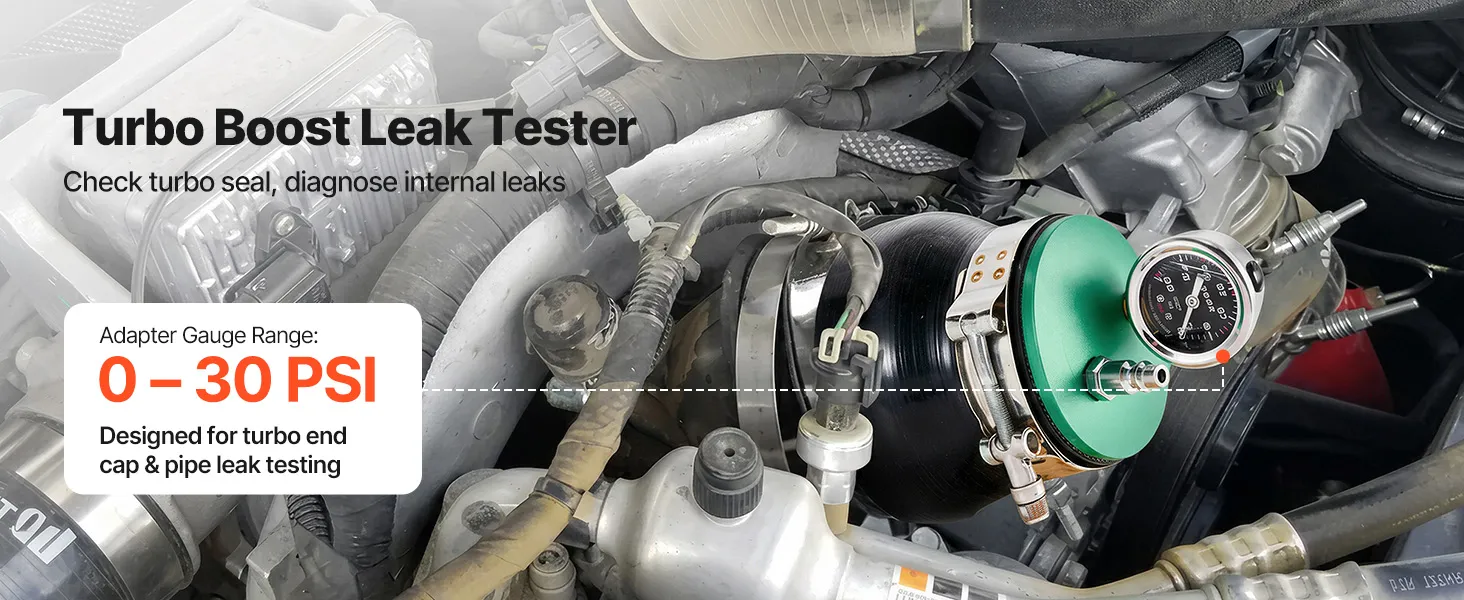
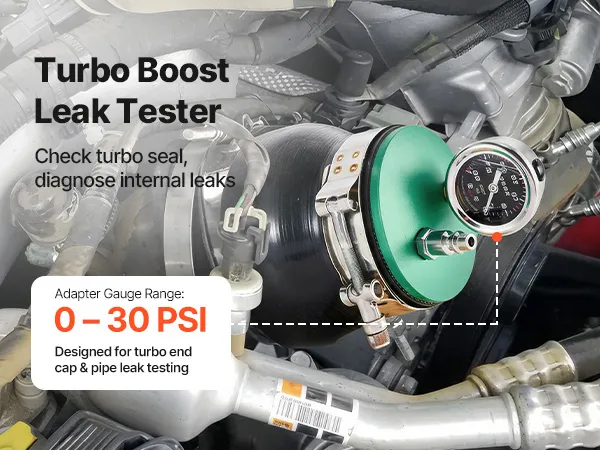
The turbo boost leak tester kit includes a dedicated aluminum end cap and silicone coupler to seal the turbocharger inlet or outlet. Paired with a 0-30 psi low-pressure gauge, it enables precise detection of leaks in key components such as the turbo shaft seal and wastegate valves.


The turbo pressure leakage tester features a 3" OD 6061 aluminum end cap to match common turbocharger compressor or turbine outlets. Paired with a flexible 4" OD silicone coupler, it adapts to slightly larger or non-standard ports to create a reliable seal during turbo testing.


The custom case keeps everything neatly stored and shields the gauges, turning the full turbo boost leak tester kit into a ready-to-use system. It saves time on organizing tools and keeps your diagnostic work efficient and orderly anywhere.
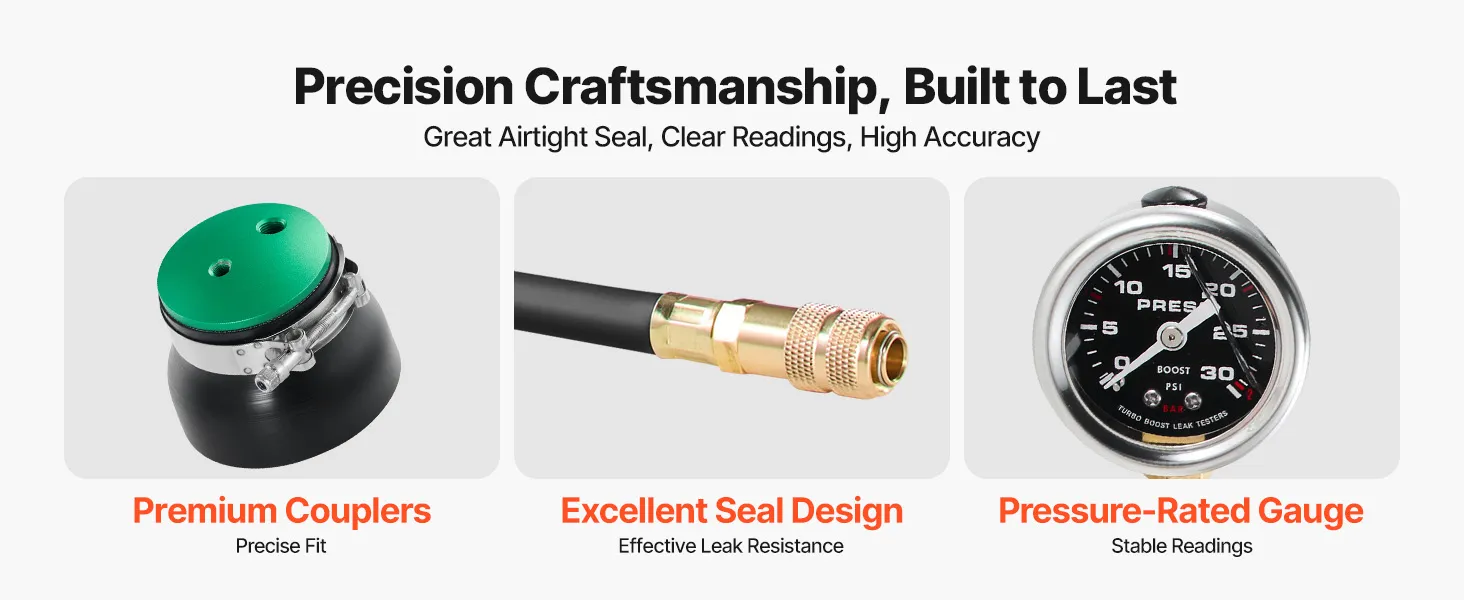
Turbo systems operate under high heat, pressure, and vibration. This boost leak tester kit features a heat-resistant coupler with excellent sealing performance and structural strength, while the sturdy pressure gauge ensures accurate tool readings through repeated use.
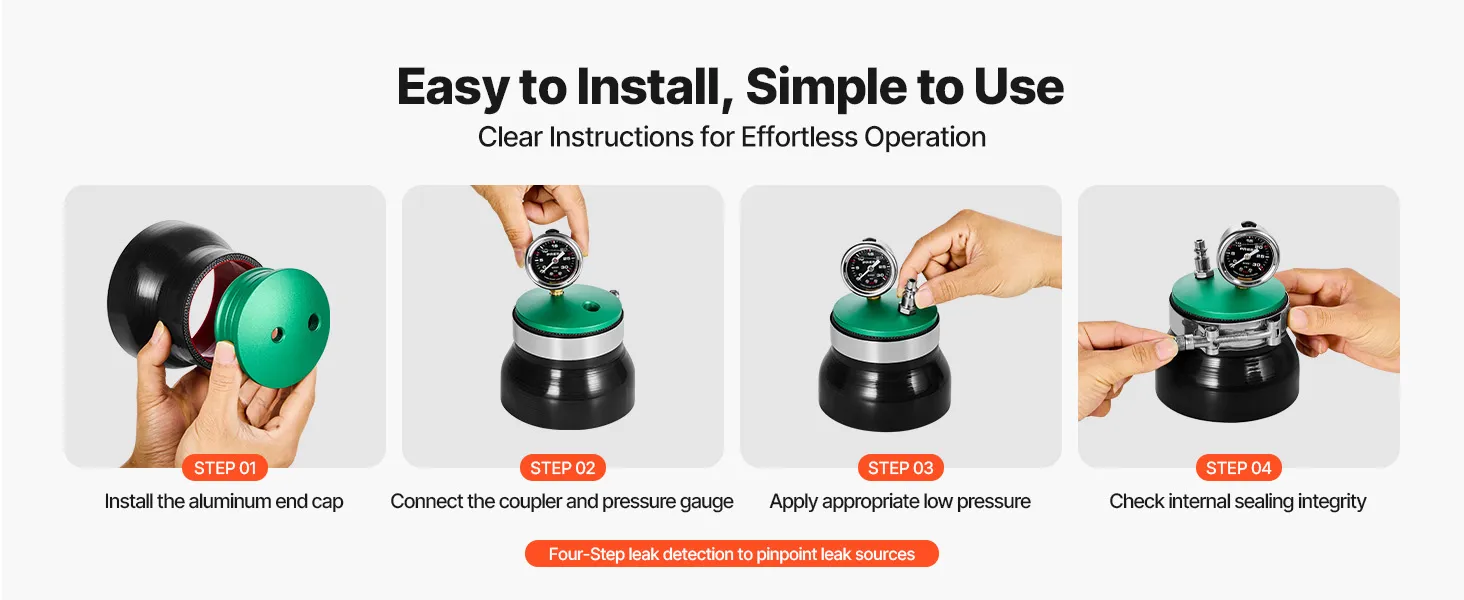
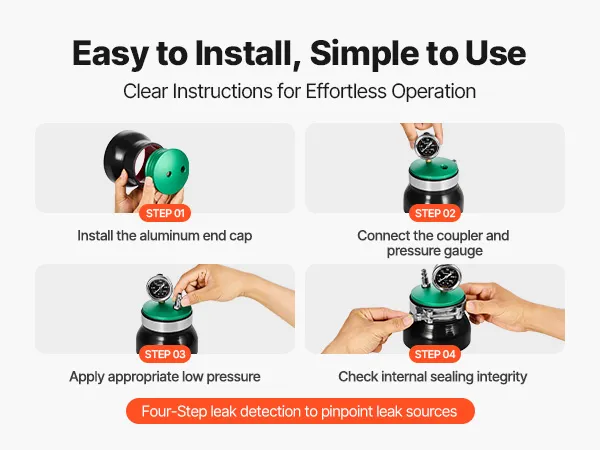
This turbo system leakage tester set simplifies disassembly steps. Simply connect the corresponding coupler to the suspected leaky pipeline, pressurize the sealed pipeline to the target value with an air source, and check whether the gauge remains stable. A pressure drop indicates a leak.
Turbo Boost Leak Tester with 0 to 30 PSI Low Pressure Gauge for Turbo Specific Diagnostics
The VEVOR turbo boost leak tester is equipped with a 0–30 PSI gauge specifically calibrated for the low operating pressure range of turbocharger intake and charge circuits. Unlike higher-range pressure gauges, the 0–30 PSI scale focuses on the pressure range commonly used for turbo system diagnostics. This makes small pressure changes easier to detect.
When the pressure is well below 30 PSI, the wastegate valves, charge pipe leaks, and turbocharger shaft seals all work and leak in most gasoline vehicles and light trucks. The right diagnostic tool for finding leaks in these parts is a gauge with this pressure range. This is because its low range matches the normal operating pressure of these parts and does not put excessive pressure on the fragile turbo seals during testing.
6061 Aluminum Alloy 3 in End Cap for Precise Turbocharger Port Sealing
The 3-in OD end cap is made from 6061 aluminum alloy, a grade commonly used in precision mechanical parts because it is easy to machine, stable in size, and corrosion-resistant. The 3 in inner diameter targets the most common compressor outlet port dimensions found on turbochargers fitted to performance cars, SUVs, and light diesel trucks, creating a snug, leak-free mechanical seal at the port opening before pressurization begins.
Because 6061 aluminum is dimensionally stable, the end cap retains its round shape and flat surface even after being put on and taken off many times. This is because it resists bending at the port-contact edge, as softer materials do over time. In diagnostic sessions, a cap that maintains its shape after multiple uses helps keep the seal geometry consistent. This prevents false pressure readings caused by a deformed cap face that does not make full contact with the port lip.
4 in Silicone Coupler for Flexible Fitment Across Non-Standard Turbo Port Sizes
When you pair this turbo boost leak tester with the 4 in OD silicone coupler, you can use it on turbocharger ports larger than the 3 in end cap's fixed diameter. The silicone's natural flexibility allows the coupler to accommodate compatible port sizes within the nominal diameter range. This provides a reliable seal on non-standard or irregular port openings that a hard aluminum cap cannot handle without custom machining.
Silicone can handle higher temperatures in the engine bay than many other rubber products. The coupler retains its shape and sealing ability even when used under the hot conditions of a recently used engine. It does not harden, crack, or lose its elasticity. This keeps the seal in place so it does not break during the pressurization and observation cycle.
Connect Pressurize Observe Workflow for Single-Person Leak Detection Without Disassembly
There are three steps to the diagnostic process: connect the right end cap or coupler to the part of the system you think is leaking, use an external air source to pressurize the sealed circuit to the target value, and check whether the gauge reading remains stable. If the gauge reading remains steady, the tested system is holding pressure. If the reading drops, it indicates a leak in the sealed part of the system. This lets the expert focus on the faulty circuit without having to take it apart and check each part separately.
Compared to smoke testing or visual inspection methods that require the engine to be running, this streamlined process enables much faster confirmation of a boost leak. This turbo boost leak tester simplifies troubleshooting by helping isolate pressure leaks without unnecessary disassembly. They can narrow down the leaking section by testing each pipe run and connection in turn until they see the pressure drop happen again in that segment.
Turbo Boost Leak Tester with 4 Pairs of Universal Air Fittings and O-Ring Seals
The kit includes four pairs of universal air fittings that work with a wide range of common air compressor connections found on compressors and shop air supplies. You can connect the kit to a pressurized air source, reducing the need for additional adapters in many setups. Just pick the right fitting from the kit and attach it to the tester gauge's outlet connection.
There are O-ring seals on the interfaces where the gauge, couplers, and air fittings meet. This makes sure that the pressurization circuit is sealed at all joints in the test assembly. For accurate diagnostics, the test assembly must be leak-free. A leaking fitting connection would cause a pressure drop that resembles a system leak, leading the technician to look for a problem in the test equipment rather than the vehicle's turbo system.
Custom Tool Case and Complete Accessory Set for Ready-to-Use Turbo System Testing
The gauge, end cap, silicone coupler, air fittings, O-ring seals, and instruction booklet are all organized and ready to use when they arrive in a custom-fitted tool case. During shipping and storage, the case protects the gauge and accessories from dust, impacts, and other damage.
The whole kit and case weigh only 1.43 pounds (0.65 kg) and measure 4.41 by 4.41 by 5.31 inches. It is small enough to fit in a tool drawer, glove box, or workbench shelf without taking up too much room. The case comes with an instruction manual that walks you through the connect-pressurize-observe process step by step. This means that home mechanics and automotive enthusiasts can use the kit to find their first boost leak, even if they have never used turbo pressure testing tools before.
Product guides and documents
User manual-en (PDF) Review
Questions and Answers (0)
Typical questions asked about products: Is the product durable? ...
In Stock
Security & Privacy
FREE Returns
Professional Service
Compare with similar items
Similar Items You Might Like
People Who Bought This Item Also Bought
Best sellers in this category
People Who Viewed This Item Also Viewed
Your Browsing History
Recommended Searches
transmission fluid pump air compressor pressure relief valve air pressure pump for tires air pressure gauge for car tires coax compression tool refrigeration manifold gauges vacuum hose new vacuum pump value vacuum pump dry vacuum pumps vacuum vacuum pump vacuum bag pump vacuum and air pump vehicle ac vacuum pump vacuum pump manufacturers vacuum ring pump vacuum pump suppliers 12v vacuum pump vacuum pump for sale vacuum pump working principle