








Download VEVOR App 

Get $5.00 Off $99.00+ Orders on Your First 3 App Orders
Scan the QR code to download
SKU: QLZXCXTZJTCSE3UP3001V9
Copy


+12
More


Deals
VEVOR Deionized Water System for Car Wash, Spotless Car Wash Water System with 2 x 4L DI Resin, Bypass Valve & TDS Meter, Portable Sport-Free Water Deionizer Filter for Cars RVs Windows
Deals
4.3 118 Reviews
$ 310 90
Earn at least 2% points on purchases or save up to 15%.
Each when you buy 0+.
Shop
Get -% off for new user
Get $5.00 Off $99.00+ Orders on Your First 3 App Orders.
Download Now

Features & Details
- Spotless Car Wash: Featuring 2 x 4L premium mixed-bed resin, this deionized water system for the final stage of car wash efficiently removes calcium, magnesium, and other dissolved ions, allowing the car to air dry naturally for a spot-free finish without wiping, saving time and effort
- Strong Purification Capacity: Under average 200 ppm water conditions, this spotless car wash water system delivers a rated purified water capacity of up to 330 Gallons (1250 L), providing sufficient deionized water for continuous spotless car washes
- Real-time Water Quality Monitoring: Designed with a TDS meter, this water deionizer for car washing allows quick checks and timely resin refills to maintain optimal water purity and get spotless results. Replacement is recommended around 30 ppm
- Dual-Mode Operation: Switch to BYPASS mode to wash the car with tap water, apply soap foam, and rinse off the foam. Then switch to FILTER mode for the final deionized water rinse and let it air dry naturally for a spotless finish
- Easy Mobility: This spot-free deionized water filter is mounted on a convenient trolley base with dual handles and wheels for effortless movement. Also features two adjustable height levels to suit different user preferences and working conditions
Product specification
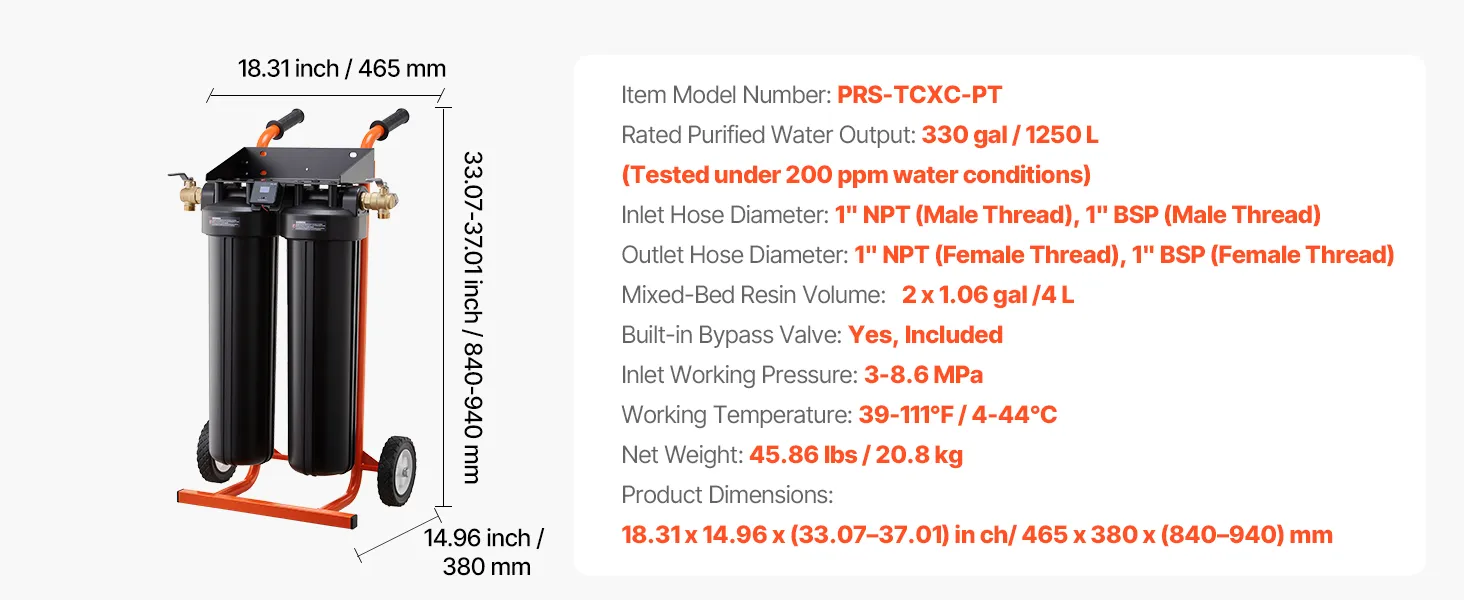
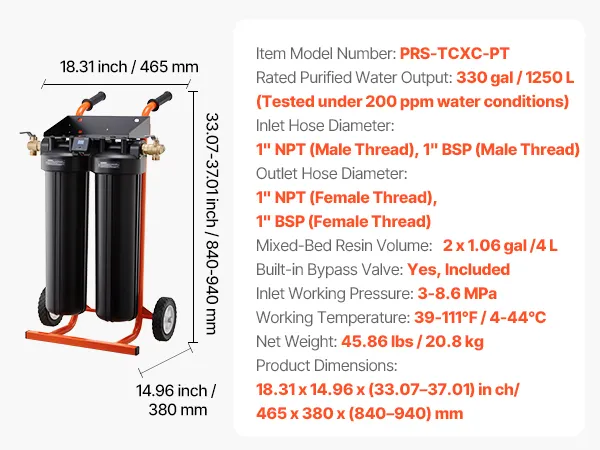
- Item Model Number PRS-TCXC-PT
- Mixed-Bed Resin Volume 2 x 1.06 gal /4 L
- Built-in Bypass Valve Yes, Included
- Inlet Working Pressure 3-8.6 MPa
- Working Temperature 39-111℉ / 4-44℃
- Net Weight 45.86 lbs / 20.8 kg
Frequently Bought Together
Reviews
About this item
Questions and Answers
Explore
Reviews
No customer reviews
Be the first to rate this product. your feedback will helps others make informed decisions.
Write a Review
Top Reviews
About this item
Product specification
- Item Model Number
- PRS-TCXC-PT
- Mixed-Bed Resin Volume
- 2 x 1.06 gal /4 L
- Built-in Bypass Valve
- Yes, Included
- Inlet Working Pressure
- 3-8.6 MPa
- Working Temperature
- 39-111℉ / 4-44℃
- Net Weight
- 45.86 lbs / 20.8 kg
- Product Dimensions
- 18.31 x 14.96 x (33.07–37.01) in / 465 x 380 x (840–940) mm
Description


Deionized Water System for Spotless Car Wash
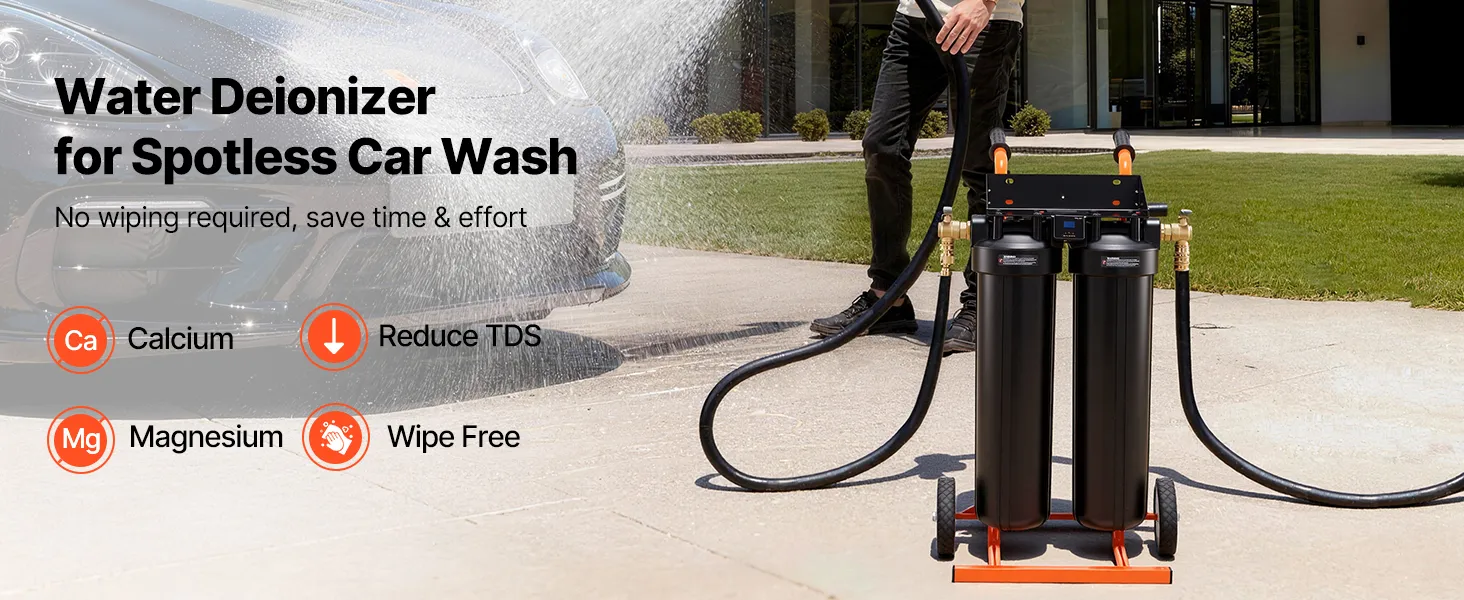
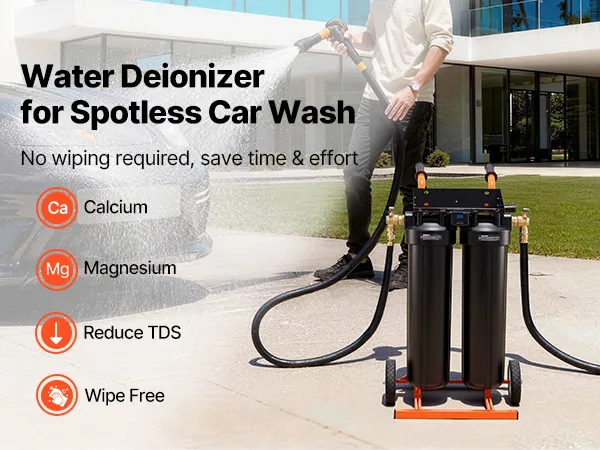
This deionized water system is a great helper for the final stage of car washing, delivering a spotless finish that allows natural air drying without wiping, making the washing process easier and more efficient.
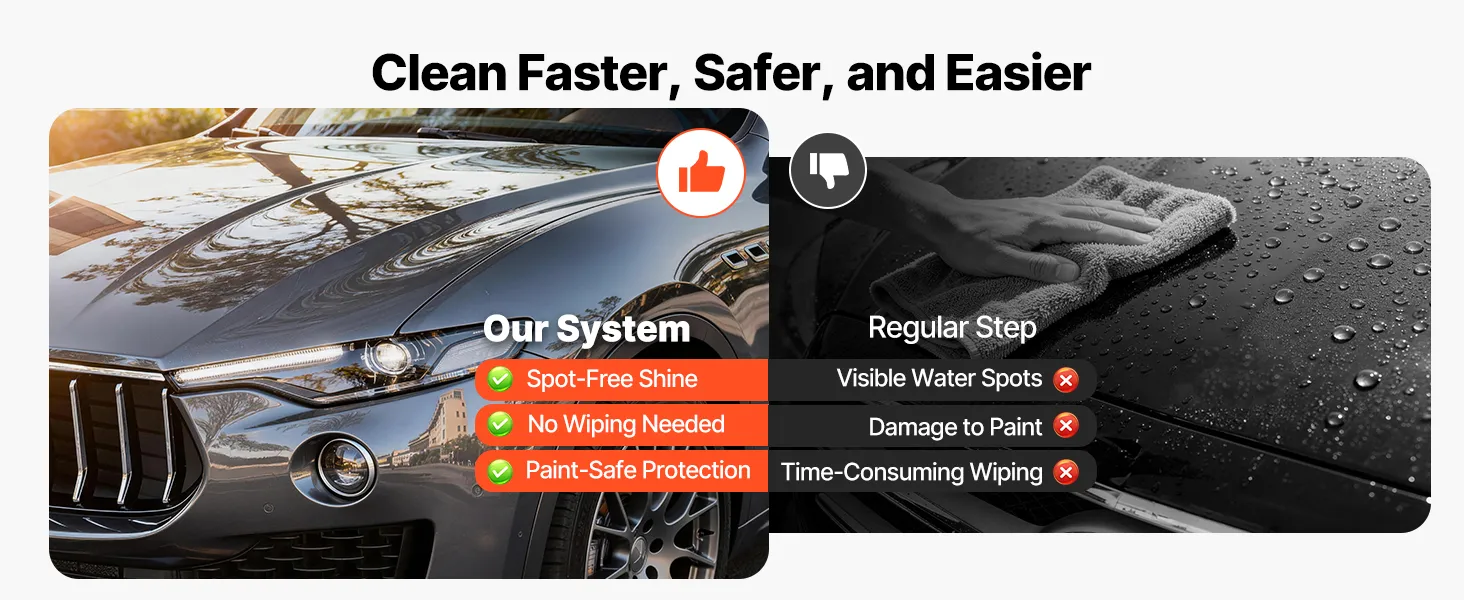
Under average 200 ppm water conditions, this spotless water deionizer delivers up to 330 Gallons (1250 L) of deionized water for consistent, reliable spot-free car washes, while helping protect your vehicle's paint.
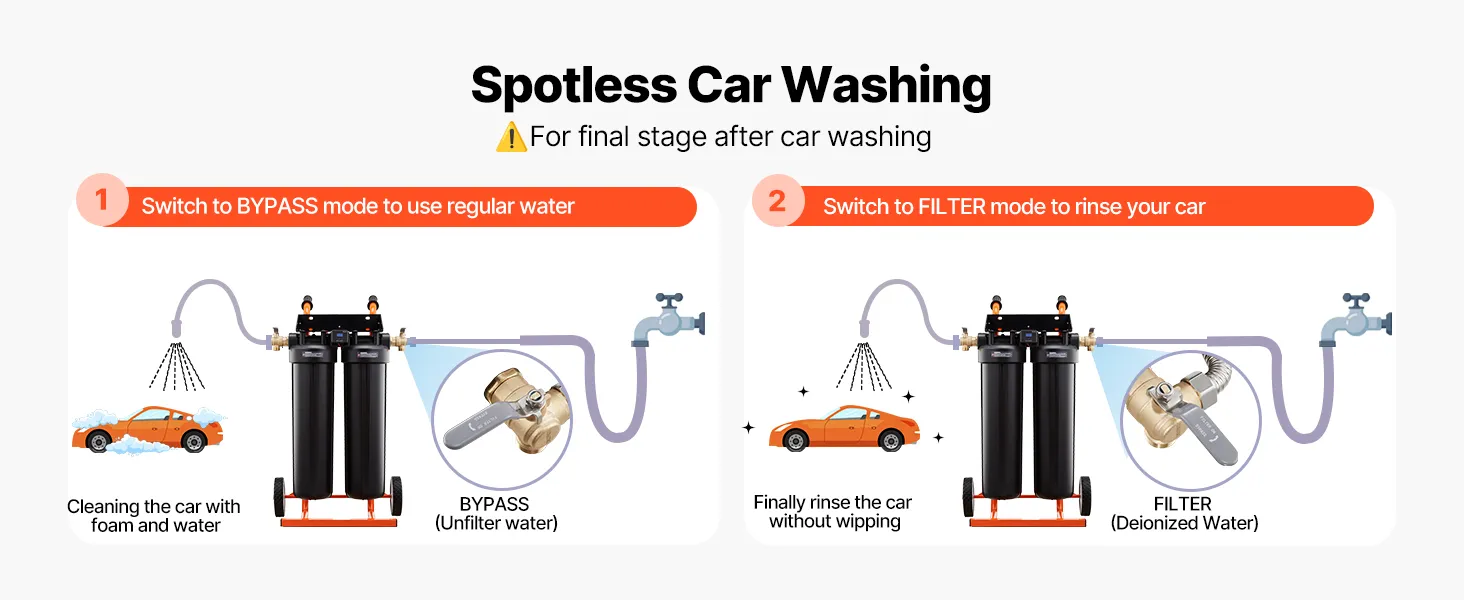
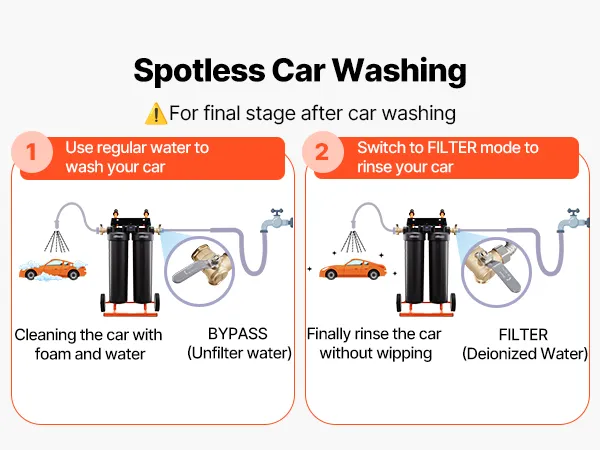
Switch to BYPASS mode to wash the car with tap water, apply soap foam, and rinse off the foam. Then switch to FILTER mode for the final deionized water rinse and let it air dry naturally for a spotless finish.
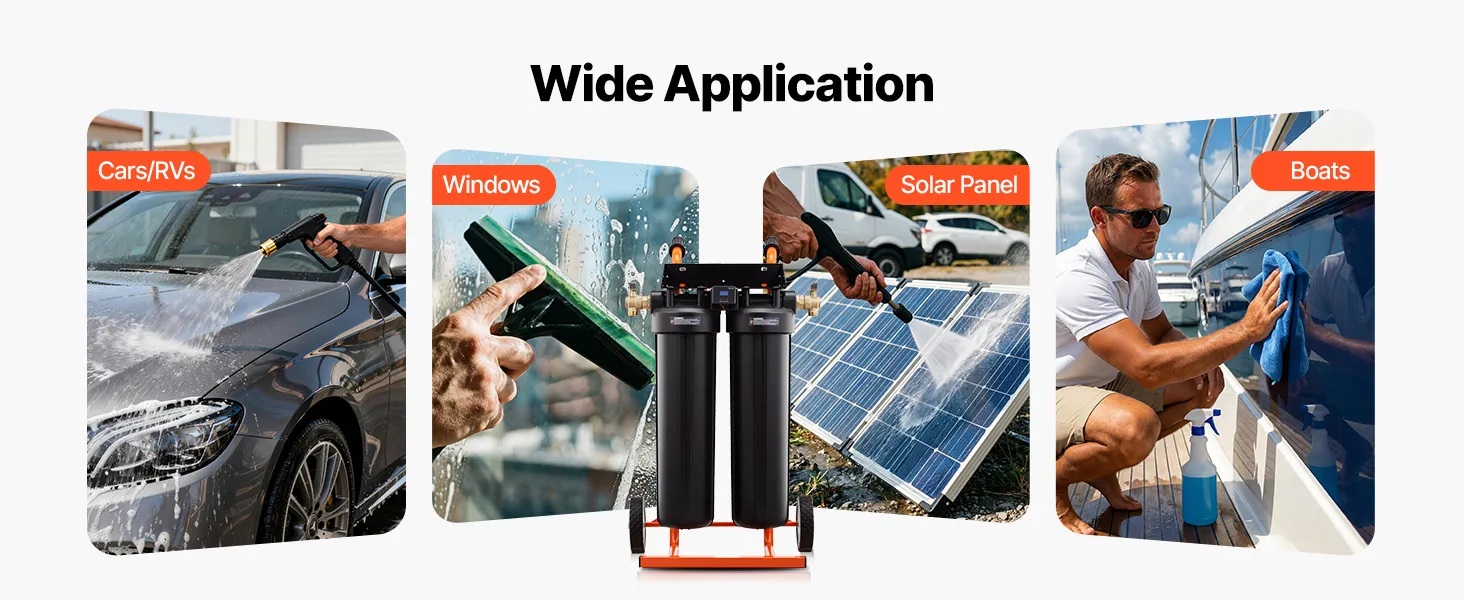
This spot-free deionized water system is suitable for cleaning cars, RVs, motorcycles, windows, and solar panels, effortlessly achieving a spotless finish without water spot residue.
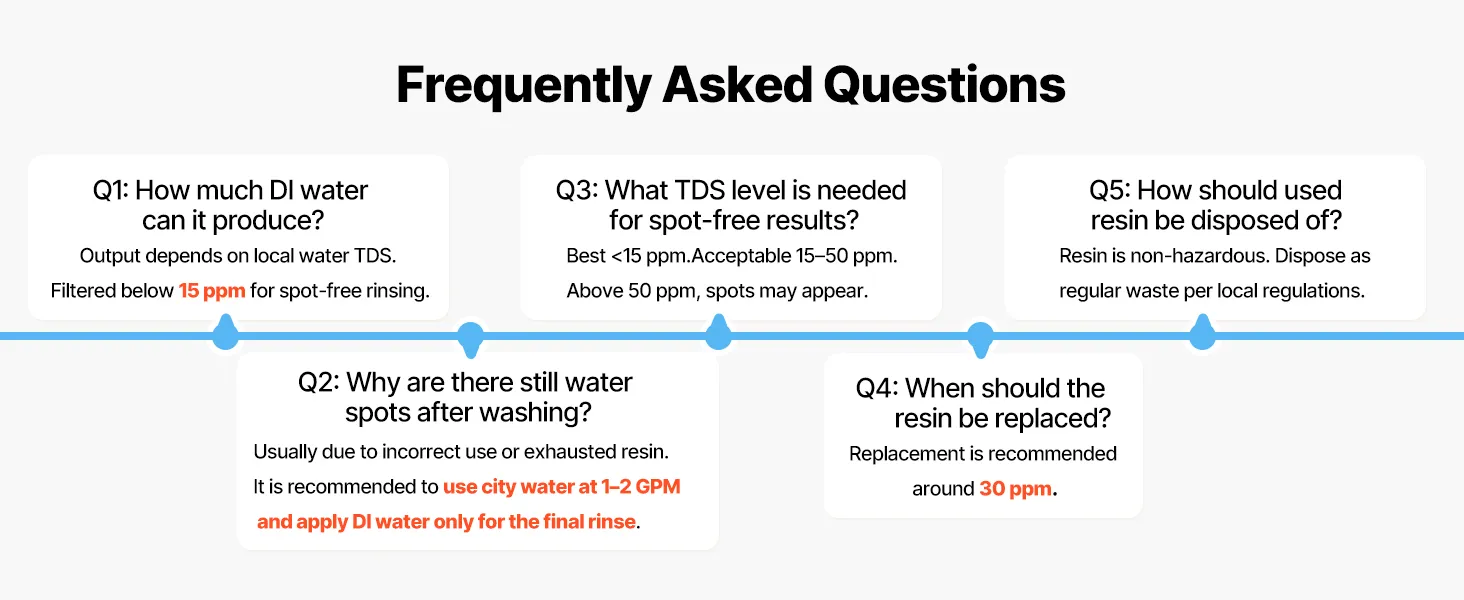
We've listed some frequently asked questions for your reference. We hope these answers help you better understand and use the system.
2 x 4L Mixed-Bed Resin Delivers Deionized Water for Home Car Wash
When calcium, magnesium, and other dissolved ions in tap water evaporate from a moist surface, they leave behind mineral deposits known as "water spots." Using 2 × 4 L of premium mixed-bed resin to remove dissolved ions from the water before it ever comes into contact with the automobile, our deionized water for home car wash system addresses the issue at its root.
As a result, there is no need for a manual wipe-down after rinsing, because the water is pure enough to air-dry naturally without leaving mineral residue. Instead of just speeding up the process, replacing a typical hose rinse with deionized water at the end eliminates the need for anyone to spend extra time chasing streaks and spots after each wash with a microfiber towel.
330 Gallon Purification Capacity Under Average 200 PPM Conditions
This deionized water for home car wash is rated to purify up to 330 gallons (1250 L) of water under average conditions with 200 ppm source water. Resin capacity influences how long a system remains effective before it needs maintenance. For the majority of home users, this means that before resin performance begins to deteriorate, a good string of consecutive car washes is necessary.
The actual capacity will vary with the hardness of the local water; regions with higher mineral content in their tap water will experience resin exhaustion more quickly than at the baseline 200 ppm. However, rather than speculating about when performance might start to decline mid-wash on a machine with no defined purifying volume, having a definite rated capacity gives consumers a solid benchmark.
Built-In TDS Meter for Real-Time Water Quality Monitoring
Visual inspection is unreliable for determining when a refill is required since purification quality steadily deteriorates as the resin becomes saturated with absorbed ions. This system addresses these concerns by providing a real-time reading of the total dissolved solids in the output water via an integrated TDS meter, allowing customers to precisely assess purification quality at any time.
Instead of relying on speculation or waiting for spots to reappear after a wash cycle is complete, guidelines advise replacing the resin when readings reach about 30 ppm. Instead of being a trial-and-error guessing game every few months, real-time monitoring makes resin maintenance a straightforward check-and-replace process.
Bypass Valve Enables Dual-Mode Wash and Rinse Operation
Since deionization is only important for the final rinse, running a full car wash with deionized water would quickly and needlessly burn through the resin's capacity. This is resolved by the system's built-in bypass valve, which allows users to switch to BYPASS mode for the soap and scrub stages while directing ordinary tap water through for the wash and foam rinse, where mineral content is irrelevant.
To achieve a spot-free finish, the final rinse is routed through the deionization resin by switching to FILTER mode after the vehicle has been soaped and cleared of suspended debris. Compared to running every gallon through purification, this two-stage method, using tap water for washing and deionized water only for the final rinse, significantly increases resin life, making the system far more economical than repeated use.
Trolley Base with Wheels Makes Deionized Water for Home Car Wash Portable
Driveways, garages, and street parking all require moving equipment, so a deionized water for home car wash system rarely stays in one fixed location. This deionized water system for a home vehicle wash machine is mounted on a trolley base with two handles and wheels, making it easy for users to move the system between wash spots without having to carry a bulky, heavy device manually.
The system's actual weight of 45.86 lbs (20.8 kg) makes the trolley design more than just a convenience feature; it is what makes it feasible for one person to move the unit around a driveway or between a garage and an outdoor wash area without needing a second set of hands every time it needs to move.
Adjustable Height Trolley Fits Different Users and Work Setups
Regardless of a user's height or the specific wash arrangement they use, a fixed-height cart compels them to adopt the same operating posture. With two height-adjustable settings, this system allows users to elevate or lower the device to a more comfortable working position based on their personal height or the design of their wash area.
This adaptability is especially useful when working with various vehicle types. For example, a lower position would be more suitable for sedans or smaller garages, while a taller setting might be better for reaching over an SUV or truck bed. The adjustable-height element completes a system designed for real-world adaptability rather than a single, fixed use case, especially when combined with the trolley's mobility.
Product guides and documents
User manual-en (PDF) Review
Questions and Answers (4)
Do the filters inside unthread to replace the resin?
I know I can buy new filters but just wondering if I can reuse them
Yes. The filter housings are refillable—they can be unscrewed so the spent deionization (DI) resin can be removed and replaced rather than replacing the entire housing.
If this answer does not resolve your issue, please contact us again for assistance.
By vevor
Helpful
(
0
)
How long do these these last, as of spot free ?
The resin filter of this VEVOR deionized water system is expected to provide up to 330 gallons (approximately 1250 liters) of water for a no-wipe, water-spot-free car wash.
By vevor
Helpful
(
0
)
Does the deionizer system work for solar panel cleaning?
Yes, you can use it.
If this answer does not resolve your issue, please contact us again for assistance.
By vevor
Helpful
(
0
)
Does the TDS Meter read input AND output?
No, a TDS meter does not read input and output simultaneously.
By vevor
Helpful
(
0
)
58% Left
Select product protection plan
Accident and warranty protection by Xcotton (partner with AIG)
No thanks
3-Year
2-Year
1-Year
In Stock
Security & Privacy
FREE Returns
Professional Service
Compare with similar items
Similar Items You Might Like
People Who Bought This Item Also Bought
Best sellers in this category
People Who Viewed This Item Also Viewed
Your Browsing History