NAAR 12V transferpomp lets you move fuel, diesel, water, oil, and other compatible fluids without a standard electrical outlet. These small pumps are suitable for vehicles, farms, boats, workshops, RVs, and machinery. However, to choose the right model, you can’t rely on voltage alone. Performance depends on flow rate, fluid compatibility, pressure, lift height, construction materials, hose size, and power requirements. This guide covers ideal 12-volt transfer pumps, where they can be used, and how to select a 12 V transfer pump. You will also learn how these pumps work and how to keep them in good condition.
Alt text: 12-volt transfer pump
Best 12 Volt Transfer Pumps
Het selecteren van de juiste pomp depends on the fluid to be transferred, flow rate, power source, and operating conditions. The applications listed below include alternative uses, such as water pumping or fuel transfer.
You may require a 12-volt transfer pump to transfer fuel, diesel, or general water, and these models have a variety of options in portability, flow performance, durability, and ease of use. Before buying, always check the specifications and whether it suits your application.
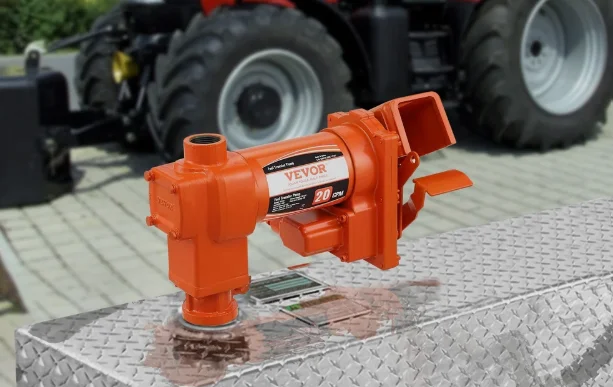
VEVOR 12V Transfer Pump
De VEVOR 12V transfer pump is a sensible choice for portable fuel transfer when you need a small, cost-effective system. Its 12V DC motor provides up to 5 GPM and can use gasoline, diesel, kerosene, and some fuel blends. It is also equipped with forward and reverse pumping by the pump, which may make it easier to transfer or recover fuel. Its cast-iron frame is durable, and overload protection and a bypass valve help safeguard the pump during operation. The kit also contains hose and nozzle-related parts; hence, it can be used in equipment refueling and other fuel-transfer operations.
Voors:
- Maximum flow rate of 5 GPM.
- Assists with gasoline and diesel.
- Forward and reverse pumping ability.
Con:
- Less flow rate than certain heavy-duty models.
Fill-Rite 12V Transfer Pump
Fill-Rite has a variety of 12 V transfer pumps that can be used in demanding fuel-transfer applications. Its 12V models come with various flow rates and configurations, enabling you to select the pump to suit your tank size and transfer needs. For example, the RD1212BN provides up to 12 GPM and can handle diesel, gasoline, kerosene, biodiesel up to B20, and mineral spirits. It also has self-priming, thermal protection, and portability, weighing less than 8 pounds. These characteristics make Fill-Rite an excellent option for durability, consistent operation, and reliable fuel transfer.
Voors:
- Up to 12 GPM flow rate
- Self-priming operation
- Heat shielding of the motor.
Con:
- Tends to be more expensive than inexpensive portable pumps.
GPI 12V Transfer Pump
When you require a dedicated solution to transfer fuel between tanks and vehicles, machines, or other equipment, a GPI 12V transfer pump may be an ideal option. GPI has a reputation for portable and tank-mounted fuel-transfer apparatus, and its models are constructed with various flow rates to meet any installation demands. In a comparison of GPI versus other 12-volt transfer pumps, the maximum flow of the pump, the fluids that it can pump, electrical draw, hose connections, and duty cycle should be taken into consideration. Match these specifications to your application for reliable performance. The right-sized GPI pump can be conveniently operated on 12V without having to have a separate AC power supply.
Voors:
- Intended to be used in fuel-transfer applications.
- Mobile equipment can be powered by 12V.
- Comes in various configurations.
Con:
- Model specifications vary, so choose carefully.
HORUSDY 12V Transfer Pump
The HORUSDY 12V transfer pump will suit customers who need a simple and mobile fuel-transfer pump. These pumps are typically built around 12 V DC and are therefore easily applicable to vehicle or equipment batteries. The package may include hoses, a nozzle, and other items needed for basic fuel transfer, depending on the model. In the case of this pump being one of the best 12-volt transfer pumps, look at its rated flow rate, compatible fuels, length of its hose, suction capacity, and duty cycle. These specifications will determine whether the pump suits occasional refueling or more frequent equipment-transfer tasks.
Voors:
- Portable 12V design
- Mobile transfer of fuel is appropriate.
- Frequently provided as a kit.
Con:
- There can be variation in performance among available configurations.
Fill-Rite FR1600 12V Transfer Pump
The Fill-Rite FR1600 series is constructed to perform reliable fuel-transfer jobs and comes in configuration designs to operate with diesel and related fluids. The similar 12V FR1612 by Fill-Rite features a cast-iron housing, rotary vane design, and self-priming design. It provides up to 10 GPM and is compatible with diesel, kerosene, and antifreeze, with a thermal protection switch to assist in protecting the motor. This type of pump is convenient to use in a mobile application as it is compact in size and comes with a built-in battery. Upon diesel, in case you are in need of a 12-volt transfer pump, its robust design and steady flow are worth considering.
Voors:
- Heavy-duty cast-iron construction
- 10 GPM maximum flow
- Design with thermal protection and self-priming.
Con:
- Engineered mainly to be compatible with fuel and fluid use.
KAT’S 12V Transfer Pump
Alternatively, KAT also offers 12V transfer pumps for portable fluid-transfer situations when battery power is needed. A 12V pump may come in handy without AC power, particularly around vehicles, equipment, boats, or remote workplaces. Before choosing a KAT model, confirm fluid compatibility and rated performance, since transfer pumps are application-specific. When comparing top 12V transfer pump options, consider flow rate, power usage, suction lift, hose connections, and operating time rather than price alone. Choosing a model that fits the job can boost productivity and reduce unnecessary stress on the pump.
Voors:
- Easy 12V battery.
- Appropriate for mobile applications.
- Small-scale method of fluid transport.
Con:
- Precision depends on the model.
SEAFLO 12V Transfer Pump
SEAFLO has 12V diaphragm pumps, which are specifically suitable for water and other similar fluid operations. One of them offers an open flow rate of 1.2 GPM, a shut-off pressure of 35 PSI, and self-priming to a depth of 4 feet. It is relatively small and has a relatively low current draw, which makes it useful in applications where space and power consumption are important. This kind of pump is better adapted to water than fuel-transfer tasks. Assuming you require a 12-volt transfer pump for water, pressure, flow rate, self-priming height, and fluid compatibility checks will aid in determining a SEAFLO model that can be used in your application.
Voors:
- Compact en lichtgewicht ontwerp
- 1.2 GPM open flow rate
- Zelf-aanzuigend vermogen
Con:
- Lower flow rate than dedicated fuel-transfer pumps
| 12 Volt Transfer Pump | Maximale stroomsnelheid | Hoofd Toepassing | Belangrijk kenmerk |
| VEVOR 12V Transfer Pump | 5 GPM | Benzine, diesel, kerosine | Forward and reverse pumping |
| Fill-Rite 12V Transfer Pump | Maximaal 12 GPM | Brandstofoverdracht | Self-priming operation |
| GPI 12V Transfer Pump | Verschilt per model | Brandstofoverdracht | Meerdere configuraties |
| HORUSDY 12V Transfer Pump | Verschilt per model | Brandstofoverdracht | Portable 12V design |
| Fill-Rite FR1600 12V Transfer Pump | Maximaal 10 GPM | Diesel and related fluids | Cast-iron construction |
| KAT’S 12V Transfer Pump | Verschilt per model | Vloeistofoverdracht | Werking op batterijen |
| SEAFLO 12V Transfer Pump | 1.2 GPM | Water and similar | Self-priming diaphragm design |
How to Choose the Best 12 Volt Transfer Pump
Alt text: how to choose the best 12 volt transfer pump
When you compare a pump’s performance with your application’s requirements, it is much easier to choose the right pump. Flow rate, fluid compatibility, lifting capacity, energy, materials, and connections all affect pump performance.
When it comes to moving diesel, gasoline, water, or any other compatible fluid, the pump must be suited to the task and not just one with a high flow rate. The following considerations will allow you to reduce your choices and select a quality 12-volt transfer pump to fit your equipment, vehicle, farm, workshop or other use.
Controleer de stroomsnelheid
Flow rate informs you of the rate at which a pump can transport fluid between containers or tanks. It is usually expressed in gallons/minute (GPM) or liters/minute (LPM). When filling large tanks or filling up equipment regularly, the flow rate can be used to reduce the transfer time. Nevertheless, it is not always essential to select the pump with the highest rating. Take into consideration your tank size, transfer distance, and the rate at which you really require to transfer the fluid. You can use the rated flow as a comparison to your application and identify one of the best 12-volt transfer pumps without spending more money on higher capacity than you require.
Consider the Fluid You Need to Transfer
One of the most critical factors when selecting a pump is fluid compatibility. A pump that is used to run on diesel would not work with gasoline, chemicals, oils, or water. The material of the housing, seals, diaphragm, and internal parts should be compatible with the fluid being transferred. For example, a 12 volt transfer pump for diesel should be specifically rated for diesel fuel and other fluids listed by the manufacturer. Likewise, a 12-volt water transfer pump must be developed to be used in water. In all cases, consult the compatibility information on manufacturers before attaching the pump to a specific fluid.
Look at Maximum Lift and Pressure
Maximum lift is the vertical distance a pump can lift fluid, while pressure is the force needed to push fluid through the system. These specifications are especially important when the source and destination containers are at different heights or when the fluid must be transported through an extended hose. Even a pump that has a high flow rate can have a low lift and fail to carry fluid. When selecting a 12V transfer pump, compare the required vertical distance, hose length, and system resistance with the pump’s lift and pressure rating to ensure it will work with your system.
Controleer de stroomvereisten
As 12V transfer pumps operate on direct current, they are typically powered by vehicle batteries, equipment batteries, or an appropriate 12V electrical system. Before purchasing a pump, check its current draw, wattage, fuse requirements, and recommended power source. A pump that has a large current may cause extra strain on a battery, particularly with prolonged use. Check the length and gauge of power cables supplied, as well, where provided. Understanding these requirements matters when studying how a 12-volt transfer pump works, since the motor converts electrical energy from the 12V source into mechanical energy that drives the fluid.
Choose the Right Pump Material
The material used to build a transfer pump affects durability, fluid compatibility, and wear and corrosion resistance. Popular materials are cast iron, aluminum, stainless steel, thermoplastics, and specialized rubber or elastomer seals. The correct decision should be determined mostly by the fluid that is transferred and the workplace. In fuel applications, select a pump that is specially designed using a material that is appropriate to the type of fuel. In water applications, corrosion resistance and long-term exposure to moisture may matter more. Examining the housing and internal materials can enable you to choose a pump that would be stable in the operating conditions that you are planning to apply.
Consider Hose and Connection Size
The hose and connection size may have an influence on the installation and the pumping performance. An oversized connection can not fit your present tank, nozzle, or fittings, and a hose that is too small can limit the flow and raise resistance. Before buying a pump, verify the size of the pump inlet and outlet and ensure that it matches your existing system. The hose length, flexibility, and compatibility with the fluid are also to be considered. Correctly sized connections may simplify installation and assist the pump to provide the desired performance. This is particularly crucial when the installation of a 12 volt transfer pump is used to supply fuel or diesel in a mobile application.
Where Can You Use a 12 Volt Transfer Pump?
Alt text: where can you use a 12 volt transfer pump
A 12V transfer pump has the capability to perform various fluid-transfer applications provided its requirements are suitable to the application. It is battery-powered and is particularly handy in places with no normal electrical outlets.
These pumps are convenient in fluid transfer, whether in fueling cars and machines or in the transfer of water in mobile environments. Nevertheless, the pump should always be specified for the type of fluid you intend to move.
Fuel and Diesel Transfer
One of the most popular uses of a 12 V pump is fuel transfer. An appropriately rated pump may transfer diesel, gasoline, kerosene, or other acceptable fuels between storage tanks and the appropriate vehicles or equipment. It can be used in fueling with a 12 volt transfer pump connected to an appropriate 12V battery, and is therefore convenient to use in mobile refueling. A specialized 12 volt transfer pump can also be utilized in diesel-powered tractors, generators, trucks, or construction equipment. Prior to operation, verify the fluid compatibility, flow rate, hose attachments, and electrical needs of the pump. Do not use a pump with a fuel that is not specifically approved by the manufacturer.
Wateroverdracht
Bepaalde soorten 12V pompen are intended to be used in pumping water and are commonly found in recreational vehicles, boats, farm equipment, and in portable water systems. When no conventional electrical outlet is available, a 12 volt water transfer pump can pump water between tanks or provide water to compatible systems. Diaphragm pumps are especially popular in the water application as they can be used to deliver the flow and pressure. In choosing one, keep in mind the needed flow rate, pressure, suction lift, and the hose size. Fuel should not be automatically pumped with a water pump as the seals, materials, and internal parts of the water pump may not be designed to pump combustible fluid.
Olie en andere vloeistoffen
Oils, lubricants, antifreeze, and other fluids can be pumped with some transfer pumps, but not all models are compatible. The seals, housing, valves, and internal parts of the pump should be engineered to accommodate the fluid that is to be transferred. The thicker fluids might also demand a pump that has the right viscosity-handling capability and power. Always refer to the approved-fluid list and operating specifications before using a pump to move oil or any other fluid. Also, the flow rate may vary when pumping thicker liquids since they cause greater resistance than water or some fuels. Using a pump that is compatible with the fluid to be pumped is an effective way of ensuring that the pump operates effectively.
RVs, Trucks, Boats, and Farms
De grootte van 12V pompen enables their application in vehicles, recreational equipment, boats, and agricultural operations. A compatible pump can help in water-transfer activities in an RV, whereas trucks and farm machinery might have special pumps to fuel their diesel. When the model is specified to be used in marine applications, 12V water pumps can be used on boats as well. These pumps can be used around tractors, generators, tanks, and other devices on the farm. Their functionality in a 12V electrical system is particularly convenient in remote areas. When choosing a 12-volt transfer pump, always follow the manufacturer’s guidelines and match the pump to the fluid it is meant to handle and the task it is intended for.
How to Maintain a 12 Volt Transfer Pump
Alt text: how to maintain a 12 volt transfer pump
Consistent maintenance can ensure that a transfer pump performs well and minimize wear and tear. Real-time inspections after use also help you notice damage before it affects performance.
It is important to clean and store properly whether using a pump with diesel, fuel, water, or any other compatible fluid. The maintenance actions below should help extend pump life and ensure your 12 volt transfer pumps run smoothly.
Clean the Pump After Use
Post-use cleaning of the pump prevents the residue of fluids, dirt, and the accumulation of components. Always follow the manufacturer’s cleaning instructions, since cleaning methods vary based on the fluid being transferred. Oil and fuel residues may require different procedures than water-based applications. Unplug the power source to the pump prior to cleaning, and never expose electrical parts to a lot of water. Check the inlet, outlet, nozzle, and other accessible surfaces for debris or residue. When there is a filter or strainer on the pump, check and clean it as per the manufacturer’s instructions. Keeping the pump clean may also help maintain steady fluid flow and reduce unnecessary component wear.
Inspecteer slangen en aansluitingen
Connections and hoses are to be checked regularly since cracks, loose fittings, old seals, or broken clamps may lead to leaks and limit the performance of the pumping. Inspect the full length of the hose to determine its condition, particularly at bends and connections. Ensure that the fittings are firmly fixed and that the seals are well maintained. In fuel-transfer applications, even a minor leak might pose a severe safety risk, and therefore damaged parts must be replaced prior to use. Check also that replacement hoses and fittings are compatible with the fluid to be transferred. Well-kept seals assist the pump to continue its designed circulation and exclude undesirable loss of fluids.
Check the Power Cables
Een ander belangrijk aspect van 12V pomp maintenance is the electrical system since damaged cables may influence motor performance and pose an electrical risk. Check power leads, battery clips, connectors, and insulation to determine whether they have been cut, corroded, loose, or have overheated. Ensure that the connections are clean and safe when operating. Unless your pump has a fuse or circuit protection, have it inspected as per the instructions of the manufacturer. Never use a damaged power cable or connector to operate the pump. Maintaining electrical connections in good condition is beneficial to deliver exceptional power to the motor and ensure reliable functioning.
Store the Pump Properly
When the pump is not in use, proper storage prevents exposure to moisture, dust, extreme temperatures, and accidental damage. Prior to storage, drain or empty any leftover fluid in the pump and hoses as per the instructions of the manufacturer. Store the pump in a clean and dry place that is not subjected to any other conditions that may harm either the electrical or mechanical parts of the pump. The storage of fuel-transfer equipment must be in line with the required provisions of fire safety and the instructions of the manufacturer. Do not place heavy objects on hoses or cables, as this may cause permanent damage. Correct storage will ensure that your pump is in readiness to be used again and may also prolong the life of the components.
Wrap-Up
De selectie van de juiste 12V transfer pump is based on the type of fluid, the flow rate needed, the lifting distance, power source, and the working conditions. Applications involving fuels and diesel need pumps with those specific ratings, whereas water applications need water-transfer designs. Inspecting hose connections, building materials, pressure, and electric considerations can assist you in identifying a pump that can suit your requirements. Correct maintenance is also necessary to keep it operating at its best and increase service life. Do you need a portable refueling system or a convenient way to transport water? Knowing the pump specifications simplifies the selection process. Always follow the manufacturer’s instructions to operate, maintain, and use fluids safely.
FAQ
What Is a 12V Transfer Pump?
A 12V transfer pump is an electrically powered pump that is used to transfer compatible fluids between containers, tanks, vehicles, or equipment using a 12-volt electrical power supply.
What is the Working Principle of a 12 Volt Transfer Pump?
A 12V transfer pump is an electrically powered pump that has a motor or diaphragm that is powered. This causes inlet and pressure suction that causes fluid to be carried through the outlet.
Will a 12V Transfer Pump pump diesel?
Yes, a diesel-specific pump can pump diesel. Never use the pump without first checking fluid compatibility, flow rate, electrical needs, and operating instructions.
Is it possible to use a 12V pump to pump water?
Yes, but it needs to be a pump that is water-based. An appropriate 12-volt transfer pump for water should be used to deliver the necessary flow, pressure, and lift.
What is a 12v Transfer Pump?
Some guidelines to follow when selecting a 12 V transfer pump include compatibility with the fluids, flow rate, maximum lift, pressure, power consumption, materials, and hose.