Choosing the wrong cord, or using a heavy duty extension cord reel incorrectly, can lead to safety issues in a workshop environment. While an industrial-strength bobine de rallonge helps organize long cords, it still requires proper installation, maintenance, and operation. The article below explains how to select, maintain, and use a heavy-duty extension cord reel properly. For more basic information, see how to choose an extension cord reel.
- What Should You Look for in a Heavy Duty Extension Cord Reel?
- How Often Should You Inspect and Clean a Heavy Duty Extension Cord Reel?
- How Do You Safely Unwind and Use a Heavy Duty Extension Cord Reel Under Load?
- Why Does a Heavy Duty Extension Cord Reel Overheat?
- What Mistakes Should You Avoid With a Heavy Duty Extension Cord Reel?
What Should You Look for in a Heavy Duty Extension Cord Reel?
Begin with your tools. Check the tools’ amperage and see where it falls relative to the reel’s ratings, along with the cord gauge and length. A well-designed extension cord reel will have a thick cord, some kind of safety device, and a durable mount, and at least one seller recommends low-gauge cords for heavy-duty tools. None of the sources reviewed here rank extension cord reels. Knowing what extension cord you need helps too, since ESFI says never to use a cord rated lower than your tool.
Which Ratings and Certification Marks Matter?
Certification also makes a difference. GFCI recommends cables tested by an independent laboratory like UL, ETL, or CSA. Check the label and manufacturer’s documentation for the certification mark. Don’t rely on a certification mark just because a listing says “Tested to UL standards.”
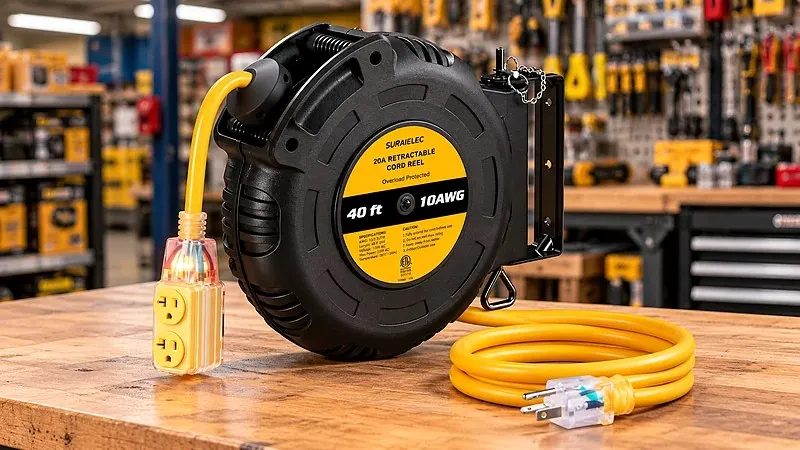
Le Bobine de 40 pieds, calibre 10 AWG is a higher-rated, heavy duty retractable extension cord reel. Its specifications include 10/3 SJTOW cable, which can handle 20 A and 2,500 W, four NEMA 5-20R outlets, and a 20 A breaker. This heavy duty extension cord reel has a mechanism that reduces rewind speed to minimize snap-back. The certification mark indicated in the name of this item is ETL. The table below compares some specifications.
| Bobine | Tissu Côtelé | Note | Remarques |
| Alert Stamping 5000A-30GF-CB | 30 ft, 16/3 SJT | 10 A, 1,250 W | Three outlets, resettable breaker |
| Bayco CA-800 | 30 ft, 16/3 SJT | A 10 | Three outlets, 10 A breaker, 6.9 lb |
| Reelcraft L 4545 123 3A | 45 ft, 12/3 SJEOOW | A 20 | One NEMA 5-20R outlet, 28 lb, indoor use |
| Coxreels EZ-PC13-5012-A | 50 ft, 12/3 SJO | 20 A à 115 V | One industrial receptacle, spring-driven, about 40 lb |
| VEVOR 45 ft 12 AWG | 45 ft, 12 AWG SJTOW | 15 A, 1,875 W | Disjoncteur 15 A, verrou à cliquet |
Read the entire specification sheet, not just the heading. The 100-foot 12 AWG manual reel has a 12 A capacity and a 15 A breaker, and it includes a Q&A on waterproofing. A breaker alone isn’t enough to prove the whole heavy duty extension cord reel can handle the load; the cord and outlets should be able to handle it too.
Recommandé pour votre projet
What Should You Know About Mounting Heavy Duty Extension Cord Reel?
Mounting is worth your attention prior to purchasing. Follow the guide’s instructions and use a fitting that matches both the wall and the weight. A longer cord means a heavier reel, so choose a fitting to match. The Bobine de 80 pieds, calibre 12 AWG weighs 22 lb. According to Alert Reels, you need a swivel base when the cord retracts at an acute angle.
How Often Should You Inspect and Clean a Heavy Duty Extension Cord Reel?
Sources provide different timelines. According to Narco, inspect the heavy duty extension cord reel immediately after each use, while one retailer recommends inspecting it monthly. However, an industrial source recommends inspecting it every three months for continual use.
| Tâche | Approche suggérée | Ce qu'il faut chercher |
| Inspection visuelle | Before use, and after, when it makes sense | Damage, exposed wires, loose parts |
| Vérification du montage | Follow the maker’s schedule | Loose fixings, rust, movement |
| Rewind and lock check | Inspecter régulièrement | Smooth retraction, secure lock |
| Protection électrique | Suivez le manuel | The specified device works as stated |
| Contrôle professionnel | When a fault is suspected | Internal electrical or mechanical problems |
How Do You Clean and Care for the Reel?
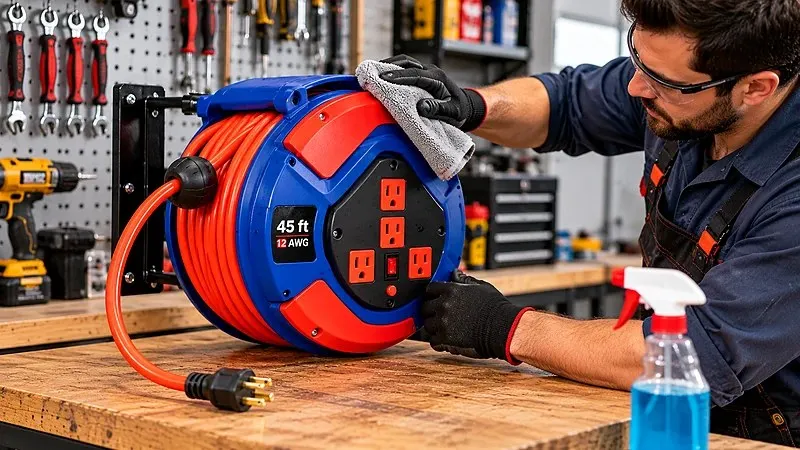
To clean your reel, unplug it and wipe it with a dry cloth. Dust and moisture can cause corrosion and electrical failures. Follow the manufacturer’s lubrication recommendations, and never open your heavy duty extension cord reel without the manufacturer’s instructions for doing so safely. Hardware should be maintained as well. The Bobine de 45 pieds, calibre 12 AWG includes an 180° swivel bracket, and a ceiling mount requires a set screw, so you have to check all your screws and brackets for corrosion or loose fit.
When Should You Stop Using a Reel?
You need to know when to stop using your reel. According to ESFI, don’t use a cord that is warm, as it may be damaged. If your cord has broken wires, replace it immediately. Cracked or dented housing, corroded brackets, screws that are loose, a lock that does not work, or a cord that does not pull out easily – all those need to be examined more closely.
How Do You Safely Unwind and Use a Heavy Duty Extension Cord Reel Under Load?
Using a heavy duty extension cord reel well comes down to two things: how much cord you pull out, and where you work.
How Much Cord Should You Pull Out?
Get the length you need, and check your manual to see how much cord you will have to unwind to handle your load. According to Narco, you should fully unwind the cable before turning on medium or high loads, and some reels require fully unwinding the cord. Calculate the amp rating and don’t exceed the reel’s rating.
Where Can You Use the Heavy Duty Extension Cord Reel?
Faites également correspondre le heavy duty extension cord reel with the location. Indoor vs. outdoor extension cords use different jackets; ESFI states that the W on a cord indicates outdoor use. Check the markings on both the cord and the reel, and avoid outdoor use until both the label and manual indicate it is safe. Avoid getting the cords wet with water and snow,w as ESFI advises against running them through both water and snow. Avoid running a live extension cord through walls, doors, and ceilings.
The listings might vary on where to use the reels. In a Q&A on the 65ft 12 AWG reel, it indicates it is designed for indoor use only, and “general use” does not apply to heavy construction. The heavy duty extension cord reel comes with a 15A breaker and 18.7lb weight. Therefore, consider the cord weight, the reel rating, and the work location.
Why Does a Heavy Duty Extension Cord Reel Overheat?
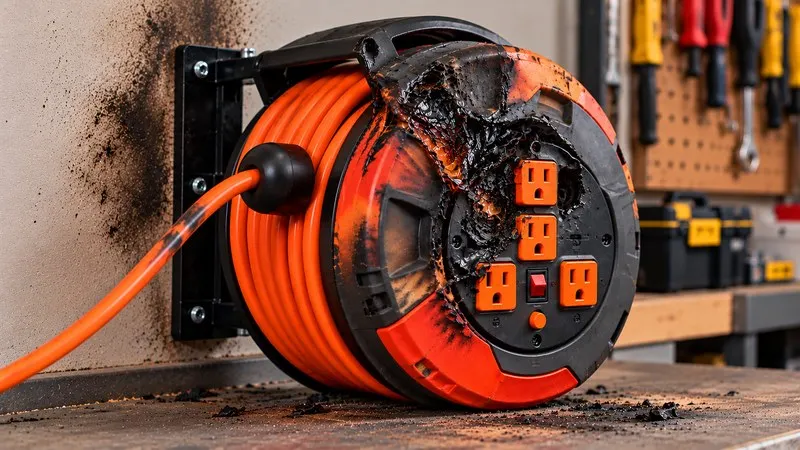
Heat is generated in different ways. Overheating in a coiled cable causes heat buildup, and according to Narco, overload damages the cable and reel. Hot air also reduces the capacity. One guide says the current-carrying capacity of a 12 AWG wire drops drastically at 120°F. ESFI says heat can get trapped in a covered cord; therefore, don’t bury an operating cord in boxes or blankets.
Can a Power Strip Make Heat Worse?
The power strip can contribute to the cord issue; regulations for power strips vs. extension cords vary. According to ESFI, plug the power strip directly into the wall outlet and don’t daisy-chain it with other units. Therefore, don’t overload the heavy duty extension cord reel or connect the power strip to it unless the product instructions allow it. Calculate the total load of all connected equipment and follow the manufacturer’s electrical safety guidelines.
Do Thin Cords Run Hotter?
Thin cords contribute to heat problems. The smaller the wire, the more electricity is lost along the way, and the more damage accumulates. Use a reel rated for 10 A to supply electricity to equipment with a total load equal to or below that rating. You need more space when using the heavy duty extension cord reel for motor tools because they draw more current.
What Mistakes Should You Avoid With a Heavy Duty Extension Cord Reel?
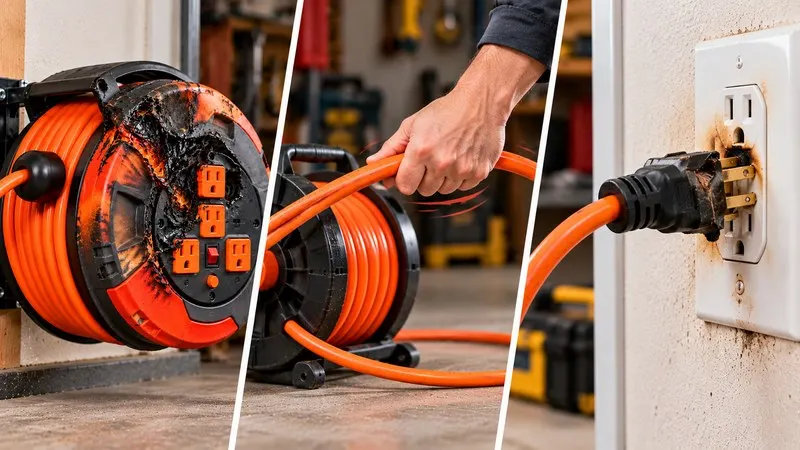
Others are designed for lightweight use despite what the label claims. For a truly heavy duty extension cord reel used daily, check the manufacturer’s manual before buying. Other manufacturers offer similar products, and a comparison of the meilleur enrouleur de rallonge reveals the differences.
What Everyday Slips Should You Dodge?
Other mistakes are easy to avoid. Never run the heavy duty extension cord reel partially retracted, and never tug at the cord or snap it back. Do not use a hose reel instead of a cord reel. Don’t trim off the ground pin to plug into the outlet, and don’t treat an extension cord as permanent wiring. Also, skipping tests is another mistake because the springs and slip rings wear out over time. One industrial website suggests adding 10% to the mounting height plus your reach.
How Should You Store the Reel?
Storing your heavy duty extension cord reel is important too. Unplug your reel and store it in a dry, cool place away from direct sunlight. According to Narco, store reels upright on flat ground, off the floor, and away from water, chemicals, and heat. Never cover them with tarps or plastic, because moisture can cause corrosion. Shorter enrouleurs de rallonge rétractables are also lighter to lift and store, making them easier to handle safely.
Conclusion
You get maximum value from a heavy duty extension cord reel when you choose one based on the load, unwind the reel as the manual specifies, and inspect the cord frequently. Ensure the cord is dry and the reel is mounted properly, and discard any that is hot or damaged. Avoid paying for unnecessary length and labeling. Choose a heavy duty bobine de rallonge suited to your work environment.
Questions fréquemment posées
How often should I inspect a heavy duty extension cord reel?
Follow the manufacturer’s maintenance guidelines. Before use, examine the cord, plug, casing, and mounting for any damage. Check it after use for any damage.
Can I leave the cord partly wound under load?
First, check the manufacturer’s instructions. The coiled wire may get hot under load. Some reels require fully unwinding the wire before use.
Can I plug a power strip into an extension cord reel?
Never plug a power bar into a reel unless the manufacturer permits it. Always follow the device’s directions and electricity safety guidelines.
Where should I store a heavy duty extension cord reel?
Store it away from the sun in a dry, cool place. Do not use a plastic cover, as it may trap moisture inside. Follow the storage directions given by the company.