Your back-of-house consists of a three-foot bench from the prep counter to the pass. If you plan to serve fried food, a twin-tank fryer just won’t cut it. You’ll need to buy a single deep fryer. Even for a low-capacity kitchen, it can be a better choice, but it has pros and cons worth considering. The commercial electric fryer range includes both types, while the commercial kitchen equipment checklist notes the fryer’s place.
Pros of Single Deep Fryer
A single fryer has three major benefits, and the second is more important than most customers realize.
One tank, potentially simpler electrical setup. A double-tank model needs two electrical cords and separate outlets. Single-element fryers require only one connection and may be the deciding factor in kitchens with a limited number of open circuits. Nevertheless, verify voltage, type of plug, wattage, and required circuit before purchasing — at 120V, 1750W requires 14.6 amps. One tank doesn’t guarantee any available outlet will work.
Less oil to buy and discard. Oil is the running ingredient, and you can’t change how much is in the tank, no matter how much action is going on. Frying oil degrades through heat, exposure to air, foreign matter, and use. Therefore, follow the manufacturer’s recommended oil disposal process and match it to the oil’s condition. This means a small single deep fryer needs only about a third of the oil compared to filling a 20-liter tank.
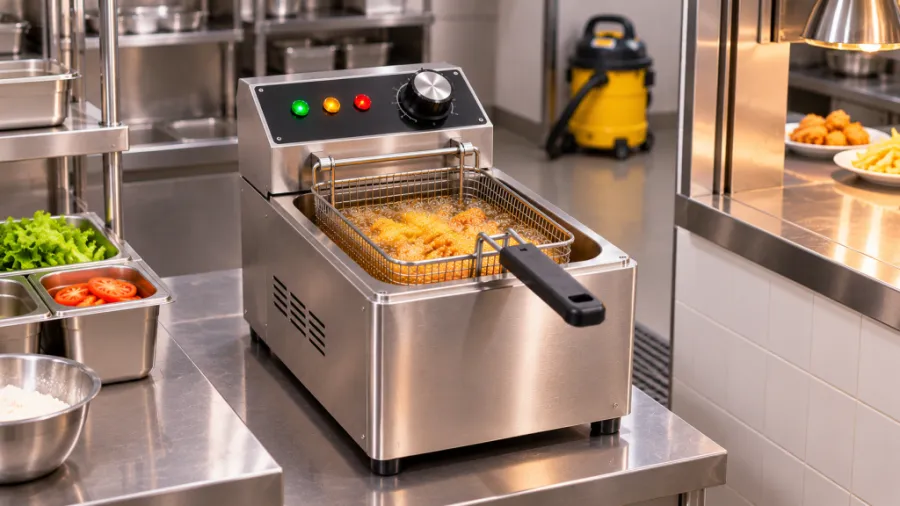
Simpler to clean. A single basket deep fryer has one tank, one basket, one drain, and one set of heating elements. This 1750W single fryer comes with a front-drain valve and a removable basket with a cool-touch handle. You’ll spend half the time cleaning it up in a small kitchen than the spec sheet suggests.
Single-Tank Models Compared
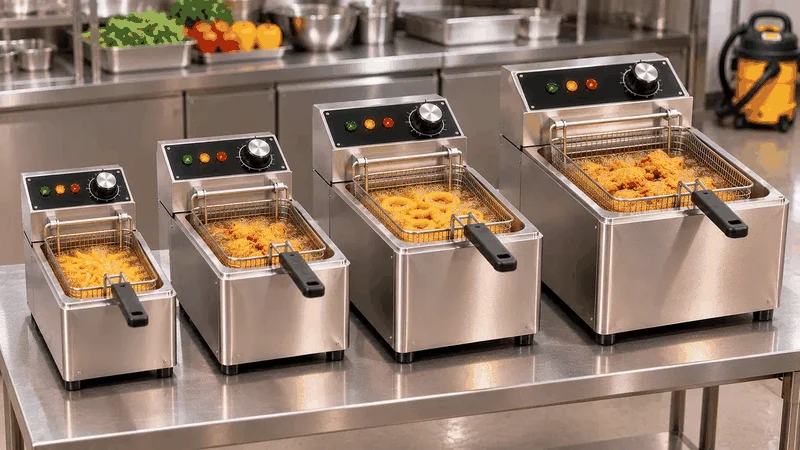
Four single deep fryer models, with quoted numbers only. It is as important to see what isn’t there.
| Model | Heating | Oil capacity | Dimensions | Duty and certification |
| VEVOR 1750W Single (EF-6V) | One 1750W element | 6.2 qt / 5.9 L | Not stated | Not stated |
| VEVOR 3000W Single (EF-201S) | Two 1500W elements, one tank | 21 qt / 20 L | Not stated | Not stated |
| Vollrath CF2-1800 | 1800W, 120V, 15 A | 10 lb | 10.75 × 17.1 × 12.6 in | UL and NSF listed |
| Cooking Performance Group EF300 | 4200/5500W, 208–240V, 20–23 A | 15 lb | 13.25 × 21.5 × 14 in | Heavy-duty, ETL listed |
One difference worth noting: The VEVOR 20-liter fryer has a double-heater setup, using two 1500W heating units, not a single-element fryer. It specifies independent thermostatic control for these heaters, with two thermostats. In terms of amperage/voltage ratio, Vollrath lists 15A 120V for the 1800W unit.
The CPG EF300 shows what high voltage can do: 4200 to 5500W into 15 lb capacity at 208–240V, compared to 1750W into 5.9 lb capacity at 120V. Voltage, not ease of installation, is where throughput differs.
Recommended For Your Project
Which commercial electric fryers are most cost-effective for low-volume operations, listed by total cost of ownership?
For a single deep fryer, running costs and oil volume will take priority. A large oil tank becomes a disadvantage with low turnover, as you lose more oil with each change regardless of how much food you cook.
Based on the above, the 5.9 liter machine will be more economical, as it requires about one-third of the oil per fill. Power requirements will follow the same trend: 1750W versus 3000W in the VEVOR machines, and 4200W or more in the CPG machine. Cost analysis isn’t done here, so this is an analysis of operating costs, not overall cost. Models across the commercial deep fryers range vary widely in tank size.
What are the top commercial electric fryers with the smallest footprint for cramped back-of-house spaces?
The competitors are rankable, while the VEVOR ones are not, since neither provides dimensions. Among those that provide them, the smallest is the Vollrath CF2-1800, 10.75 inches wide by 17.1 inches deep, and the second smallest is the CPG EF300, 13.25 inches wide by 21.5 inches deep.
However, one issue makes the answer to the previous question completely different. The Vollrath requires 6 inches of clearance on all sides and cannot be installed under combustible material. Thus, the 10.75-inch-wide fryer requires 22.75 inches of bench width when you account for clearance.
In other words, published dimensions often understate the space a single deep fryer actually needs. Always ask suppliers about the unit dimensions and clearance requirements. When it comes to VEVOR models, always ask about the dimensions first.
Cons of Single Deep Fryer
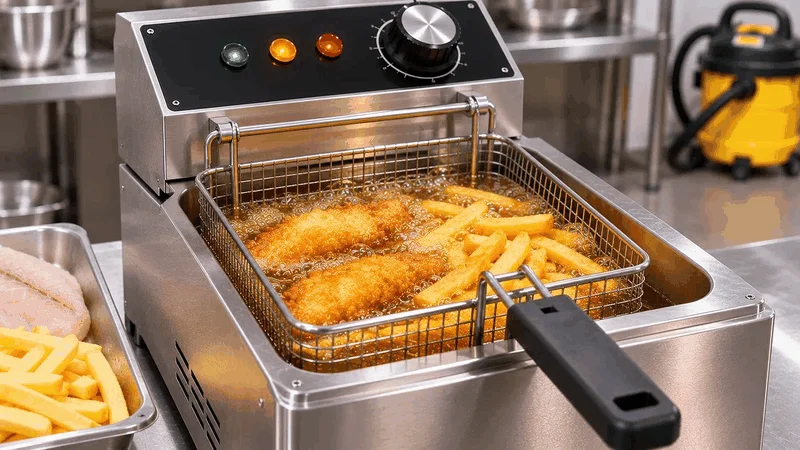
But a single fryer also has disadvantages. This section will help you decide whether to buy one.
What are the drawbacks of choosing a countertop electric fryer over a floor model, and which models minimize those drawbacks?
The single deep fryer has four types of disadvantages, ranked by how much they will affect you.
1. Single oil for all meals. This is the true cost of a single tank, which no model solves. Fish and chips prepared using the same oil may transfer proteins from the fish meal to the chips, raising food allergy and food-quality concerns. Staff should follow the food-allergen procedures and disclosure requirements that apply in their location.
2. No published duty rating for the VEVOR units. Both competitors publish one; CPG states heavy-duty, while neither VEVOR single model does. Neither can be guaranteed for continuous commercial use, so ask the manufacturer. Related products cover the appliances lineup.
3. Voltage limit of 120V. The CPG EF300 shows what additional voltage can do: 4200 to 5500W to fill 15 lb tanks at 208-240V vs 1750W to fill 5.9 L tanks at 120V. If capacity is a concern, then voltage is the answer.
4. No recovery times are published for any of these units. None of these four units specifies how fast they recover oil temperature after a drop.
Which of these is less prone to it? In terms of heating capability per oil volume, the 1750W single deep fryer reaches 297 W/L, compared with 150 W/L for the 20-liter unit, calculated by dividing element power by oil volume.
On third-party certification, the disparity becomes more pronounced. The Vollrath manufacturer claims UL and NSF listings, while the CPG manufacturer claims ETL. The VEVOR single deep fryer does not mention any form of certification. This can help show compliance with safety standards. Ask your inspector and insurer which one you need. Formats across the deep fryer range differ in what they document.
Doughnuts, Churros and Why Tank Shape Matters
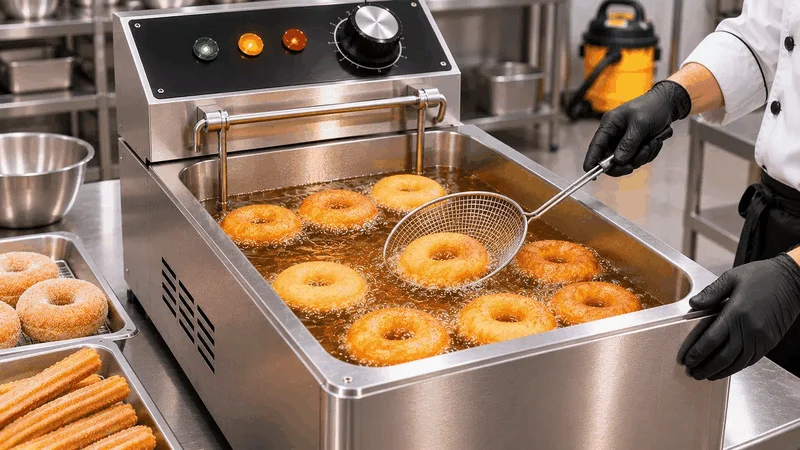
Fried specialty products differ from chips, and that affects equipment requirements.
Which commercial electric fryers are best for small-batch specialty foods like doughnuts or churros?
Doughnuts and churros can float. Place them on top, turn them halfway through, and pull them out rather than lowering them in a basket.
The surface area of the floating item, such as doughnuts, is important because it requires space to place, turn, and retrieve each item from the fryer. Nevertheless, the fryer must meet the manufacturer’s minimum oil-level requirements—items need proper submersion and cannot be cooked with only a shallow fill.
This suggests that a wide-tank fryer is more suitable. The 3000W single fryer is stated to cook large items and has a removable divider that provides cooking surface area. The drawback of using the fryer in this case is the quantity of oil required.
This points towards the tank. The 3000W single fryer is said to fry large products and comes with an optional removable divider, which creates open surface area for frying. However, the major disadvantage is the oil capacity: 20 liters for a small batch.
Two important things to note. A flat skimmer or spider is better than a basket for lifting food and should be in the budget. Second, doughnuts drop flour and sugar into the oil, which carbonizes and reduces the oil’s life; therefore, you’ll need to filter more often than when frying chips. This will be covered in the section on cleaning a commercial deep fryer.
In terms of design, the CPG EF300 is the best of the four. It features a tubular immersion element that tilts for easy access, plus a welded oil pan with two removable lifting handles. Tilting elements are better than fixed elements.
Temperature Control for Gentle Frying.
The single deep fryer product specifications reveal a crucial issue you need to know before you specify any of them.
What are the best commercial electric fryers for a bakery that needs gentle frying options, ranked by temperature control?
A full ranking is unreliable because both VEVOR models provide conflicting information about the temperature range. For the 20-liter model, the specification table lists 175°F to 390°F, while the description lists 122°F to 392°F.
For the 5.9-liter VEVOR, the specification table lists 80°C to 200°C, while one section of the description lists 60°C to 200°C.The temperature ranges conflict, so it’s difficult to recommend a VEVOR model for low-temperature frying.
These competitors are more evident, and one of them is interesting. CPG manufactures a thermostatic range from 120° to 375°F, designed for gentle work at lower temperatures. Vollrath, on the other hand, is thermostatically controlled at 375°F, a single point rather than a range, with thermal overload protection at 500°F. This means it is not suitable for variable-temperature baking, regardless of its other qualities.
All four models have a high-limit cut-off point; this is actually what is important on hot oil: 446°F on both VEVOR models, 464°F on the CPG model, 500°F on the Vollrath model. Troubleshooting of electric deep fryers can be found in this section.
Footprint and Capacity for a Bakery Adding Fried Items
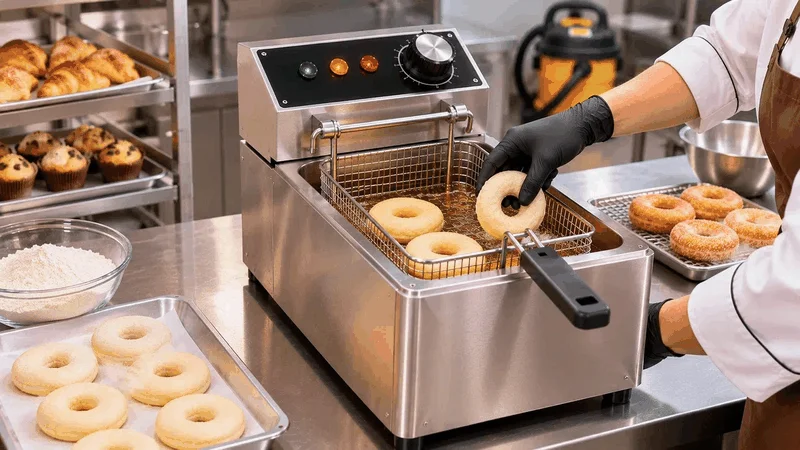
Adding a single deep fryer to a bakery is mostly a space and oil-management question.
What are the best commercial electric fryers for a baker adding fried items, ranked by footprint and capacity?
Capacity: the 20L VEVOR offers a larger batch size and more working area, which is better for doughnuts. The 5.9L tank is good for occasional or small-batch use and, at 19 lb, light enough to move away from the workbench after use. There is also a mid-capacity version: a 1500W single deep fryer with 11.6 qt of capacity, though I haven’t verified the specs.
Footprint: Both brands publish their footprint sizes, but VEVOR doesn’t— so if bench space is tight, consider the models with the specified dimensions and account for overhead clearance.
Oil consumption: In this case, you’ll choose the smaller one, as it has a smaller capacity. With the bigger one, with a 20-liter capacity, you should change and maintain 3.4 times more oil than with the 5.9-liter capacity one, if filled to full capacity.
A reasonable solution is to choose the smaller size and expand the volume when needed. Otherwise, you’ll waste unnecessary oil on frying. All supporting accessories are available for small kitchen appliances.
One aspect that needs clarification from the start is the requirement for a ventilation hood, as stated in the documentation available from Vollrath and in commercial cooking codes. Ventilation hood codes usually require a Type I hood if you have an indoor deep fryer or any other cooking appliance that generates grease-laden vapors. Clarify this with the relevant authorities in your area before placing an order, since they may make the purchase impossible. All options in the commercial electric fryer range fall into that category.
Conclusion
Using a single deep fryer is better for circuits, maintenance costs, and oil cost, but it’s poor for versatility since the single tank must use one type of oil for all uses, and quality is a key issue here. For low volume, the small tank is ideal since the oil will go bad regardless of usage. The listings still don’t specify size, operating temperatures, or duty ratings. Cleaning practice sits in commercial kitchen cleaning.
Frequently Asked Questions
Is a single deep fryer enough for a restaurant?
For a restricted fried menu, absolutely. It’s not about capacity; it’s about using one oil for all items, which can transfer taste and trigger allergies. In case you have fish and chips on your menu, two tanks will fix what one cannot.
How much bench space does a single fryer really need?
Beyond the dimensions. A specific manufacturer requires 6 inches of clearance on all sides; for a 10.75-inch-wide model, the total required width is 22.75 inches.
Can I fry doughnuts in a single deep fryer?
Yes, but usable surface area matters more than volume because donuts float and need to be turned. Always maintain the manufacturer’s recommended minimum oil depth, and a flat skimmer is preferable to the included basket.
Does an indoor deep fryer need ventilation?
Yes, in most cases, and one maker even says so in its literature. Codes usually require a Type I hood for any cooking equipment that generates grease-laden vapors. Check with your local authority. Compare an air fryer vs. a deep fryer for low-volume applications.