One of the most crucial cooling systems in large buildings and industrial facilities is a commercial chiller system. It eliminates unnecessary heat, enhances the comfort within the home, and safeguards equipment that must maintain consistent operating temperatures. Whether you are in charge of an office building, hospital, factory, hotel, or data center, knowing what a commercial chiller system is and how it operates can help you make informed decisions. This guide will describe the various categories of commercial chillers, their major components, common uses, installation factors, maintenance factors, cost, and troubleshooting habits to help you achieve maximum efficiency and long-term performance.
Table of Contents
What Is a Commercial Chiller System?
Commercial buildings, manufacturing plants, hospitals, and other large buildings generate a lot of heat in their daily operations. Without a good cooling system, equipment can overheat, leading to higher energy consumption and lower indoor comfort. By knowing what a commercial chiller system is, you can understand why it is one of the most significant aspects of large-scale HVAC systems.
A commercial chiller system is meant to remove undesirable heat from water or another cooling fluid and expel it from the building. The cold water is then pumped through pipes to cool indoor spaces, industrial equipment, or production machines. The systems are designed to support a greater cooling load compared to residential air conditioners; therefore, they are best suited to businesses with constant and dependable temperature regulation requirements.
Recommended For Your Project
Definition of a Commercial Chiller System
A commercial chiller system is a large cooling system that removes heat from water through a refrigeration cycle, and the cooled water is then distributed across the entire building or other industrial process. The chilled water takes heat from either indoor air or equipment and returns to the chiller, where it is cooled once more, forming a cooling cycle.
If you ask what a commercial chiller system is, consider it the main source of cooling in large facilities. The chiller cools water before blowing cold air like a normal air conditioner. The cooled water is then pumped through air handlers, fan coil units or industrial equipment to stabilize temperatures. Commercial chillers come in various sizes and configurations to support the cooling needs of offices, hospitals, hotels, factories, shopping centers, and data centers, while enhancing energy efficiency and reliable operation.
How a Commercial Chiller System Is Different from Residential Cooling
Residential air conditioners are set up to dehumidify a single home or a small building, whereas a commercial chiller system is set up to handle much larger areas and greater cooling requirements. Commercial systems run longer hours, refrigerate more than one area at a time, and can have sensitive equipment that must be kept at a specific temperature all day.
The largest disparity is the cooling process. In residential systems, the air is cooled directly, but in commercial chillers, the water is cooled and then distributed via a large piping system. This enables them to control large plants with a lot of uniformity in their temperatures. Commercial chillers are more complex; therefore, they also demand professional commercial chiller system maintenance to ensure reliable operation, minimize power use, and increase the life of major components.
Where Commercial Chiller Systems Are Commonly Used
Wherever there is a necessity to cool at a large scale, either to achieve comfort, productivity, or to protect equipment, a commercial chiller system is deployed. These systems are relied upon in many industries to provide year-round stable operating temperatures as well as support year-round business processes.
Chillers are used in commercial office buildings to cool many floors effectively and in hospitals to provide comfortable settings for patients and safeguard delicate medical equipment. Chilled water is used in manufacturing plants to regulate the temperature of machinery and enhance production efficiency. Commercial chillers are also relied upon by hotels, universities, shopping malls, pharmaceutical plants, food processing facilities, and even data centers to ensure safe and reliable operating conditions. The choice of the appropriate system will be determined by the size of the building, cooling load, energy efficiency objectives, and operational needs.
How Does a Commercial Chiller System Work?
By understanding how a commercial chiller system operates, it will be simpler to select the correct machinery, improve performance, and identify issues before they become expensive. Chiller designs may differ, but they are all based on the same fundamental principles of refrigeration to eliminate undesirable heat.
The system can constantly transfer the water’s heat to the outside environment through a number of interconnected elements. The different phases of the cooling cycle are significant in providing stable performance and minimizing power usage.
Heat Absorption Process
The cooling system starts with warm water coming back into the building or industrial machines into the evaporator part of the commercial chiller system. The warm water then passes through the evaporator, where heat is exchanged with the refrigerant circulating within the system. This heat is captured by the refrigerant, which moves out of the refrigerator as a low-pressure vapor, and the water becomes much cooler.
The cooled water is then pumped back into the building’s cooling system, where it takes up more heat in indoor areas or production machines before being pumped back to the chiller. This constant process enables commercial buildings to have constant temperatures during day-to-day activities. One of the most important reasons commercial chillers can reliably cool large buildings with high workloads is their ability to absorb heat effectively.
Refrigeration Cycle Explained
The first thing that one should know in order to understand how a commercial chiller system works is the refrigeration cycle. The compressor increases the pressure and temperature of the refrigerant by compressing the vapor after the refrigerant releases heat in the evaporator. The hot refrigerant is then pumped into the condenser, where the captured heat is expelled into the air or cooling water around it.
When the refrigerant cools and condenses back to a liquid, it is forced through the expansion valve. This valve decreases the pressure and temperature of the refrigerant, and then it is pumped back to the evaporator to complete the cycle again. The closed-loop refrigeration cycle operates indefinitely as long as cooling is needed, providing efficient and reliable temperature control to commercial facilities.
How Chilled Water Cools Buildings and Equipment
Once out of the evaporator, the chilled water is passed through insulated pipes to several cooling units scattered across the building. These units exchange heat with the indoor air using the chilled water, which helps keep offices, hospitals, hotels, and industrial facilities at comfortable temperatures.
Chilled water can also be used in industrial equipment to ensure that overheating in the manufacturing processes is avoided. After the water has taken the heat, it goes back to the chiller to undergo the cooling cycle once again. This ongoing looping enables a commercial chiller system to cool numerous spaces effectively, helping to maintain uniform indoor comfort and equipment functionality. Clean water flow, clean heat exchangers, balanced operation, and proper operation all lead to reliable cooling and reduced operating costs.
Main Components of a Commercial Chiller System
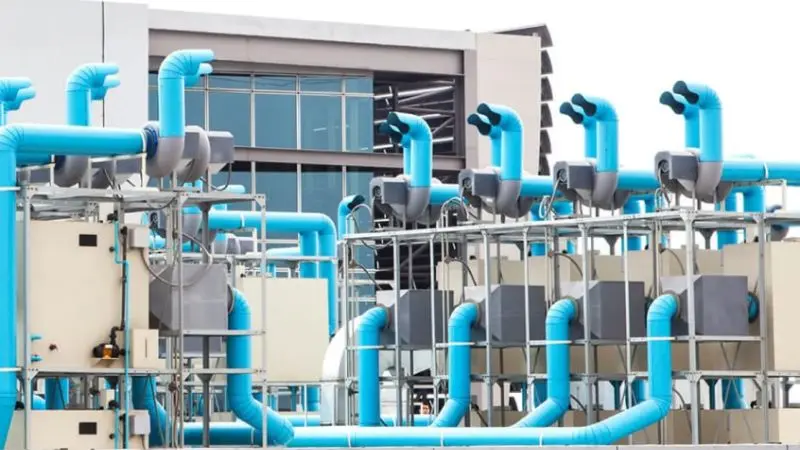
Each component of a chiller has a particular purpose that leads to effective and dependable cooling. With all elements functioning properly, the system will not only provide stable performance but also reduce energy usage and unnecessary wear.
These main components are also easier to understand and, therefore, troubleshooting of commercial chiller systems becomes easier. Understanding the functionality of every part is beneficial to detecting performance problems early and making choices about maintenance.
Compressor
The compressor is sometimes referred to as the heart of a commercial chiller system since it circulates refrigerant through the refrigerant cycle. Once the refrigerant has taken up the heat in the evaporator, the compressor pumps up the pressure and temperature, which is then pumped into the condenser. This decrease in pressure enables the refrigerant to extract heat effectively and further the cooling cycle.
Depending on the cooling capacity and the use, commercial chillers can utilize either a scroll, screw, centrifugal, or reciprocating compressor. Periodic inspections, adequate lubrication, and observation of operating pressures are fundamental components of commercial chiller system maintenance. Maintaining the compressor in optimal condition improves energy efficiency, reduces sudden failures, and increases the overall life of the cooling system.
Evaporator
The part in which the actual cooling starts is the evaporator. The warm water out of the building passes through the evaporator, with refrigerant passing on the other side of the heat exchanger. Since the water is heated and the heat is transferred to the refrigerant, the refrigerant is evaporated as a gas, and the water is left much colder.
The cold water is then pumped around the building or industrial equipment to take up more heat and pumped back to the evaporator once again. To ensure efficient performance, clean heat transfer surfaces and adequate water flow are needed. Regular check-ups will prevent scaling, corrosion, and decreased cooling capacity so the evaporator can remain efficient during the system’s service life.
Condenser
The condenser eliminates the heat that the refrigerant collects during the cooling process. Once the compressor is done with the refrigerant, this high-pressure and hot refrigerant goes into the condenser, where it gives out heat to the outside air or cool water. When the refrigerant is cooled, it returns to a liquid and is now ready to undergo the next part of the refrigeration cycle.
Air-cooled condensers utilize large fans to eliminate heat, whereas water-cooled condensers use cooling towers in large plants. Fouled condenser coils or limited water supply may lower cooling efficiency and increase energy use, so routine cleaning is vital to ensure reliable operation.
Expansion Valve
The expansion valve regulates the amount of refrigerant going into the evaporator. Prior to this valve, the refrigerant is at a high pressure. Passing through the expansion valve, its pressure decreases quickly, and the refrigerant is significantly colder when it enters the evaporator.
To achieve effective cooling and maintainability of the system, it is necessary to keep the flow of the refrigerant proper. Failure of the expansion valve may result in poor cooling, frozen evaporators, or overworking the compressor. In troubleshooting a commercial chiller system, technicians will often check the expansion valve to verify that it is functioning properly to meet the system’s varying cooling needs and that refrigerant flow is balanced.
Cooling Tower and Water Pumps
Chilled water is carried around the building by water pumps, and condenser water is circulated between the chiller and cooling tower in water-cooled cooling systems. Stable water flow will guarantee effective heat transfer and will be used to stabilize temperatures throughout the cooling network.
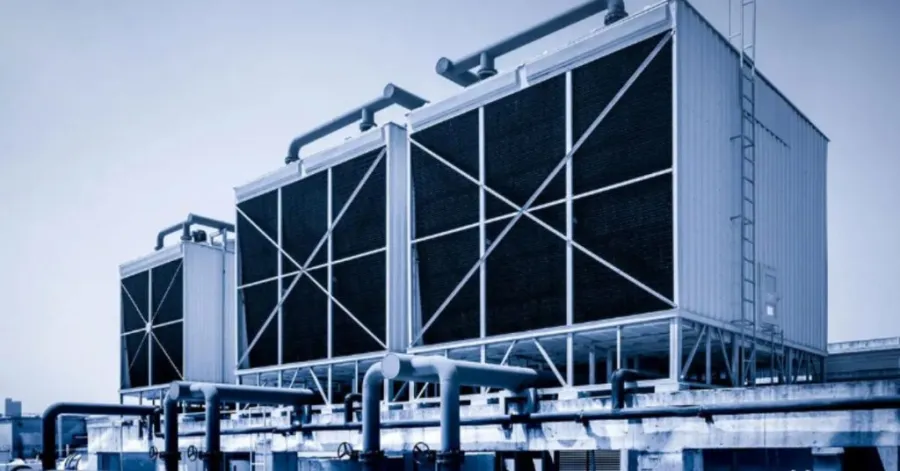
The cooling tower removes heat from the condenser water by allowing some of the water to evaporate, releasing the undesirable heat to the atmosphere before the cooled water is fed back to the condenser. Routine inspection of pumps, valves, cooling tower parts, and water quality is a significant aspect of commercial chiller system care, as it improves efficiency, reduces equipment wear, and helps prevent expensive failures.
Different Types of Commercial Chiller Systems
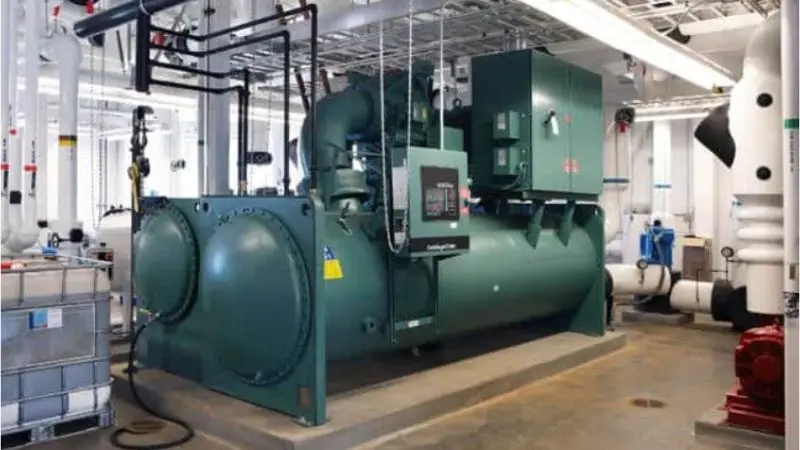
There are a variety of commercial chiller types, and each model is adapted to satisfy various cooling needs. The right decision depends on how large your building is, how much cooling you need, what matters is your energy efficiency, and where the system will be used. Being aware of your options will enable you to choose a system that provides dependable operation at the lowest long-term operating expense.
When installing a new commercial chiller system or replacing the current one, it becomes easy to understand the strengths of each type of chiller and select the right one. Each system has its own benefits according to the application and cooling requirements.
Air-Cooled Commercial Chillers
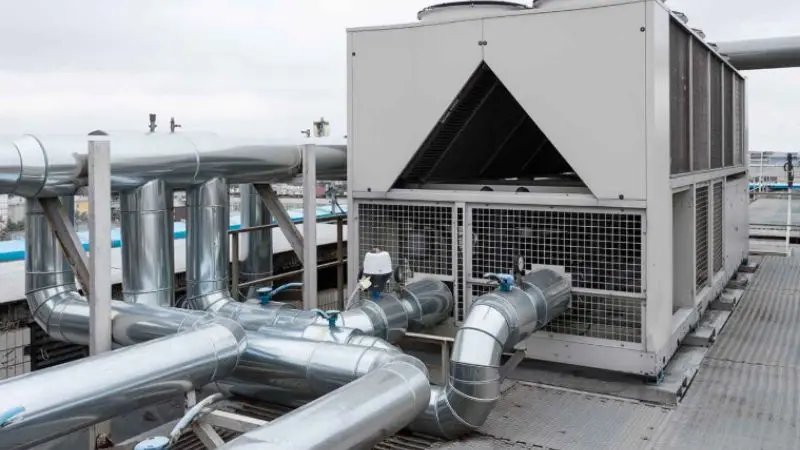
In air-cooled commercial chillers, the outdoor air is used to cool the refrigerant by passing it through condenser coils and high-powered air fans. These systems do not need a cooling tower and are therefore often simpler to install and require less supporting equipment. This makes them a good choice in small to medium commercial buildings where space and installation cost are critical factors. Air-cooled chillers are typically used in office buildings, schools, retail stores, and health facilities. Although they perform well in most settings, their performance might decline during very hot days. Maintaining commercial chiller systems, such as cleaning condenser coils and checking fans, can ensure reliable cooling performance throughout the year.
Water-Cooled Commercial Chillers
Water-cooled commercial chillers use water to cool the refrigerant rather than the outside air. The hot condenser water is pumped to a cooling tower where the surplus heat is emitted, and the cooled water is pumped back into the system. This design is highly energy efficient, particularly in facilities with high and continuous cooling requirements. Water-cooled chillers are very popular in hospitals, universities, hotels, manufacturing factories, and large office buildings. Commercial chiller system installation is more complicated since it involves installation of cooling towers, pumps, and additional piping, but these systems usually have lower operating costs in the long run. Regular water treatment and preventive maintenance are required in order to guarantee long-term reliable operation.
Scroll Commercial Chillers
Scroll commercial chillers have scroll compressors, which are filled with two spiral-shaped pieces to compress refrigerant effectively. One of the spirals is stationary, and the other rotates in a circular motion to squeeze the refrigerant in a smooth and quiet motion. Scroll chillers are also said to be reliable and require low maintenance due to their fewer moving parts as compared to other compressor designs. These systems are suited to small and medium-sized commercial buildings like offices, schools, medical centers, as well as shopping centers. They also occupy minimal space and thus are easy to install in areas where space in the mechanical rooms is minimal. Periodic checks and tests of refrigerant help keep equipment running efficiently and prolong equipment life.
Screw Commercial Chillers
Screw commercial chillers involve two helical screws that rotate to compress the refrigerant and provide uniform cooling in different operating conditions. They can be installed in medium and large commercial buildings since they can effectively respond to varying cooling loads as the day goes by. Such chillers are usually used in factories, hospitals, colleges, hotels, and commercial office buildings where there is a need to have reliable cooling throughout the year. They are designed for high reliability and reduced vibration in their durable compression design, enabling continuous operation. Regular chiller system maintenance (oil analysis, refrigerant monitoring, equipment checks, etc.) can help improve energy efficiency and prevent unexpected system malfunctions.
Centrifugal Commercial Chillers
High-speed rotating impellers are used in centrifugal commercial chillers to compress refrigerant and generate very large cooling capacities. These systems are installed in facilities with high and sustained cooling requirements, and thus they are among the most energy-efficient systems to use on a large scale. Centrifugal chillers are commonly used in airports, convention centers, universities, district cooling systems, and high-rise commercial buildings due to their excellent performance and reduced long-term energy use. The initial cost and price of commercial chiller systems are usually higher than smaller chiller types, but their operating efficiency can lead to significant savings over the life of the equipment.
Absorption Commercial Chillers
Absorption commercial chillers are unlike traditional chillers as they do not use mechanical compressors to drive the refrigeration cycle but rather rely on heat to do this. They are usually run on natural gas, steam, hot water, or industrial waste heat. This makes them a perfect option when a facility needs to improve overall power efficiency while minimizing electricity use. Absorption chillers are commonly placed in hospitals, universities, manufacturing plants, and combined heat and power plants where there is an easy source of waste heat. They have a slower cooling response than compressor-driven systems, but provide dependable performance in appropriate applications. The total commercial chiller system cost is determined by the installation requirements, the sources of available heat, and the long-term operating conditions.
Wrap-Up
When selecting the appropriate commercial chiller system, it is crucial to attain reliable cooling, reduce energy use, and ensure the long lifespan of equipment. Knowledge of the types of chillers available, system components, installation, maintenance needs, and operating expenses will enable you to choose the most suitable solution for your facility. Commercial chiller system maintenance and timely troubleshooting are done regularly to avoid surprises and extend the life of the equipment. Whether it is the installation of a new commercial chiller system or the replacement of an older unit, proper investment in the appropriate system will provide reliability in cooling, increased efficiency, and lower operating costs over many years of use.
FAQs
What is a commercial chiller system?
A commercial chiller system is used to remove heat from water by refrigeration and supply chilled water to cool large buildings, industrial equipment, and commercial facilities effectively without affecting the indoor temperatures.
How does a commercial chiller system work?
What is the functioning of a commercial chiller system? It absorbs the heat using an evaporator, compresses the refrigerant, dissipates the heat using the condenser, and circulates chilled water to cool buildings continuously.
What is the cost of a commercial chiller system?
The price of the commercial chiller system depends on the capacity, type, and complexity of installations. The majority of systems are between several thousand dollars and hundreds of thousands of dollars for large commercial systems.
What is the frequency of maintenance of a commercial chiller system?
Professional maintenance of commercial chiller systems must be done at least twice a year. Routine maintenance, cleaning, refrigerant testing, and performance testing enhance performance and minimize unforeseen failures.
What are typical commercial chiller system troubleshooting problems?
Other typical commercial chiller system troubleshooting problems can be refrigerant leakage, condenser coil contamination, improper water flow, faulty compressors, blocked filters, sensor failures, and insufficient cooling due to improper maintenance.