Gold jewelry lasts through everyday use—but at what temperature does it really melt? The exact melting point of gold is 1,064°C (1,947.5°F) and 1,337.33 Kelvin. This number varies slightly with purity and pressure. For example, 14K and 18K gold melt at lower temperatures because they contain other metals. You will learn about the science behind this high σημείο τήξης. You will also find out what factors affect it and how this temperature is used in real life. Gold purity also matters, as lower-karat alloys can melt at different temperatures depending on their metal composition. What is the melting point of gold? Knowing gold’s melting point helps with jewelry making, repairs, recycling, and metalworking.
You also need to know how gold behaves as it changes from solid to liquid and then cools back into a solid. This guide explains gold’s melting temperature, the factors that affect it, and how it compares with other common metals. It also covers practical melting methods, essential tools, applications, and answers to common questions about melting gold.
- Gold Melting Point Explained: Complete Guide
- Gold Melting Temperature by Purity: A Complete Guide
- Γιατί ο χρυσός έχει υψηλό σημείο τήξης;
- What Affects the Melting Point of Gold?
- How Is Gold Melted? Methods, Tools, and Equipment
- What Happens to Gold When It Melts and Solidifies?
- Gold Melting Point Compared With Other Metals
Gold Melting Point Explained: Complete Guide
Ατοφιο ΧΡΥΣΑΦΙ changes phase from solid to liquid at a specific temperature. Gold melts at 1,064°C (1,947.5°F or 1,337.33 K) across the three temperature scales. It melts at such a high temperature because gold atoms are closely packed and held tightly by metallic bonds. This means gold is stable at room temperature and only melts when heated in a furnace or with a torch. For jewelry making, repairs, or anything else, it is important to know gold’s melting point.
Gold Melting Point in Celsius, Fahrenheit, and Kelvin
To convert this to Fahrenheit, you can calculate 1,064 x 1.8 + 32 = 1,947.5°F, which is the gold melting point in Fahrenheit. Scientists also use the Kelvin scale. In Kelvin, gold melts at 1,337.33K. The three numbers represent the same threshold. This table serves as a quick reference. In everyday use, Celsius is most commonly used. Fahrenheit is well known in American workshops. Kelvin appears in the science literature.
| Κλίμακα | Θερμοκρασία |
| Κελσίου | 1,064 ° C |
| Φαρενάιτ | 1,947.5 ° F |
| Kelvin | 1,337.33 K |
Does Gold Have a High Melting Point?
Yes, gold has a high melting point compared to many common metals. Gold’s melting point is much higher than that of lead, tin, and zinc. How much heat is needed to melt gold? It requires a powerful heat source to attain this temperature. This high value comes from gold’s atomic structure. Atoms are closely packed and held together by strong metallic bonds. A significant amount of thermal energy is needed to break those bonds. That is why gold doesn’t melt easily under normal conditions. You can see this when wearing χρυσά κοσμήματα. Even a hot day or a warm kitchen cannot melt your ring. The melting temperature is well above environmental temperatures. You can achieve the required heat only with a controlled furnace or a torch.
Gold Melting Temperature by Purity: A Complete Guide
Pure 24 K gold contains no other metals and melts at approximately 1,064°C (1,947.5°F). Lower karat gold (22K, 18K, 14K) is an alloy that typically has a lower melting point than 24K gold because it is mixed with other metals. An alloy’s actual melting point varies depending on the type and amount of metal components in it. These differences explain why jewelers must use correct settings when repairing or making gold and should choose the right setting for their gold.
What Is the Melting Point of 24K Gold?
24K gold is 100 percent pure. It is free from other metals. This means that the melting point of pure gold is equal to the σημείο τήξης of 24K gold: 1,064°C (1,947.5°F). You can rely on this figure for all 24K samples, provided they are truly 24 K. This purity level matters in real-world applications. A jeweler who knows how to melt 24K gold is well aware of the precise moment at which it will melt. Alloy content will be obvious to no one. The gold’s melting point remains the same. What is the temperature at which gold melts? The properties that bind its atoms together explain the high melting point of 24K gold. At normal temperatures, gold atoms are packed in the solid state. As heat is added, the atoms become more energetic and vibrate more strongly. At ~1064°C, the atoms have enough energy to overcome their fixed positions, allowing the gold to flow as a liquid.
What Is the Melting Point of 22K, 18K, and 14K Gold?
This is not the case for alloyed gold. Pure gold is alloyed with other metals such as copper, silver, nickel,l or zinc. The additional metals lower the blend’s melting temperature: the more alloy, the lower the value. The pattern is evident. How hot does it have to be to melt gold? A 14K ring will require less heat to melt than a 24K coin. The exact value for each karat depends on which metals the maker used. Two 18K pieces from different sources may have different melting temperatures. This is important for repair work. If a jeweler overheats 14Κ χρυσό, he will damage the piece. This helps estimate the material’s melting point and ensures safe working practices.
Γιατί ο χρυσός έχει υψηλό σημείο τήξης;
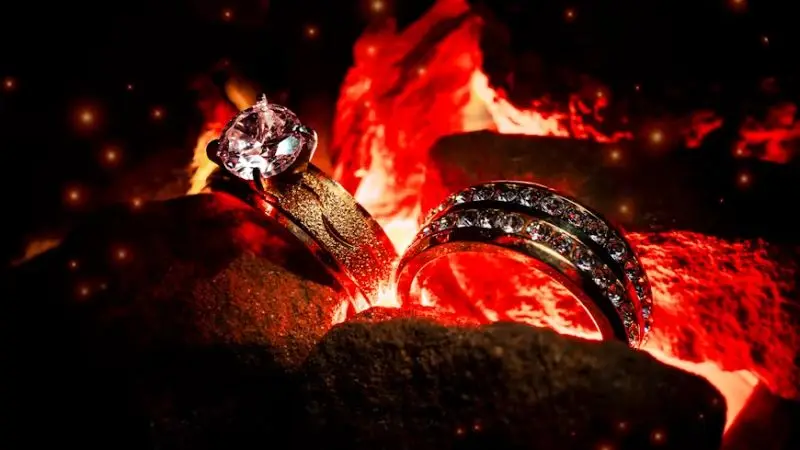
The atoms are closely packed and strongly bonded by metallic bonds, so gold has a high σημείο τήξης. It takes a considerable amount of thermal energy to break one of these bonds, so gold needs to reach approximately 1,064°C to be melted. This means that gold can withstand high heat and stay solid and dependable for use in electronics, aerospace parts, and dental work. By its resistance to high temperatures, gold is highly advantageous for the most extreme applications where other metals would not be.
What Makes Gold Hard to Melt?
The answer lies in the minuscule particles within each gold atom. Gold atoms are arranged in an orderly fashion in very close proximity. They have very strong metallic bonds with adjacent atoms. These bonds act as strong adhesives that hold the structure together. These bonds are very difficult to break and require a great deal of heat. At what Celsius temperature does gold melt? To release the atoms from the metal, it needs to be heated to 1064°C so that the atoms can flow as a liquid. That’s gold’s melting temperature, which is well above your everyday temperature range. Compare and contrast gold’s strength with other metals. Lead, tin, and zinc have much lower σημεία τήξης. They have weaker attraction between their atoms than do other atoms. You can melt tin with a soldering iron. To melt gold, you need a furnace or a high-heat torch.
How Gold’s High Melting Point Supports Its Applications
The atomic structure also explains gold’s ability to remain solid under harsh conditions. There’s no comparison to a hot kitchen, a summer car, or a hot workshop. The bonds remain intact, so the metal maintains its shape. This property is what makes gold valuable in engineering. Gold’s heat resistance is used in electronics, aerospace components, and dental applications. What’s the safe way to melt gold? If a connector melted under normal operating temperatures, it would fail. Gold doesn’t fade; it never “goes away.” You can compare the melting point to a fingerprint of the metal’s strength. All metals have their price. The high melting point of gold indicates the strong forces of attraction between its atoms. For this reason, it excels in challenging applications.
What Affects the Melting Point of Gold?
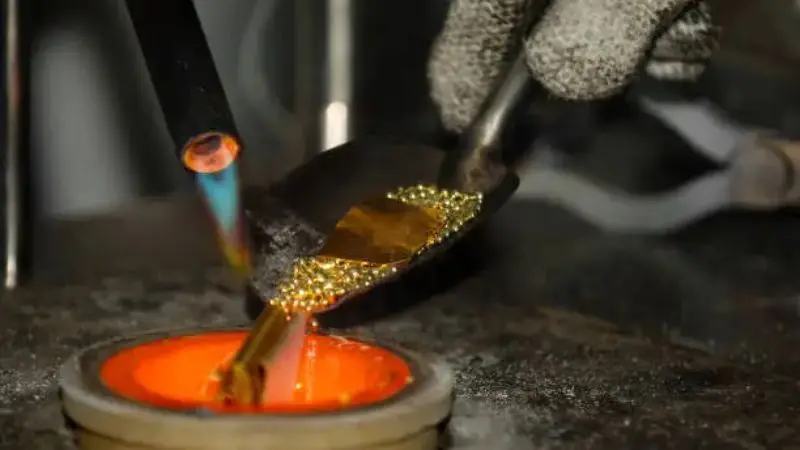
The melting temperature of gold is primarily influenced by its degree of purity and the composition of its alloys, but to a lesser extent by pressure under normal conditions. Differences in επίχρυσα κοσμήματα come from the fact that the outermost layer of gold is just a thin layer over another metal with a lower melting temperature. The thin gold layer typically governs the jewelry’s melting point, but the base metal does too. Knowing the purity, alloy, and plating helps you choose the right heating method for gold and jewelry work.
Factors That Change Gold’s Melting Temperature
A few factors can change gold’s melting point. The most important factor is purity. At what temperature does pure gold melt? You have to add metals to lower the melting point; pure gold melts at 1064 °C. Copper, silver, nickel, and zinc weaken the metal’s bonds. This mixture requires less heat to melt. Pressure has a less significant influence. High pressure slightly affects gold’s melting point. This effect is measured in a laboratory. You won’t see it in a typical workshop. Mixing the alloy is also important. If the two 18K pieces have different recipes, they will melt at different temperatures. A piece that’s more copper is different from a piece that’s more silver. Test a small section first before heating a whole section.
Does Gold Melt at the Same Temperature as Gold-Plated Jewelry?
No, gold-plated jewelry does NOT melt at the same temperature as solid gold jewelry. Plated pieces are typically made of one base metal and then clad with a thin layer of another. The base is frequently a mix of brass, copper, or nickel. Each of these metals melts at a much lower temperature than pure gold. The gold-tone is extremely thin. It contributes negligibly to fire resistance. How much heat is needed to melt gold? Plated Jewelry is heated—First the base metal melts. The thin gold layer fractures, then peels off. Once melted, solid gold cannot be stripped from a plated piece of metal. Gold plating also does NOT change the base metal’s melting point. The thinness does not greatly affect the thermal properties of the whole object. The base metal is the predominant material in the jewelry and determines the heat reaction it exhibits.
Does Gold Plating Change the Melting Point?
Το σημείο τήξης του βασικό μέταλλο does not significantly increase or decrease when gold is added to it. The coating does not significantly change the overall response to heating. The melting characteristics remain the same as the base metal. Plating does change the surface appearance and wear. It provides a low-cost gold color. This color fades with wear and tear. As the plating wears out, the underlying metal is exposed. Treat plated jewelry as base metal when soldering or repairing parts. How hot does it have to be to melt gold? Use low heat and keep contact time short. Excessive heat will burn away the plating and ruin the article. The thin gold plating may also react differently to heat than the base material. At high temperatures, the plating can discolor, lose its appearance, crack, or separate from the surface.
How Is Gold Melted? Methods, Tools, and Equipment
Gold is a very hard material to melt, as it has a very high melting point of 1064°C (or 1947.5°F). You can melt it with a proper torch and crucible for a few at a time, or use an electric or induction gold melting furnace for larger amounts. These tools are essential to have on hand: crucibles, tongs, molds, flux, adjustable torches, and heat-resistant surfaces. It’s also important to have the right safety gear, such as gloves, safety glasses, and a face shield, when working with molten gold.
What Methods Are Used to Melt Gold?
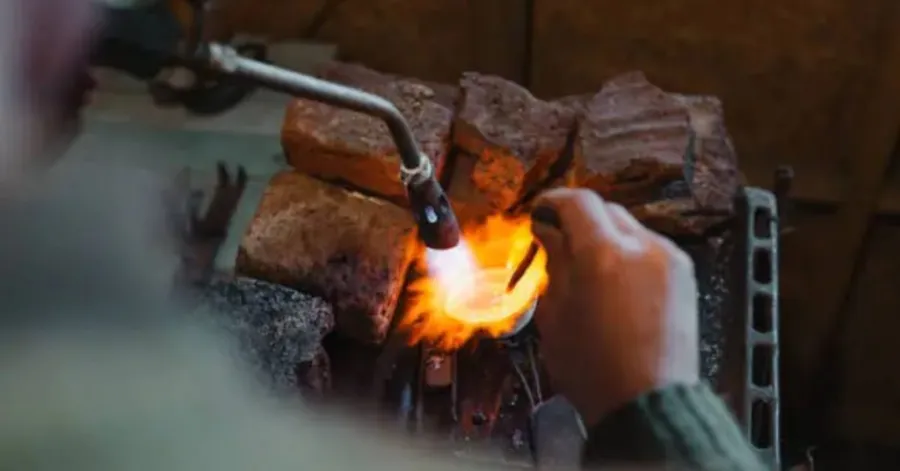
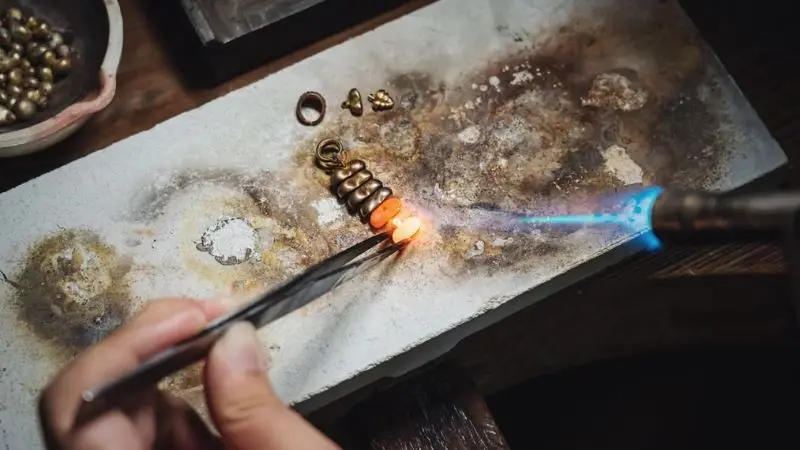
Melting gold from solid to liquid form requires intense, controlled heat. A basic stove won’t be sufficient. At what temperature does pure gold melt? The metal needs to reach 1,064°C (1,947.5°F) before it flows. The high temperatures require special melting techniques and equipment. Several setups are available, depending on how much gold you plan to melt and how much space you have. A small-scale κοσμηματοπώλης will use a handheld torch. You can reach the required temperature with a torch using propane or acetylene fuel. The flame is directed at the gold in a small ceramic crucible. The metal is melted in the crucible. This technique suits small quantities and rapid repairs. For large operations, gold melting furnaces are used. These machines can reach very high temperatures using electric resistance or induction heating. An induction furnace generates a magnetic field that directly heats the gold. This provides accurate temperature control. This equipment can melt larger amounts in a shorter time.
What Tools Are Essential in a Comprehensive Jewelry Making Kit?
A full jewelry-making kit includes several tools for melting and working with gold. A crucible is required to contain the metal. Crucibles are made from ceramic, graphite, or clay. Each type heats differently. Tongs are also necessary to safely lift the hot crucible. At what temperature does pure gold melt? Pour the molten gold into a mold or ingot tray to form the desired shape. All kits should have safety equipment. Heat-resistant gloves, safety glasses, and a face shield are required. Have a fire extinguisher on hand. Another essential item is flux. Flux removes impurities and helps the gold flow smoothly. An adjustable torch flame lets you control the heat intensity. You also need a heat-resistant surface to work on. Together, these tools let you safely and effectively melt gold.
What Happens to Gold When It Melts and Solidifies?
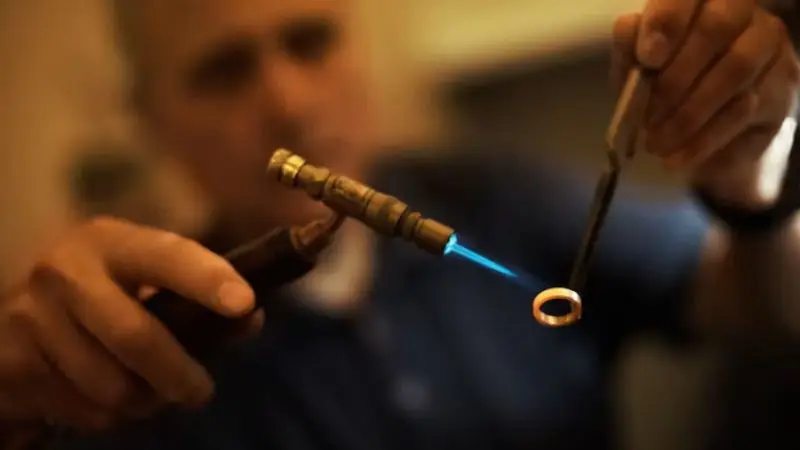
When gold melts, its atoms move freely, turning the gold into a liquid. The molten gold is cast in molds, expands slightly, and the droplets round due to surface tension. As it cools and solidifies, the cooling rate can affect crystal size and whether it crystallizes. Gold retains its properties after being melted and reshaped several times.
Understanding Gold in Its Liquid State
If you bring gold to its melting point, it melts and becomes liquid. At that point, strong bonds between the atoms are broken. The atoms can then move around and flow like water. Liquid gold can be poured into a mold or shaped with tools. During this transition, the metal retains its color and luster. The metal remains golden and shiny throughout this transition. The volume of the liquid gold is slightly larger than the solid. This expansion occurs because the atoms have more space in which to move around. Use a crucible with enough space to avoid spills. What temperature does pure gold melt? This molten metal also pulls itself into a round shape. This effect of surface tension causes the liquid gold to bead up or form droplets. You can see this when you melt a small piece of gold on a flat surface. The liquid gold remains warm and colorful. Initially, it has a warm orange hue. The glow intensifies as the temperature rises. Care for the molten metal. A single drop can cause a serious burn.
How Does Gold Solidify After Melting?
Gold changes back into a solid when it cools. Atoms re-establish a new pattern. This is known as solidification. As the gold cools and solidifies, it can crystallize. You can adjust the cooling rate to change crystal size. Slow cooling produces larger crystals. Smaller ones if it cools faster. The melting point is never altered when you heat the metal again. Gold’s properties remain unchanged after it is melted and reshaped many times. When the temperature drops below gold’s melting point, it turns back into a solid. The process of changing from a liquid state to a solid is called solidification. What temperature does pure gold melt? The melting point of pure gold is around 1,064°C (1,947.5°F), and as the temperature falls below this point, the gold atoms slowly lose the energy they had when molten. They start to form a more solid structure.
Gold Melting Point Compared With Other Metals
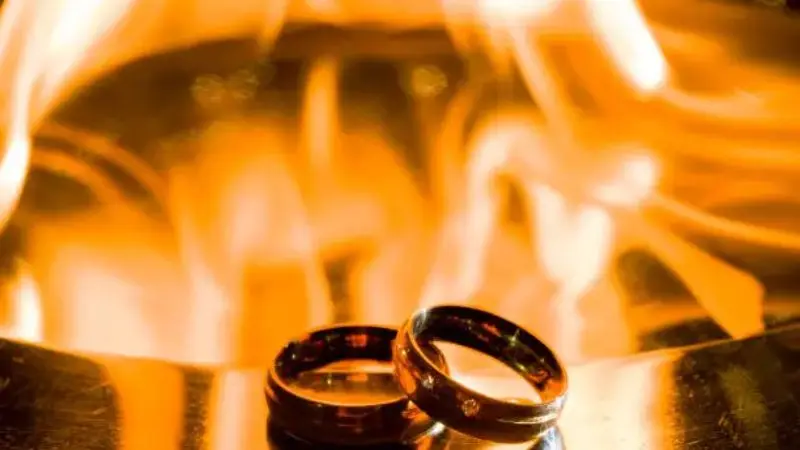
Silver melts at 965°C, while copper melts at 1,200°C, and gold is in between at 1,064°C. Both silver (961.8°C) and copper (1,084.6°C) melt close to the melting point of gold. Platinum melts at 1,768°C, which is very high, so it takes much more heat to melt it. These differences let jewelers choose the right heat source, tool, and alloy combinations for each metal.
Gold vs. Silver Melting Point
Silver melts at 961.8°C (1,763°F). This is approximately 100 °C lower than gold’s melting point. You need less heat to melt silver. If a jeweler uses both metals, they must adjust the torch setting each time. Silver also has higher conductivity than gold. Heat conducts rapidly through a piece of silver, so the entire object reaches its limit quickly. The same flame keeps the shape of gold for a longer period.d This difference is what makes silver solder flow at lower temperatures than gold solder. Gold has a higher melting point, so it requires more heat to melt gold. Gold resists melting at high temperatures, even when the temperatures are high enough to melt silver. At what Celsius temperature does gold melt? Pure gold needs a furnace or a high-temperature torch to reach about 1064°C, and silver needs slightly less heat, at about 961.8°C. Both metals still require special equipment and temperature control.
Gold vs. Copper Melting Point; Gold vs. Platinum Melting Point
Copper melts at 1,084.6°C (1,984°F). It’s close, but slightly above gold’s melting point. Both metals require a high heat input. Closeness is important in alloys. Often, copper is added to gold, and it has a lower melting point than pure gold. Platinum melts at 1,768°C (3,214°F). That’s above the threshold of gold. How much heat is needed to melt gold? Platinum is much harder to work and requires a much hotter torch. The complete picture is below: Two distinct clusters are visible. Silver, gold, and copper form a cluster around 120°C. Platinum is much more expensive than the rest. This gap influences how tools are arranged in workshops. You can’t put platinum on a gold-and-silver bench without new equipment. Melting points also influence the alloy’s design.
| Μέταλλο | Σημείο τήξης |
| Ασημένιο | 961.8 ° C (1,763 ° F) |
| Χρυσό | 1,064 ° C (1,947.5 ° F) |
| Χαλκός | 1,084.6 ° C (1,984 ° F) |
| Πλατινένιο | 1,768 ° C (3,214 ° F) |
Τύλιξε
Gold’s melting point is very precise, at 1,064°C (1,947.5°F), so it can withstand everyday temperatures. What is the melting point of gold? Its high melting point is due to the close attachment of gold atoms in the metal, which creates strong metallic bonds. The melting properties of gold vary depending on its karat rating; 24K gold will melt at the pure gold temperature, whereas any gold that has a lower karat rating will melt at a different temperature. The temperature at which gold melts can also be affected by the composition of the alloy and by the amount of pressure inflicted on it. When heated above its melting point, gold becomes a fluid which can be poured and shaped. When molten gold cools, it turns solid again and can be remolded without changing its identity. Gold has a σημείο τήξης between those of silver, copper, and platinum. Jewelers, metalworkers, and manufacturers should know gold’s melting point to choose appropriate tools and heating methods. By learning a bit about the properties of gold and the tools and equipment available for melting, shaping, repairing, and creating gold objects, you can better understand the work of goldsmiths.
Συχνές Ερωτήσεις
At 1,000 degrees does gold melt?
No, it takes more heat to melt pure gold! Gold melts at 1,064°C (1,947.5°F). A furnace at 1000℃ is inadequate. Before the metal becomes liquid, you must increase the temperature.
Is it possible to melt gold at home?
You can melt small amounts in a crucible using a torch. You need heat-resistant gloves, safety glasses, and a fire extinguisher. Maintain the flame at 1064 degrees. Work on a heat-resistant surface. Avoid melting in houses without ventilation.
Why is it that 14K gold melts quicker than 24K gold?
Alloy metals reduce the melting point. Copper, silver, and zinc weaken the metal’s bonds. These metals are present in greater abundance in a 14K piece than in a 24K piece. It is easier to destroy the structure with less heat. Hence, 14K gold flows faster under a torch.
Which of these metals is the first to melt, gold or silver?
Silver melts first. Its melting point is 961.8°C (1,763°F). Gold needs 1,064°C (1,947.5°F). A difference of about 100°C matters in a workshop: when switching between the two metals, you will need to adjust your torch setting.
Is the gold that has been melted useless?
When gold is melted and cooled, it remains gold. When the metal solidifies, the atoms rearrange, but the element remains the same. Gold is malleable and can be melted and reshaped again and again. It retains the same color, density, and melting point.