For years, farmers believed that working harder was the only way to increase crop yields and quality. But it’s no longer true anymore, it’s about working smarter. Modern farming has evolved with advanced tools, and techniques that help farmers grow more with fewer resources.
Advanced technology has become a necessity for meeting the demand for abundant food production. In this guide, you’ll get to know eight proven techniques used by successful farmers worldwide, along with practical steps and affordable tools like greenhouse heaters to use them in your own fields and increase their crop yields.
These strategies will help you grow stronger, healthier, and more profitable crops.
Factors that determine your crop yield
Before we jump into techniques to increase crop yield, you have to accept the reality that yield is the product of biology, soil, water, and timing. Most farmers just chase big-ticket machinery and forget the basics. But that’s not how it works.
If you want to increase crop yield, then it doesn’t mean planting more seeds, using more fertilizers will be enough. It’s about understanding and optimizing the key factors that support plants’ growth. Nevertheless, there are several interlinked variables that influence how many results you get:
1. Soil health and nutrient content
The soil is where it all starts. Your plants simply cannot reach their maximum potential if the pH of the soil is incorrect or if vital nutrients like phosphorus, potassium, and nitrogen are not balanced.
By omitting soil testing, many farmers unintentionally reduce their own yields. You provide the ideal growing conditions for your crops by routinely testing the soil in a lab and adding nutrients.
2. Water availability and management
For your crops, water is like blood to increase crop yield. Poor water management can undo all of your hard work, even if your soil is ideal. Plants are stressed by too little water, and they lose nutrients or develop root diseases when they receive too much.
For this reason, knowing how much water your field can hold and selecting the appropriate irrigation. When water arrives at the right time and in the right amount, yields rise naturally.
Farmers who monitor moisture levels or use efficient irrigation often see dramatic improvement. You can use a water pressure pump with high flow for faster irrigation.
3. Climate and weather patterns
Your local weather isn’t something you can control, but you can plan around it. Temperature swings, rainfall timing, heat stress, frost risk, and humidity all shape crop performance.
When you understand your area’s climate patterns, you can choose better sowing dates, select resilient varieties, and avoid preventable losses. Smart farmers follow weather forecasts and long-term climate trends to stay one step ahead.
4. Crop genetics and seed quality
The seed you choose decides half your yield before you even plant it. Modern varieties, including hybrid, drought-tolerant, high-yielding, or pest-resistant, can give you a major advantage.
Poor-quality or uncertified seeds may look cheap at the start, but cost you later in reduced productivity. Always select seeds that match your soil, climate, and cropping goals.
5. Pest and disease control
Pests, weeds, and diseases silently steal your yield long before you notice the damage. When plants spend their energy fighting attacks, they have less energy to produce grain, fruit, or biomass.
This is why routine field scouting, preventive sprays, biological control, and integrated pest management (IPM) are essential. Controlling pests early protects your investment.
6. Technology adoption
Drones, data-driven irrigation, precision farming, soil sensors, and automated equipment are just a few of the tools available to farmers today that those in earlier generations could only imagine. It’s not necessary to use everything.
You can increase yield and decrease waste by implementing just one or two technologies. Technology makes farming smarter rather than harder by enabling you to apply inputs precisely where they are needed.

How to assess your current farming conditions
You don’t need a PhD to do an honest assessment, but you do need to measure.
Soil testing and nutrient analysis
Soil testing and nutrient analysis give farmers an accurate picture of soil fertility, pH, and organic matter, ensuring every input is used wisely. It identifies key macronutrients like potassium, calcium, and micronutrients like zinc and iron that directly influence plant health.
- You need to collect soil samples from different parts of the fields.
- After collecting samples, send them to a known laboratory for pH, organic matter, nitrogen (N), phosphorus (P), potassium (K), and secondary nutrients analysis.
Soil testing helps a lot in increasing crop yield. You collect samples from different field zones and send them to a certified lab, and get precise data on deficiencies or excesses.
Understanding climate, rainfall patterns, and local constraints
When you understand climate constraints, it helps you plan which crops to grow, when to plant, and how to manage water.
- Review local climate data that includes historical rainfall, temperature extremes, and seasonal trends.
- Use weather station data, satellite imagery, or local agricultural extension resources to get more clearer picture.
- Map out risk zones: for example, areas prone to drought or waterlogging.
Identifying crop-specific needs
Different crops have different nutrient, water, and spatial requirements. For example, maize may need more nitrogen, while legumes might fix their own nitrogen. Rice needs warm climates, continuous water, and high nitrogen, along with zinc for proper growth.
Barley prefers cool climates, well-drained soils, moderate water, and controlled nitrogen to maintain grain quality. Overall, rice demands more water and nutrients, while barley is hardier and more drought-tolerant. You must know what climate conditions, water quantity, and temperature your crop needs to grow.
8 ways to increase crop yield
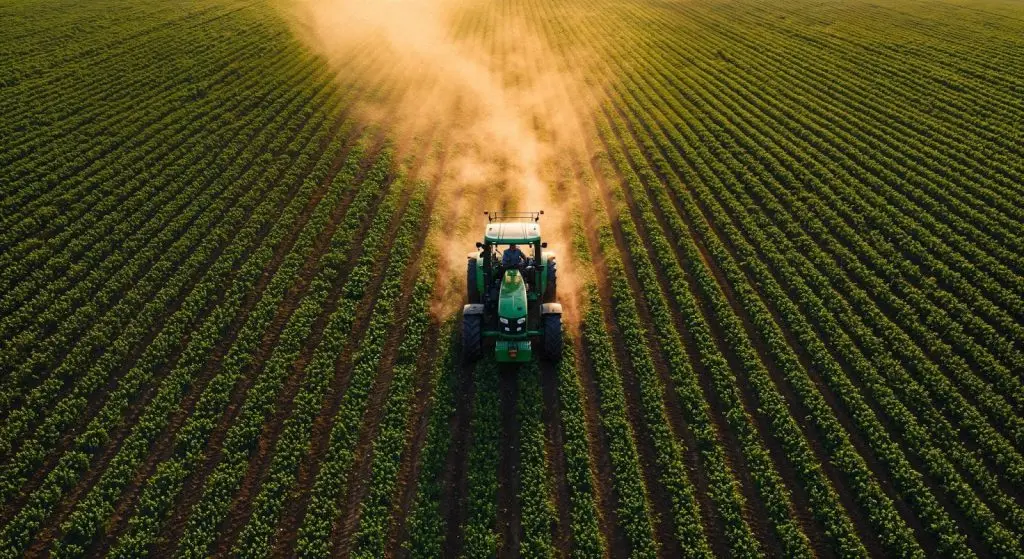
In this section, we will discuss eight proven, modern farming techniques that can substantially increase your crop yield.
1. Improve soil and nutrients
Healthy soil is the foundation of a good yield. You need to use a mixture of soils like compost, biochar, or lime. Lime helps maintain PH levels.
Studies show precision input application can reduce fertilizer use by 20–30%, while increasing yields. Most often, farmers waste a lot of money on purchasing things that their soil doesn’t even need.
You can use variable-rate technology (VRT) from soil maps to help avoid under- or over-application and to give nutrients to your soil exactly where needed.
2. Do crop rotation
Crop rotation is a highly effective method to increase crop yield. Crop rotation breaks pest and disease cycles, improves soil fertility, and can enhance yield over time. For example, rotating cereals with legumes allows nitrogen-fixing plants to enrich the soil, reducing dependence on synthetic nitrogen.
3. Use moisture sensors for precise hydration
You can waste a season’s yield by watering at the wrong time. A couple of capacitance sensors wired through a cheap datalogger or simple wireless nodes give you real-time soil profile moisture and tell you whether that last rain actually reached the root zone. This is another way to increase crop yield this year!
In drought years, that data is gold, you can hold off irrigation and save 20–30% water and still keep yields respectable. You can use a water pressure pump for faster irrigation over large areas and greenhouse heaters to maintain the temperatures.
4. Improve irrigation
Farmers can improve irrigation by switching to modern and efficient systems like drip or sprinkler irrigation. Technology has made everything easy.
Farmers now use smart irrigation techniques such as soil moisture sensors and precision watering, and are adopting water-saving farming practices like conservation tillage, crop rotation, and cover cropping.
Plus, they improve overall efficiency by reducing water loss from channels, planting drought-resistant crops, and capturing and storing rainwater.
5. Intercrop for better spacing
Intercropping is an old technique that uses different plantation arrangements and crop combinations to improve spacing and maximise yield in a given area. In this technique, you grow crops with different growth rates, such as planting radish, which is a fast-growing plant with a slow-growing plant like tomatoes.
Intercropping increases yield per area, which is useful for small gardens and you can use the garden to grow more crops and it also reduces the risk of total crop failure.
6. Utilize synthetic or organic fertilizer
Not sure how do fertilizers increase crop yield? Fertilizers are the fastest way to provide your soil with the nutrients it needs. You can use either synthetic or organic fertilizer. It totally depends on your choice.
However, it is advised to use any of them or a combination of both after testing your soil. It helps you apply fertilizer more efficiently, maximizing return and minimizing environmental loss.
7. Use technology and systems
In precision agriculture, you will get GPS-guided machinery, yield maps, VRT, and soil sensors to help give your plants the fertilization and spraying they need in the right amount.
Most Farmers in the US have started using AI-driven models to predict yield, detect nutrient deficiency, and pests.
8. Use greenhouses during the offseason
Last but not least, A greenhouses give you more control over environmental conditions like light, temperature, and humidity, which leads to higher yields, fewer pest issues, and potentially multiple crop cycles per year. Greenhouses help in off-season production and reduce dependency on weather variability. You don’t need to spend a lot on greenhouse heaters; if you do your research well, you can get within your budget.
FAQs
What is the fastest way to increase crop yield?
The fastest ways to increase crop yield require planting high-quality, hybrid seeds and using precision agriculture techniques like smart irrigation and applying specific fertilizers to targeted areas. It also includes growing plants with accurate spacing, using effective pest and disease prevention tips.
Which fertilizer increases yield the most?
There is no one-size-fits-all fertilizer that can universally increase yield. Rather, it totally depends on the existing soil nutrient deficiencies, crop type, and the environmental conditions in which you are growing your crops.
If your soil has a nitrogen deficiency, a balanced nitrogen-rich synthetic fertiliser or an organic fertiliser can increase yield. However, the only way to increase the yield the most is to apply fertiliser precisely and where it is needed and when it is needed.
How can small farmers increase crop yield affordably?
Farmers can reduce the cost by using low-cost soil test kits or community labs to test their soil for deficiencies, pests, or disease risk. Once they have a complete report of their soil analysis, they can use either synthetic or organic fertiliser strategically that help them reduce the cost. Moreover, a simple moisturiser moisture sensor can help than a full-blown IOT system.
Does technology actually help increase crop yield?
Yes! Using precision agriculture technologies can boost yields by 3–18% via targeted fertilizing, planting, spraying, and irrigation. Moreover, 75% of farmers using precision farming report higher yields, according to market research.
Conclusion
Modern farming methods are no longer optional. They are necessary to increase crop yield and compete with other farmers in the industry. When you understand the fundamental factors that affect yield after assessing your current farming condition, you can implement new methods.
The eight farming techniques mentioned in this blog help you not only increase yield but also use your resources more efficiently, reduce waste, and build a more sustainable farming business.