You can hear or smell the trouble, but you can’t see it: a ticking valve deep in an engine, a crack behind drywall, grit inside a gearbox. Pulling it all apart to find that fault burns hours and often causes fresh damage. The right borescope cameras let you look inside without opening anything. A steerable borescope camera bends its tip where you aim, turning a blind probe into a tool you control. A short endoscope camera guide clears up the choice. Below: the three articulation types, the specs that matter, and real costs.
How Articulating Borescopes Work And The 3 Articulation Types
An articulating borescope, sometimes sold as an articulating inspection camera or an articulating endoscope camera, is a camera on a flexible cable whose tip you steer on demand. That control is the whole point. It turns a push-and-hope probe into something you aim with intent, and the best articulating borescope answers what a plain probe can’t: what sits just out of line with the cable? Models differ in how many directions the tip actually moves, a point worth checking across any range of inspection cameras.
What Makes A Borescope Articulating
Articulation means the camera head bends under your control instead of only following the cable. You work a lever or dial on the handle, and a set of internal pull-wires tugs the tip up, down, or sideways- the same idea as a gooseneck lamp, shrunk into a 4 mm head.
A plain snake camera points straight ahead, so you have to twist the whole cable to shift the view, which is slow and clumsy in a packed engine bay. A flexible articulating camera keeps the cable still. It moves only the lens, which lets a steerable inspection camera peek around a valve or over a weld seam. Some sellers call the same tool a directional borescope camera or an articulating scope camera; the mechanism is identical. For a fuller primer, this articulating borescope walkthrough is a good start.
What is the difference between a 2-way, 4-way, and 360-degree articulating borescope?
A 2-way model bends the tip in one plane, usually up and down. A four way borescope adds left and right for full cross movement, and a 360-degree, or rotating, borescope camera sweeps the head through a full circle without moving the cable.
More directions mean more coverage from a single insertion, and a higher price. Inside a cramped combustion chamber, that extra reach often makes the difference between one clean pass and five frustrating ones, so the best articulating borescope for complex work usually offers more steering, not less. One option that shows the full-circle style is this rotating probe design. The table lays the three out side by side.
| Articulation Type | Tip Movement | Best For | Trade-off |
| 2-Way | Up and down, one plane | Straight pipes, simple pass-throughs | Few side views |
| 4-Way | Up, down, left, right | Engines, gearboxes, winding paths | Costs more than 2-way |
| 360-Degree | Full rotating sweep | All-angle, single-pass checks | Priciest, slight learning curve |
What To Check Before You Buy An Articulating Borescope
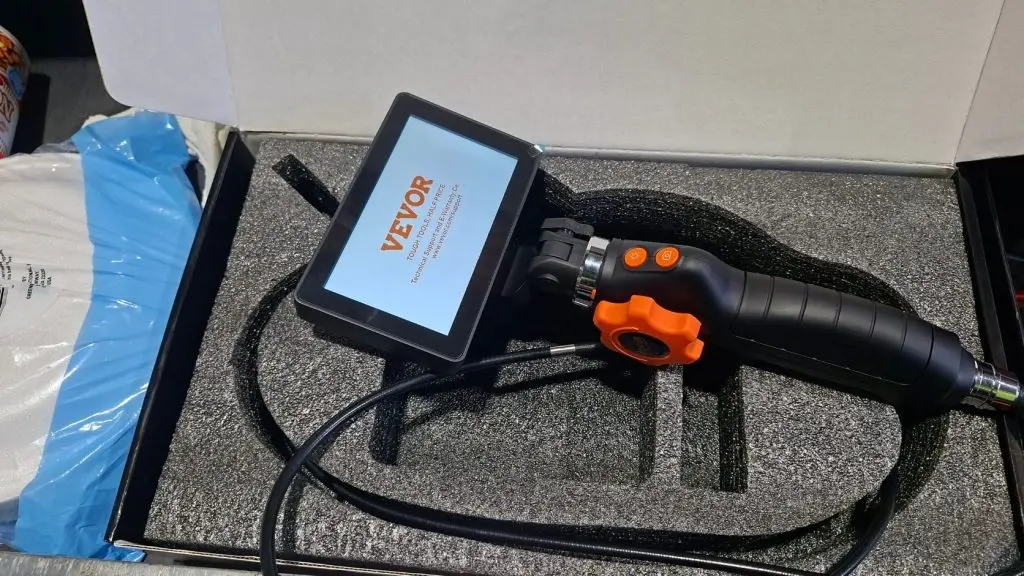
The articulation type sets the ceiling, but a handful of other specs decide whether the scope is usable on your jobs. Probe size, screen, sealing, and battery matter as much as steering, and the best articulating borescope on paper can still disappoint if the probe is too fat for your access hole. These specs also separate a steerable borescope camera made for tight engines from one meant for long pipe inspection cameras. For a drain or conduit, a longer directional borescope camera with a semi-rigid cable earns its keep.
What should I consider when buying an articulating borescope online?
Online you can’t hold the tool, so judge the best articulating borescope by the specs that drive real performance, and match each one to where you’ll actually use the articulating inspection camera:
- Probe diameter: a 3.9 mm (0.15 in) tip reaches spark-plug ports; thicker probes won’t enter tight spaces.
- Screen: a 4.3 to 6-inch IPS display keeps faults readable in daylight.
- Resolution: 720p covers general work; 1080p captures document findings better.
- Cable: 4.9 ft flexible suits engines; longer semi-rigid reaches pipes and ducts.
- Sealing: IP67 means the lens shrugs off oil, water, and coolant.
- Power and light: adjustable LEDs and a large battery keep long jobs going.
Confirm these before checkout. A compact two-way articulating model is a sensible first buy, and a thinner probe always beats a bulky one for a steerable inspection camera. If you mostly work in cramped spots, lean toward a slim flexible articulating camera over a wide-headed articulating endoscope camera you can’t fit through the opening.
| Spec | What To Look For | Why It Matters |
| Probe diameter | 3.9–8 mm | Thinner reaches tighter gaps |
| Screen | 4.3″–6″ IPS | Clear in bright light |
| Waterproofing | IP67 | Survives oil and coolant |
| Cable | 4.9 ft flexible or longer semi-rigid | Reach vs control |
| Battery | 5000–7000 mAh | Full-shift runtime |
How much does a good articulating borescope cost, and what features are worth paying for?
Cost tracks articulation and build quality more than anything else. Entry-level 2-way scopes sit lowest; four way borescope and 360-degree models climb higher for the extra steering gear, and rugged professional kits with long battery life top the range. Worth paying for: true 4-way control, an ultra-slim 3.9 mm probe for engine work, IP67 sealing, a 1080p-capable lens, and a battery that lasts a shift. Skip inflated zoom numbers the lens can’t back up. An occasional user does fine with a solid articulating scope camera, while a dual-lens inspection setup suits anyone who needs front and side views at once.
If you’re weighing features against budget, a plain-language inspection camera guide helps you see which upgrades you’ll really use and which are marketing noise. For most buyers, the best articulating borescope fits the job, not the one with the longest spec sheet. A balanced articulating inspection camera beats a spec-sheet champion every time.
Recommended For Your Project
Best Articulating Borescope By Application
There’s no single best articulating borescope for everyone; the right one depends on what you inspect most. An engine bay rewards different strengths than a drain line or a quick wall check, so matching the articulating inspection camera to the job saves money and hassle. A plumber wants reach and a stiffer cable; a mechanic wants a slim cable that bends around a cylinder. These directional borescope camera tools also overlap with the everyday endoscope cameras people reach for on home repairs. A tool that suits one trade can frustrate another.
Which articulating borescope is best for automotive engine inspections?
For automotive engine work, the best articulating borescope is a 4-way, 360-degree model with an ultra-slim 3.9 mm (0.15 in) probe. Engines are tight, curved, and oily, so the tip has to slip through a spark-plug port, steer around the cylinder, and resist coolant with IP67 sealing.
A rotating borescope camera captures the whole combustion chamber in one pass instead of repeated re-insertions, and a four way borescope with a thin, flexible articulating camera head reaches valve seats a straight probe never will. This 360° articulating borescope is built for exactly that, and a 1080p lens lets you photograph the fault for the customer.
Before you commit, it helps to read real borescope reviews from people doing the same job. The table shows how the automotive pick stacks up against a professional daily setup and a lighter budget steerable inspection camera, so you can see where a directional borescope camera, an articulating endoscope camera, or a simpler articulating scope camera fits your routine.
| Use Case | Best Articulation | Must-Have Spec |
| Automotive engines | 4-way 360° | 3.9 mm probe, IP67 seal |
| Daily professional | 4-way | 6″ HD screen, 7000 mAh |
| Light/home use | 2-way | 4.3″ screen, flexible 4.9 ft cable |
| VEVOR example | 4-way 360° | 0.15″ ultra-slim articulating probe |
Choosing A Reliable 360-Degree Borescope
A 360-degree scope is the most capable steerable borescope camera, and arguably the best articulating borescope for all-angle work, which also makes it the easiest to overpay for. The gap between a dependable and a throwaway shows in the steering, the lens, and the support. A good rotating borescope camera still holds its angle after a year of use; a weak one goes slack in a month. It’s the same judgment you’d apply across the wider borescope lineup.
Can you recommend top brands for 360-degree borescopes?
Rather than chase a logo, judge a 360-degree borescope by what it gets right: a genuine four way borescope articulation that holds its angle, an honest resolution rating, true IP67 sealing, and real warranty and parts support. Plenty of cheap listings claim 360° steering but only bend two ways, so read the spec sheet closely. Among accessible options, VEVOR makes a 360-degree articulating endoscope camera for auto and mechanical work without professional-tier pricing, like this four-way articulating scope.
Many weak directional borescope camera listings look identical on a thumbnail, so a hands-on endoscope review is worth reading before you buy. The table below shows what separates a dependable steerable borescope camera from a flimsy articulating scope camera that loses its tension fast.
| Quality Marker | Dependable Scope | Weak Scope |
| Articulation | True 4-way, holds its angle | Claims 360°, bends only two ways |
| Lens | 1080p capture, clear in low light | Blurry, overstated zoom |
| Sealing | Genuine IP67 | Splash-only, fails in oil |
| Support | Warranty and spare parts | None after purchase |
Conclusion
Finding the best articulating borescope comes down to matching the tip’s movement to your work: a 2-way scope for simple straight runs, a four way borescope for engines and gearboxes, and a rotating borescope camera when you need every angle in one pass. Confirm probe size, an IP67 seal, screen, and battery before you buy, and don’t pay for reach you won’t use. A well-chosen articulating endoscope camera pays for itself the first time it spares you a needless teardown. Browse the full inspection camera range to compare your options.
FAQs
Can an articulating borescope reach around a 90-degree bend?
Yes, within limits. A 4-way or 360-degree tip can angle around a sharp corner, but a very tight 90-degree turn in a narrow pipe may still need a thinner probe. Smaller lenses and a flexible articulating camera handle the tightest bends best.
Is a higher megapixel borescope always better?
Not always. Past 1080p, lighting and lens quality matter more than raw resolution. A clean 720p image with good LEDs often beats a noisy high-megapixel sensor on a steerable inspection camera in a dark cavity. Judge the sample footage, not the number on the box.
Do articulating borescopes work with a phone?
Some do, but most mid-range models use a built-in screen instead. A dedicated IPS display on a steerable inspection camera avoids app lag and dead phone batteries during long jobs. Check connectivity before buying if phone streaming matters to you.
How do I keep an articulating tip from wearing out?
Steer gently and never force the lever past its stop. The pull wires inside the tip wear faster with rough handling. Clean the probe after oily jobs and store it loosely coiled, not kinked, to protect your articulating scope camera for years.
What probe diameter do I need for engine work?
A 3.9 mm (0.15 in) probe fits most spark-plug ports and tight engine passages. Thicker 6–8 mm probes suit drains and larger cavities but won’t enter microbore openings. For mixed work, a thinner tip gives the rotating borescope camera more overall access.