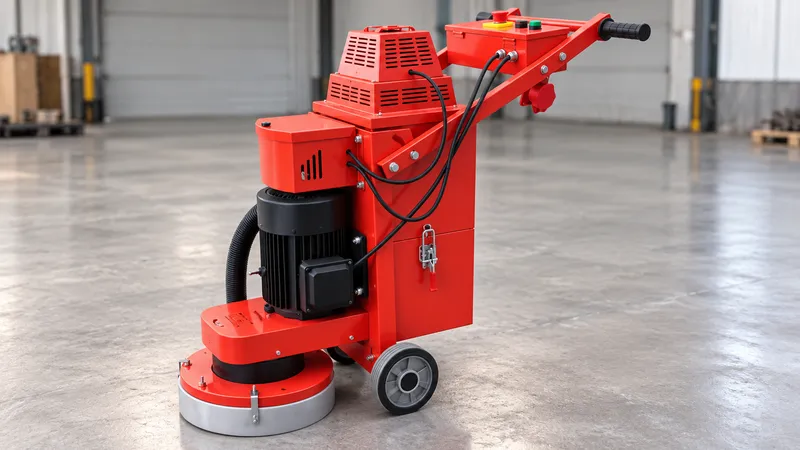
It looks like you have a rugged garage floor that needs flattening, and even after an hour with a hand-held floor grinder, you have only flattened one corner. But before renting any grinder, it helps to understand how a walk behind floor grinder differs from a hand-held floor grinder, since each excels at different tasks. The electric concrete floor grinder buying guide clearly shows how each machine differs in size, power, and weight. This helps you choose between walk behind floor grinders and handheld ones.
Walk Behind Floor Grinder vs Handheld Grinder: Which One Do You Need?
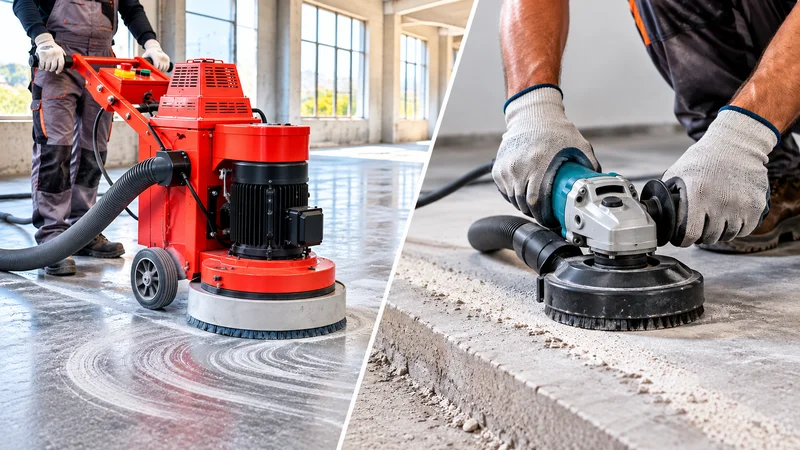
Choose a walk behind floor grinder for large, open slabs, and a handheld grinder for edge work, corners, and small areas. In most cases, you need both: a walk behind floor grinder cannot reach the wall, and a handheld grinder is slow on open floors.
| Factor | Walk-behind floor grinder | Handheld grinder |
| Best for | Whole floors and large slabs | Edges, corners, stairs, and spot repairs |
| Coverage | Roughly 500 to 2,000+ sq ft per day | Roughly 50 to 150 sq ft per hour |
| Disc size | 10 to 30 in heads, single-disc or planetary | 4 to 7 in diamond cup wheel |
| Weight | Roughly 150 to 400+ lb; compact models weigh less | Most are under 10 lb |
| Dust control | Often a built-in vacuum port | Shroud is optional, so confirm it |
| Skill level | Intermediate; some experience helps | Beginner to intermediate |
Three Things That Decide It
Three things decide which grinder fits your jobs:
- Size of space: A small walk-behind space under 200 square feet with many corners and obstructions suits a handheld unit; a whole garage or basement suits the walk behind floor grinder.
- Finish: A large epoxy or polished concrete surface requires even grinding, so the walk-behind floor grinder suits it.
- Access: Small doors and stairways can prevent using the larger machine. Use a hand-held angle grinder with cup wheels on stairway landings, narrow strips, and the last few inches of wall area, where larger machines simply won’t fit.
Prep the Slab Before You Grind
No matter which one you choose, prepare the surface before grinding. Grinding exposes all pits and cracks, while stripping removes any coating that has been covering them up. Before using either tool, do everything in the order you would prepare your garage floor for cracks, and seal all gaps to avoid re-grinding the same spots.
Understand the limitations of both tools before starting work. Neither grinder can cut joints or make through-cuts, so this work requires two stages: cutting. Then smoothing the surface by grinding. For projects that require joint control or through-cuts, use a guide for a concrete cutting saw instead.
What Jobs Is a Walk-Behind Floor Grinder Best For?
Handheld Grinders for Edges and Corners
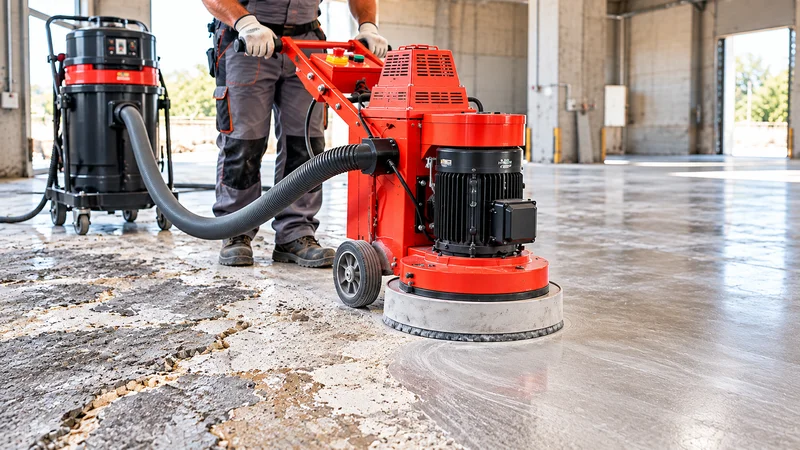
Edges and corners are the one place a handheld tool still beats the larger machine. Use a handheld angle grinder with a dust shroud and a 5-inch cup wheel for the perimeter, connect it to a vacuum, then blend that edge into the field the walk-behind floor grinder ground. The handheld tool only wins at the edges and corners. Take your handheld angle grinder, attach a dust shroud and a 5 in cup wheel, connect it to the vacuum, and blend the edge into the field the walk-behind floor grinder made.
Walk Behind Floor Grinder With Vacuum
Dust control is just as important as the machine, since the process generates silica dust. According to OSHA’s silica guidelines for walk behind floor grinders, the manufacturer recommends a dust collection system with a filter with 99% efficiency or more, or a water feed. Indoor dust collection uses a HEPA vacuum cleaner for loose dust after each pass. The dust collection system has to fit the machine.
The dust port is also a part of the machine. This 7-inch, 1.7 HP floor grinder has a dust port that connects to the external vacuum. The VEVOR listing shows wet and dry use, but the 7-inch floor grinder manual states it is designed for dry use with an industrial vacuum.
After grinding, vacuum the dust and slurry from the area before it has a chance to settle. The slab must be clean in order to bond effectively with whatever you apply after, so read about cleaning a concrete garage floor prior to sealing.
What Are the Best Walk-Behind Floor Grinders for Preparing and Smoothing Large Concrete Floors?
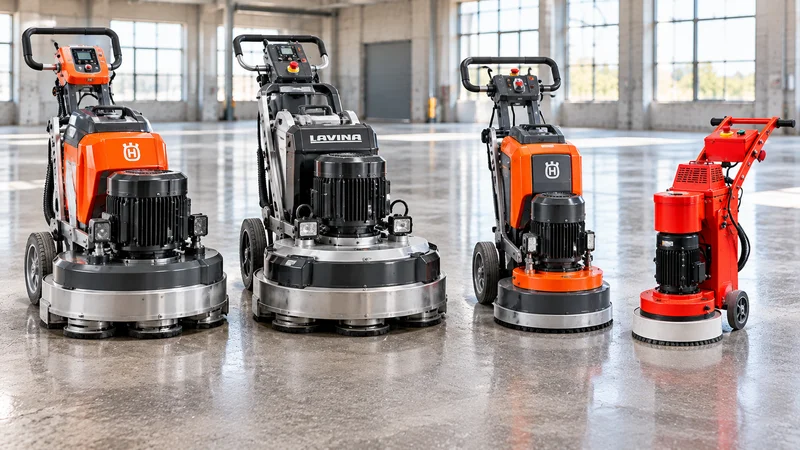
Match the walk behind floor grinder with the slab size. For large warehouse slabs, a multi-head three-phase machine like the Husqvarna PG 690 or Lavina 32 Pro can handle the job in one pass. For medium-sized slabs, the Husqvarna PG 540 is the right choice. For a garage or basement slab, a smaller one-disc machine from VEVOR’s list of concrete grinders will suffice. Since no source ranks these machines, you can compare their working area and weight alongside other features.
| Machine | Working width | Power and supply | Notes |
| Husqvarna PG 690 (push) | 640 mm, three 270 mm discs | 12.5 kW, 380-415 V three-phase | 502 kg; floor prep, grinding, and polishing |
| Superabrasive Lavina 32 Pro | 32 in, six 9 in heads | 20 hp, 3-phase at 240 or 480 V | Six-head planetary machine made for large commercial projects |
| Husqvarna PG 540 | Three 9 in discs | 4.0 kW (5.5 hp), single- or three-phase | 177.8 kg; compact model for floor prep, grinding, and polishing |
| VEVOR 10-inch 1.7HP | 10 in disc | 1300W, 1720 RPM | Dust collection port that connects to an external vacuum |
Recommended For Your Project
Power Supply for Large Machines
Units this size often require more than a standard household outlet. For example, some industrial grinders require 220-volt, single-phase or three-phase electricity, while some planetary units require 460-volt, three-phase electricity.
How Do I Choose the Right Disc Size for a Walk Behind Floor Grinder?
Select a disc size that fits both your floor space and accessibility: choose smaller sizes for garages and small spaces, and larger sizes for wide-open floors. The recommendations vary on how specific the sizes should be. One recommendation says home floor scrubbers range from 18 to 22 inches in diameter, medium-sized commercial models are around 25 to 30 inches, and anything over 32 inches is for large areas. Another source says a smaller floor scrubber, 7 to 11 inches, is enough for spaces smaller than 1,000 sq feet.
The disc size depends mostly on the machine. For instance, the 10-inch 1.7HP floor grinder uses a 10-inch disc, while the 7-inch one uses a 7-inch disc that fits through a door easily but covers less of the floor each cycle. Power is also a factor here.
How Do I Move a Walk Behind Floor Grinder Up Steps or Into a Vehicle?
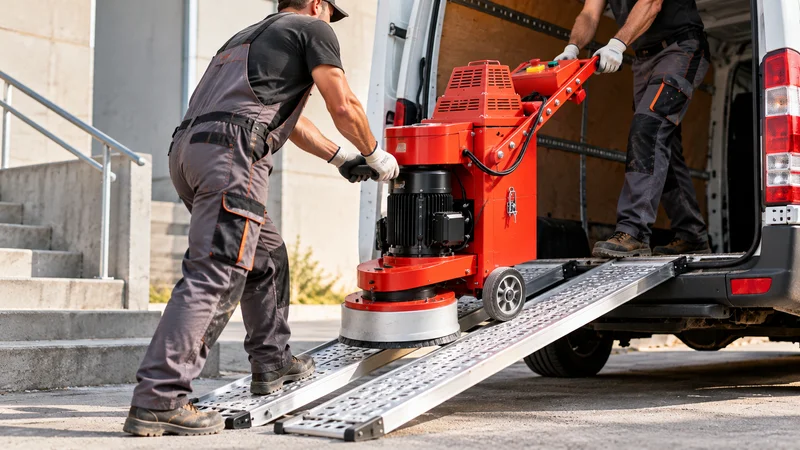
Consider the machine’s weight first, then factor in another person, a ramp, or lifting machinery when lifting heavy objects. The NIOSH lifting equation starts with a 51-pound (23 kg) load under ideal conditions and reduces it for awkward lifting. It’s an initial calculation, not an absolute safe limit; therefore, most walk behind floor grinders require assistance. Weight varies widely, from lighter models two people can lift to heavier ones that require lifting machinery. The 1400W walk behind floor grinder is listed at 62.5 lb with a folding handle, which is already above that figure.
Getting It Up Steps
For stairways, release the strain on your back. If possible, fold or disconnect the handle, lift from the areas indicated in the manual, and have another person lift the other end. Never drag the equipment upstairs.
Getting It Into a Vehicle
Big industrial grinders require a separate transportation plan. The Husqvarna PG 690 (push) weighs 502 kg, so confirm the exact weight, lifting points, and transportation instructions for that machine before arranging the lifting equipment. If you’re renting, ask which of the three options applies: you load it yourself, you tow it using a trailer, or it will be delivered to you. In the first case, you need a vehicle that can carry the machine’s weight; in the second, you need a vehicle with the appropriate towing capacity. Delivery solves that issue, but you’re responsible for everything you transport yourself. Find the exact weight of the models in the concrete walk-behind floor grinder range.
Should I Buy or Rent a Walk Behind Floor Grinder?
Rent if you have only one floor, or one large floor, and need a commercial machine. Buy if you will be grinding more than one floor, or if your walk-behind floor grinder rental costs for future projects would equal the cost of buying a small machine.
| Factor | Renting | Buying |
| Project size | Fits one-off jobs and large floors | Fits repeat work with a smaller machine |
| Tooling | Ask for tooling that fits the machine, or a conversion plate | You choose and store the tooling |
| Dust control | Ask for a matching dust collector | Buy a matching vacuum and shroud |
| Moving and storage | Delivery or pickup options | You move and store it yourself |
Conclusion
Clean the open floor with a walk behind floor grinder, and use a hand-held floor grinder on the edges. In some cases, you may need both. Consider the slab size, your power source, and your dust collection system, and decide how you’ll move the machine before you rent or purchase. The equipment and dust collection system are just as important as the grinding machine. Once the floor surface is level, choosing between garage floor tiles and epoxy becomes easy.
Frequently Asked Questions
Is a walk behind floor grinder better than a handheld grinder?
It will depend on the task. A walk-behind unit is good for big, level floors, but a handheld grinder is better for edges and corners.
Can a handheld grinder replace a walk behind floor grinder on a garage floor?
If it is just a small area, then yes, but doing the whole garage takes much longer. People generally use a walk-behind floor grinder for the floor and a handheld grinder on the walls.
Do I need a vacuum with a walk behind floor grinder?
Yes. Dry grinding produces fine silica dust, so you need to connect the manufacturer-recommended dust collector with a 99% effective filter. A standard shop vacuum may not capture fine dust particles.
What power does a walk behind floor grinder need?
It depends on the machine. Some smaller machines use a 110-volt system, while bigger machines may use 220 volts or a three-phase power system, so check the rating plate.