
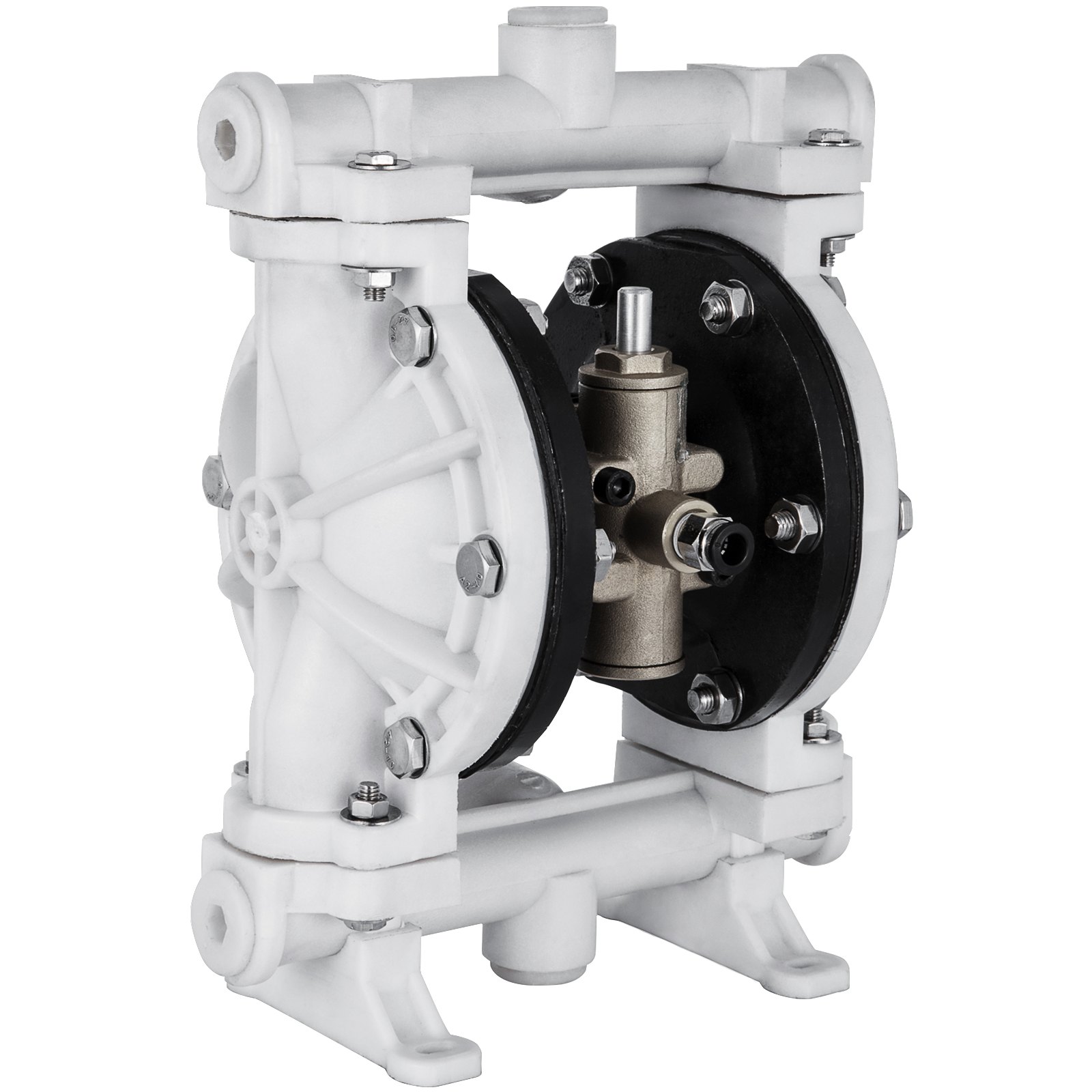
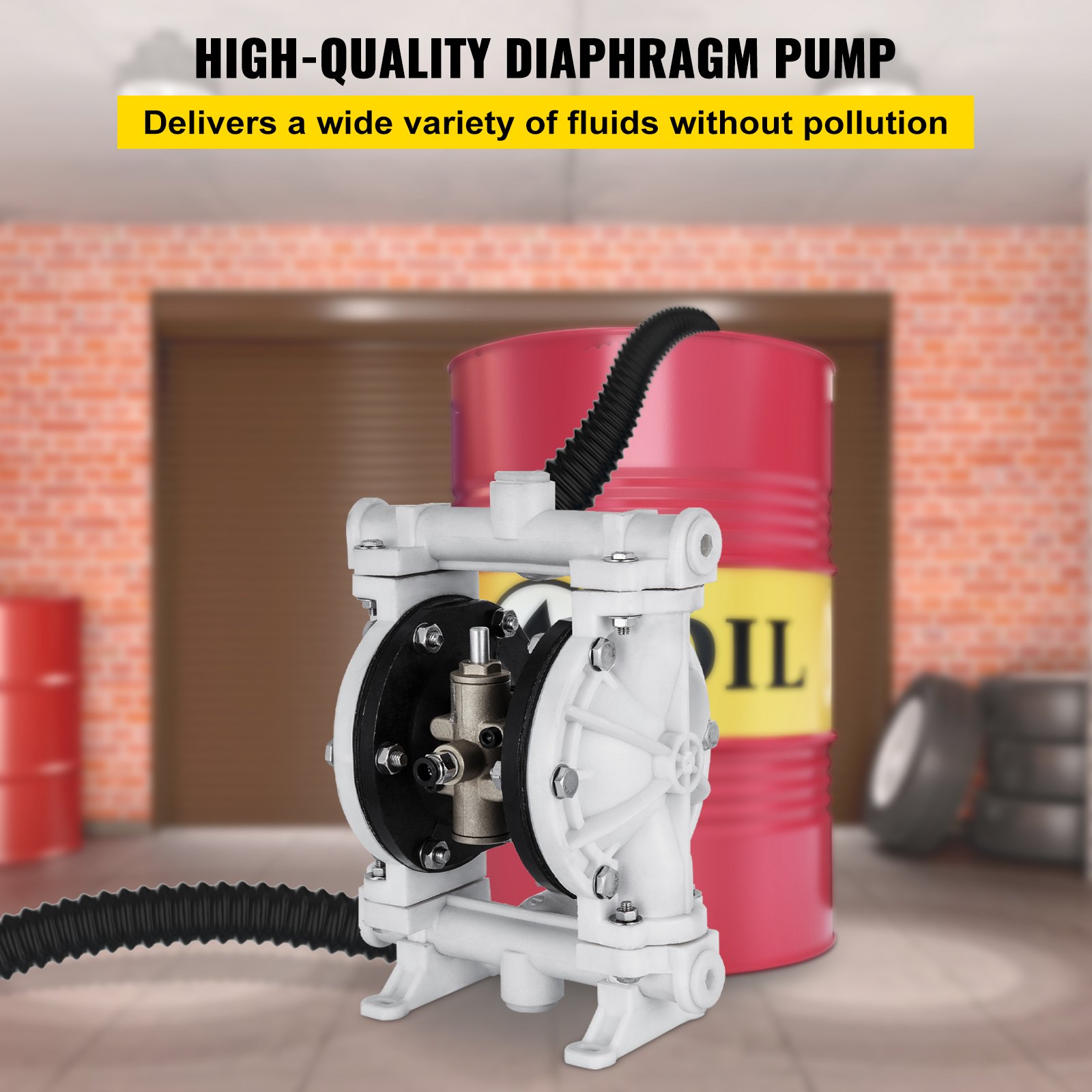
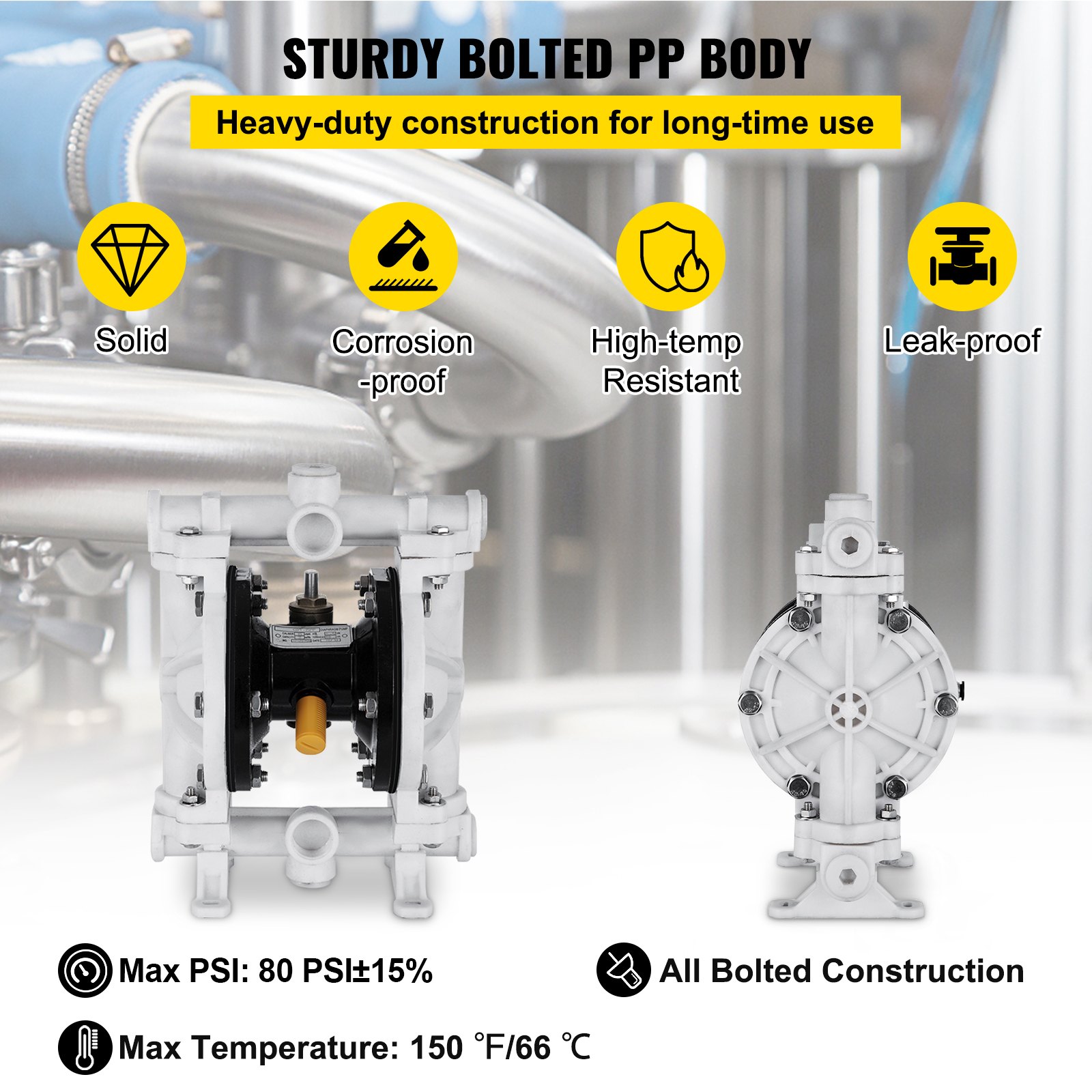
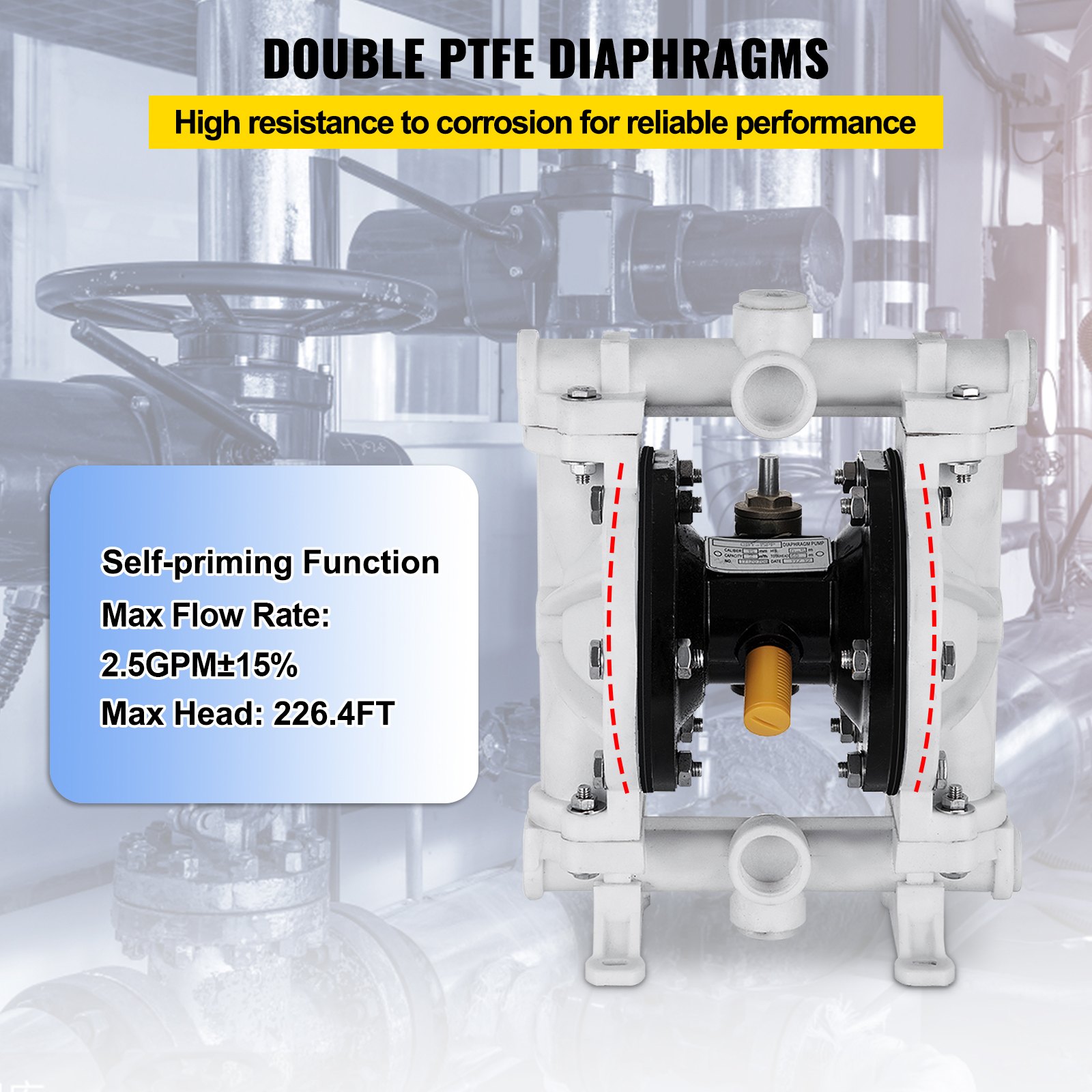
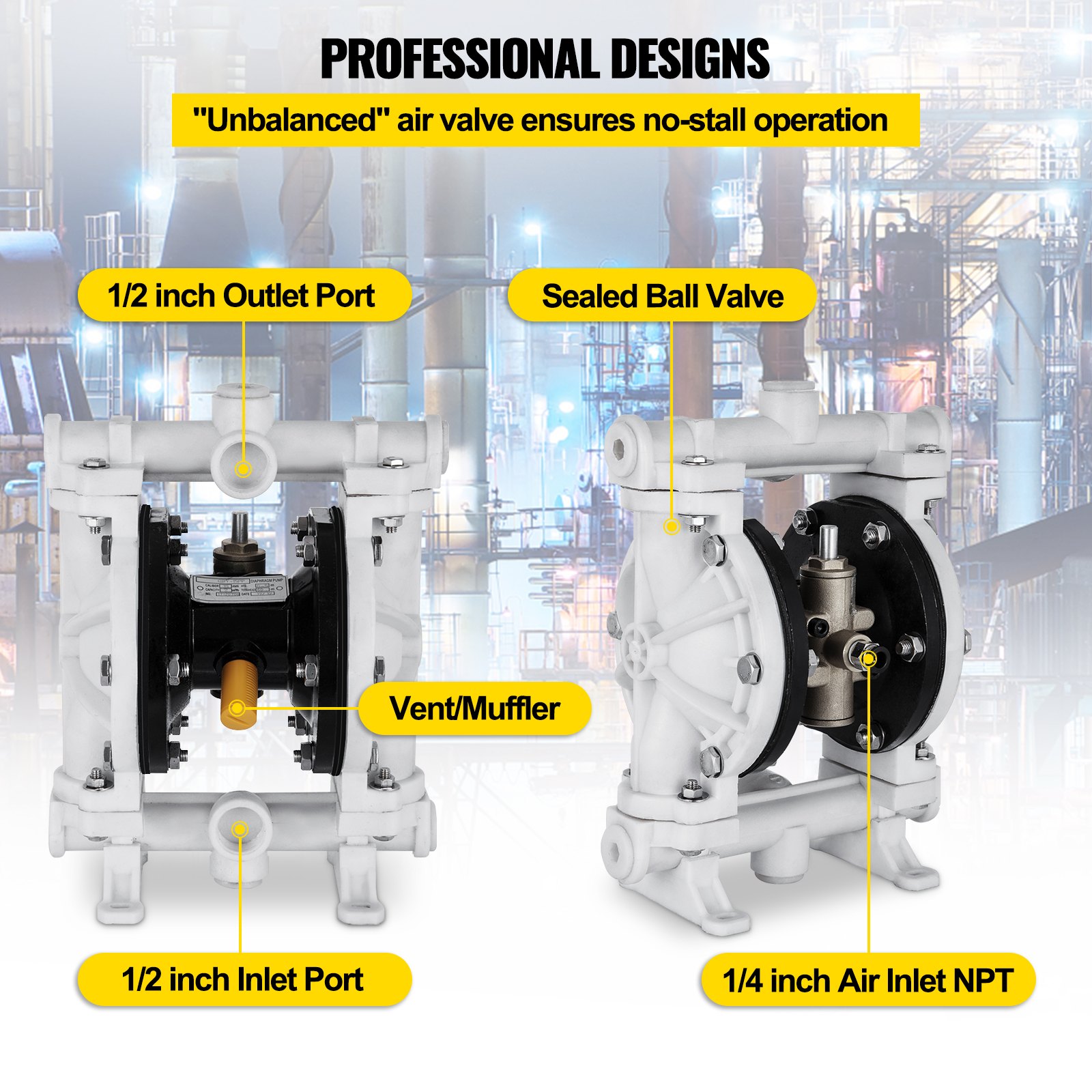
Unlock the full potential of your VEVOR Air-Operated Double Diaphragm Pump with our comprehensive product manual download. Designed specifically for the 1/2 in Inlet & Outlet model with a Polypropylene body, boasting a 13.2 GPM capacity and a maximum pressure of 120 PSI, this manual is your ultimate guide to setup, troubleshooting, and optimization.
Whether you’re transferring petroleum, diesel, oil, or other low-viscosity fluids, our VEVOR Double-diaphragm manual ensures you get the most out of your PTFE diaphragm pneumatic transfer pump. Detailed instructions cover every aspect of the pump’s operation, from initial setup to routine maintenance, making it easier than ever to achieve peak performance. Troubleshooting tips help you quickly identify and resolve any issues, minimizing downtime and maximizing efficiency.
Our user-friendly manual is written in clear, professional language, ensuring you can easily follow along, regardless of your technical expertise. Download now to streamline your operations, enhance productivity, and ensure your VEVOR Air-Operated Double Diaphragm Pump runs smoothly for years.
Product Description
This series of diaphragm pumps is the latest model at home. They arefunctioned to take out and suck in various corrosive liquid containing granules, viscous, volatile, inflammable, explosive or poisonous liquid, porcelain slurry, mashed fruit, flue, the reclamation of residual oil in tanker, temporary reversion of tanker, etc.
The performance parameters of this series are close to those of German WLLDENPUMPS and American MARIO-WPUMPS. The components in contact with the flow are made of stainless steel, aluminium alloy, cast iron, and engineering plastics, while the diaphragm may be NBR, Viton, neoprene, or PTFE.
Function
Air-operated double diaphragm pumps can exhaust the liquid flow and act as self-pumping pumps, Diving pumps, Shield pumps, Slurry Pumps, and impurity pumps, among other things.
- It’s unnecessary to pour the drawing water; the suction lift reaches 7m height, the delivery lift reaches 50m length, and the export pressure is greater than or equal to 6 kgf/cm².
- Wide flow and good performance. The diameter allowed to pass the maximum grain is 10mm. The damage is very little.
to the pump while exhausting the slurry and impurity; - The delivery life and flow can pass the pneumatic valve open to realize the step-less adjustment (The pneumatic pressure
adjustment is between 2- 8 kgf/cm²); - This pump has no rotary parts and no bearing seals. The diaphragm will separate the exhausted medium and pump running parts from the working medium. The conveyed medium can’t be leaked outside. Thus, it will not cause environmental pollution and danger to the human body while exhausting the toxin and flammable or corrosive medium.
- No electricity. It’s safe and reliable when used in flammable and explosive places;
- It can be soaked in medium.
- It’s convenient to use and reliable to work with. Only open or close the gas valve body while starting or stopping. Even if no medium operation or sudden pausing for a long time due to accident matters, the pump will not be damaged by this. Once overloaded, the pump will automatically stop and possess the self-protection function. When the load recovers normally, it can also start automatically.
- This pump has a simple structure and fewer wearing parts. It is simple in structure, Installation, and maintenance. The medium conveyed by the pump will not touch the matched pneumatic valve and coupling lever, etc. Unlike other kinds of pumps, the performance will drop gradually because of damage to the rotor, gear, and other parts.
- lt can transmit the adhesive (the viscosity is below 10000 centipoise)
- This pump doesn’t need oil lubrication. Even if idling, it doesn’t have any influence on the pump. This is a major feature of this pump.
Working Principle
Each diaphragm is installed in the aligned working cavities (A) and (B), which can be connected with a central coupling lever. Compressed air enters the air distribution valve through the air entrance of the pump. The air is directed into one cavity through the air distribution mechanism, pushing the diaphragm within that cavity. Meanwhile, the gas in the other cavity is expelled.
Once the stroke reaches the terminal point, the distribution system automatically draws air into the opposite cavity, pushing the diaphragm in that section. In this way, both diaphragms continuously move back and forth in synchrony.
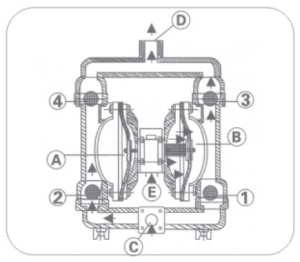
As the diagram shows, compressed air enters the air distribution valve from point (E), causing the diaphragm to move toward the right. This creates a suction force in chamber (A), pulling medium from entrance (C) and pushing open the ball valve (2), allowing it to enter chamber (A). Due to the suction, the ball valve (4) remains closed.
Simultaneously, the medium in chamber (B) is compressed, pushing open ball valve (3) so the medium can exit through outlet (D). Meanwhile, the ball valve (1) closes to prevent backflow. This cyclical motion allows the medium to be continuously drawn from (C) and discharged from the outlet (D).
Cautions
- Installing the foundation bolts is generally unnecessary if the pump vibration is very slight.
- If compressed air is mixed with dirty things, the pump’s normal starting will be influenced. It is suggested that the user install the pneumatic triplex part additionally.
- When pumping media that will easily freeze or deposit, please install a valve at the pump’s inlet. If the pump is to be stopped, please first close the valve, and then run the pump for several minutes to empty the media inside the pump and clean the accumulated liquid inside the pump in time, to avoid any difficulties in starting the pump next time.
- When replacing the diaphragm, please clean the connecting rod in the inner cavity and the copper bush of the pump. And avoid damaging the white PTFE seal ring.
Application Examples
- Oil tank bottom cleaning. Although there is a water underlaying process to pump the oil, it is not guaranteed to be thoroughly pumped out. There will always be a layer of oil with a 3-5mm thickness on the surface. Taking the oil tank of 5000 m3 as an example. It wastes 1-1.5 tons of oil every time. As for oil tanks with low-position dehydration tanks, although the oil and water that are left will be discharged to oil-bearing sewage farms for recycling and then volatilized during transportation, they will also pollute the environment.
- Temporary tank dumping, loader, and oil sampling. During oil refining production scheduling, temporary dumping, loading, and sample inspection of oil in the tank occur frequently. To avoid polluting normal pipelines, the diaphragm pump connects with a temporary pipeline to complete these tasks rapidly and conveniently.
- Recovery of bilge oil in the oil tanker. In an oil tank of 3000t, at least 50t oil are left between baffles of the warehouse when discharging the oil with the fixed screw pump. If the diaphragm pump with a larger displacement is used, a better effect will be achieved.
- Transportation of gas and hydrogen sulphide residues. The gas residue and sulphur-bearing water at the bottom of the tower in refineries need to be discharged and disposed of together; otherwise, acidity will form and corrode the equipment.
- Ceramic industry: The pump pumps glaze slurry and sends pressure to the filter press.
- Remove dirty water and oil in sewage wells and blind drains. During the maintenance and servicing of sewage well pipes, valves, and blind drains, dirty water and oil must be removed. Although the submerged pump can completely pump out the dirty water, these places are always far away from the power supply, causing great inconvenience. When used, the diaphragm pump adopts compressed air as the driving power to reclaim dirty oil and discharge dirty water.
- Cleaning of sewage farms and sludge pools. Large amounts of oil sludge, mud, and sand that must be cleaned gather in the sludge pools in sewage farms. The diaphragm pump features flexibility, convenience, labor, manpower, and time savings.
- Dirty water is discharged in liquefied gas pump rooms and laboratories. As these places have lower topography and are Class A fire prevention zones, the double diaphragm pump is relatively safe for discharging dirty water, and its efficiency is many times higher than that of hydro ejectors and steam ejectors.
- In addition, the pump also displays its advantages when applied to naphthenic acid-refined transformed materials, transportation of loaded sodium sulphite liquid, and loading of benzene raw materials.
Recommended For Your Project
VEVOR Air-Operated Double Diaphragm Pump, 1/2 in Inlet & Outlet Manual

Reviews
There are no reviews yet.