
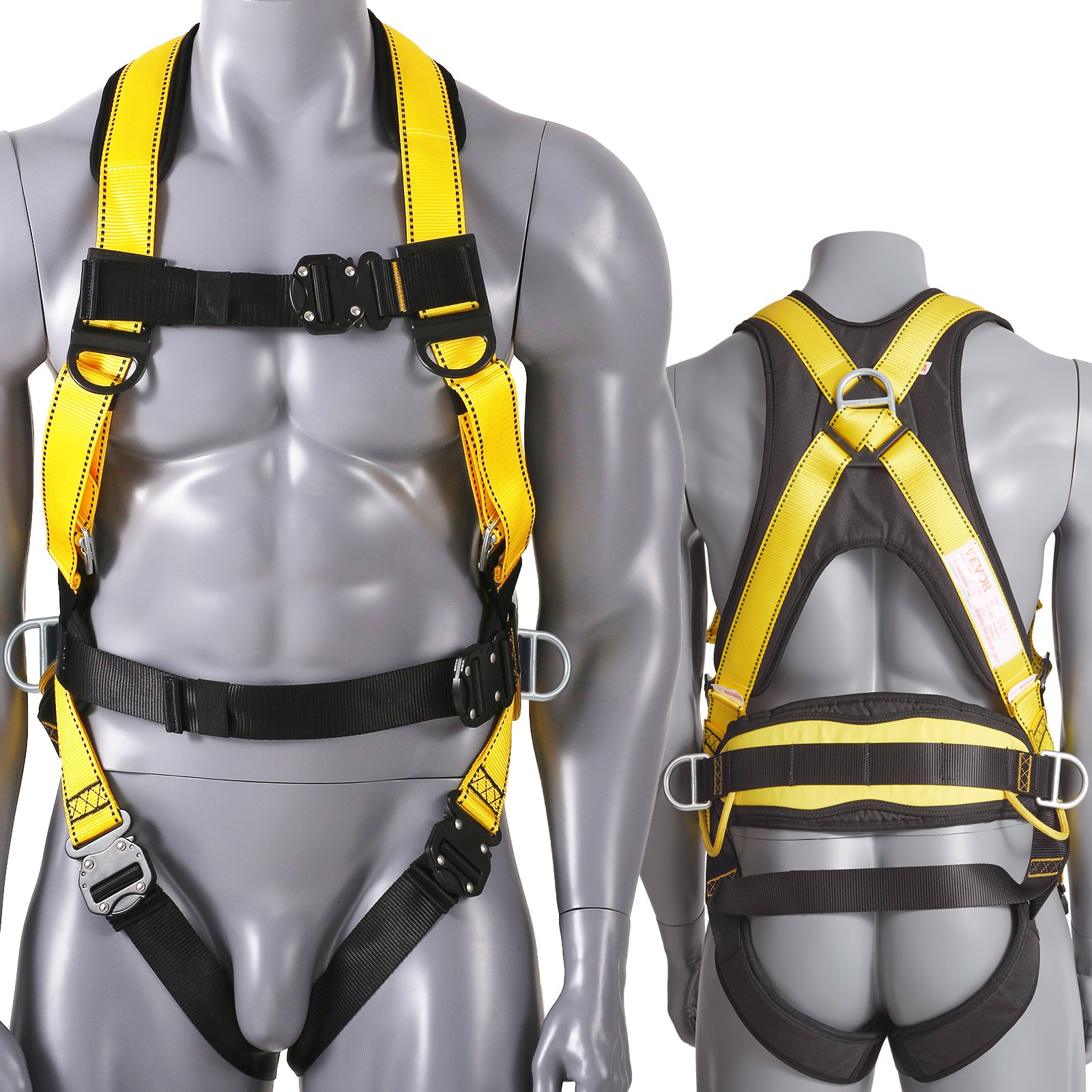
Unlock the full potential of your VEVOR Safety Harness with our comprehensive product manual download. Designed for both novices and professionals, our detailed manual covers every aspect of the Full Body Harness, ensuring that you can set it up correctly and use it safely.
This guide provides step-by-step instructions for harness setup, optimization, and troubleshooting, guaranteeing you get the most out of your investment.
With added padding for comfort, side rings, dorsal D-rings, and a lanyard, this harness meets the ANSI/ASSE Z359.11-2014 standards and supports up to 160 lbs. Our user-friendly manual ensures that safety is never compromised while you are at work. Download your VEVOR Safety Harness manual today for a safer and more efficient experience.
FULL BODY & HALF BODY SAFETY HARNESS
MODEL NO.: Q-3A, Q-2A-S, Q-2A-M, Q-2A-L, Q-2C, B-1A
WARNING: Please read this manual carefully before using the safety harness. Failure to do so may result in serious injury.
SAVE THIS MANUAL
GENERAL INSTRUCTIONS
All instructions attached to the device must be read and understood carefully before use. Attention! This sheet contains only the general instructions.
TRAINING AND PHYSICAL FITNESS.
The activities related to this safety harness are potentially dangerous, and its use is reserved exclusively for competent and trained persons or persons directly supervised by skilled and qualified persons. Before using the harness, it is essential to have received adequate training and instruction and, where required, specific training for using the devices; be familiar with the device; and be in perfect psycho-physical shape.
Attention! Consumption of alcohol or psychotropics, including medication that may alter perception, balance, and concentration, is to be avoided.
WARNINGS.
Before use, ensure that all equipment is in perfect operating conditions, appropriate for the intended use, compatible with each other, and complies with the current rules, regulations, and directives. Also, check that the system is assembled correctly and that the various components work without interfering with one another.
Before and during use: check the perfect closure of the lever and the associated locking of any connectors used.
Devices to be used with ropes.
Before and during each use, always verify the compatibility of the rope/s used. Some ropes may become smoother or smoother due to different factors (e.g., construction of the sheath, possible surface treatments, inadequate diameter, wet, icy, dry, or muddy ropes, etc.).
Check the correct positioning of the rope inside the device. Pay attention to potential foreign bodies that can prevent the device from properly functioning on the rope.
Conditions for use.
This equipment is meant to be used in climatic conditions typically tolerated by human beings (the permitted temperature range is shown on the specific instructions).
Please pay attention to the following conditions, which could jeopardize the device’s strength: humidity, frost, extreme temperatures, aging, and inadequate storage.
Attention! Do not apply and avoid contact with the following substances, which could damage the device and compromise its safety: chemical substances, eg, paint, solvents, adhesives, corrosive substances, reagents, etc; self-adhesive labels; other potentially harmful products/substances.
Attention! When using textile devices, avoid contact with sharp edges and, when necessary, use protective devices.
Responsibilities.
Each individual is responsible for his/her choices and actions: anyone incapable of assuming this responsibility must not use these devices under any circumstances. The manufacturer’s responsibility is limited to manufacturing defects and the materials used.
Attention! Do not use the safety harness for activities exceeding its limitations or for purposes other than those intended!
Attention! Being equipped with personal protective devices does not justify exposing oneself to potentially lethal risks. There are many incorrect usage procedures, and only the procedures indicated as correct are allowed; any other possible usage procedure must be considered forbidden.
Materials.
All materials and treatments (unless otherwise specified)are antiallergic and do not cause skin irritation or sensitization.
Warnings.
Such warnings relate only to devices reporting, in the specific instructions, the ANSI/ASSE 359 or ASTM F1772 standard. Before each use, make sure that all the devices show the correct reference to the standard and are in perfect working order; make sure that the maintenance sheets of each device are correctly updated.
Ensure you have carefully considered the safest way of access, equipped yourself properly, and provided a rescue procedure to recover the incapacitated operator or to deal with any emergency during work; inform the user of the arranged rescue procedure.
During each use, pay attention to the dangers that could jeopardize the device’s performance (e.g., twisting or dragging lanyards or rescueropes on sharp edges; chemical reagents; electrical conductivity; pendulum fall, etc.). For devices intended for use in a fall arrest system.
For the operator’s safety, the device or anchor point must always be correctly positioned, and the work is carried out so that the risk of falling and the length of a fall are minimized; before any use, verify the free space required below the user at the work station so that, in the event of a fall, there is no collision with the ground or other obstacles on the path of the fall; consider that a body harness is the only acceptable body holding device that can be used in a fall arrest system.
INSPECTIONS.
Inspections carried out by the user are necessary to ensure that the device is efficient, functions correctly, and can be used.
Before and after each use, verify that the metal and plastic parts, if present, do not show deformations, sharp edges, abnormal variations in color, corrosion, and oxidation; verify that the metal and plastic parts, if present, do not show cuts, cracks, incisions, or signs of wear with a depth greater than 1 mm.
Verify that the textile parts, if present, and their stitching do not show cuts, abrasions, fraying, wear, burns, damage due to exposure to heat or ultraviolet rays, excessive stretching, corrosion, and traces of mold or chemicals, paying attention to checking any hidden areas as well.
Verify that the stitching, if present, do not show cut, pulled or loose threads; verify, feeling with the fingers the whole length of the devices made of rope, that the inner core does not show cuts, points of emptiness, splits, swelling; verify that any moving parts (e.g. opening levers, locking cams, etc.) correctly rotate without jamming and, where provided with a spring, slowly automatically return to their position once released; verify that there is no dirt, particularly near any gap, e.g., sand—deposits of material.
DEVICES FOR PERSONAL USE.
Besides exceptions, each device must be considered for strictly personal use, and where necessary, it must be prescribed that it be delivered individually to the user.
In case of use by a second user, inspect the device before and after use and, where required, note the details on the appropriate sheet.
Attention! Never use a device if you do not know the related complete life path or if it is provided without the correct documentation (instructions for use, any inspection sheet, etc.).
MARKING
The indications on the device can appear in different places, depending on the device’s dimensions.
- Product name.
- Product code.
- Product definition.
- Name of the manufacturer or person responsible for placing the product on the market.
- Warning: The device is designed to be used by only one person.
- Reference standard.
LIFE SPAN
It is difficult to accurately predict real lifespan of the safety harness because it is influenced by several factors (e.g., the environment in which the equipment is used, climatic factors, storage conditions, frequency and intensity of use).
Nevertheless, it is possible to estimate the device’s maximum lifespan, consisting of an initial period of optimal storage and a period of use. For textile and plastic products, the maximum lifespan is 12 years from the date of manufacture, of which no more than10yearsfromthe date of the first use.
The maximum life span of metallic products is theoretically indefinite, but replacing them after 10 years is still advisable.
Attention! A device’s life span can be limited to just one use, involving an exceptional event (central falls, extreme temperatures, contact with harmful chemical agents or sharp edges, etc.).
INTERRUPTION OF USE/ELIMINATION
Stop using the device immediately: if the maximum life span has been exceeded; if it is obsolete, incompatible with more moderndevicesoroutclassed due to standards’ updates; if the result of the inspections is not satisfactory; if there are doubts on the functioning or the good condition of the device; if it has been exposed to an exceptional event or hard fall: even if there is no visible defect or degradation, its initial strength and resistance could be seriously reduced.
Attention! Destroy discarded products to avoid any further use.
Attention! Please do not use the device again until you receive written confirmation from a competent person authorized by the manufacturer stating that it is acceptable to do so.
PERIODIC INSPECTION
It is generally recommended that the device be thoroughly inspected by the manufacturer, by a competent person authorized by the manufacturer, or by a qualified person according to the current national regulations on PPE inspection at least every 12 months.
Attention! Such inspection is mandatory only for devices for which it is indicated in the specific instructions. Nevertheless, regular inspections are essential to ensure the continued efficiency and durability of the device, which depend on the user’s safety.
The carrying out of the periodic inspections does not exempt the user from the obligation to carry out the checks before and after each use, nor to request an extraordinary periodic inspection at the occurrence of exceptional events (e.g., fall from low height, etc.) or in case of doubts on the proper functioning of the safety harness.
The device’s data and the results of the inspections must be reported respectively in the device’s identification sheet and the periodic inspection sheet. The instructions for use and any additional documents must be kept for the device’s entire life.
Attention! If the document showing the device’s data and the check results is absent or illegible, refrain from using the safety harness.
Frequency of inspections.
The minimum frequency of 12 months can be changed according to the national regulations in force or the frequency, intensity, and mode of use (e.g., heavy uses, use in the marine environment, corrosive atmospheres, etc.).
Device identification sheet
- Trademark.
- Manufacturer.
- Product (type, model, code).
- User (company, name, and address).
- Serial number.
- Year of manufacture.
- Purchase date.
- Date of first use.
- Expiry date.
- Reference standards.
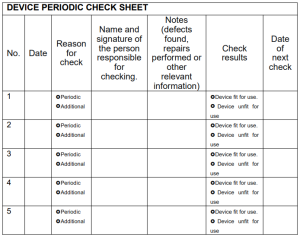
Device periodic inspection sheet (Fig. B).
- Date.
- Reason for the inspection: periodic inspection or additional check.
- Name and signature of the person responsible for the inspection.
- Notes(defects found, repairs performed, or other relevant information).
- Inspection results: device fit for use, device unfit for use.
- Date of next inspection.
NOTIFIED BODIES
The specific instructions for use are indicated by the notified bodies about the product and are listed in this instruction.
DISPOSAL
At the end of the safety harness’s lifespan, i.e., its working life, it is compulsory to take care of its disposal, considering its potential environmental impact.
For this purpose, it is recommended that the harness be disposed of per the laws in force in the country where the disposal occurs.
TAMPERING AND REPAIRS.
Any alteration or tampering immediately voids the guarantee, and it is forbidden, as it can compromise the device’s safety.
Repairs, where feasible, must be carried out exclusively by the manufacturer or by a competent person expressly authorized by the manufacturer, in compliance with what is indicated in the inspection and/or maintenance procedures.
LUBRICATION.
Clean any moving parts of metal devices with compressed air and lubricate them using exclusively silicone-based spray oil.
Attention! An excessive quantity of oil encourages dirt and dust to stick.
Remove any excess oil using a cloth. Attention! Check that the lubrication does not compromise the interaction between the device and the other components of the system, e.g., ropes.
MAINTENANCE AND CLEANING.
Avoid contact with sources of heat or with abrasive or sharp materials. To disinfect, use a dilute ammonia solution according to the safety instructions provided with the product.
After washing, or in the case of damp equipment, leave to dry in the open air away from direct heat sources.
STORAGE AND TRANSPORT
For optimal storage, store the safety harness completely dry at room temperature in well-ventilated areas. Do not expose the devices to chemically aggressive substances, persistent dust or dirt, or environments with high salt concentrations.
During transport, avoid compressions, exposure to direct sunlight, and contact with sharp objects. Do not leave the devices in the car or expose them to the sun in closed environments.
For the transport, use the protective case supplied or, if absent, a packaging that preserves the integrity of the product.
GUARANTEE
The guarantee is valid for 3 years from the purchase date and covers any manufacturing defect or defect in the materials used. The following are excluded from the warranty: everyday wear, inadequate maintenance and storage, incorrect or improper usage, unauthorised tampering or repairs, and lack of observance of the instructions for use.
The manufacturer declines all liabilities concerning the direct, indirect, or accidental consequences, including any consequence that derives from the incorrect use of the safety harness, including the correct use of the device in unsuitable situations that do not ensure proper safety levels.
For the user’s safety, the retailer must provide the device’s instructions for use, maintenance, repair, and periodic check in the language of the country where they will be used, whenever the devices are sold outside of the original country of destination.
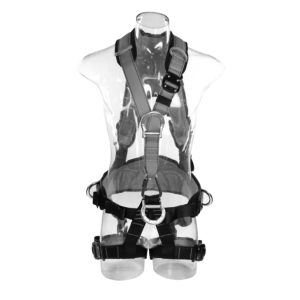
SAFETY HARNESS TECHNICAL SPECIFICATIONS
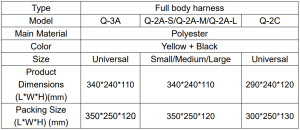

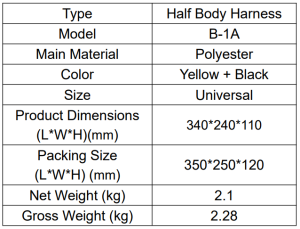
PRODUCT INSTRUCTIONS
MODEL NO.: Q-3A
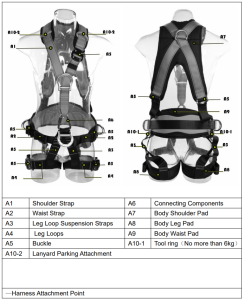
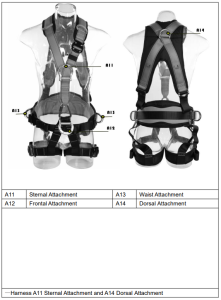
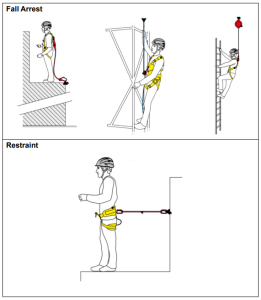
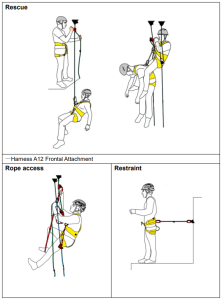
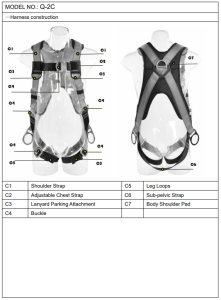
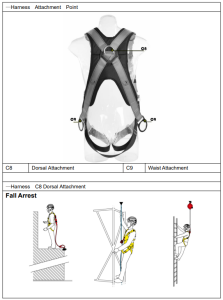
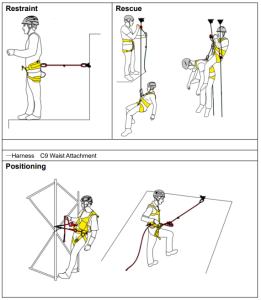
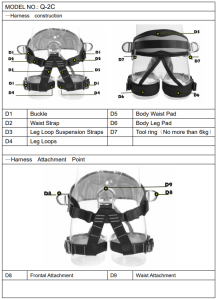
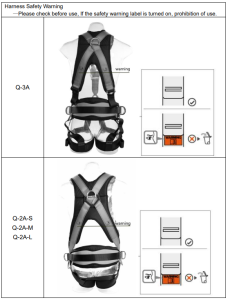
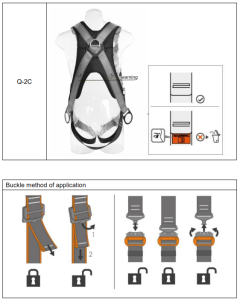
These instructions explain how to use your equipment correctly. Only specific techniques and uses are described.
1. Field of application
Personal protective equipment (PPE): Full-body fall arrest harness. This safety harness must not be pushed beyond its limits or used for any purpose other than its design.
WARNING: Activities involving the use of this equipment are inherently dangerous. You are responsible for your actions, decisions, and safety. Before using this equipment, you must read and understand all the instructions. Get specific training in its proper use. Become acquainted with its capabilities and limitations. Understand and accept the risks involved.
Failure to heed any of these warnings may result in severe injury or death. This product must only be used by competent and responsible persons or those placed under the direct and visual control of a competent and accountable person.
You are responsible for your actions, decisions, and safety, and you assume the consequences. If you are not able, or not in a position to take this responsibility, or if you do not fully understand the Instructions for Use, do not use this safety harness.
2. Compatibility
Verify that this safety harness is compatible with the other system elements in your application (compatible =good functional interaction).
3. Harness setup
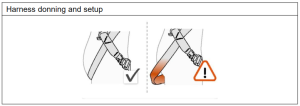
Be sure to stow the excess webbing (folded flat) in the keepers. Beware of foreign objects that could impede the operation of the FASTLTPLUS buckles (e.g., pebbles, sand, clothing). Verify that they are securely fastened.
Adjustment and suspension test: Your harness must fit snugly to reduce the risk of injury in the event of a fall. In a safe environment, you must move around and hang in the harness from each attachment point with your equipment to verify that the harness fits properly, provides adequate comfort for the intended use, and is optimally adjusted.
This harness must be appropriately sized and adjusted to fit the user to ensure adequate protection. See the diagrams for adjustment and function tests. Do not use this harness if you cannot adjust it to fit correctly. Replace it with a different harness size or model.
4. Fall arrest harness.
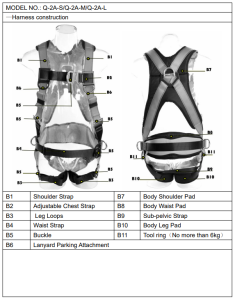
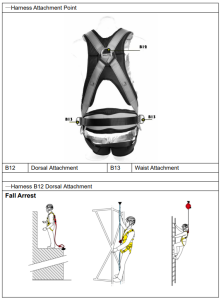
Set up the sternal and dorsal attachment points—textile dorsal attachment points for self-retracting devices. The sternal attachment point, the dorsal attachment point, or the textile dorsal attachment point for the self-retracting device must be connected to a fall arrest system that meets current standards.
Only these attachment points are to connect a fall arrest system, such as a mobile fall arrestor or an energy absorber. These points are marked with the letter ‘A’ for easy identification. Always use the two loops—specifics on the textile dorsal attachment point for the self-retracting device.
This attachment point is designed only to connect a self-retracting fall arrest system. Follow the manufacturer’s recommendations for using the safety harness.
Clearance: The amount of free space is below the user. The free space below the user must be sufficient to prevent the user from hitting an obstacle in the event of a fall. For the clearance calculation, consider the length of any connectors that will affect the fall distance.
The Instructions for Use of the other components(energy absorbers, mobile fall arresters, etc.) provide specific details on calculating clearance. In a fall, the fall arrest attachment point elongates. This elongation (approximately 0.5 ml maximum) must be considered for the clearance calculation.
5. Rescue
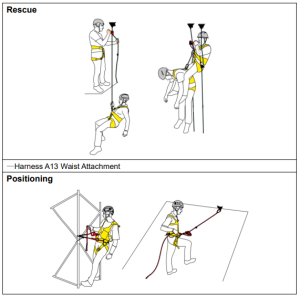
The sternal attachment point or the dorsal point may be used for rescue.
6. Fall arrest lanyard connector-holder
- To be used only as a connector-holder for unused lanyard ends.
- In the event of a fall, the connector holder releases the lanyard-end connector to avoid impeding deployment of the energy absorber.
Warning: This is not a fall arrest attachment point.
7. Equipment loops must only be used for equipment.
WARNING-DANGER: Never use equipment loops for belaying, rappelling, tying in, or anchoring a person.
8. ANSI/ASSE Z359 requirements for proper use and maintenance of full-body harnesses.
Note: These are general requirements and information provided by ANSI/ASSE Z359; the manufacturer of this equipment may impose more stringent restrictions on the use of its products. See the manufacturer’s instructions.
9. It is essential that the users of this type of equipment receive proper training and instruction, including detailed procedures for the safe use of such equipment in their work application. ANSI/ASSEZ359.2, minimum requirements for a managed fall protection program
That establishes guidelines and requirements for an employer’s managed fall protection program, including policies, duties, and training, fall protection procedures, eliminating and controlling fall hazards, rescue procedures, incident investigations, and evaluating program effectiveness.
10. The correct fit of a full-body harness is essential to proper performance. Users must be trained to select the size and maintain the fit of their full-body harness.
11. Users must follow the manufacturer’s instructions for proper fit and sizing, paying particular attention to ensure that buckles are connected and aligned correctly, leg straps and shoulder straps are kept snug at all times, and chest straps are located in the middle chest area. Leg traps must also be positioned and snug to avoid contact with the genitalia should a fall occur.
12. Full-body harnesses that meet ANSI/ASSE Z359.11 are intended to be used with other components of a personal fall arrest system that limit maximum arrest forces to 1800 pounds (8 kN) or less.
13. Suspension intolerance, also called suspension trauma or orthostatic intolerance, is a serious condition that can be controlled with good harness design, prompt rescue, and postfall suspension relief devices. A conscious user may deploy a suspension relief device to remove tension around the legs, freeing blood flow, which can delay the onset of suspension intolerance.
An attachment element extender is not intended to be attached directly to an anchorage or connector for fall arrest. An energy absorber must be used to limit maximum arrest forces to 1800 pounds (8 kN). The length of the attachment element extender may affect free-fall distances and free-fall clearance calculations.
14. Full-body harness (FBH) stretch, the amount of the FBH component of a personal fall arrest system that will stretch and deform during a fall, can contribute to the overall elongation of the system in stopping a fall.
When calculating the total clearance required for a particular fall arrest system, the increase in fall distance created by FBH stretch, the FBH connector length, the settling of the user’s body in the FBH, and all other contributing factors must be included.
15. When not in use, unused lanyard legs still attached to a full-body harness D-ring should not be connected to a work positioning element or any other structural element on the full-body harness unless deemed acceptable by the competent person and manufacturer.
This is especially important when using some types of Y-style lanyards, as a [dangerous shock] load may be transmitted to the user through the unused lanyard leg if it cannot be released from the harness. The lanyard parking attachment is generally located in the sternum area to help reduce tripping and entanglement hazards.
16. Loose strap ends can get caught in machinery or cause the accidental disengagement of an adjuster. All full-body harnesses shall include keepers or other components that control the loose strap ends.
17. Due to the nature of soft loop connections, it is recommended that soft loop attachments only be used to connect with other soft loops or carabiners. Snap hooks should not be used unless the manufacturer approves the application.
18. Dorsal
The dorsal attachment element shall be used as the primary fall arrest attachment, unless the application allows the use of an alternate attachment. The dorsal attachment may also be used for travel restraint or rescue.
When supported by the dorsal attachment during a fall, the design of the full-body harness shall direct load through the shoulder straps supporting the user and around the thighs. Post-fall, supporting the user by the dorsal attachment will result in an upright body position with a slight lean to the front and slight pressure to the lower chest.
Considerations should be made when choosing a sliding versus a fixed dorsal attachment element. Sliding dorsal attachments are generally easier to adjust to different user sizes and allow a more vertical rest position post-fall, but they can increase FBH stretch.
19. Sternal
The sternal attachment may be used as an alternative fall arrest attachment in applications where the dorsal attachment is determined to be inappropriate by a competent person, and where there is no chance of falling in a direction other than feet first.
Accepted practical uses for asternal attachment include, but are not limited to, ladder climbing with a guided type fall arrestor, ladder climbing with an overhead self-retracting lifeline for fall arrest, work positioning, and rope access.
The sternal attachment may also be used for travel restraint or rescue. When supported by the sternum attachment during a fall, the design of the full-body harness shall direct load through the shoulder straps supporting the user, and around the thighs.
Supporting the user post-fall by the sternal attachment will result in roughly a sitting or cradled body position with weight concentrated on the thighs, buttocks, and lower back. Supporting the user during work positioning by the sternal attachment will result in an approximate upright body position.
If the sternal attachment is used for fall arrest, the competent person evaluating the application should take measures to ensure that a fall can only occur feet first. This may include limiting the allowable free-fall distance.
A sternal attachment incorporated into an adjustable-style chest strap may cause the strap to slide up and possibly choke the user during a fall, extraction, or suspension. For these applications, the competent person should consider full-body harness models with a fixed sternum attachment.
20. Frontal
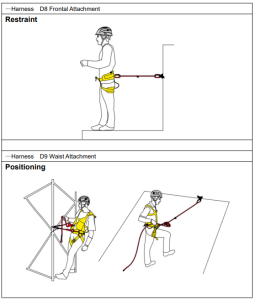
The frontal attachment serves as a ladder climbing connection for guided-type fall arrestors where there is no chance to fall in a direction other than feet first, or may be used for work positioning. Supporting the user, postfall or during work positioning, by the frontal attachment will result in a sitting body position, with the upper torso upright, with weight concentrated on the thighs and buttocks.
When supported by the frontal attachment, the design of the full-body harness shall direct the load around the thighs and under the buttocks using the sub-pelvic strap.
If the front attachment is used for fall arrest, the competent person evaluating the application should take measures to ensure that a fall can only occur feet first. This may include limiting the allowable free-fall distance.
21. Shoulder
The shoulder attachment elements shall be used as a pair and are acceptable for rescue, entry, and retrieval. They shall not be used for fall arrest. It is recommended that the shoulder attachment elements be used in conjunction with a yoke, which incorporates a spreader element to keep the full-body harness shoulder straps separated.
22. Waist
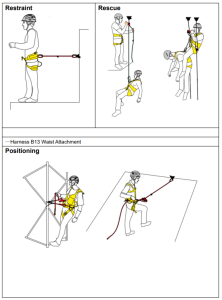
The waist attachment shall be used solely for travel restraint. The waist attachment element shall not be used for fall arrest. Under no circumstances is it acceptable to use the waist attachment for purposes other than travel restraint.
The waist attachment shall only be subjected to minimal loading through the user’s waist and shall never be used to support the user’s full weight.
23. USER INSPECTION, MAINTENANCE, AND STORAGE OF EQUIPMENT
Users of personal fall arrest systems shall, at minimum, comply with all manufacturer instructions regarding the equipment’s inspection, maintenance, and storage. The user’s organization shall retain the manufacturer’s instructions and make them readily available to all users. See ANSI/ASSE Z359.2, Minimum requirements for managed fall protection program regarding user inspection, maintenance, and equipment storage.
1. In addition to the inspection requirements outlined in the manufacturer’s instructions, the user shall inspect the equipment before each use and, additionally, by a competent person, other than the user, at intervals of no more than one year for:
- absence or illegibility of marking the absence of any elements affecting the harness’s form or function
- evidence of defects in or damage to hardware elements, including cracks, sharp edges, deformation, corrosion, damage from chemicals, excessive heating, alteration, and excessive wear
- evidence of defects in or damage to the strap or ropes, including fraying, unsplicing, unlaying, kinking, knotting, roping, broken or pulled stitches, excessive elongation, chemical attack, excessive soiling, abrasion, alteration, needed or excessive lubrication, excessive aging, and excessive wear.
2. The user’s organization shall set inspection criteria for the equipment. Such criteria for the equipment shall equal or exceed the criteria established by this standard or the manufacturer’s instructions, whichever is greater.
3. When inspection reveals defects in, damage to, or inadequate equipment maintenance, the equipment shall be permanently removed from service or undergo adequate corrective maintenance by the original equipment manufacturer or their designate before returning to service.
24. Maintenance and storage
- The user’s organization shall conduct maintenance and storage of equipment per the manufacturer’s instructions. Unique issues, which may arise due to conditions of use, shall be addressed with the manufacturer.
- Equipment that requires or is scheduled for maintenance shall be tagged as “unusable” and removed from service.
- Equipment shall be stored to prevent damage from environmental factors such as temperature, light, UV, excessive moisture, oil, chemicals, vapors, or other degrading elements.
PERIODIC CHECKING OF PERSONAL PROTECTIVE EQUIPMENT
GENERAL REMARKS
Carrying out periodic checks (at predetermined intervals by the manufacturer) ensures the equipment’s efficiency, durability, and user safety. The ANSI/ASSE 359 or ASTM F1772 standard requires the performance of regular periodic inspections, and they are, therefore, mandatory only for some device categories whose instructions for use expressly indicate such obligation.
Carrying out periodical controls doesn’t relieve the user from the obligation to perform the controls before and after each use, neither to require an extraordinary periodic check, in case an outstanding event occurs (ex, afall, even from a low height, a change of user etc.), or in case of doubts about the correct functioning of the device.
Attention! Before first use, the owner/user of PPE must fill in the “device identification sheet” when present in the user’s instructions.
Attention! The Inspector, after having carried out the inspection, is responsible for the proper functioning of PPE. After completing all the necessary steps, the check must be performed with the highest accuracy, without haste.
The regular periodic checks must be carried out: If the previous use of the device is unknown; at least every 12 months, with normal/standard use; in the presence of anomalies found during the inspections before and after each use; except for exceptions, whenever there is a changeof user;fillingthe periodic inspection sheet in:
Attention! The periodic inspection sheet also exists in the optimized version for kits or systems of PPE.
Attention! The minimum mandatory frequency for the periodic inspection is 12 months. Still, it can be increased (e.g., 3 months, 6 months, etc.)according to the national regulations in force or the frequency, intensity, and method of use (e.g., heavy use, use in a marine environment, corrosive atmospheres, etc.).
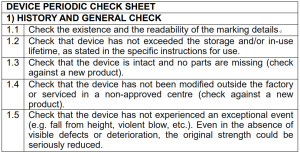
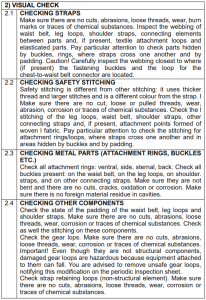
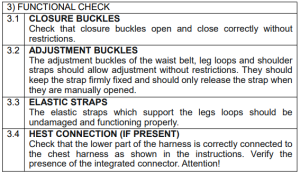
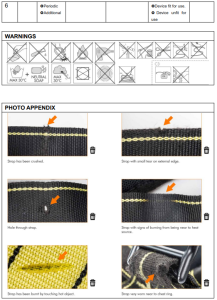
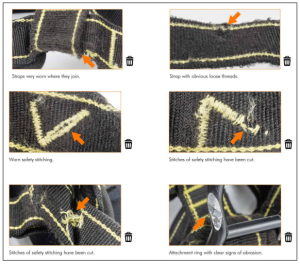
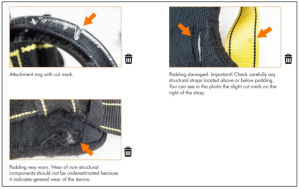
The periodic inspection sheet must be filled out following the specific procedure for each type of device; consulting the photographic material available, where present; consulting the instructions for use of the device; examining the device in a suitable, tidy, and well-lit environment.
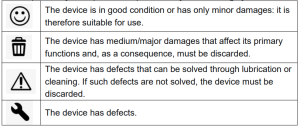
The photographic material at the end of the procedures is accompanied by an explanatory caption and by the following symbols:
Device Periodic Check Sheet
Made In China
Recommended For Your Project
VEVOR Safety Harness, Full Body Harness S Manual


Reviews
There are no reviews yet.