
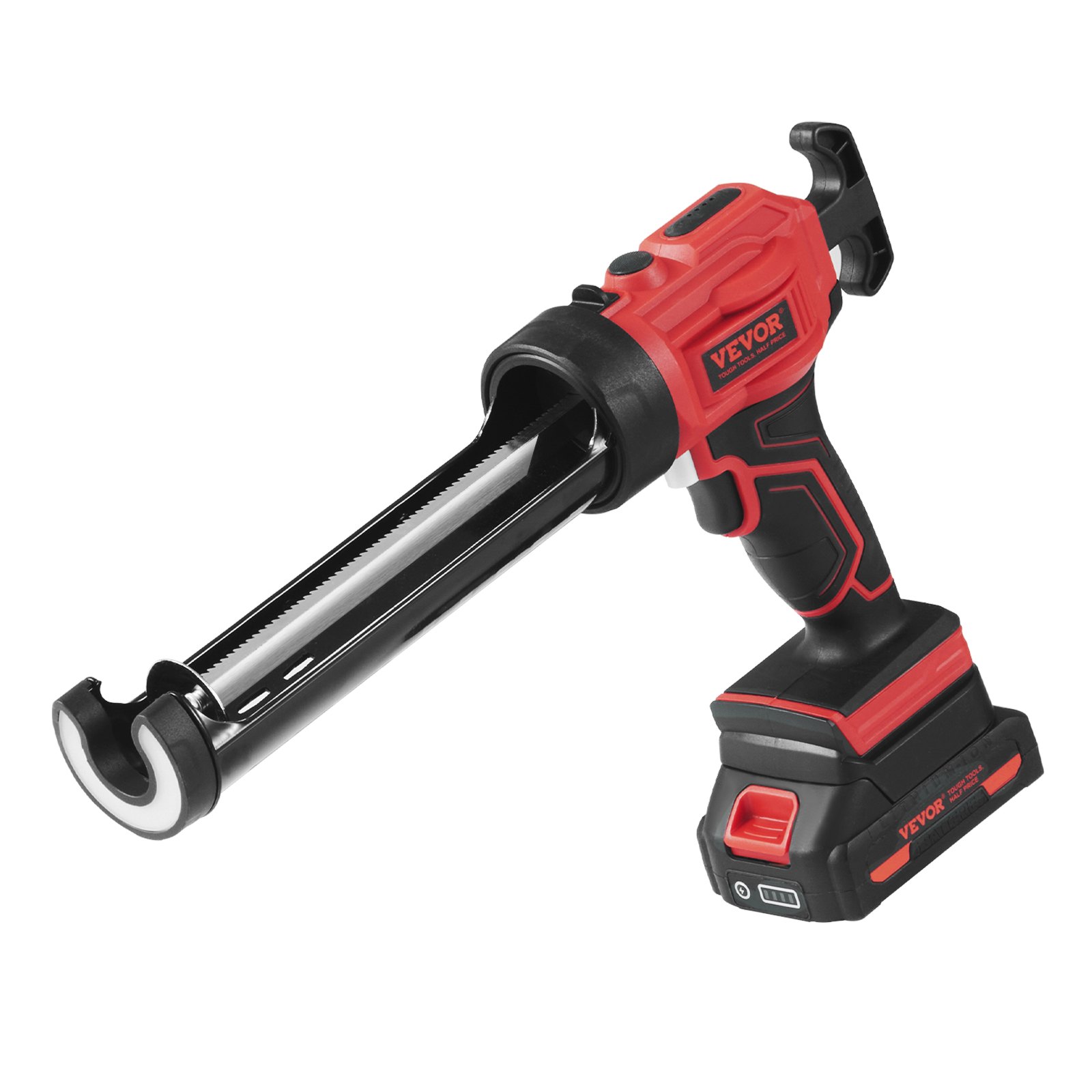
Discover the ultimate guide to mastering your VEVOR Cordless Caulking Gun 10oz/300ml, 20V Electric Caulking Gun with 4 Adjustable Speeds, Anti-Drip Battery Powered Adhesive Caulk Gun & 2.0AH Battery, Fast Charger, LED Light for Filling and Sealing.
Our comprehensive product manual is designed to make setup, troubleshooting, and optimization as effortless as possible. With detailed instructions and clear illustrations, you can easily navigate through the features of your electric caulking gun, ensuring you get the most out of its innovative design and capabilities.
Whether you’re filling gaps, sealing joints, or applying adhesives, our manual provides step-by-step guidance to enhance your efficiency and accuracy. Download now to enjoy a seamless user experience and unlock the full potential of your VEVOR Cordless Caulking Gun.
VEVOR Cordless Caulking Gun User Manual
MODEL: Q0V-CX51-20
Important Safety Warnings
WARNING: Read all safety warnings, instructions, illustrations, and specifications provided with this power tool. Failure to follow all instructions listed below may result in electric shock, fire, and/or serious injury.
Save all warnings and instructions for future reference. The term “power tool” in the safety instructions refers to your Cordless caulking gun.
Work area safety
- Keep the work area clean and well-lit. Cluttered or dark areas invite accidents.
- Do not operate power tools in explosive atmospheres, such as those containing flammable liquids, gases, or dust. Power tools create sparks, which may ignite the dust or fumes.
- Keep children and bystanders away while operating a power tool. Distraction can cause you to lose control.
Electrical safety
- Power tool plugs must match the outlet. Never modify the plugin anyway. Do not use any adapter plugs with earthed (grounded) power tools. Unmodified plugs and matching outlets will reduce the risk of electric shock.
- Avoid body contact with earthed or grounded surfaces, such as pipes, radiators, ranges, and refrigerators. If your body is earthed or grounded, you are at an increased risk of electric shock.
- Do not expose power tools to rain or wet conditions. Water entering a power tool will increase the risk of an electric shock.
- Do not abuse the cord. Never use the cord for carrying, pulling, or unplugging the power tool. Keep the cord away from heat, oil, sharp edges, or moving parts. Damaged or entangled cords increase the risk of electric shock.
- When operating a power tool outdoors, use an extension cord suitable for outdoor use. This reduces the risk of electric shock.
- If operating a power tool in a damp location is unavoidable, use a residual current device (RCD) protected supply. An RCD reduces the risk of electric shock.
Personal safety
- Stay alert, watch what you are doing, and use common sense when operating a power tool. Do not use a power tool while you are tired or under the influence of drugs, alcohol, or medication. A moment of inattention while operating power tools may result in serious personal injury.
- Use personal protective equipment. Always wear eye protection. Protective equipment such as a dust mask, non-skid safety shoes, a hard hat, or hearing protection, used under appropriate conditions, will reduce personal injuries.
- Prevent unintentional starting. Ensure the switch is in the off-position before connecting to a power source and/or battery pack, picking up, or carrying the tool. Carrying power tools with your finger on the switch or energizing power tools that have the switch on invites accidents.
- Remove any adjusting key or wrench before turning the power tool on. Awrenchor a key left attached to a rotating part of the power tool may result in personal injury.
- Do not overreach. Keep proper footing and balance at all times. This enables better control of the power tool in unexpected situations.
- Dress properly. Do not wear loose clothing or jewellery. Keep your hair and clothing away from moving parts. Loose clothes, jewellery, or long hair can get caught in moving parts.
- If devices are provided for connecting dust extraction and collection facilities, ensure these are connected and properly used. Dust collection can reduce dust-related hazards.
- Do not let familiarity gained from frequent use of tools allow you to become complacent and ignore tool safety principles. A careless action can cause severe injury within a fraction of a second.
Power tool use and care
- Do not force the Cordless Caulking Gun. Use the correct power tool for your application. The correct power tool will do the job better and safer at the rate for which it was designed.
- Do not use the power tool if the switch does not turn it on and off. Any power tool that cannot be controlled with the switch is dangerous and must be repaired.
- Disconnect the plug from the power source and/or remove the battery pack, if detachable, from the power tool before making any adjustments, changing accessories, or storing power tools. Such preventive safety measures reduce the risk of starting the power tool accidentally.
- Store idle power tools out of the reach of children, and do not allow persons unfamiliar with the power tool or these instructions to operate them.
Power tools are dangerous in the hands of untrained users. - Maintain power tools and accessories. Check for misalignment or binding of moving parts, breakage of parts, and any other condition that may affect the power tool’s operation. If damaged, have the power tool repaired before use. Poorly maintained power tools cause many accidents.
- Keep cutting tools sharp and clean. Properly maintained cutting tools with sharp cutting edges are less likely to bind and are easier to control.
- Follow these instructions for using the power tool, accessories, tool bits, etc., taking into account the working conditions and the work to be performed. Using the power tool for operations other than those intended could result in a hazardous situation.
- Keep handles and grasping surfaces dry, clean, and free from oil and grease. Slippery handles and grasping surfaces prevent safe handling and control of the tool in unexpected situations.
Service
a) Have your power tool serviced by a qualified repair person using only identical replacement parts. This will ensure the tool’s safety.
Battery Power Tool Safety Instructions
- Prevent unintentional starting. Ensure the switch is in the off position before connecting the battery pack, picking up, or carrying the power tool. Carrying the power tool with your finger on the switch or energizing a power tool that has the switch on invites accidents.
- Disconnect the battery pack from the power tool before making adjustments, changing accessories, or storing it. This preventive safety measure reduces the risk of accidentally starting the power tool.
- Recharge only with the charger specified by the manufacturer. A charger suitable for one type of battery pack may create a risk of fire when used with another battery pack.
- Use power tools only with specifically designated battery packs. Use of any other battery packs may create a risk of injury and fire
- When the battery pack is not in use, keep it away from other metal objects, such as paper clips, coins, keys, nails, screws or other small metal objects, that can make connections from one terminal to another. Shorting the battery terminals together may cause burns or a fire.
- Under abusive conditions, liquid may be ejected from the battery; avoid contact. If contact accidentally occurs, flush with water. If liquid contacts the eyes, additionally seek medical help. Liquid ejected from the battery may cause irritation or burns
- Do not use a damaged or modified battery pack or power tool. Damaged or modified batteries may exhibit unpredictable behavior, resulting in fire, explosion, or risk of injury.
- Do not expose a battery pack or power tool to fire or excessive temperature. Exposure to fire or a temperature above 265°F may cause an explosion.
- Follow all charging instructions and do not charge the battery pack or power tool outside of the temperature range specified in the instructions. Charging improperly or at temperatures outside of the specified range may damage the battery and increase the risk of fire.
- Have servicing performed by a qualified repair person using only identical replacement parts. This will ensure the product’s safety.
- Do not modify or attempt to repair the power tool or the battery pack except as indicated in the instructions for use and care.
- The battery Charger gets hot during use. The Charger’s heat can build up to unsafe levels and create a fire hazard if it does not receive adequate ventilation, due to an electrical fault, or if it is used in a hot environment.
Do not place the charger on a flammable surface. Do not obstruct any vents on the Charger. Especially avoid placing the charger on carpets and rugs; they are not only flammable, but they also obstruct vents under the charger.
Place the charger on a stable, solid, nonflammable surface (such as a stable metal workbench or concrete floor) at least 1 foot away from all flammable objects, such as drapes or walls.
Keep a fire extinguisher and a smoke detector in the area. Frequently monitor the Charger and Battery Pack while charging. - Lithium Battery Safety Warnings LITHIUM BATTERIES STORE A LARGE AMOUNT OF ENERGY AND WiLL VENT FIRE OR explode if mistreated:
a. Keep the Battery pack dry.
b. DO NOT DO ANY OF THE FOLLOWING TO THE BATTERYPACK: Open, Drop, Short-circuit, puncture, incinerate, or expose to temperatures greater than 265°F.
c. Charge Battery Pack only according to its Charger’s instructions.
d. Inspect Battery Pack before every use; Do not use or charge if damaged.
Other safety rules
- Keep the work area clean and well lit. Cluttered or dark areas invite accidents.
- Do not operate power tools in explosive atmospheres, such as those containing flammable liquids, gases or dust. Power tools create sparks that may ignite the dust or fumes.
- Keep children and bystanders away while operating a power tool. Distractions can cause you to lose control.
- Stay alert, watch what you are doing and use common sense when operating a power tool. Do not use a power tool while you are tired or under the influence of drugs, alcohol or medication.
- Use of personal protective equipment, such as a dust mask, non-skid safety shoes, a hard hat or hearing protection, in appropriate conditions will reduce personal injuries.
- Prevent unintentional starting. Ensure the switch is in the off position before connecting to the power source and/or battery pack or picking up or carrying the tool.
- Do not overreach. Keep proper footing and balance at all times. This enables better control of the power tool in unexpected situations.
- Dress properly. Do not wear loose clothing or jewelry. Keep your hair and clothing away from moving parts. Loose clothes, jewellery or long hair can be caught in moving parts.
- When the battery is not in use, keep it away from other metal objects, like paperclips, coins, keys, nails, screws or other small metal objects, that can make a connection from one terminal to another.
- Have your power tool serviced by a qualified repair person using only identical replacement parts. This will ensure the tool’s safety.
SAVE THESE INSTRUCTIONS
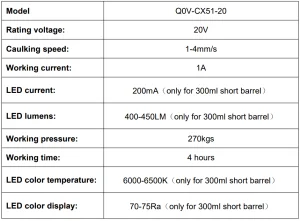
VEVOR Cordless Caulking Gun Technical Parameters
Functional Description
Applications
- You may use this tool for the following purposes:
- Sealing cracks to keep your home’s conditioned air inside while keeping unconditioned air outside increases your home’s energy efficiency.
- Filling holes and cracks before painting.
- Creating a moisture barrier around areas that could be damaged by water.
- Sealing cracks to keep insects from crawling inside your home.
- Applying adhesive.
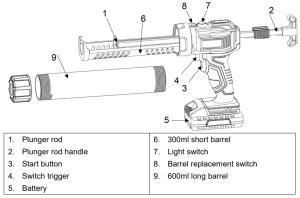
Product Details
Cordless Caulking Gun Operating Instructions
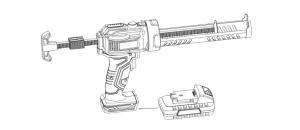
Installing the Battery
Push the battery to the bottom of the gun.
Installing and Replacing the Barrel
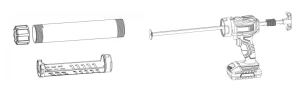
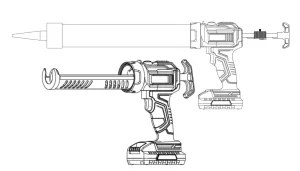
To install a 300ml cartridge barrel, just put the barrel into the bayonet at a 90 ° angle and rotate it back until a sound is heard; that is, the fixation is completed.
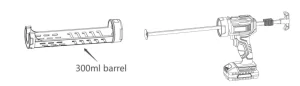
Also, you need to change the plunger rod’s length to fit the 300ml barrel. As shown in the following figure, slide the length control slider to the left until it is stuck in the position hole and cannot move forward.
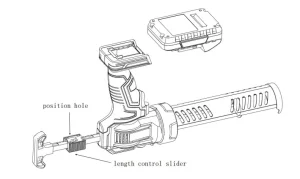
In this way, you will get a 300ml glue gun.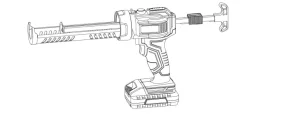
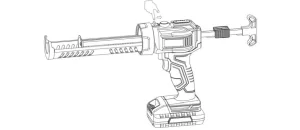
To remove the 300ml cartridge barrel, slightly pull the barrel replacement switch backwards, rotate the barrel by 90 ° and pull it out.
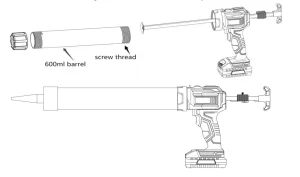
To install a 600ml cartridge barrel, rotate the barrel directly.
Starting/Stopping the Caulking Gun
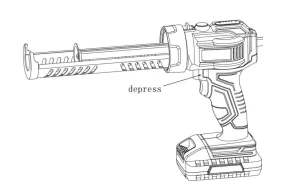
- To turn the caulk gun ON, depress the switch trigger.
- To turn the caulk gun OFF, release the switch trigger
Applying Caulk
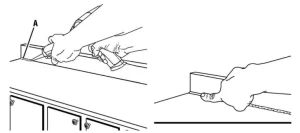
Remove any dust, dirt, or remnants of old caulking. Make sure the area to be caulked is clean and dry. Hold the gun at a slight angle.
If filling a crack, insert the spout into the crack if possible; otherwise, run the caulk gun along the surface. Squeeze the trigger, allowing the caulk to extrude from the tube tip.
If the caulk bead is too narrow, re-cut the nozzle to provide a larger opening. However, it is better to apply a thin bead and add a little more if necessary rather than apply too much and attempt to remove the excess.
If there is a blockage, you can release the switch trigger, and the plunger rod will automatically unlock and back off, check and make sure that:
- The nozzle tip is cut.
- Inner seal in the caulk tube is broken.
- Hardened material is removed from the nozzle.
- The caulking tube is not damaged or frozen.
- Plunger rod is free of caulk/adhesive materials.
If the motor continues to shut off, try another tube of material or take the tool to an authorized service center. Carefully move the caulk gun at an even pace along the gap to be filled as you continue to depress the switch trigger. Make sure the caulk comes in full contact with both application surfaces.
If necessary, use your finger to gently press the caulk into a corner or crack.
Cordless Caulking Gun Maintenance
When servicing, use only identical replacement parts. Using any other parts could create a hazard or cause product damage.
To avoid serious personal injury, always remove the batteries from the product when cleaning or performing any maintenance. Avoid using solvents when cleaning plastic parts.
Most plastics are susceptible to damage from various types of commercial solvents and may be damaged by their use.
Use clean clothes to remove dirt, dust, oil, grease, etc. Do not at any time let brake fluids, gasoline, petroleum-based products, penetrating oils, etc., come in contact with plastic parts. Chemicals can damage, weaken or destroy plastic, which may result in serious personal injury.
Recommended For Your Project
VEVOR Cordless Caulking Gun 10oz/300ml, 20V Manual


Reviews
There are no reviews yet.