
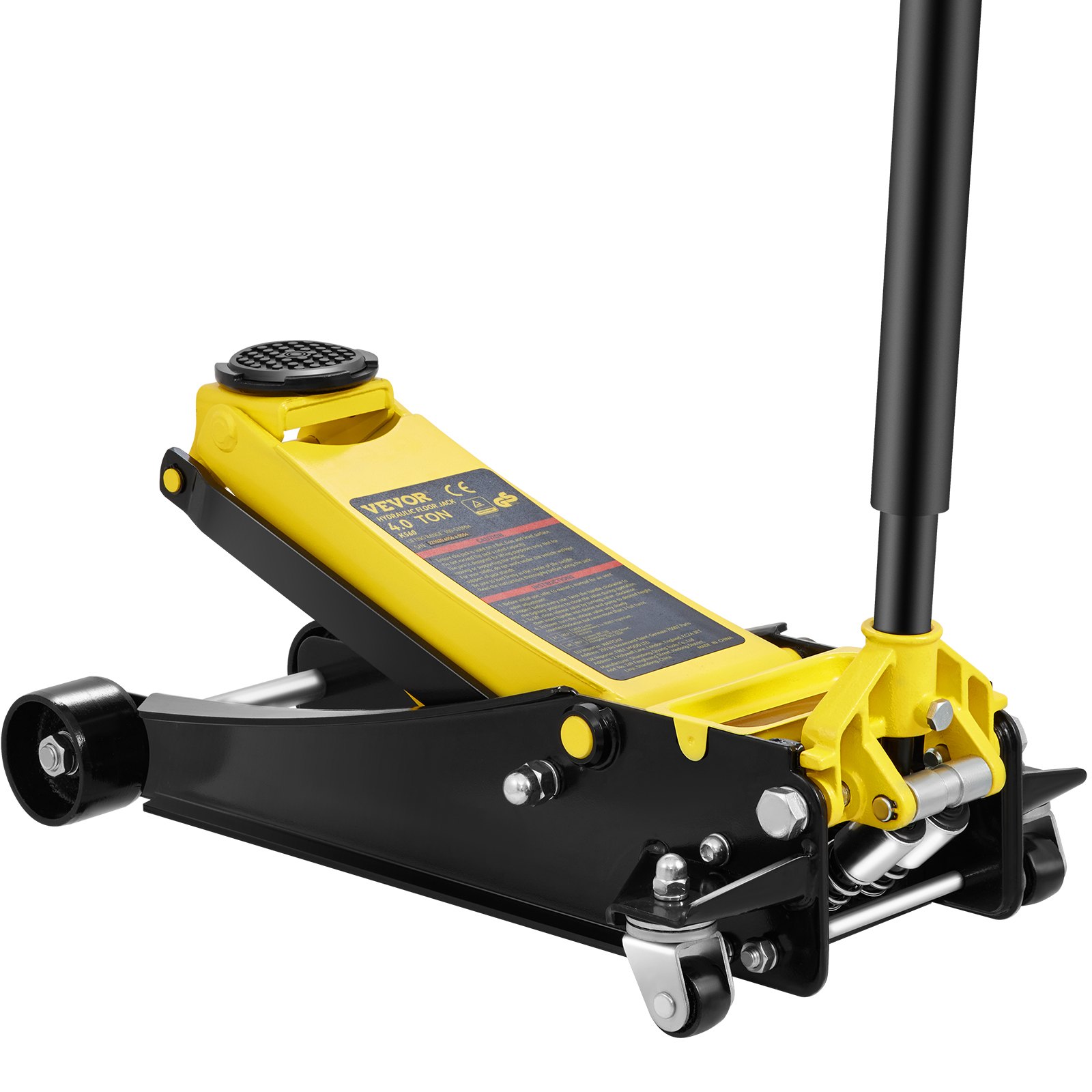
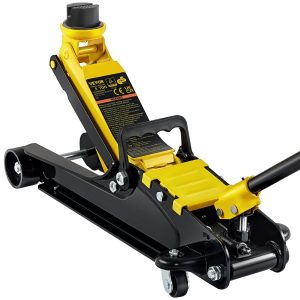
Unlock the full potential of your VEVOR Floor Jack with our comprehensive product manual download. This detailed guide covers every aspect of your 4-ton low-profile floor Jack, crafted from heavy-duty steel and equipped with a dual-piston quick-lift pump.
Whether you’re a seasoned professional or a DIY enthusiast, our manual ensures you can efficiently set up, troubleshoot, and optimize your floor jack. With a lifting range from 3.35″ to 19.69″, this racing floor jack is designed for maximum performance and reliability.
Our manual’s step-by-step instructions and clear diagrams make it incredibly user-friendly, allowing you to do the job right every time. Download now and take the first step towards mastering your VEVOR Floor Jack.
Safety Instructions
- WARNING: The jack must be used only on hard level surfaces and be free to roll during lifting and lowering. Do not get under a vehicle supported only by a trolley jack – use support stands.
- CAUTION: Carefully read instructions and procedures for safe operations.
Inspections
Before Each Use
Before using the garage jack, visually inspect it for abnormal conditions such as cracked welds, leaks, and damaged, loose, or missing parts.
After Each Use
The garage jack should be inspected immediately if the lift is believed to have been subjected to an abnormal load or shock. It is recommended that inspection be made by the manufacturer’s or supplier’s authorized repair facility.
Recommendations for Safe Usage of the Jack
- The jack should be used on a hard level surface and be free to roll during lifting and lowering.
- The vehicle’s unlifted wheels should be chocked.
- The load should be centrally located on the head cap.
- No person should remain in a vehicle that is being lifted.
- The jack should be used for lifting and lowering only; the raised vehicle should be supported on vehicle support stands.
- No person should get their body under a vehicle supported only by a hydraulic trolley jack.
- The vehicle manufacturer’s owner’s manual should be consulted before lifting the vehicle.
- Ensure the lift point is stable and properly centered on the head cap.
Caution Before Using
Due to shipment and/or handling, air can be trapped in the hydraulic system, interfering with the jack’s lifting. To release air from the hydraulic system:
- Open the release valve by turning the jack handle counterclockwise.
- Remove the oil filler plug from the cylinder.
- Rapidly pump the handle through several full strokes.
- Replace the oil filler plug in the cylinder.
Warning
- The unlifted wheels of the vehicle should be chocked.
- The load should be centrally located on the head cap.
- No person should remain in a vehicle that is being lifted.
- The vehicle manufacturer’s manual should be consulted before lifting the vehicle.
- The hydraulic trolley jack should be used for lifting and lowering only. It can not be used as a support tool.
Set Up – Before Use
WARNING: Read the ENTIRE IMPORTANT SAFETY INFORMATION section at the beginning of this manual, including all text under subheadings, before setting up or using this product.
Attaching the Handle
- Attach the Upper Handle to the Lower Handle.
- LoosentheSetScrewand insert the assembled Handle into the Handle Socket.
- Tighten the Set Screw.
Functions
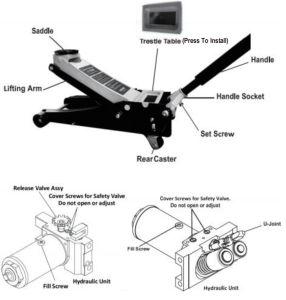
Floor Jack Operating Instructions
WARNING: Read the ENTIRE IMPORTANT SAFETY INFORMATION section at the beginning of this manual, including all text under subheadings, before setting up or using this product.
Bleeding
BEFORE EACH USE OR IF JACK’S PERFORMANCE DECREASES, check for excessive air and proper hydraulic fluid level in the Jack. If Jack appears not to be working correctly, it may be necessary to purge its hydraulic system of excessive air as follows:
- Loosen the Set Screw.
- Loosen the Fill Screw.
- Check fluid level and, if necessary, top off by adding Hydraulic Fluid.
- To close the valve, twist the Handle clockwise to the tightest position, then pump the Handle several times quickly.
- Replace Fill Screw.
IMPORTANT: After bleeding the floor jack, test it for proper operation before its actual use.
6. If, after bleeding, the Jack does not appear to be working correctly, do not use it until a qualified service technician repairs it.
Adding Hydraulic Fluid
- Remove the Fill Screw. Do not remove or loosen Safety Valve Cover Screws.
- Add high-grade hydraulic fluid (sold separately) slowly until the fluid reaches 1/4″ below the top of the Fill Port. Note: Do not touch the handle when adding hydraulic fluid.
- Replace Fill Screw.
Lifting
WARNING: Park vehicle on a flat, level, solid surface safely away from oncoming traffic. Turn off the vehicle’s engine. Place the vehicle’s transmission in “PARK” (if automatic) or in its lowest gear (if manual). Set the vehicle’s emergency brake. Then choke the wheels that are not being lifted.
- Slowly twist the Handle counterclockwise to lower the Jack. Once the Jack is fully lowered, twist the handle clockwise to the tightest position to close the Valve.
- Carefully position the Jack’s Saddle under the manufacturer’s recommended lifting point. (See vehicle manufacturer’s owner’s manual for location of frame lifting point.)
- Pump the Handle until the top of the Saddle has nearly reached the vehicle’s lifting point. Position the Saddle directly under the vehicle’s lifting point.
- To lift the vehicle, pump the Handle. Use smooth, full strokes.
- Select matching jack stands (sold separately) of appropriate capacity. Set the jack stands to the same height according to the manufacturer’s instructions, ensuring they lock securely into position.
- Position the jack stands’ saddles under the manufacturer’s recommended support points.
- WARNING! Ensure that the vehicle support points are fully seated in the saddles of both jack stands. Use a matched pair of jack stands per vehicle to support one end only.
- Slowly twist the Handle counterclockwise to lower the vehicle onto the jack stands’ saddles.
- Once the vehicle is fully seated on the jack stands, continue slowly lowering the Jack until it is completely lowered.
- Remove the Jack and store it safely out of the way.
Lowering
- Carefully remove all tools, parts, etc., from under the vehicle.
- Position the Jack’s Saddle under the lifting point. Turn the Handle clockwise firmly and raise the vehicle to clear the jack stands.
- Carefully remove the jack stands.
- Slowly turn the Handle counterclockwise to lower the vehicle onto the ground.
- Lower the Jack completely. Store the Jack indoors out of children’s reach.
Floor Jack Maintenance and Servicing
WARNING: Procedures not explicitly explained in this manual must be performed only by a qualified technician.
WARNING: TO PREVENT SERIOUS INJURY FROM TOOL FAILURE: Do not use damaged equipment. If abnormal noise or vibration occurs, correct the problem before further use.
Cleaning, Maintenance, and Lubrication
BEFORE EACH USE, inspect the general condition of the Jack. Check for:
- Loose hardware,
- Misalignment or binding of moving parts,
- Cracked or broken parts,
- Any condition that may affect its safe operation.
BEFORE EACH USE, thoroughly test the Jack for proper operation before its actual use. If Jack appears not to be working correctly, follow the Bleeding instructions.
AT LEAST ONCE EVERY THREE YEARS, change the hydraulic fluid:
- With the Jack fully lowered, remove the Fill Screw.
- Tip the Jack over to allow the old hydraulic fluid to drain completely. Dispose of the old hydraulic fluid per local regulations.
- With the Jack upright, fill the Hydraulic Unit with high-grade hydraulic fluid until thefluidis1/4″ below the top of the Fill Port.
- Turn the Handle counterclockwise to open the Release Valve.
- Pump the Handle up and down several times to purge air from the system.
- Recheck fluid level and refill as needed.
- Replace the Fill Screw.
AFTER EACH USE, wipe with a clean cloth. Store the Jack indoors out of children’s reach.
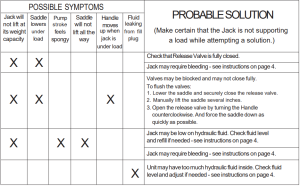
Troubleshooting
WARNING:
TO PREVENT SERIOUS INJURY:
Use caution when troubleshooting a malfunctioning jack. Stay well clear of the supported load. Completely resolve all problems before use. If the solutions presented in the Troubleshooting guide do not solve the problem, have a qualified technician inspect and repair the jack before use. After the jack is repaired, Test It Carefully Without a load by raising and lowering it fully, checking for proper operation, BEFORE RETURNING THE JACK TO OPERATION.
Do not use a damaged or malfunctioning Jack.
PLEASE READ THE FOLLOWING CAREFULLY
The manufacturer and/or distributor has provided the parts list and assembly diagram in this manual as a reference tool only. Neither the manufacturer nor the distributor makes any representation or warranty to the buyer that he or she is qualified to make any repairs to the product, or that he or she is qualified to replace any parts of the product.
The manufacturer and/or distributor expressly states that all repairs and parts replacements should be undertaken by certified and licensed technicians, not the buyer. The buyer assumes all risk and liability arising out of his or her repairs to the original product or
replacement parts or from the installation of replacement parts.
NOTE: Some parts are listed and shown for illustration purposes only, and are not available individually as replacement parts
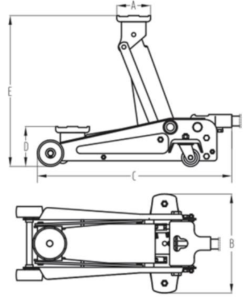
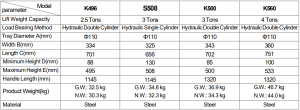
Floor Jack Technical Specifications
Recommended For Your Project
VEVOR Floor Jack, 4 Ton Low Profile Floor Jack Lifting Range 3.35"-19.69" Manual
Reviews
There are no reviews yet.