
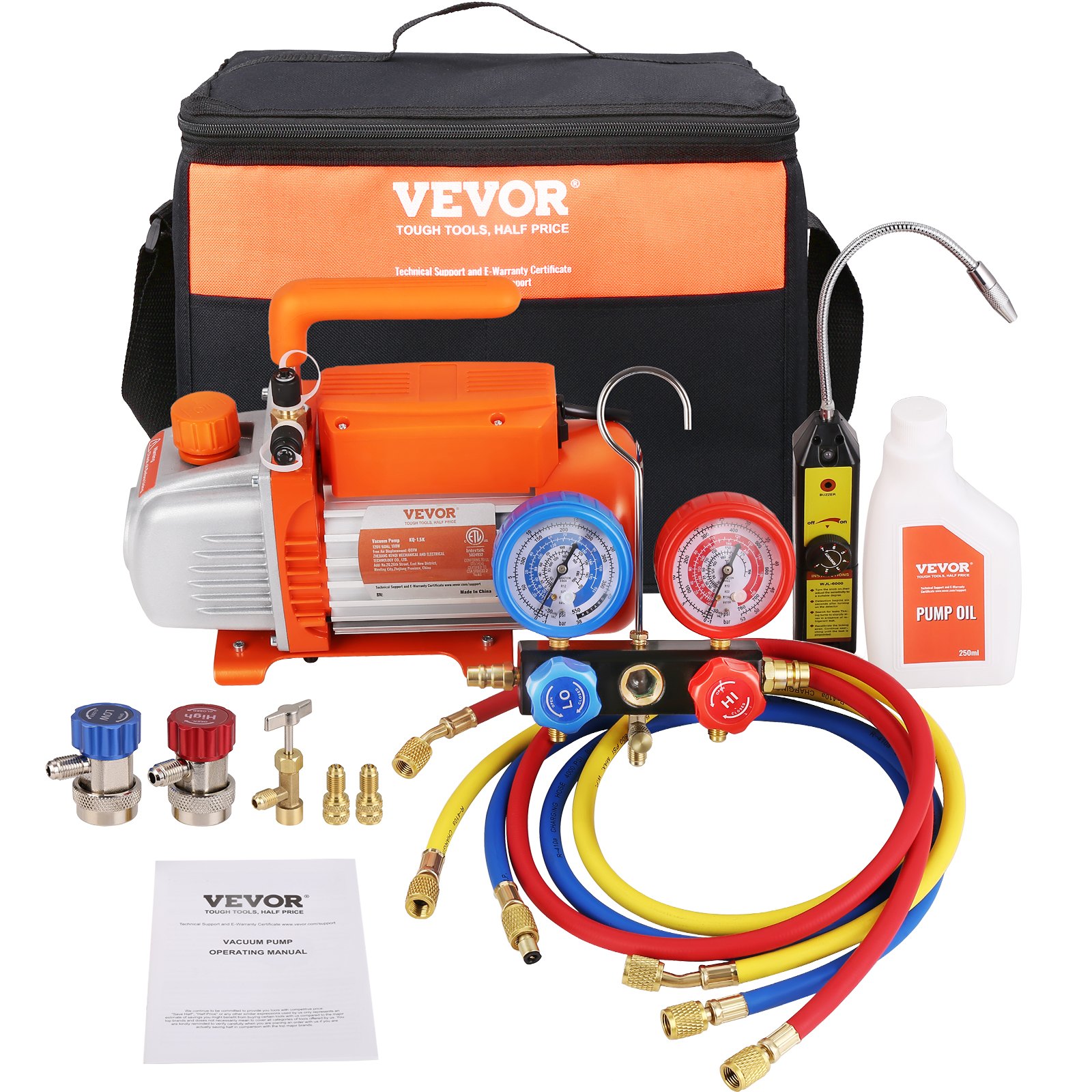
Unlock the full potential of your VEVOR 1/4 HP 4.5 CFM AC Vacuum Pump and Gauge Set with our comprehensive product manual. This detailed guide is essential for anyone looking to efficiently set up, troubleshoot, and optimize their Single Stage Rotary Vane HVAC Air Vacuum Pump A/C Refrigerant Kit Manifold Gauge Set.
With clear instructions and easy-to-follow diagrams, our manual covers everything from initial setup to advanced troubleshooting, ensuring you get the most out of your equipment. The manual includes detailed sections on using the three-colour hose carry bag and applying it to refrigerants like R134a and R410a. Download now to make your maintenance tasks smoother and more efficient, and ensure your vacuum pump operates at peak performance.
This manual is designed to be user-friendly and professional, providing valuable insights and tips to enhance your HVAC tasks.
PUMP MODEL: KQ-1K
Introduction
Welcome to the user manual for your VacuumPumpandGaugeKit, which is designed to assist you in maintaining your AC system. This tool kit includes a vacuum pump, vacuum gauge, hoses, and adapters, and is essential for vacuuming and recharging the refrigerant in your AC system.
This user manual has been developed to provide comprehensive guidance on using the toolkit. We will explain the key features and components of the kit and provide essential safety guidelines to help you avoid potential risks or damage during maintenance.
Please note that this is a basic user guide for AC maintenance scenarios. We recommend that you familiarize yourself with AC maintenance operations and have sufficient knowledge to avoid damage or injury.
By following the instructions and guidelines in this user manual, you can ensure your vacuum pump kit’s safe and effective use and maintain or repair your AC system to guarantee optimal performance.
Safety Precautions
Please note that while this user manual provides important warnings, precautions, and instructions for using the vacuum pump and gauge kit, it cannot anticipate every possible situation or condition that may arise during use.
The operator must exercise good judgment, common sense, and caution while handling the product. These factors cannot be built into the product but must be supplied by the operator.
Safety guidelines for handling your vacuum pump
To ensure this kit’s safe and proper use, it is essential to note that it is designed only for vacuuming air or small amounts of residual refrigerant. It should not be used to remove refrigerant directly from an AC system.
- If refrigerant recovery is required, a recovery machine is strongly recommended. Using a vacuum pump and recovery tank to recover refrigerant without a recovery machine should only be operated by a trained and certified AC technician.
- Electrical shock hazard: Do not touch the vacuum pump with your hands or while standing on a wet surface. Always use the vacuum pump in a dry environment and plug it into a properly grounded outlet.
- Fire hazard: Do not use the vacuum pump near flammable or combustible materials. Keep the pump away from sources of heat or sparks, such as flames, cigarettes, or electrical appliances.
- Explosion hazard: Do not use the vacuum pump with flammable, explosive, or poisonous gases. Always check the gas’s safety data sheet (SDS) before using it with the vacuum pump. Additionally, do not exceed the pump’s specified pressure range.
- Corrosion hazard: Do not use the vacuum pump with gases that can corrode metals or exert chemical charges. Check the gas’s compatibility with the pump’s materials and accessories. Always wear protective gloves and eyewear when handling corrosive materials.
- Never operate the pump without oil, as it can damage the pump and create potential hazards.
- The temperature of the pumped gas should not exceed 80 °C, and the environment temperature should be around 5°Cto 60°C. This will help prevent damage to the pump and ensure safe operation.
- When unplugging the pump, always pull the plug. Do not unplug the unit by pulling on the wire, as this can cause damage to the cord and create potential hazards.
- Do not use a damaged plug or outlet, which can cause an electrical shock or fire.
Safety guidelines for handling the gauge set
- Wear appropriate personal protective equipment (PPE), such as safety glasses and gloves, when using the gauge set. This is especially important when handling refrigerant, which can cause skin and eye irritation and can be harmful if inhaled.
- Ensure that the gauge set is connected correctly and secured before use. Loose connections can lead to leaks, which can cause the refrigerant to escape into the environment and create a hazardous situation.
- Always use the gauge set in a well-ventilated area. This is important to avoid the buildup of refrigerant vapours, which can displace oxygen and create a suffocation hazard. If you feel dizzy or lightheaded while using the gauge set, move to a well-ventilated area immediately.
- Do not exceed the maximum pressure rating of the gauges, set, and hoses. This information should be clearly labelled on the gauge or user manual. Exceeding the maximum pressure rating can cause the gauge to malfunction or even rupture, leading to potential hazards.
- Service hoses can not withstand high temperatures or severe mechanical stress. Keep them away from moving or hot engine parts. Service hoses can split or burst, causing injury.
- Never use the gauge set for purposes other than those specified in the manual. Using the gauge set for other applications can damage the equipment, potentially injure users, or create other hazards.
Getting Started
Introducing the vacuum pump and gauge set series.
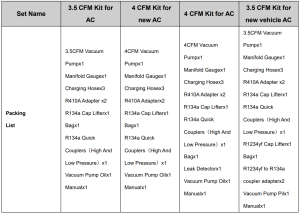
The product series includes 4 SKUS, each vacuum pump and gauge set designed for different user scenarios and intended purposes based on the pump’s and accessories’ explosion-proof performance.
- SKU1: 3.5 CFM AC Kit is designed to maintain most home/vehicle AC or refrigerant systems using A1 refrigerant. However, it should not be used for maintaining AC systems with R32, R1234yf, or other A2L or above-level refrigerants.
- SKU2: The 4 CFM Kit for new AC is designed for maintaining most ACor refrigerant systems. Due to its sparkless design, it can also be used to maintain AC systems with R32, R1234yf (quick connect adapter not included), or other A2L level refrigerants, as well as all A1 level refrigerant systems.
- SKU3: 4 CFM Kit for AC with leak detector is designed for maintaining most AC or refrigerant systems using A1 refrigerant and includes a leak detector to help the operator find the leak point of the system.
- SKU4: 3.5 CFM Kit for new vehicle AC is designed to maintain most home/vehicle AC or refrigerant systems using A1 refrigerant and systems using A2L refrigerant due to its sparkless design. It comes with R134a quick connectors and R1234yf adapters to make it applicable to old and newly manufactured vehicles.
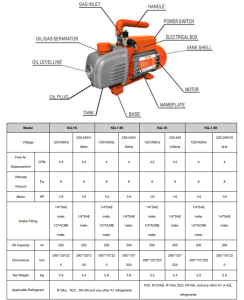
Explanation of the vacuum pump’s components and specifications
Vacuum Pump Manifold Gauge Set Package Contents
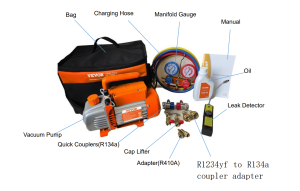
Package Content List
Operation Guide for Pulling Vacuum to the AC System
- Pump preparation: Insert the pump’s plug and fill it with oil, making sure not to exceed the maximum level.
- Locate the AC system’s high—and low-pressure service ports. These ports are usually situated near the compressor on the lines.
- Connect the gauge set hoses to the AC system’s high- and low-pressure service ports. The high-pressure side is typically marked with red, and the low-pressure side with blue. Choose the appropriate adapter for the refrigerant system and fitting.
- Shut the valves on the gauge set and attach the hoses from the vacuum pump to the gauge set. Switch on the vacuum pump and allow it to run for a few minutes to ensure it functions correctly.
- Open the valves on the gauge set and allow the vacuum pump to operate until the system pressure reaches approximately 30 inch-Hg and stabilises. Continue pumping for at least 30 minutes to remove all the remaining air.
- Shut the valves on the gauge and switch off the vacuum pump. Allow the system to rest for approximately 30 minutes to confirm no leaks. Any increase in the pressure displayed on the gauge set implies the presence of a leak.
- Once you are convinced there are no leaks and have attained the desired vacuum level, you can charge the refrigerant or close the valve for future use.
Maintenance of the AC Vacuum pump
Proper maintenance of the vacuum pump is essential to ensure its optimal performance. Here are some maintenance guidelines:
- Keep the pump clean and free from foreign matter.
- Keep the oil filled to the oil level, and never let the pump run without oil.
- Keep the oil clean. If the oil becomes dirty, muddy, or water or other volatile substances get in, it will affect the pump’s performance, and the oil should be replaced. To replace the oil, start the pump and run it for about 30 minutes to thin it. Then stop the pump and drain the oil from the oil drain plug. Open the gas inlet and run the pump for 1-2 minutes while adding a small quantity of clean oil to the gas inlet. This is to replace the residual oil from the inside of the pump. After ensuring the pump is clean, put the drain plug back in and fill the clean pump oil from the gas inlet to the oil level.
- When not in use for long periods, cover the oil cap and exhaust cap (if applicable) and store the pump in a dry place.
- Repair of the pump should only be done by a qualified service technician.
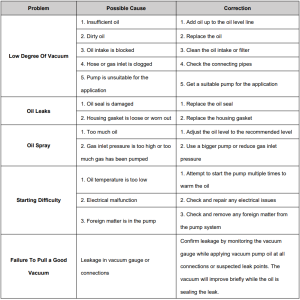
AC Vacuum Pump Troubleshooting Guide
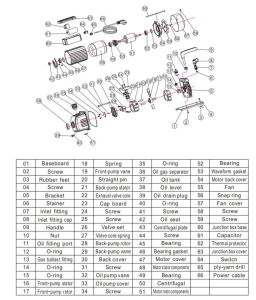
Exploded Diagram of the Pump
Recommended For Your Project
VEVOR 1/4 HP 4.5 CFM AC Vacuum Pump and Gauge Set Applicable to R134a, R410a Manual

Reviews
There are no reviews yet.