

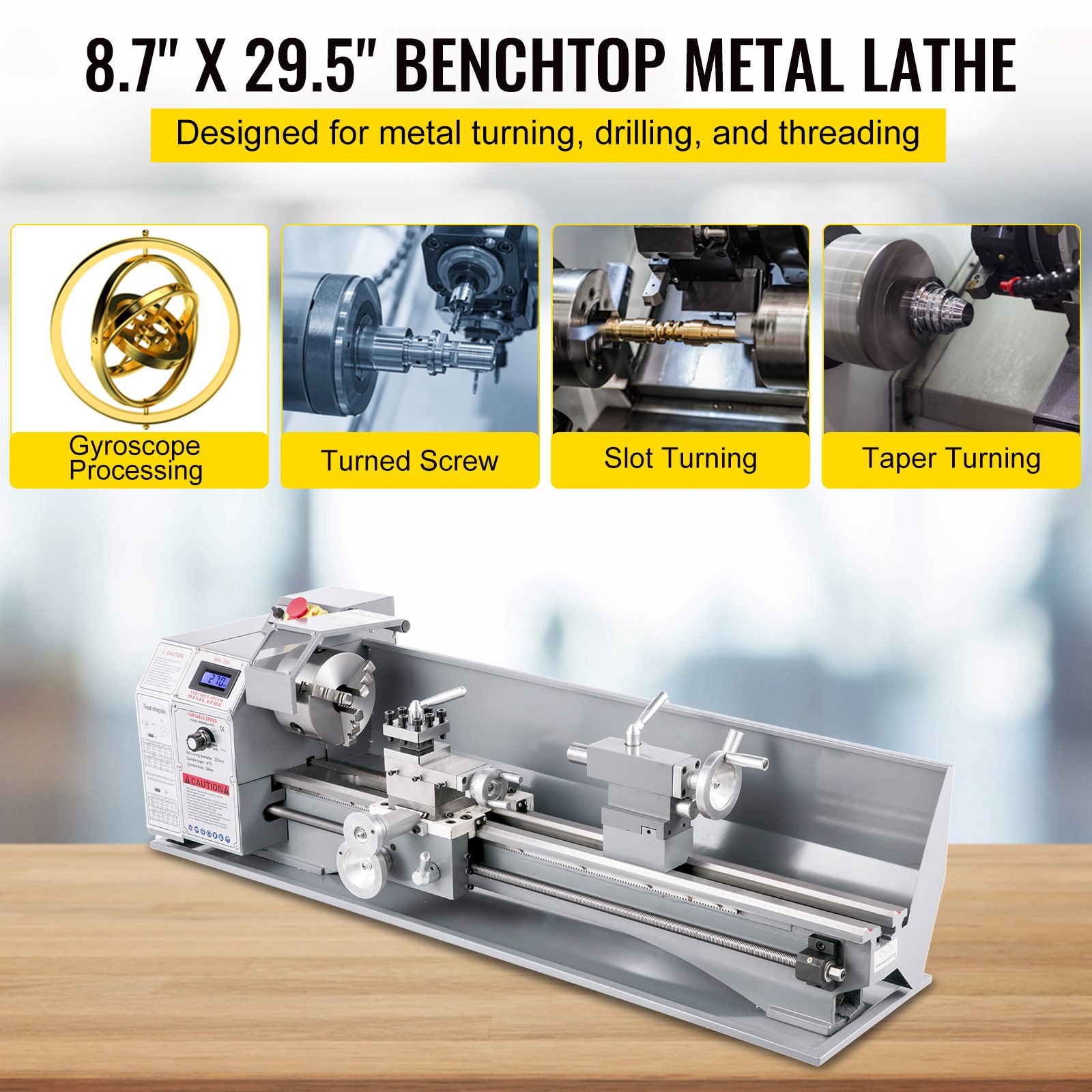
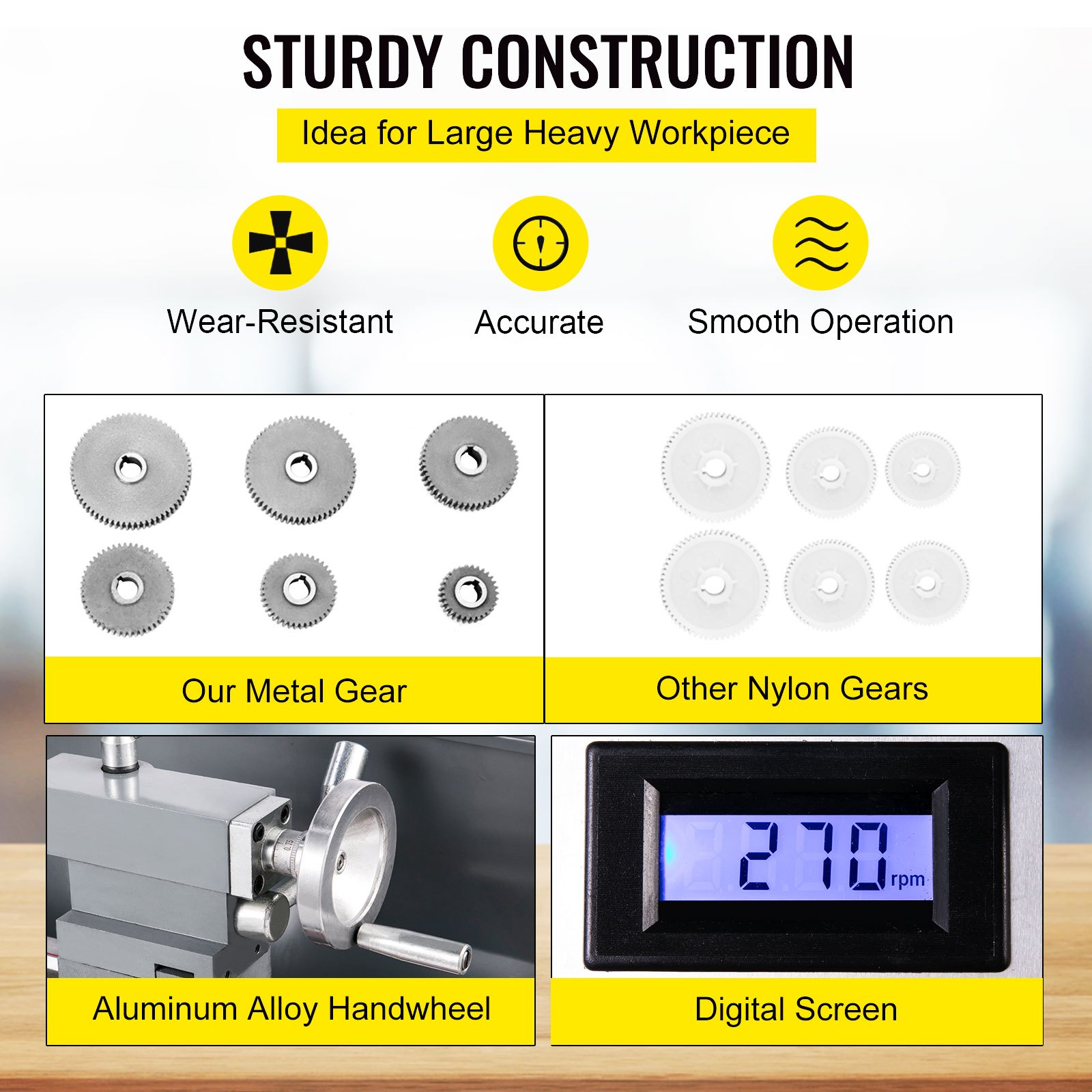
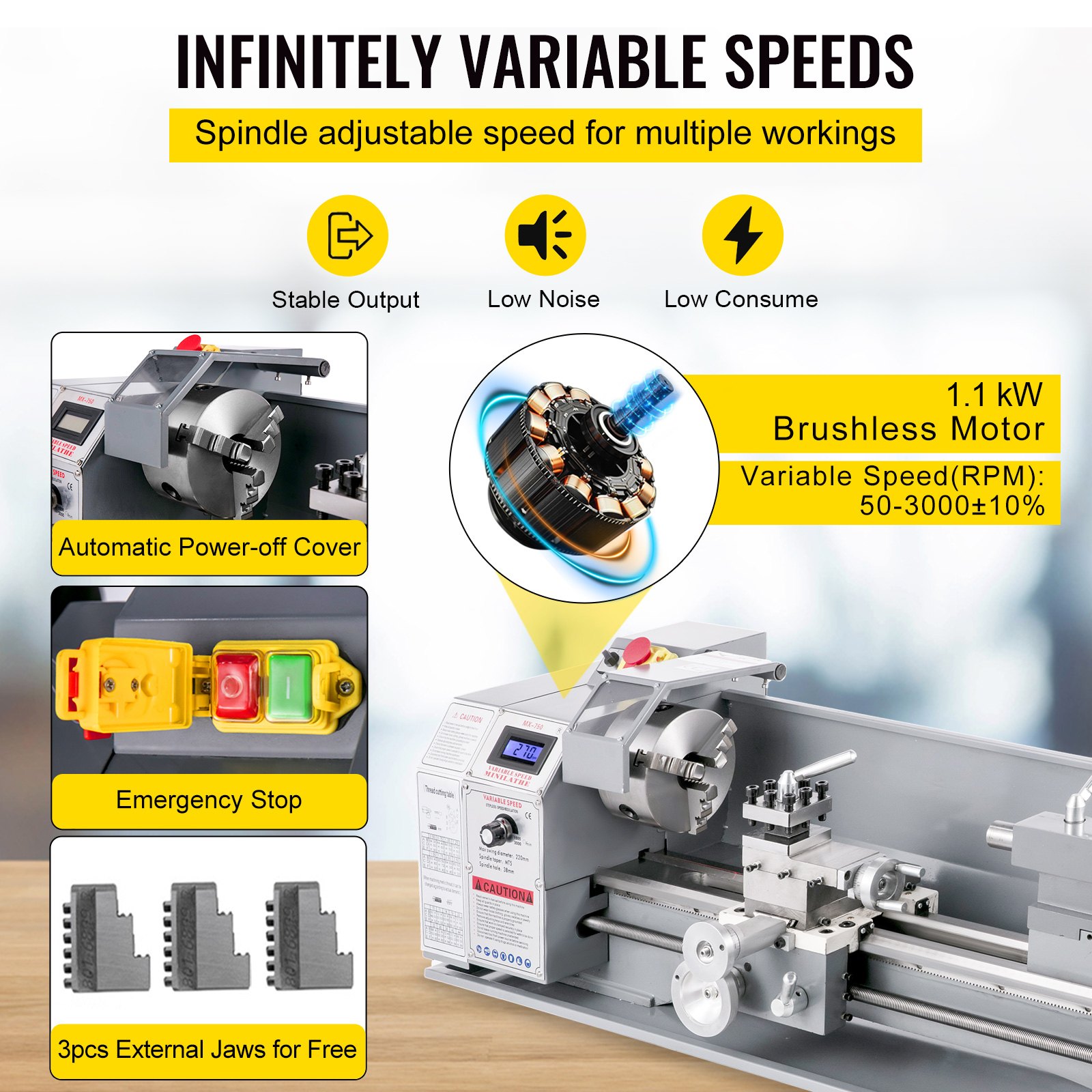
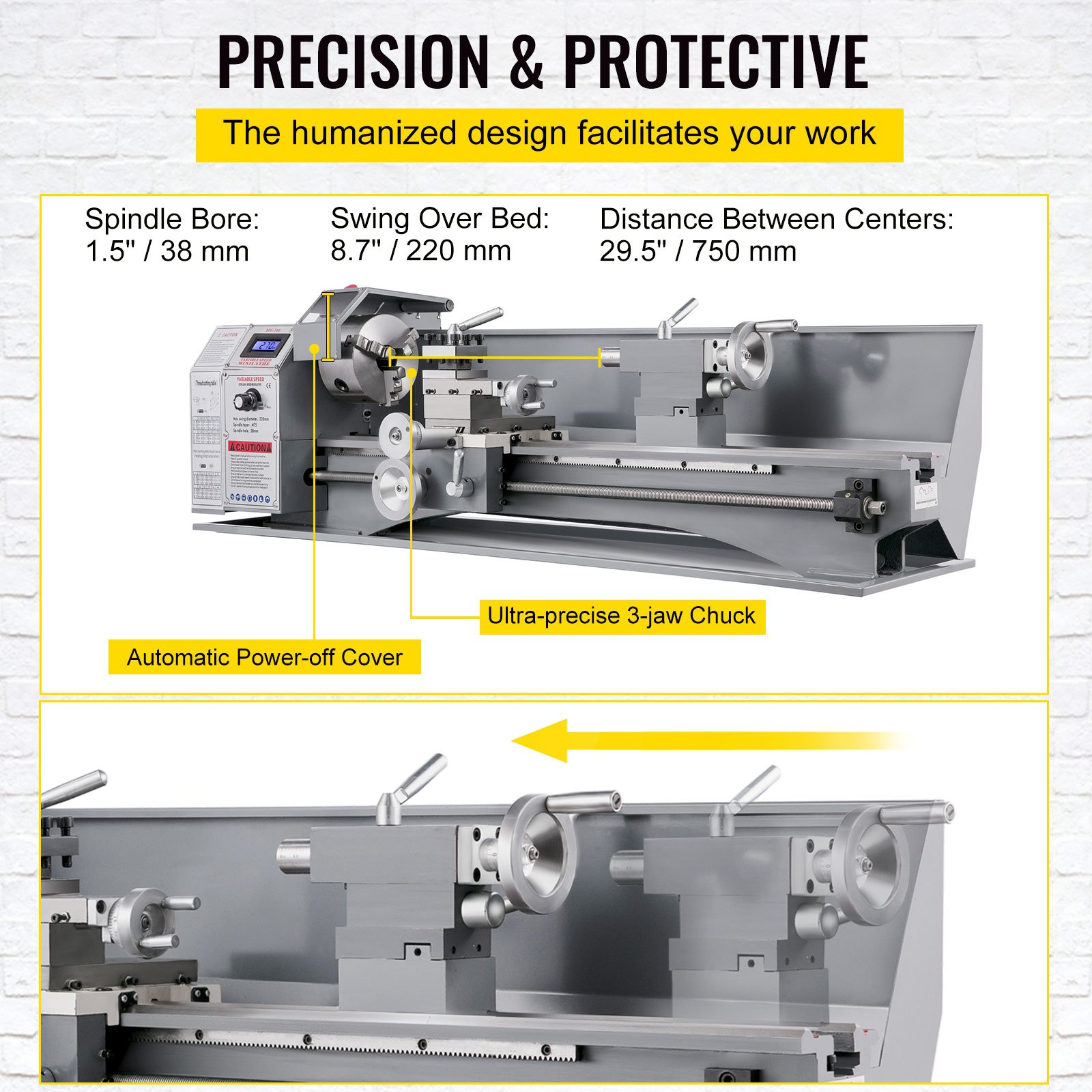
With our comprehensive product manual, unlock the full potential of your VEVOR Metal Lathe 8.7 x 29.5 Inch/220 x 750MM Mini Metal Lathe 1100W Infinitely Variable Speed Mini Lathe Machine.
This detailed guide is essential for both beginners and experienced users. It provides step-by-step instructions for setup, troubleshooting, and optimization. The manual covers everything from counter face turning to drilling, ensuring you can easily make precise adjustments.
Each section is simple to navigate, with clear illustrations and a user-friendly layout. Downloading our manual ensures you have all the information you need right at your fingertips, making your metalworking experience smoother and more efficient.
VEVOR Metal Lathe User Manual
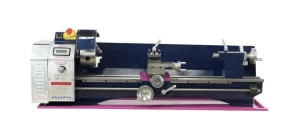
Keep, Read, and Understand the Operation Manual and Safety Information Before Operating!
NOTE
The information contained in this handbook is intended as a guide to the operation of these machines and does not form part of any contract. The data it contains has been obtained from the machine manufacturer and from other sources. Whilst every effort has been made to ensure the accuracy of these transcriptions, it would be impracticable to verify every item.
Furthermore, the development of the machine may mean that the equipment supplied may differ in detail from the descriptions herein. Therefore, the user’s responsibility lies with himself to satisfy himself that the equipment or process described is suitable for the intended purpose.
LIMITED WARRANTY
We make every effort to ensure that its products meet high quality and durability standards and warrants to the original retail consumer/purchaser of our products that each product will be free from defects in materials and workmanship as follows: ONE YEAR LIMITED WARRANTY ON ALL PRODUCTS UNLESS SPECIFIED OTHERWISE.
This Warranty does not apply to defects due directly or indirectly to misuse, abuse, negligence, or accidents, normal wear-and-tear, repair or alterations outside our facilities, or to a lack of maintenance.
We shall in no event be liable for death, injuries to persons or property, or for incidental, contingent, special, or consequential damages arising from the use of our products.
The product or part must be returned to us for examination, postage prepaid, to take advantage of this warranty. Proof of purchase date and an explanation of the complaint must accompany the merchandise. If our inspection discloses a defect, we will either repair or replace the product, or refund the purchase price if we cannot readily and quickly provide a repair or replacement, if you are willing to accept a refund. We will return a repaired product or a replacement at our expense. Still, if it is determined that there is no defect, or that the defect resulted from causes not within the scope of Herman’s warranty, then the user must bear the cost of storing and returning the product.
The manufacturers reserve the right to change specifications at any time as they strive to achieve better quality equipment.
Copyright: The copyright of this instruction book is our property and may not be reproduced or copied without our prior consent.
WARNING!
Read and understand the entire instruction manual before setting up or operating this machine!
-
- This machine is designed and intended for use by properly trained and experienced personnel only. If you are unfamiliar with the proper safe use of lathes, do not use this machine until you have obtained proper training and knowledge.
- Keep guards in place. Safety guards must be kept in place and in working order.
- Remove adjusting keys and wrenches. Before turning on the machine, check for any adjusting wrenches that have been removed from the tool.
- To reduce the risk of unintentional starting, ensure the switch is OFF before plugging in the tool.
- Do not force the tool. Always use a tool at the rate for which it was designed.
- Use the right tool. Do not force a tool or attachment to do a job it was not designed for.
- Maintain tools with care. Keep tools sharp and clean for the best and safest performance. Follow instructions for lubrication and changing accessories.
- Always disconnect the machine from the power source before adjusting or servicing.
- Check for damaged parts. Check for alignment of moving parts, breakage of parts, mounting, and any other condition that may affect the tool’s operation. A guard or any part that is damaged should be repaired or replaced.
- Turn the power off. Never leave a machine unattended, and do not leave it until it comes to a complete stop.
- Keep the work area clean. Cluttered areas and benches invite accidents.
- Do not use in a dangerous environment. Do not use power tools in damp locations or expose them to rain. Keep the work area well-lit.
- Keep children and visitors away. All visitors should keep a safe distance from the work area.
- Make the workshop child-proof. Use padlocks, master switches, and remove starter keys.
- Wear proper apparel. Loose clothing, gloves, neckties, rings, bracelets, or other jewelry may get caught in moving parts. Non-slip footwear is recommended. Wear a protective hair covering to contain long hair. Do not wear any gloves.
- Always use safety glasses. Every day glasses only have impact-resistant lenses; they are not safety glasses.
- Do not overreach. Keep proper footing and balance at all times.
- Do not put your hands near the cutter while the machine is operating.
- Do not perform any set-up work while the machine is operating.
- Read and understand all warnings posted on the machine.
- This manual is intended to familiarize you with the technical aspects of this lathe. It is not, nor was it intended to be, a training manual.
- Failure to comply with all of these warnings may result in serious injury.
- Some dust created by power sanding, sawing, grinding, drilling, and other construction activities contains chemicals known to cause cancer, birth defects, or other reproductive harm. Some examples of these chemicals are lead from lead-based paint and crystalline silica from bricks, cement, and other masonry products.
- Your risk from those exposures varies depending on how often you do this type of work. To reduce exposure to these chemicals, work in a well-ventilated area and wear approved safety equipment, such as dust masks designed to filter out microscopic particles.
VEVOR METAL LATHE SPECIFICATIONS

The specifications in this manual are given as general information and are not binding. We reserve the right to make changes or alterations to parts, fittings, and accessory equipment deemed necessary for any reason whatsoever at any time and without prior notice.
TOOLBOX CONTENTS (Fig. 1)
- 1 Dead Center MT2
- 1 Oil Gun
- 1 Cross Screwdriver
- 1 Flat Screwdriver
- 5 Hex Socket Wrench 3.4.5.6.8mm
- 3 Double End Head Wrench 8-10mm, 12-14mm, 13-16mm
- 6 Change Gears 307,407,507,527,607,66T
The key for the 4-jaw chuck, the center rack, and the follow tool carrier are selected parts.
UNCRATING AND CLEAN-UP
- Finish removing the wooden crate from around the lathe.
- Check all the accessories of the machine tool according to the packing list.
- Unbolt the lathe from the shipping crate bottom.
- Choose a location for the lathe that is dry, has good lighting, and has enough room to service the lathe on all four sides.
- With adequate lifting equipment, slowly raise the lathe off the bottom of the shipping crate. Do not lift by the spindle. Make sure the lathe is balanced before moving to a sturdy bench or stand.
- The lathe’s location must be absolutely flat and level to avoid twisting the bed. Bolt the lathe to the stand (if used). If using a bench, use a through bolt for best performance.
- Clean all rust-protected surfaces using a mild commercial solvent, kerosene, or diesel fuel. Do not use paint thinner, gasoline, or lacquer thinner; these will damage painted surfaces. Cover all cleaned surfaces with a light film of 20W machine oil.
- Remove the end gear cover. Clean all components of the end gear, assembly and coat all gears with heavy, non-slinging grease.
FOUNDATION DRAWING
GENERAL DESCRIPTION
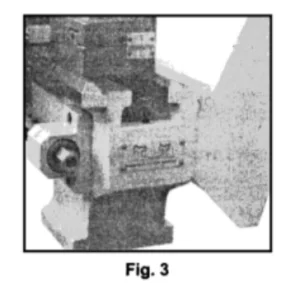
Lathe Bed (Fig. 3)
The lathe bed is made of high-grade iron. Combining high cheeks with strong cross ribs produces a bed of low vibration and rigidity. It integrates the headstock and drive unit to attach the carriage and leadscrew. The two precision-ground V-sideways, reinforced by heat hardening and grinding, are the accurate guides for the carriage and tailstock. The main motor is mounted to the rear of the left side of the bed.
Headstock (Fig. 4)
The headstock is made of high-grade, low-vibration cast iron and is bolted to the bed with four screws. It houses the main spindle with two precision taper roller bearings and the drive unit.
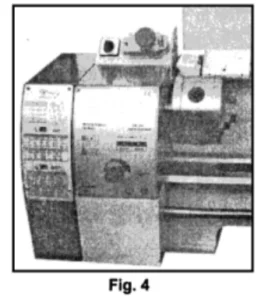
The main spindle transmits the torque during the turning process. It also holds the workpieces and clamping devices (e.g., a 3-jaw chuck).
Carriage (Fig. 5)
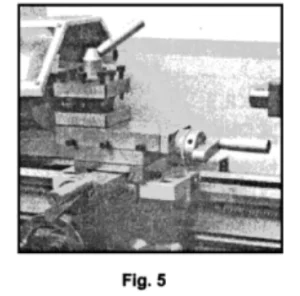
The carriage is made from high-quality cast iron. The slide parts are smoothly ground and fit the V on the bed without play. The lower sliding parts can be easily and simply adjusted. The cross slide is mounted on the carriage and moves on a dovetailed slide. The gibs allow adjustment of the play in the cross slide.
Move the cross slide with its conveniently positioned handwheel. There is a graduated collar on the handwheel.
A four-way tool post is fitted on the top slide and allows four tools to be clamped. Loosen the center clamp handle to rotate any of the four tools into position.
Apron (Fig. 6)
The apron is mounted on the bed. It houses the half nut with an engaging lever for activating the automatic feed. The half nut gib can be adjusted from the outside.
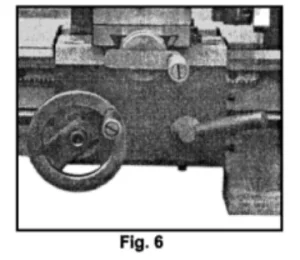
A rack mounted on the bed and a pinion operated by a handwheel on the carriage allow the apron to travel quickly.
Leadscrew
The leadscrew (A, Fig.7) is mounted on the front of the machine bed. It is connected to the gearbox at the left for automatic feed and is supported by bearings on both ends.
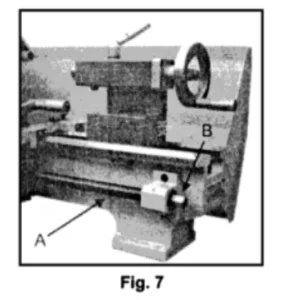
The hex nut (B, Fig.7) on the right end is designed to take up play on the leadscrew.
Tailstock (Fig. 8)
The tailstock slides on a V-way and can be clamped anywhere. It has a heavy-duty spindle with a Morse taper No. 2 socket and a graduated scale.
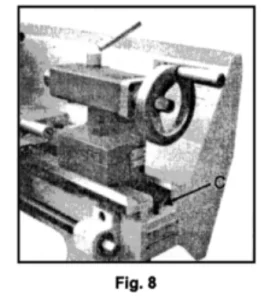
A clamping lever allows the spindle to be clamped at any location. A handwheel moves the spindle at the end of the tailstock.
NOTE:
Fit the securing screw (C, Fig. 8) at the end of the lathe to prevent the tailstock from falling off the lathe bed.
CONTROLS
Emergency Button ON/OFF Switch (D, Fig. 9)
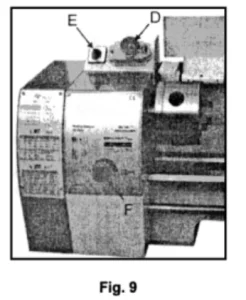
The machine is switched on and off with the ON/OFF button. Press to stop all machine functions. To restart, lift the cover and press the ON button.
Change-over Switch (E, Fig. 9)
After the machine is switched on, turn the switch to the “F” position for counter-clockwise spindle rotation (forward) or to the “R” position for clockwise spindle rotation (reverse).
The “0” position is OFF, and the spindle remains idle.
Variable Speed Control Switch (F, Fig. 9)
Turn the switch clockwise to increase the spindle speed, or turn the switch counter-clockwise to decrease it. The possible speed range is dependent on the position of the drive belt.
Carriage Lock
Tighten the hex socket cap screw (A, Fig.10) clockwise to lock. Turn counterclockwise and loosen to unlock.
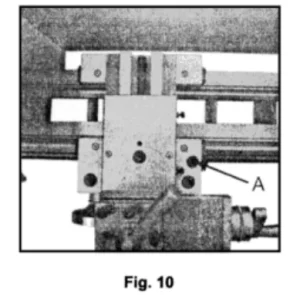
Caution: carriage lock screw must be unlocked before engaging automatic feeds, or damage to the lathe may occur.
Longitudinal Traverse Handwheel (B, Fig. 11)
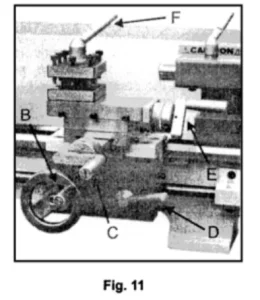
Rotate the hand wheel clockwise to move the apron assembly toward the tailstock (right), or counter-clockwise to move it toward the headstock (left).
Cross Traverse Lever (C, Fig. 11)
Clockwise rotation moves the cross slide toward the rear of the machine.
Half Nut Engage Lever (D, Fig. 11)
Move the lever down to engage. Move the lever up to disengage.
Compound Rest Traverse Lever (E, Fig. 11)
Rotate clockwise or counterclockwise to move or position.
Tool Post Clamping Lever (F, Fig. 11)
Rotate counter-clockwise to loosen and clockwise to tighten. Rotate the tool post when the lever is unlocked.
Tailstock Clamping Screw (G, Fig. 12)
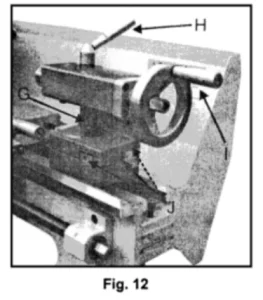
Turn the hex nut clockwise to lock and counterclockwise to unlock.
Tailstock Quill Clamping Lever (H, Fig. 12)
Rotate the lever clockwise to lock the spindle and counter-clockwise to unlock.
Tailstock Quill Traverse Handwheel (I, Fig. 12)
Rotate clockwise to advance the quill. Rotate counterclockwise to retract the quill.
Tailstock Off-Set Adjustment (J. Fig. 12)
Three sets of screws located on the tailstock base offset the tailstock for cutting tapers. Loosen the lock screw on the tailstock end. Loosen one side set screw while tightening the other until the amount of offset is indicated on the scale. Tighten the lock screw.
VEVOR METAL LATHE OPERATION
Replacement of Chuck
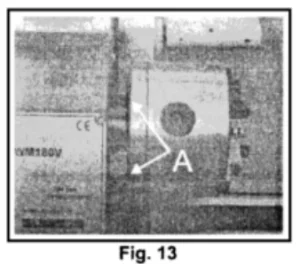
The head spindle holding fixture is cylindrical. Loosen three set screws and nuts (A, Fig.13, only two are shown) on the lathe chuck flange to remove the chuck. Position the new chuck and fix it using the same set of screws and nuts.
Tool Set-Up
Clamp the turning tool into the tool holder.
The tool must be clamped firmly. When turning, the tool tends to bend under the cutting force generated during the chip formation. For best results, the tool overhang should be kept to a minimum of 3/8″ or less.
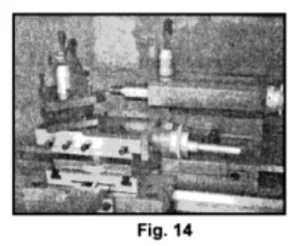
The cutting angle is correct when the cutting edge is in line with the center axis of the workpiece. The proper height of the tool can be achieved by comparing the tool point with the point of the center mounted in the tailstock. Use steel spacer shims under the tool to get the required height if necessary. (Fig. 14)
Change Speed
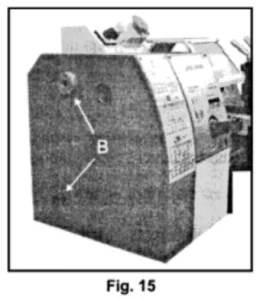
- Unscrew the two fastening screws. (B, Fig.15) and remove the protective cover.
- Adjust the V-belt (C, Fig.16)to the corresponding position.
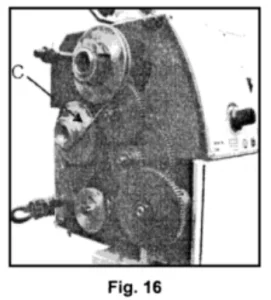
- Tighten the tension pulley and fasten the nut again.
Manual Turning
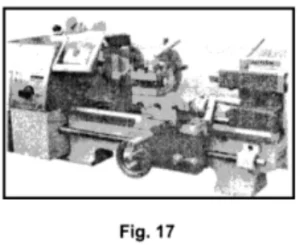
Apron travel, cross travel, and top slide handwheel can be operated for longitudinal or cross feeding. (Fig.17)
Longitudinal Turning with Auto-Feed
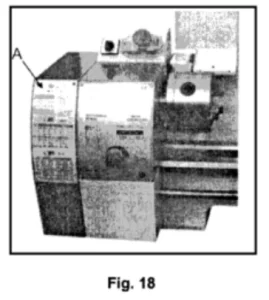
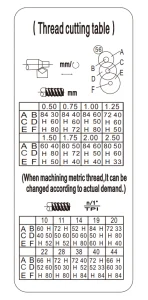
Select the feed speed or thread pitch using the table (A, Fig.18) on the lathe. Adjust the change gear if the required feed or thread pitch cannot be obtained with the installed gear set.
Change Gears Replacement
- Disconnect the machine from the power source.
- Unscrew the two fastening screws and remove the protective cover.
- Loosen the locking screw (B, Fig.19) on the quadrant.
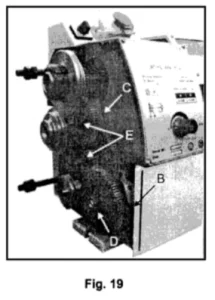
- Swing the quadrant (C, Fig.19) to the right.
- Unscrew the nut (D, Fig.20) from the leadscrew or the nuts (E, Fig.19) from the quadrant bolts in order to remove the change gears from the front.
- Install the gear couples according to the thread and feed table (Fig.20) and screw the gearwheels onto the quadrant again.
- Swing the quadrant to the left until the gearwheels have engaged again.
- Readjust gear backlash by inserting a standard sheet of paper as an adjusting or distance aid between the gearwheels.
- Immobilize the quadrant with the locking screw.
- Install the protective cover of the headstock and reconnect the machine to the power supply.
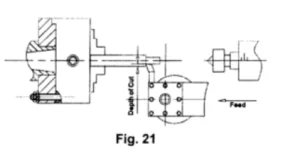
Straight Turning (Fig. 21)
In the straight turning operation, the tool feeds parallel to the workpiece’s axis of rotation. The feed can be manually turned on the handwheel on the lathe saddle or the top slide or activated automatically. The crossfeed for the depth of cut is achieved using the cross slide.
Facing and Recesses (Fig. 22)
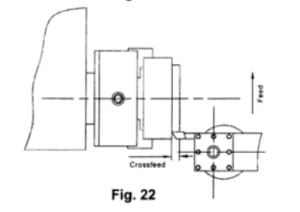
In the facing operation, the tool feeds perpendicular to the workpiece’s axis of rotation. The feed is made manually with the cross slide handwheel. The crossfeed for cut depth is made with the top slide or lathe saddle.
Turning Between Centers (Fig. 23)
To turn between centers, the chuck must be removed from the spindle. Fit the M.T.3 center into the spindle nose and the M.T. 2 center into the tailstock. Mount the workpiece fitted with the driver dog between the centers. The driver is driven by a catch or face plate.
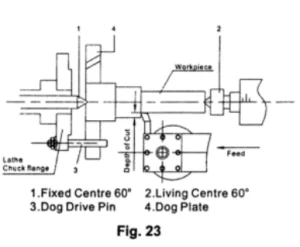
Note: Always use a small amount of grease on the tailstock center to prevent the center tip from overheating.
Taper Turning Using Tailstock Off-Set
Offsetting the tailstock can turn work to a side angle of 5. The angle depends on the length of the workpiece.
To offset the tailstock, loosen the locking screw (A, Fig. 24). Unscrew the set screw (B, Fig.24) on the right end of the tailstock. Loosen the front adjusting screw( C, Fig.24) and take up the same amount by tightening the rear adjusting screw (D, Fig 24) until the desired taper has been reached.
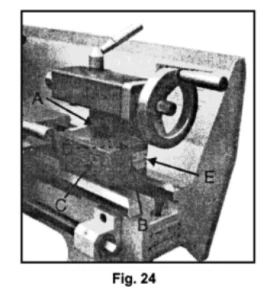
The desired cross-adjustment can be read off the scale. (E, Fig.24). First, retighten the set screw (B, Fig.24) and then the two (front and rear) adjusting screw to lock the tailstock in position. Retighten the locking screw (A, Fig.24) of the tailstock. The workpiece must be held between two centers and driven by a face plate and driver dog.
After taper turning, the tailstock should be returned to its original position according to the zero position on the scale of the tailstock. (E, Fig.24)
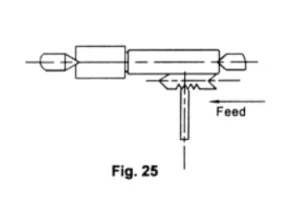
Thread Cutting
Set the machine to the desired thread pitch (according to the threading chart, Fig.20). Start the machine and engage the half nut. The tool will cut the initial threading pass when it reaches the part.
When the tool reaches the end of the cut, stop the machine by turning the motor off and backing the tool out of the part so that it clears the thread. Do not disengage the half-nut lever.
Reverse the motor direction to allow the cutting tool to traverse back to the starting point. Repeat these steps until you have obtained the desired results.
NOTES
Example: Male Thread
- The workpiece diameter must have been turned to the diameter of the desired thread.
- The workpiece requires a chamfer at the beginning of the thread and an undercut at the thread runout.
- The speed must be as low as possible.
- The change gears must have been installed according to the required pitch.
- The thread cutting tool must be exactly the same shape as the thread, absolutely rectangular, and clamped to coincide with the turning center.
- The thread is produced in various cutting steps, so the cutting tool must be completely removed from the thread (with the cross slide) at the end of each cutting step.
- The tool is withdrawn with the leadscrew nut engaged by inverting the change-over switch.
- Stop the machine and feed the thread cutting tool in low cut depths using the cross slide.
- Before each passage, place the top slide approximately 0.2 to 0.3mm alternately to cut the thread free to the left and right. This way, the thread cutting tools cut only on one thread flank with each passage. Keep cutting the thread free until you have almost reached the full depth of the thread.
VEVOR Metal Lathe Accessories
Three-Jaw Universal Lathe Chuck
This universal chuck may clamp round, triangular, square, hexagonal, octagonal, and twelve-sided stock. (Fig.26)
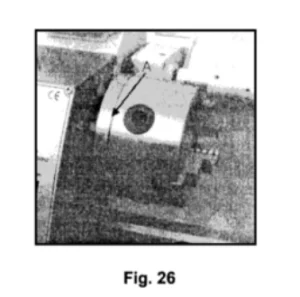
Note: New lathes have very tight-fitting jaws. This is necessary to ensure accurate clamping and long service life. With repeated opening and closing, the jaws adjust automatically, and their operation becomes progressively smoother.
Note:
The factory mounted the original 3-jaw chuck on the lathe in the best way to guarantee holding accuracy: with two “0” marks (A, Fig.26) on the chuck and chuck flange.
There are two types of jaws: Internal and external jaws. Please note that the number of jaws fits the number inside the chuck’s groove. Do not mix them. When you mount them, please mount them in ascending order: 1-2-3. When you take them out, take them out in descending order: 3-2-1, one by one. After finishing this procedure, rotate the jaws to the smallest diameter and check that the three jaws fit well.
Four-Jaw Independent Lathe Chuck
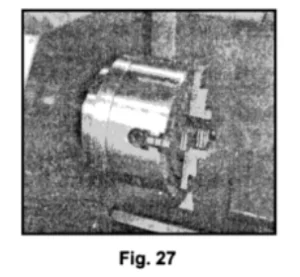
This special chuck has four independently adjustable chuck jaws. These permit the holding of asymmetrical pieces and enable the accurate set-up of cylindrical pieces. (Fig.27)
Drill Chuck (Optional)
Use the drill chuck to hold centering drills and twist drills in the tailstock. (B, Fig.28)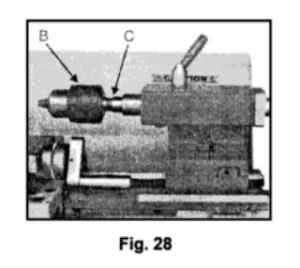
Morse Taper Arbor (Optional)
An arbor is necessary for mounting the drill chuck in the tailstock. It has a No. 2 Morse taper. (C, Fig.28)
Live Center (Optional)
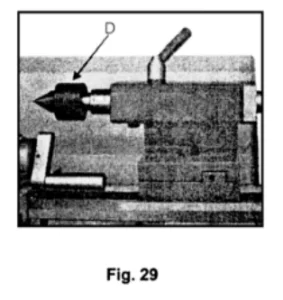
The live center is mounted in ball bearings. It is highly recommended for turning at speeds exceeding 600 RPM. (Fig.29)
ADJUSTMENT
After a period, wear in some of the moving components may need to be adjusted.
Main Spindle Bearings
The main spindle bearings are adjusted at the factory. The bearings may be adjusted if end play becomes evident after considerable use.
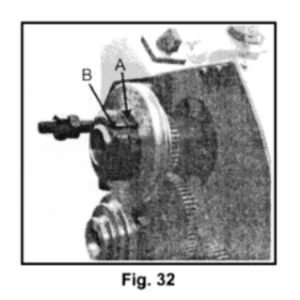
Fasten the slotted nut (A, Fig.32) on the back of the spindle, loosen the outer slotted nut (B, Fig.32), and adjust the slotted nut (A, Fig.32) until all end play is taken up. The spindle should still revolve freely. Fasten the slotted nut (A, Fig.32) again and tighten the outer slotted nut (B, Fig.32).
Caution: excessive tightening or preloading will damage the bearings.
Adjustment of Cross Slide
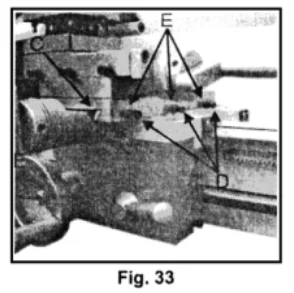
The cross slide is fitted with a gib strip (C, Fig.33) and can be adjusted with screws (D, Fig.33) equipped with lock nuts (E, Fig.33). Loosen the lock nuts and tighten the set screws until the slide moves freely without play. Tighten the lock nuts to retain adjustment.
Adjustment of Top Slide
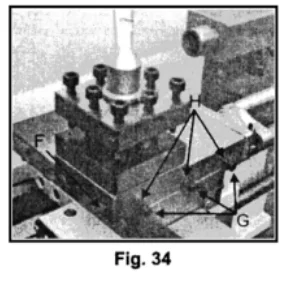
The top slide is fitted with a gib strip (F, Fig.34) and can be adjusted with screws (G, Fig. 34) fitted with lock nuts. (H, Fig. 34) Loosen the lock nuts and tighten the set screws until slide moves freely without play. Tighten lock nuts to retain adjustment.
Adjustment of Half Nut Guide
The half nuts engagement can be adjusted with screws (1, Fig.35) fitted with lock nuts (J. Fig.35). Loosen the nuts on the right side of the apron and adjust the control screws until both half nuts move freely without play. Tighten the nut.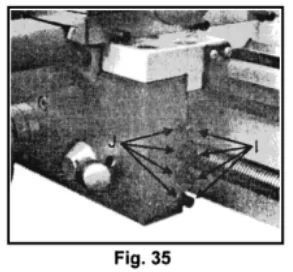
LUBRICATION
NOTES
Lubricate all slideways lightly before every use. Also, lightly grease the change gears and the leadscrew with lithium-based grease.
Carriage
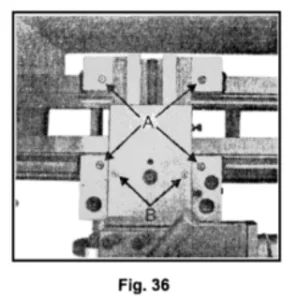
Lubricate Four oil ports (A. Fig.36) with 20W machine oil once daily.
Cross Slide
Lubricate two oil ports (B, Fig. 36) with 20W machine oil once daily.
Leadscrew
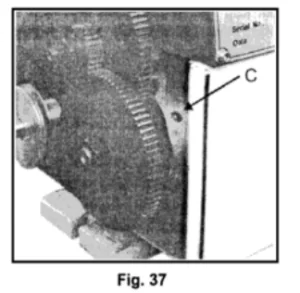
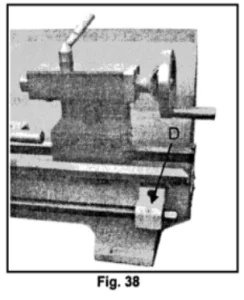
Lubricate the left oil port (C, Fig. 37 and right (D, Fig. 38) with 20W machine oil once daily.
ELECTRICAL CONNECTIONS
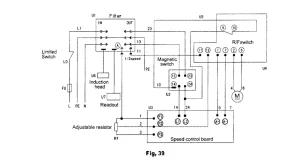
The Lathe is rated at 600W, 230V/120V. Confirm that the power available at the lathe’s location is the same rating as the lathe. The writing diagram (Fig. 39) connects the lathe to the main supply.
Make sure the lathe is properly grounded.
The following is a wiring diagram of the lathe: (Fig. 39)
VEVOR METAL LATHE MAINTENANCE
Keep the maintenance of the machine tool during operation to guarantee the accuracy and service life of the machine tool.
- To retain the machine’s precision and functionality, it is essential to treat it with care, keep it clean, and grease and lubricate it regularly. Only through good care can you be sure that the working quality of the machine will remain constant.
NOTES:
Disconnect the machine plug from the mains supply whenever you carry out cleaning. Maintenance or repair work!
Oil, grease and cleaning agents are pollutants and must not be disposed of through the drains or in regular refuse. Dispose of those agents in accordance with current legal requirements on the environment. Cleaning rags impregnated with oil, grease, and cleaning agents are easily flammable. Collect cleaning rags or cleaning wool in a suitable closed vessel and dispose of them in an environmentally sound way – do not put them with normal refuse!
- Lubricate all slideways lightly before every use. The change gears and the leadscrew must also be lightly lubricated with lithium-based grease.
- During the operation, chips that fall onto the sliding surface should be cleaned in a timely manner, and inspections should be made often to prevent chips from falling into the position between the machine tool saddle and lathe bed guideway. Asphalt felt should be cleaned at certain times.
NOTES:
Do not remove the chips with your bare hands. Sharp-edged chips can cause cuts. Never use flammable solvents, cleaning agents, or agents that generate noxious fumes! When cleaning, protect electrical components such as motors, switches, switch boxes, etc., against humidity.
- After every daily operation, all the chips are eliminated, different parts of the machine tool are cleaned, and machine tool oil is applied to prevent rusting.
- To maintain machining accuracy, take care of the center, the surface of the machine tool for the chuck, and the guideway, and avoid mechanical damage and wear due to improper guidance.
- If the damage is found, the maintenance should be done immediately.
NOTES:
Repair work may only be done by qualified personnel with the corresponding mechanical and electrical knowledge.
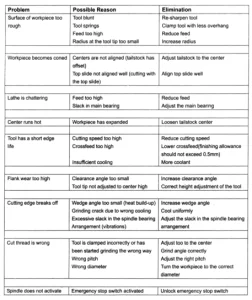
TROUBLESHOOTING THE VEVOR METAL LATHE
Recommended For Your Project
VEVOR Metal Lathe 8.7 x 29.5 Inch/220 x 750MM Mini Metal Lathe 1100W Manual
Reviews
There are no reviews yet.