
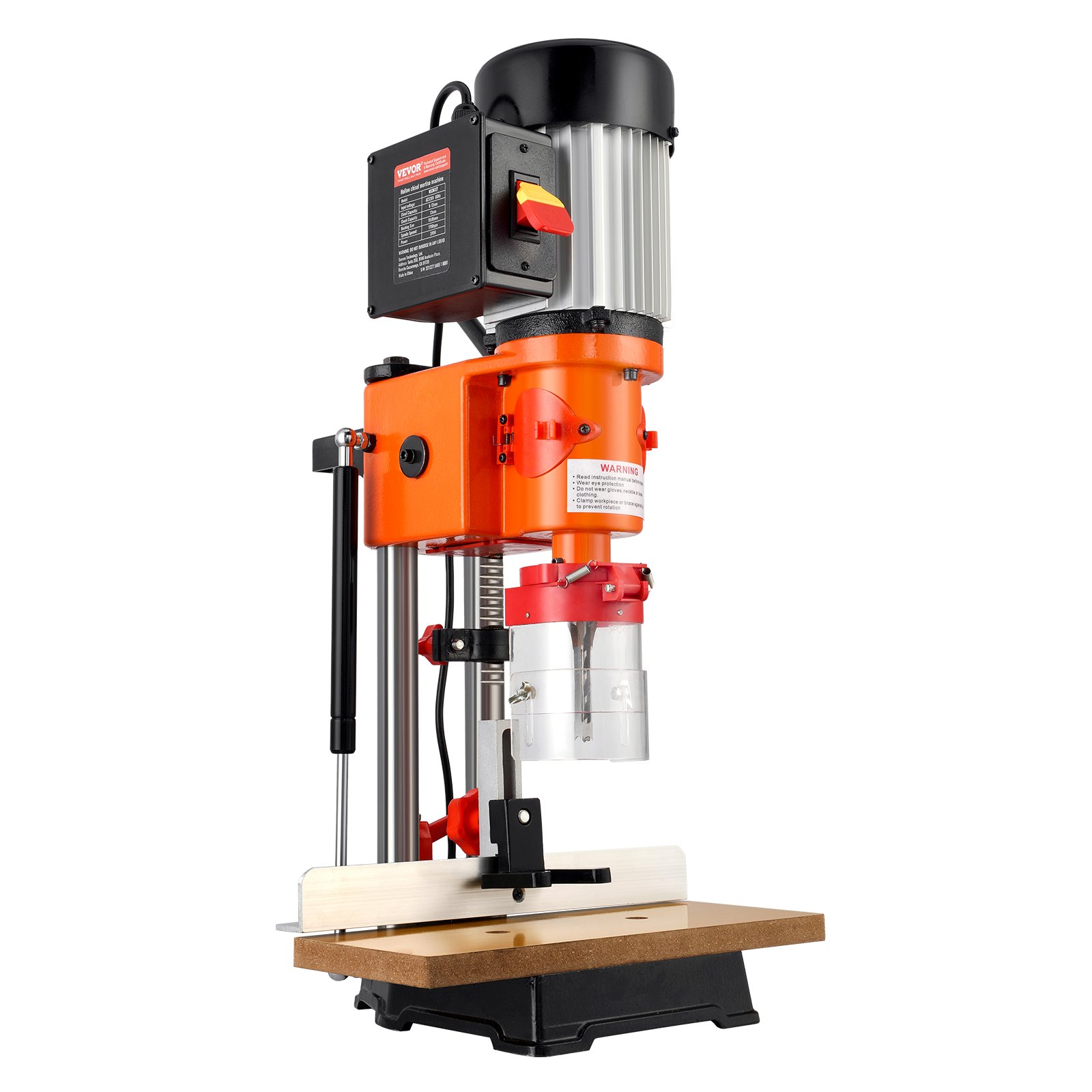



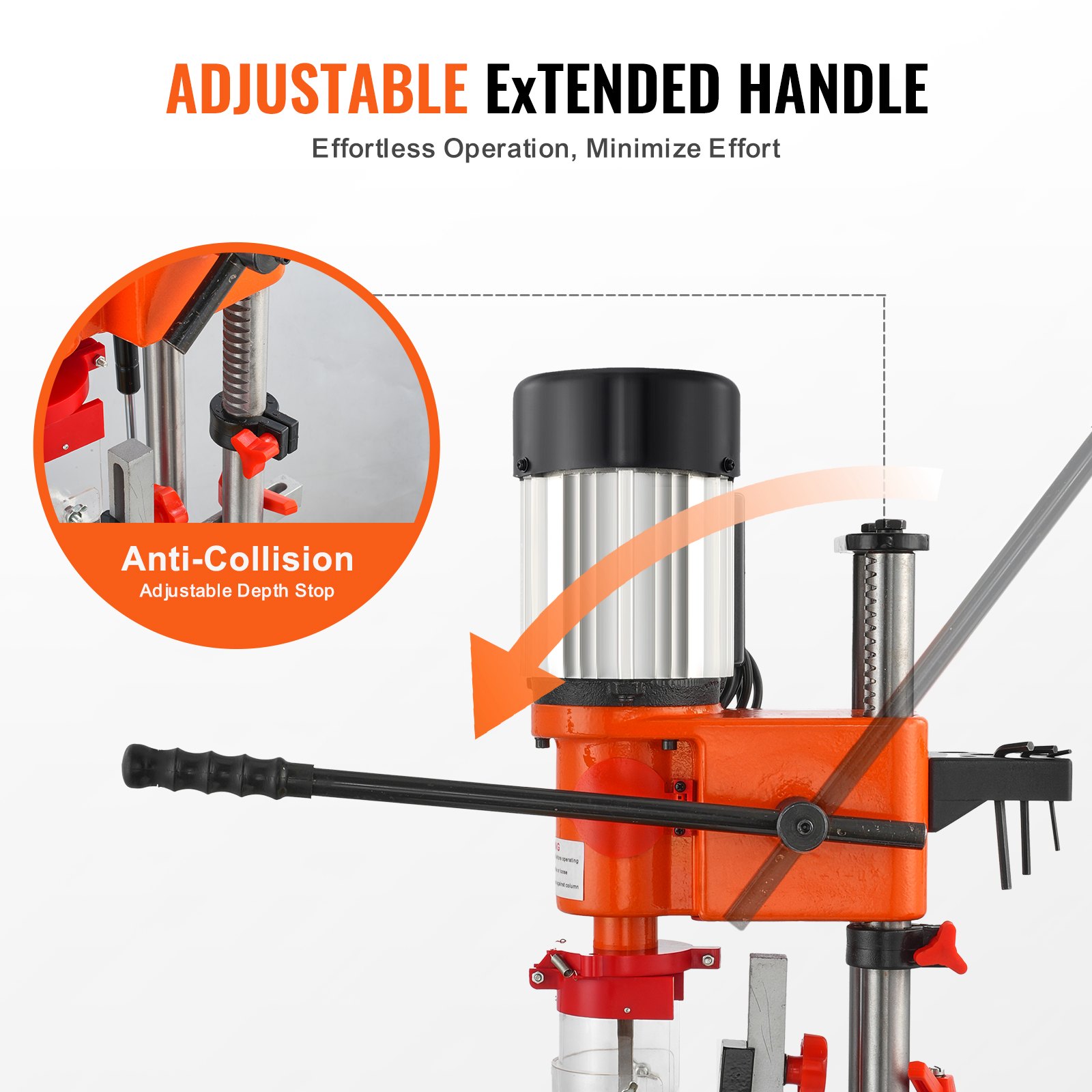
Unlock the full potential of your VEVOR Benchtop Mortise Machine with our comprehensive product manual download. Designed specifically for the 370W, 1725 RPM Woodworking Mortising Machine, this manual is your ultimate guide to mastering the art of precision mortising. Whether you’re a seasoned professional or a woodworking enthusiast, our detailed manual covers everything from initial setup to advanced troubleshooting and optimization techniques.
With clear, step-by-step instructions and detailed illustrations, you’ll easily learn how to use the 1/4-inch, 3/8-inch, and 1/2-inch chisels to create perfect round holes, square holes, or special square holes in your wooden workbench projects. Our user-friendly manual ensures you can maximize the efficiency and accuracy of your VEVOR Benchtop Mortise Machine, reducing downtime and enhancing your woodworking craftsmanship.
Download the VEVOR Benchtop Mortise Machine manual today and equip yourself with the knowledge to take your woodworking skills to the next level. Experience the ease of setup, the confidence in troubleshooting, and the satisfaction of optimized performance with our expertly crafted guide.
VEVOR Benchtop Mortise Machine User Manual
MODEL: MS36127
General Safety Rules
- Woodworking can be dangerous if safe and proper operating procedures are not followed. As with all machinery, specific hazards are involved with its operation. Using the machine with respect and caution will considerably lessen the possibility of personal injury.
However, if standard safety precautions are overlooked or ignored, personal injury to the operator may result. Safety equipment such as guards, push sticks, hold-downs, feather boards, goggles, dust masks, and hearing protection can reduce the potential for injury.
But even the best guard will not compensate for poor judgment, carelessness, or inattention. Always use common sense and exercise caution in the workshop. If a procedure feels dangerous, do not try it. Figure out an alternative method that feels safer.
REMEMBER: Your safety is your responsibility.
- This machine was designed for specific applications only. We strongly recommend that this machine not be modified and/or used for any application other than that for which it was intended if you have questions relative to a particular application.
DO NOT use the machine until you have first contacted your local dealer to determine if it can or should be performed on the product.
WARNING: FAILURE TO FOLLOW THESE RULES MAY RESULT IN SERIOUS PERSONAL INJURY.
- FOR YOUR SAFETY, READ THE INSTRUCTION MANUAL BEFORE OPERATING THE TOOL. Learn the tool’s application, limitations, and specific hazards.
- KEEP GUARDS IN PLACE and working order.
- ALWAYS WEAR EYE PROTECTION. Wear safety glasses. Eyeglasses worn daily only have impact-resistant lenses; they are not safety glasses. Also, wear a face or dust mask if the cutting operation is dusty.
- REMOVE ADJUSTING KEYS AND WRENCHES. Make a habit of checking to see that keys and adjusting wrenches are removed from the tool before turning it “on.”
- KEEP WORK AREA CLEAN—Cluttered areas and benches invite accidents.
- DO NOT USE IN DANGEROUS ENVIRONMENT. Do not use power tools in damp locations or expose them to rain. Keep the work area well-maintained.
- KEEP CHILDREN AND VISITORS AWAY. All children and visitors should be kept a safe distance from the work area.
- MAKE the WORKSHOP CHILDPROOF – with padlocks, master switches, or by removing starter keys.
- DO NOT FORCE THE TOOL. It will do the job better and be safer at the rate at which it was designed.
- USE THE RIGHT TOOL. Do not force a tool or attachment to do a job for which it was not designed.
- WEAR PROPER APPAREL. Avoid loose clothing, gloves, neckties, rings, bracelets, or other jewellery that could get caught in moving parts. Nonslip footwear is recommended. Wear protective hair covering to contain long hair.
- SECURE WORK. When practical, use clamps or a vise to hold work. It is safer than using your hand and frees both hands to operate.
- DO NOT OVERREACH. Keep proper footing and balance at all times.
- MAINTAIN TOOLS IN TOP CONDITION. Keep tools sharp and clean for the best and safest performance. Follow instructions for lubricating and changing accessories.
- DISCONNECT TOOLS before servicing and when changing accessories such as blades, bits, cutters, etc.
- USE RECOMMENDED ACCESSORIES. The use of accessories and attachments not recommended by the manufacturer may cause hazards or risk of injury to persons.
- REDUCE THE RISK OF UNINTENTIONAL STARTING. Ensure the switch is in the “OFF” position before plugging in the power cord. In the event of a power failure, move the switch to the “OFF” position.
- NEVER STAND ON THE TOOL. Serious injury could occur if the tool is tipped or if the cutting tool is accidentally contacted.
- CHECK DAMAGED PARTS. Before further use of the tool, a guard or other damaged part should be carefully checked to ensure that it will operate properly and perform its intended function—check for alignment of moving parts, binding of moving parts, breakage of parts, mounting, and any other conditions that may affect its operation. A guard or other damaged part should be properly repaired or replaced.
- DIRECTION OF FEED. Feed work into a blade or cutter against the direction of rotation of the blade or cutter only.
- NEVER LEAVE THE TOOL RUNNING UNATTENDED. TURNPOWEROFF. Do not leave the tool until it comes to a complete stop.
- STAY ALERT, WATCH WHAT YOU ARE DOING, AND USE COMMON SENSE WHEN OPERATING A POWER TOOL. DO NOT USE THE TOOL WHILE TIRED OR UNDER THE INFLUENCE OF DRUGS, ALCOHOL, OR MEDICATION. A moment of inattention while operating power tools may result in serious personal injury.
- MAKE SURE the TOOL IS DISCONNECTED FROM the power supply while the motor is mounted, connected or reconnected.
- DUST GENERATED BY CERTAIN WOODS AND WOOD PRODUCTS can injure your health. Continuously operate machinery in well-ventilated areas and ensure proper dust removal. Use wood dust collection systems whenever possible.
- WARNING: SOME DUST CREATED BY POWER SANDING, SAWING, GRINDING, DRILLING, AND OTHER CONSTRUCTION ACTIVITIES contains chemicals known to cause cancer, birth defects or other reproductive harm. Some examples of these chemicals are:
Lead from lead-based paints.
Crystalline silica from bricks, cement, and other masonry products.
Arsenic and chromium from chemically-treated lumber.
Your risk from these exposures varies depending on how often you do this work. To reduce exposure to these chemicals, work in a well-ventilated area and wear approved safety equipment, such as dust masks specially designed to filter out microscopic particles.
Additional Safety Rules for Hollow Chisel Mortisers
- DO NOT OPERATE THIS MACHINE until it is assembled and installed according to the instructions.
- If you are not familiar with the operation of this machine, OBTAIN ADVICE FROM YOUR SUPERVISOR, instructor, or another qualified person.
- FOLLOW ALL WIRING CODES and recommended electrical connections.
- MAKE CERTAIN the machine is fastened to a supporting surface to prevent it from tipping over during operation.
- NEVER turn the mortiser “ON” before clearing the table of all objects(tools, scrap pieces, etc.).
- ALWAYS keep hands, fingers and hair away from the rotating bit.
- DO NOT attempt to mortise material without a flat surface unless suitable support is used.
- ALWAYS position the hold-down directly over the workpiece to prevent the workpiece from lifting during operation.
- ALWAYS support the workpiece securely against the fence to prevent rotation.
- Before operation, ensure the drill bit is sharp, not damaged, and correctly secured in the chuck.
- MAKE SURE the chuck key is removed before starting the machine.
- NEVER turn on the power with the drill bit or chisel contacting the workpiece.
- NEVER perform layout, assembly, or set-up work on the table while the mortiser operates.
- ADJUST the depth stop to avoid drilling into the table.
- ALWAYS turn off the power before removing scrap pieces from the table.
- Shut off the power, remove the drill bit and chisel, and clean the table before leaving the machine.
- FOR YOUR SAFETY – Don’t wear gloves when operating the machine.
- SHOULD ANY part of your tool be missing, damaged, or fail in any way, or any electrical component fail to perform properly, shut off the switch and remove the plug from the power supply outlet. Replace the missing, damaged, or failed parts before resuming operation.
- THE USE of attachments and accessories not recommended by Delta may result in the risk of injuries.
- TURN THE MACHINE “OFF” AND DISCONNECT THE MACHINE from the power source before installing or removing accessories, adjusting or changing setups, or making repairs.
- TURN THE MACHINE “OFF”, disconnect the machine from the power source, and clean the table/work area before leaving the machine. LOCK THE SWITCH IN THE “OFF” POSITION to prevent unauthorised use.
WARNING: FAILURE TO FOLLOW THESE RULES MAY RESULT IN SERIOUS PERSONAL INJURY. SAVE THESE INSTRUCTIONS.
Refer to them often and use them to instruct others.
Connecting the Benchtop Mortise to the Power Source
Power Connections.
Your tools should be connected to a separate electrical circuit. If an extension cord is used, use only 3-wire extension cords with grounding-type plugs and receptacles that accept the tool’s plug. Before connecting the motor to the power line, ensure the switch is in the “OFF” position and that the electric current has the same characteristics as indicated on the tool.
All line connections should make good contact. Running on low voltage will damage the motor.
WARNING: DO NOT EXPOSE THE TOOL TO RAIN OR OPERATE THE TOOL IN DAMP LOCATIONS
Motor Specifications
Your tool is wired for: North America, 120V 60Hz alternating current. Before connecting the tool to the power source, make sure the machine is disconnected from the power source.
Grounding Instructions
WARNING: THIS TOOL MUST BE GROUNDED WHILE IN USE TO PROTECT THE OPERATOR FROM ELECTRIC SHOCK. All grounded, cord-connected tools:
- Grounding provides a path of least resistance for electric current in the event of a malfunction or breakdown, reducing the risk of electric shock. This tool has an electric cord, an equipment-grounding conductor, and a grounding plug. The plug must be plugged into a matching outlet that is properly installed and grounded, following all local codes and ordinances.
- Do not modify the plug provided. If it does not fit the outlet, have the proper outlet installed by a qualified electrician.
- Improper connection of the equipment-grounding conductor can result in a risk of electric shock. The conductor with insulation having an outer green surface with or without yellow stripes is the equipment-grounding conductor. If repair or replacement of the electric cord or plug is necessary, do not connect the equipment-grounding conductor to a live terminal.
- If you are unsure whether the tool is properly grounded or if the grounding instructions are not completely understood, check with a qualified electrician or service personnel.
- Use only 3-wire extension cords with grounding-type plugs and receptacles that accept the tool’s plug.
- Repair or replace the damaged or worn cord immediately.
WARNING: IN ALL CASES, MAKE CERTAIN THE RECEPTACLE IN QUESTION IS PROPERLY GROUNDED. IF YOU ARE NOT SURE, HAVE A QUALIFIED ELECTRICIAN CHECK THE RECEPTACLE.
Use proper extension cords. Make sure your extension cord is in good condition. It is a 3-wire extension cord with a grounding-type plug and a receptacle that will accept the tool’s plug. When using an extension cord, use one that is heavy enough to carry the tool’s current. An undersized cord will cause a drop in line voltage, resulting in loss of power and overheating.
Instructions for Operating the Benchtop Mortise Machine
Foreword
The Fox MS36127 is easier to handle than traditional drilling machines equipped with mortise attachments. It is made of cast iron and steel, which is rigid and stable. The mortise is equipped with a standard 3-jaw chuck for positive gripping of the tenon.
Unpacking and Cleaning
Carefully unpack the machine and all loose items from the shipping carton(s). Remove the protective coating from all unpainted surfaces. This coating may be removed with a soft cloth moistened with kerosene (do not use acetone, gasoline or lacquer thinner for this purpose).
After cleaning, cover the unpainted surfaces with good-quality household floor paste wax.
NOTICE: THE MANUAL COVER PHOTO ILLUSTRATES THE CURRENT PRODUCTION MODEL. ALL OTHER ILLUSTRATIONS ARE REPRESENTATIVE ONLY AND MAY NOT DEPICT THE ACTUAL COLOR, LABELING OR ACCESSORIES AND MAY BE INTENDED TO ILLUSTRATE TECHNIQUE ONLY.
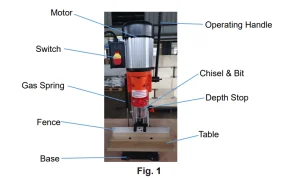
Hollow Chisel Mortiser Parts
(See Figure 1)
WARNING: FOR YOUR SAFETY, DO NOT CONNECT THE MACHINE TO THE POWER SOURCE UNTIL THE MACHINE IS COMPLETELY ASSEMBLED AND YOU READ AND UNDERSTAND THE ENTIRE INSTRUCTION MANUAL.
Lifting handle and gas spring.
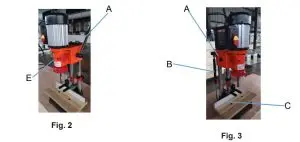
1. Raise the mortising machine head (E), Fig. 2, to the up position by turning the handle (A) clockwise.
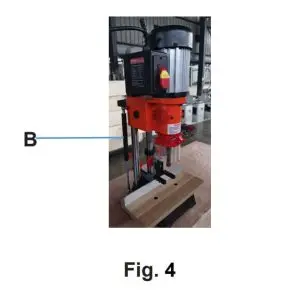
2. Make sure head (A) Fig.3 is held in the up position, and assemble the gas spring (B) to the two fittings (C), one on the column and the other on the back of the head.
3. Fig.4 illustrates the gas spring (B) assembled to the machine. The gas spring (B)keeps the head in the up position.
Death Stop
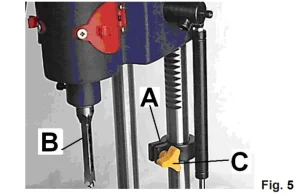
A depth stop guide (A), Fig. 5, is provided to limit the depth of the chisel (B). To adjust the depth stop guide (A), loosen the screw (C) and lower the head until the chisel (B)is at the desired depth. Lower depth stop guide (A) until it is at the desired depth, tighten screw (C).
Installing the Chisel & Bit
1. Loosen lock screw, shown in Figure 6.
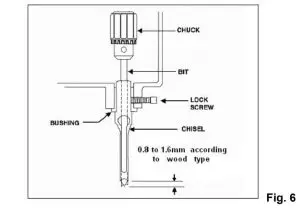
2. Insert the chisel bushing (with the hole facing forward) into the head. Tighten the screw just enough to hold the chisel in place. NOTE: Set the slot in the side of the chisel to the left or right, NOT to the front or back. This will allow chips to escape when cutting mortises.
3. Push the chisel up as far as possible into the head. Then lower the chisel approximately 0.8mm to 1.6mm, depending on the type of wood being worked. Tighten the screw to hold the chisel in place.
4. Push the bit up through the chisel opening as far as it will go. Then, use the chuck key to lock the drill bit in place.
5. Loosen the screw and push the chisel up against the bushing, then tighten the screw. This should provide the proper distance between the chisel points and the bit.
Benchtop Mortise Machine Maintenance
- The Mortiser requires only minor maintenance, such as cleaning, lubrication, routine adjustment and sharpening of the chisel and bit.
- Dust the machine down after each use and, as necessary, use light oil or grease applications to lubricate linkages, moving parts, etc.
Sharpening Chisel & Bit
Chisels and drill bits should be kept sharp for optimal performance. Blunt edges will give inaccurate results on the mortise and tenon, which can lead to overheating and breakage of the chisel or bite. If the chisel and drill bit are badly worn and difficult to sharpen, they should be replaced.
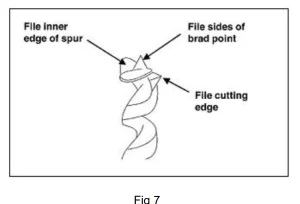
- Sharpen the bit by using a small, smooth file, following the original shape of the bit. File the inside edge of the spur, the sides of the bradpoint, and the cutting edge inwards toward the flute of the bit. See Fig7. Do not file the outside edge of the spur, as this will affect the bit’s diameter.
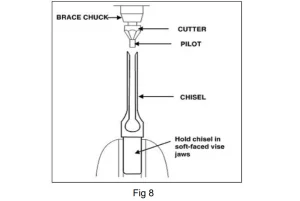
- Sharpen the chisel with a mortise and tenon chisel with the correct size guide. (Pilot size will vary depending on the size of the chisel.) Two to three turns of the cutter in the carpenter’s bracket chuck are enough to sharpen the chisel, as shown in Figure 8.
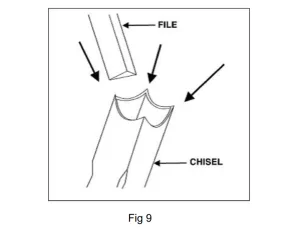
- Use a small, triangular, smooth file to relieve the inner corners of the chisel (see Fig.9). With a fine oilstone, remove any burrs from the outside of the chisel.
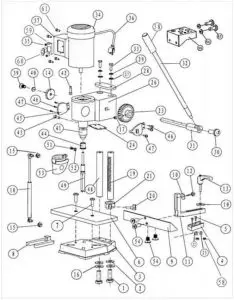
Benchtop Mortise Machine Parts Drawing and Parts List
Parts Diagram
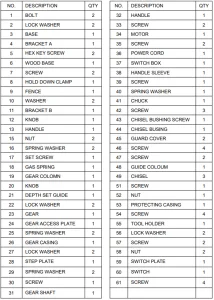
Parts List
Benchtop Mortise Machine Wiring Diagram

This service instruction contains general information about the type MS36127 and a list of the equipment delivered on request. The show rating plate is placed on the Headstock.
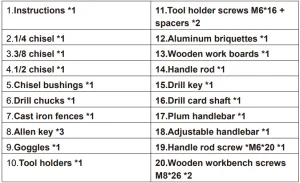
Benchtop Mortise Machine Accessories List
Recommended For Your Project
VEVOR Benchtop Mortise Machine, 370W, 1725 RPM Manual
Reviews
There are no reviews yet.