
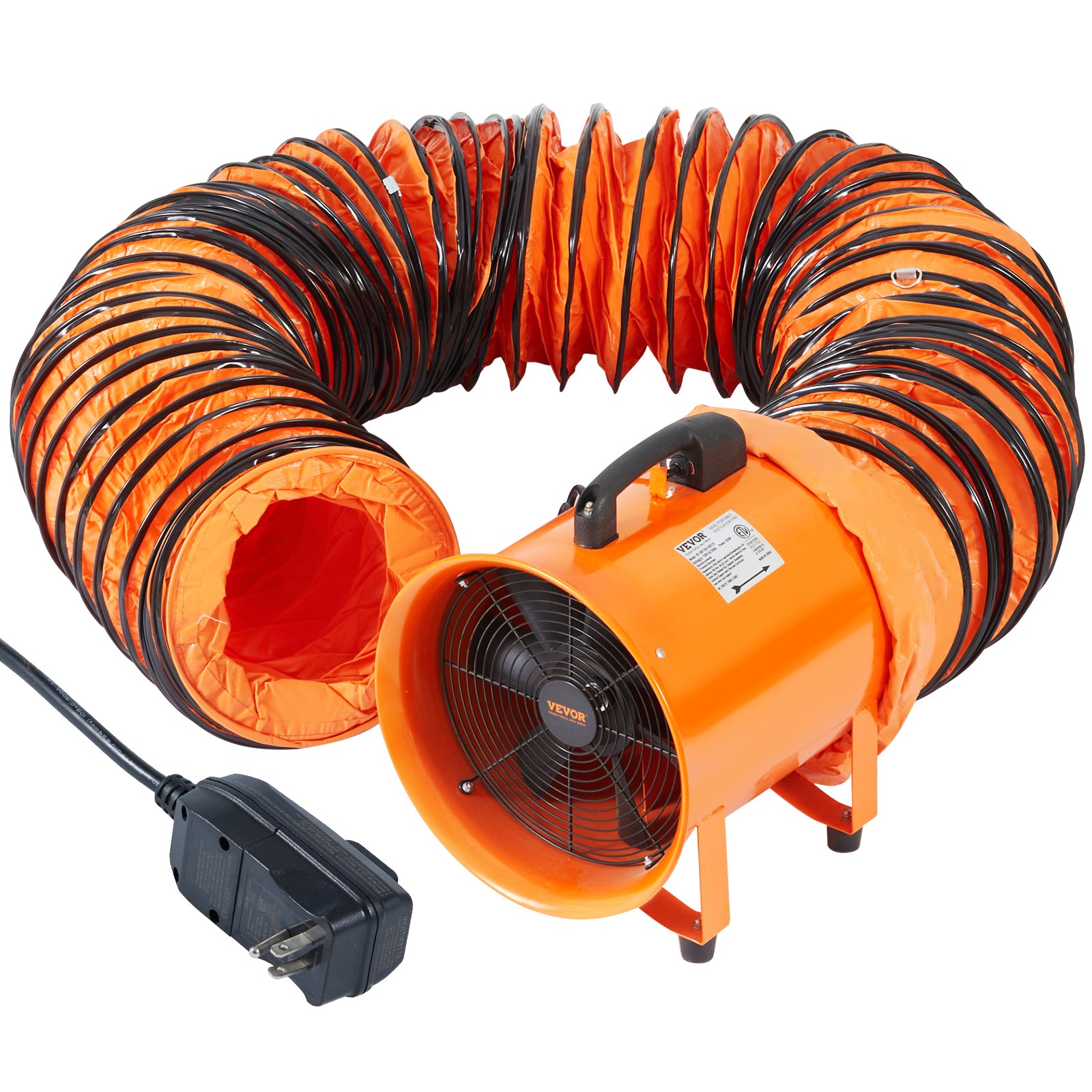





Discover the ultimate guide to maximizing the performance and longevity of your VEVOR Portable Ventilator, 16 inch Heavy Duty Cylinder Fan with 33ft Duct Hose, 1350W Strong Shop Exhaust Blower 5175CFM, Industrial Utility Blower for Sucking Dust, Smoke, Smoke Home/Workplace. Our comprehensive product manual is designed to provide you with detailed instructions for setup, troubleshooting, and optimization, ensuring you get the most out of your investment.
This user-friendly manual covers every aspect of your VEVOR portable ventilator, from initial assembly to advanced troubleshooting techniques. With step-by-step guidance, clear diagrams, and helpful tips, you’ll find it easier than ever to maintain and operate your heavy-duty cylinder fan. Whether you’re using it to exhaust dust and smoke in a busy workshop or keeping your home environment clean and safe, this manual is an invaluable resource.
Download the VEVOR Portable Ventilator manual today and experience the convenience of having all the information you need at your fingertips. It’s your go-to guide for ensuring optimal performance and longevity for your powerful 1350W industrial utility blower. Don’t miss out on this essential tool for effective setup and maintenance.
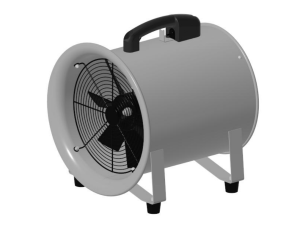
Axial Portable Ventilator Fan
Warning: To reduce the risk of injury, the user must read the instructions manual.
FCC statement: This device complies with Part 15 of the FCC Rules. Operation is subject to the following two conditions: (1) This device may not cause harmful interference, and (2) this device must accept any interference received, including interference that may cause undesired operation.
CORRECT DISPOSAL: This product is subject to European Directive 2012/19/EC provisions. The symbol showing a wheelie bin crossed through indicates that the product requires separate refuse collection in the European Union. This applies to the product and all accessories marked with this symbol. Products marked as such may not be discarded with regular domestic waste, but must be taken to a collection point for recycling electrical and electronic devices.
WARNING
To reduce the risk of fire or electric shock from the portable ventilator;
- Do Not Use it With Any Solid-State Speed Control Device. Include instructions about the risk of fire, electric shock, or injury to persons, as well as cleaning and user maintenance, such as lubrication.
- DO NOT operate the portable fan with a damaged cord or plug. Discard the fan or return to an authorized service facility for examination and/or repair.
- DO NOT run cord under carpeting. Do not cover the cord with throw rugs, runners, or similar coverings.
- DO NOT route the cord under furniture or appliances. Arrange it away from the traffic area and where it will not be tripped. Disconnect the appliance from the power supply before servicing.
- Regular Check: Have your wall fan checked regularly for any sign of malfunction! Stop using it, check if the plug, cord, or appliance is faulty. Watch out for excessive noise, unpleasant odor, or abnormal heat.
Safety Precautions
- This appliance is not intended for use by people (including children) with reduced physical, sensor,y or mental capabilities, or a lack of experience and knowledge, unless they have been given supervision or instruction
concerning the use of the appliance by the person responsible for their safety. - Children should be supervised to ensure they do not play with the appliance.
- Have any repairs carried out solely by a qualified electrician. Never try to repair the appliance yourself.
- The duct fan shall not be intended to be mounted in a duct to move heated air.
- Close supervision is necessary when children are using the appliance. They should be supervised to ensure they do not play with it. Children shall not do cleaning and user maintenance unless they are acceptableably elderly and supervised.
- Use the appliance only for intended household purposes as described in this User Manual. Any other use is not recommended, as it may cause fire, electric shock, or injury to people.
Important Safety Information
Work area safety
- Keep the work area clean and well lit. Cluttered or dark areas invite accidents.
- Do not operate tools in explosive atmospheres, such as in the presence of flammable liquids, gases, or dust. Tools create sparks that may ignite the dust or fumes.
- Keep children and bystanders away while operating a power tool. Distractions can cause you to lose control.
Electrical safety
- Tool plugs must match the outlet. Never modify the plugin anyway. Do not use any adapter plugs with grounded tools. Unmodified plugs and matching outlets will reduce the risk of electric shock.
- Avoid body contact with grounded surfaces such as pipes, radiators, ranges, and refrigerators. There is an increased risk of electric shock if your body is grounded.
- Do not expose tools to rain or wet conditions. Water entering the tool will increase the risk of an electric shock.
- Do not abuse the cord. Never use the cord for carrying, pulling, or unplugging the power tool. Keep the cord away from heat, oil, sharp edges, or moving parts. Damaged or entangled cords increase the risk of electric shock.
- When operating a tool outdoors, use an extension cord suitable for outdoor use. Using a cord suitable for outdoor use reduces the risk of electric shock.
- If operating a tool in a damp location is unavoidable, use a Ground Fault Circuit Interrupter (GFCI) protected supply. Use of GFCI reduces the risk of electric shock.
Personal safety
- Stay alert, watch what you are doing, and use common sense when operating a tool. Do not use a tool while you are retired or under the influence of drugs, alcohol, or medication. A moment of inattention while operating tools may result in serious personal injury.
- Use personal protective equipment. Always wear eye protection. Safety equipment such as a dust mask, non-slip safety shoes, a hard hat, or hearing protection used for appropriate conditions will reduce personal injuries.
- Prevent unintentional starting. Ensure the switch is off before connecting to a power source, picking up, or carrying the tool. Carrying tools with your finger on the switch invites accidents.
- Dress properly. Do not wear loose clothing or jewellery. Keep your hair, clothing, and gloves away from moving parts. Loose clothes, jewelry, or long hair can be caught in moving parts.
- Only use safety equipment that an appropriate standards agency has approved. Unapproved safety equipment may not provide adequate protection. Eye protection must be ANSI-approved, and breathing protection must be NIOSH-approved for the specific hazards in the work area.
Portable Ventilator use and care
- Use the correct tool for your application. The correct tool will do the job better and safer at the rate for which it was designed.
- Do not use the tool if the switch does not turn it on and off. If you can’t control the fan by its switch, that could be dangerous.
- Disconnect the plug from the power source before adjusting or storing tools. This preventive safety measure reduces the risk of starting the tool accidentally.
- Store idle tools out of the reach of children and do not allow persons unfamiliar with the tool or these instructions to operate the tool. Tools are dangerous in the hands of untrained users.
- Maintain tools. Check for misalignment or binding of moving parts, breakage of parts, and any other condition that may affect the tool’s operation. If damaged, have the tool repaired before use. Poorly maintained tools may cause accidents.
Ventilator Safety Warnings
- Connect to the GFCI outlet only.
- Keep children away from the ventilator. They could insert their small fingers through the grill, which is dangerous.
- Do not use near flammable fumes or dust. The ventilator has internal arcing parts that will ignite flammable fumes/dust.
- Do not use without the guard in place.
- To reduce the risk of fire or electric shock, do not use this ventilator with any solid-state speed control device.
- Do not reposition the fan while in use.
- Unplug after use.
- Inspect before use; do not use if parts are loose or damaged.
- Keep the inlet and outlet clear during use.
- Do not allow paper, drapes or other types of loose material to get into the inlet end of the unit. They might restrict air movement through the ventilator, which will overheat the motor and cause a fire.
- Maintain labels and nameplates on the tool. These carry important safety information. If unreadable or missing, contact Harbor Freight Tools for a replacement.
- Avoid unintentional starting. Prepare to begin work before tuning on the tool.
- This product is not a toy. Keep it out of reach of children.
Caution
- People with pacemakers should consult their physician (s) before use. Electromagnetic fields close to a heart pacemaker could cause pacemaker interference or failure.
In addition, people with pacemakers should:
- Avoid operating alone.
- Do not use with the power switch locked on.
- Properly maintain and inspect to avoid electrical shock.
- Properly ground the power cord. Ground Fault Circuit Interrupter (GFCI) should also be implemented. It prevents sustained electrical shock.
The warnings, precautions, and instructions discussed in this instruction manual cannot cover all possible conditions and situations that may occur. The operator must understand that common sense and caution are factors that cannot be built into this product, but must be supplied by the operator.
Portable Ventilator Setup
TO PREVENT SERIOUS INJURY FROM ACCIDENTAL OPERATION:
Turn the tool’s Power Switch off and unplug it from its electrical outlet before performing any procedure in this section.
NOTE: For additional information about the parts listed on the following pages, refer to the Parts List and Diagram.
Workpiece and Work Area Set Up
- Designate a clean and well-lit work area. To prevent distraction and injury, do not allow children or pets to access it.
- There must not be drapes, paper, or other forms of cloth nearby that could get into the inlet part of the ventilator, obstructing airflow.
- Route the power cord along a safe route to reach the work area without creating a tripping hazard or exposing the power cord to possible damage. The power cord must reach the workplace with enough extra length to allow free movement while working.
- To reduce the risk of fire or electric shock, do not use this ventilator with any solid-state speed control device.
Flexible Duct Operation
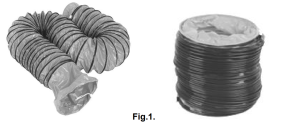
You can fold and unfold the flexible ducts easily. Unfolded length of 5 or 10 meters. (See Fig.1.)
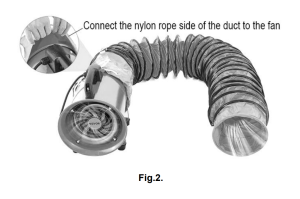
Connect the nylon rope side of the duct to the fan. Then tie the nylon rope tightly. (See Fig.2.)
General Operating Instructions
Automatically Operated Device – Disconnect from the power supply before servicing to reduce the risk of injury. The ventilator may restart without warning after thermal shutoff.
- Turn the fan on by moving the switch to the right or left.
- To prevent accidents, turn off the ventilator and disconnect its power supply afterwards. Clean, then store the tool indoors out of children’s reach.
TIP: You would feel a louder running sound of the fan indoors than outdoors.
Main Components and Diagram
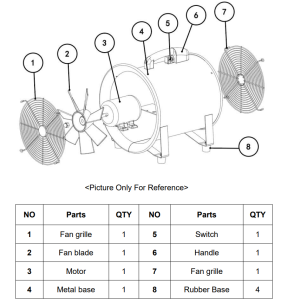
Care and Maintenance
Cleaning the Portable Ventilator
CAUTION- Before cleaning the fan, disconnect the power plug. Clean the grille surface with a clean, damp cloth. Do not use harsh chemical or abrasive cleaners. DO NOT IMMERSE THE FAN OR ANY WIRES IN WATER.
Replace the front grille before using the fan. Allow to dry completely before use. Periodic grille cleaning with a vacuum will prevent dust buildup. The motor is sealed and requires no internal maintenance, cleaning or lubrication.
Maintaining the Portable Ventilator
The internal motor bearings are permanently lubricated at the factory and do not require any additional lubrication.
Repairing the Portable Ventilator
DO NOT OPERATE THE FAN WITHOUT THE GRILLE IN PLACE. DO NOT USE THE FAN IF IT HAS MALFUNCTIONED OR BECOME DAMAGED IN ANY WAY.
Storing the Portable Ventilator
Keep the original carton for the fan’s storage. Coil and tie the power cord to avoid damage during storage.
Troubleshooting
Q: Excessive noise
- Usually, there is noise during operation. If it’s too loud, please set the fan to a lower speed.
- Check if the blade is installed properly.
Q: The Fan does not operate
- Connect the portable fan to a powered electrical outlet.
- Clean the blade regularly.
Recommended For Your Project
VEVOR Portable Ventilator, 16 inch with 33ft Duct Hose Manual


Reviews
There are no reviews yet.